UAE's A:5 AI Chip Tier: Decoupling Pays Off
How the UAE earned preferential AI chip access by cutting Chinese ties.
Model Diplomat4 min readMiddle East
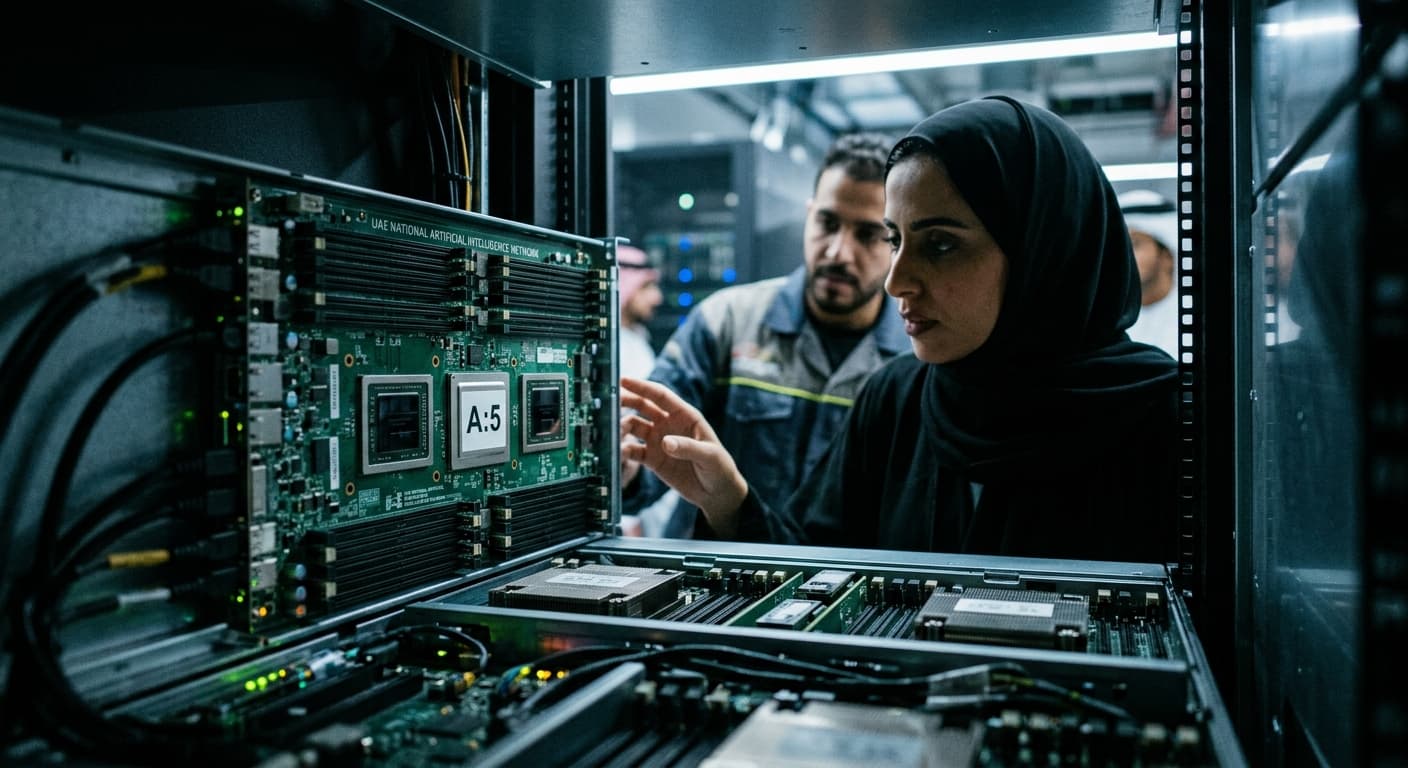
The favorability-for-decoupling bargain
The UAE has spent two years buying its way into this tier. The pivot began with G42's 2024 divestment from Huawei and other Chinese technology firms — a precondition for Microsoft's $1.5 billion minority investment and a board seat CSIS. By late 2024, Microsoft-operated G42 data centers were using military-grade encryption and being audited by U.S. Defense Department contractors; the deal forbade G42 from using the infrastructure for surveillance or sharing technology with other militaries without Microsoft's permission
CSIS. In May 2025, the Trump administration greenlit the export of roughly 500,000 advanced AI chips to the UAE, 100,000 of them directly to G42, overriding U.S. intelligence-community concerns about the firm's historic ties to Huawei and Chinese military-linked entities
U.S. Senate Banking Committee;
House Oversight letter.
The July 2026 country-group rule is the regulatory payoff for that decoupling. By moving the UAE into A:5, BIS converts what had been ad hoc, deal-by-deal licenses into a structural presumption of approval — the difference between asking permission for each shipment and being on the list of entities entitled to receive. The framework is the U.S.–UAE AI Acceleration Partnership announced during Trump's May 2025 Abu Dhabi visit, which underwrites a 5-gigawatt AI campus; within it, G42 partnered with OpenAI, Oracle, Nvidia, Cisco and SoftBank to build Stargate UAE, with the first 200-megawatt cluster on track for delivery in 2026 IISS Strategic Comments. The scale is without precedent outside the United States and China
INSS.
Why Saudi Arabia was left out
The asymmetry inside the Gulf is the story most analyses miss. Saudi Arabia remains in D:3 and D:4. Its flagship AI vehicle, HUMAIN — backed by the Public Investment Fund and partnered with Qualcomm, Google Cloud and Nvidia — has not received the same country-level elevation IISS. The reason is structural: Riyadh has not broken with Chinese technology to the degree Abu Dhabi has. Huawei 5G equipment via Saudi Telecom Company remains intact, and the PIF has not made a comparable, verifiable divestment commitment
IISS.
This is the implicit graduation criterion the Biden-era AI Diffusion Framework never spelled out. That framework, published January 15, 2025, sorted the world into three tiers and placed the UAE and Saudi Arabia together in Tier 2 — subject to country caps of roughly 50,000 H100-equivalent GPUs and case-by-case licensing with no transparent pathway upward Brookings;
CSIS. Emirati officials complained bitterly about being "grouped with our crazy neighbors" alongside Pakistan and Yemen, arguing the categorization ignored the UAE's cooperation on space, nuclear energy and sensitive technology
CSIS. The July 2026 rule answers that complaint — but only for Abu Dhabi. It establishes, by action if not by published metric, that verifiable supply-chain decoupling from China is the price of A:5 admission.
"We respect the U.S. system, we understand your concerns, but as a partner we need stability." — a senior UAE official, in a CSIS field interview, on the absence of a clear pathway up the country-designation list
CSIS
The enforcement community's dissent
Not everyone in Washington agrees the UAE has earned the tier. Career export-control enforcement officials have described both Saudi Arabia and the UAE as "notorious sieves," with little confidence that technology exports will stay in-country rather than transit onward to Russia or China CSIS. The CIA has warned about G42's working relationships with blacklisted Chinese firms tied to the People's Liberation Army
U.S. Senate Banking Committee. Senate Democrats — Warren, Van Hollen, Kim and Slotkin — pushed a floor resolution to condemn and reverse the UAE chip deal after reporting that the UAE's national security adviser, Sheikh Tahnoon bin Zayed, agreed to buy a 49% stake in Trump's crypto venture World Liberty Financial days before the inauguration, months before the chip approvals
U.S. Senate Banking Committee. House Democrats separately requested an investigation into whether personal financial interests "compromised U.S. export controls and national security decision-making"
House Oversight letter.
The rule's inclusion of a dedicated "Enforcement of License Requirements for Advanced Computing Items" section is, in part, a response to that pressure — a signal that A:5 status comes with named-list conditions rather than a blanket green light. The GAO has separately found that BIS's advanced-semiconductor rules were implemented with compliance gaps, including stockpiling risks and workforce constraints at the agency itself GAO-25-107386. The Trump administration's May 2025 rescission of the AI Diffusion Framework — which the GAO determined was itself a "rule" subject to the Congressional Review Act — left the UAE and Saudi Arabia in a discretionary limbo that the July 2026 country-group rule now resolves, at least for Abu Dhabi
GAO.
The strategic logic: diffusion over containment
The underlying theory is the one White House AI envoy David Sacks articulated during Trump's Gulf tour: "We need our friends, like the kingdom of Saudi Arabia and other strategic partners and allies, to want to build on our tech" CSIS. The argument — a deliberate echo of the 1990s encryption export debate — is that if swing states are going to buy chips, it is better for U.S. security and economic interests that they buy American, and lock themselves into U.S. software, maintenance and standards ecosystems
CSIS;
Foreign Affairs. The July 2026 rule operationalizes that logic by giving the UAE the one thing it asked for: a stable, codified status, not a revolving-door license queue.
The risk is that the favorability is irreversible in practice. Chips need replacement every few years; once A:5 status is granted and Stargate's gigawatt-scale campus is built, Washington's leverage shifts from "will we let you buy" to "will we let you keep buying" — a weaker hand Foreign Affairs. And the physical concentration of AI infrastructure in a region that the Foreign Affairs analysis characterizes as "persistently unstable" raises the prospect that the most critical U.S. AI assets abroad become military targets in a future Gulf conflict
Foreign Affairs.
Discover more

US Politics
US Launches $166B Tariff Refund Portal
The US is launching a $166 billion tariff refund portal to aid importers hit by Trump-era tariffs, with major implications for trade and supply costs.

India
Delhi CM Rekha Gupta Blasts Opposition's Delm
Delhi CM Rekha Gupta's remarks on women's quota defeat reveal BJP's strategy for the 2029 Lok Sabha elections, focusing on delimitation.
India
Congress Accuses Modi of Stalling Women's Law
Congress accuses Modi of stalling women's reservation law by linking it to delimitation, revealing a deeper electoral strategy.

Conflict & Security
Drone Warfare Killing Aid Workers at Unprec
Over 1,000 humanitarian workers killed in three years as cheap armed drones collapse legal protections. Gaza, Sudan, Ukraine, and DRC see deliberate targeting of aid convoys and hospitals with zero prosecutions.

