Taiwan's Parliament Cuts Lai's Defence Budget
President Lai fights back against budget cuts for defence.
Model Diplomat3 min readasia
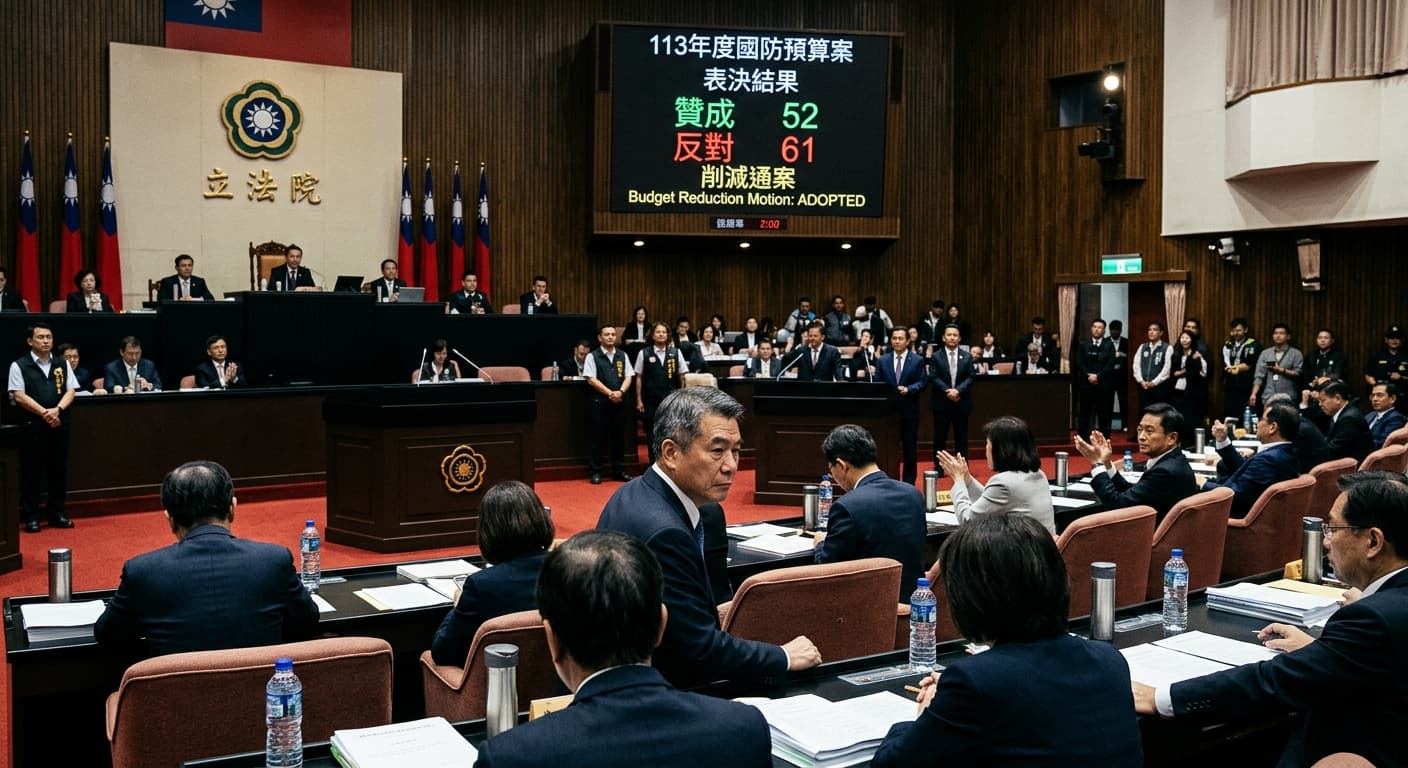
Taiwan's Parliament Slashes Lai's Defence Ambitions — The President Is Fighting Back
Taiwan’s opposition-controlled legislature cut the president’s $40 billion special defence budget to $25 billion, stripping funds for indigenous drones and missiles. Lai is now pursuing workarounds — and the fight isn't over.
On Tuesday, June 16, Taiwan President Lai Ching-te stood at a military base in New Taipei and declared he would "not give up" on defence spending, after the island's opposition-majority parliament approved only two-thirds of his signature $40 billion supplementary budget last month. The legislature passed roughly $25 billion — enough for U.S.-sourced weapons — but vetoed funds for domestically produced drones and missiles that formed the heart of Lai's asymmetric warfare strategy (
SRN News).
The message was as much for Washington as Taipei. Lai is under direct pressure from the Trump administration to raise defence spending toward 5% of GDP by 2030, and the American Institute in Taiwan's director, Raymond Greene, had publicly endorsed the special budget just days earlier (NPR). The parliamentary cut leaves Lai with a credibility problem in both capitals.
Where the leverage sits
The power dynamic is structural and unforgiving. Lai's Democratic Progressive Party (DPP) holds the presidency but not the legislature. The Kuomintang (KMT) and the Taiwan People's Party (TPP) control the purse strings and have blocked the special budget at least eight times since December — arguing Lai was asking for "a blanket authorization without any knowledge of the situation," in the words of KMT caucus leader Fu Kun-chi (NPR).
The opposition's counter-offer is revealing. The KMT has proposed its own $12 billion budget focused narrowly on nine U.S.-offered items — TOW-2B and Javelin anti-tank missiles, HIMARS, M109A7 howitzers, and others — that have already reached the contracting stage (Brookings). The legislature had to authorize the defence ministry to sign the Letters of Offer and Acceptance before those U.S. deals expired. In other words, the KMT is willing to fund American hardware but has drawn a hard line against the indigenous defence industry Lai wants to build.
This split cuts to the core of Taiwan's political fault lines. KMT leader Cheng Li-wun met Xi Jinping in Beijing in April and faced a sceptical reception in Washington in June for defending her party's obstruction of the budget (The Economist). Meanwhile, Beijing staged its largest military exercises around Taiwan in years in December 2025, and the National Security Bureau recorded a record 3,570 Chinese military aircraft incursions into Taiwan's airspace that year.
The workaround strategy
Lai has three paths to salvage his programme. He signalled on June 16 that he would pursue separate special legislation, push supplementary budgets, or increase the annual government budget to keep defence projects moving. The defence ministry has already proposed another package — NT$210 billion ($6.64 billion) for surveillance and unmanned surface drones (Al Jazeera).
None of these workarounds are straightforward. Taiwan's legislature cannot add line items to the executive's budget — it can only cut or freeze them, making it a disruptor rather than a constructor of defence policy. And every delay feeds a secondary risk: the longer Taipei takes to appropriate funds, the more Washington may question Taiwan's resolve, as DPP legislator Chen Kuan-ting warned: "The longer Taipei delays… the more likely Beijing is to misjudge Taiwan's political resolve. Deterrence depends on readiness."
What to watch next
The KMT's $12 billion counter-budget remains the most likely near-term compromise — a bill that funds U.S. hardware but strips out almost everything indigenous (Brookings). The TPP, which holds the balance of power, is the wildcard: its leader Huang Kuo-chang visited the U.S. before signalling his party would propose amendments.
Second-order question: how the U.S. reads this. A U.S. intelligence report in early 2026 concluded China likely does not plan to invade Taiwan in 2027, giving the KMT ammunition to argue Lai is overstating the threat (NPR). But the DPP is not backing down — and neither, by all appearances, is Lai. November 2026 local elections will test whether independent voters reward the KMT's fiscal caution or punish it for weakening deterrence.
Discover more

US Politics
US Launches $166B Tariff Refund Portal
The US is launching a $166 billion tariff refund portal to aid importers hit by Trump-era tariffs, with major implications for trade and supply costs.
Global Politics
Xi Jinping Calls China-Russia Ties 'Precious'
Xi Jinping's description of China-Russia ties as 'precious' reflects a strategic imbalance, with Beijing dictating terms in the partnership.

US Politics
Virginia GOP Rallies Rural Voters Against Red
Virginia Republicans are mobilizing rural voters against a Democratic-led redistricting referendum, a fight seen as pivotal to control in the 2026 midterms.

Economics
Fed's Amex AML order puts correspondent banking on notice
Federal Reserve's Amex AML order requires board-level controls and a 90-day plan; OCC fined the bank $350 million over enterprise-wide deficiencies.