Turkey's Journalist Crackdown Before NATO
Turkey's pre-summit actions raise concerns over press freedom.
Model Diplomat8 min readEurope
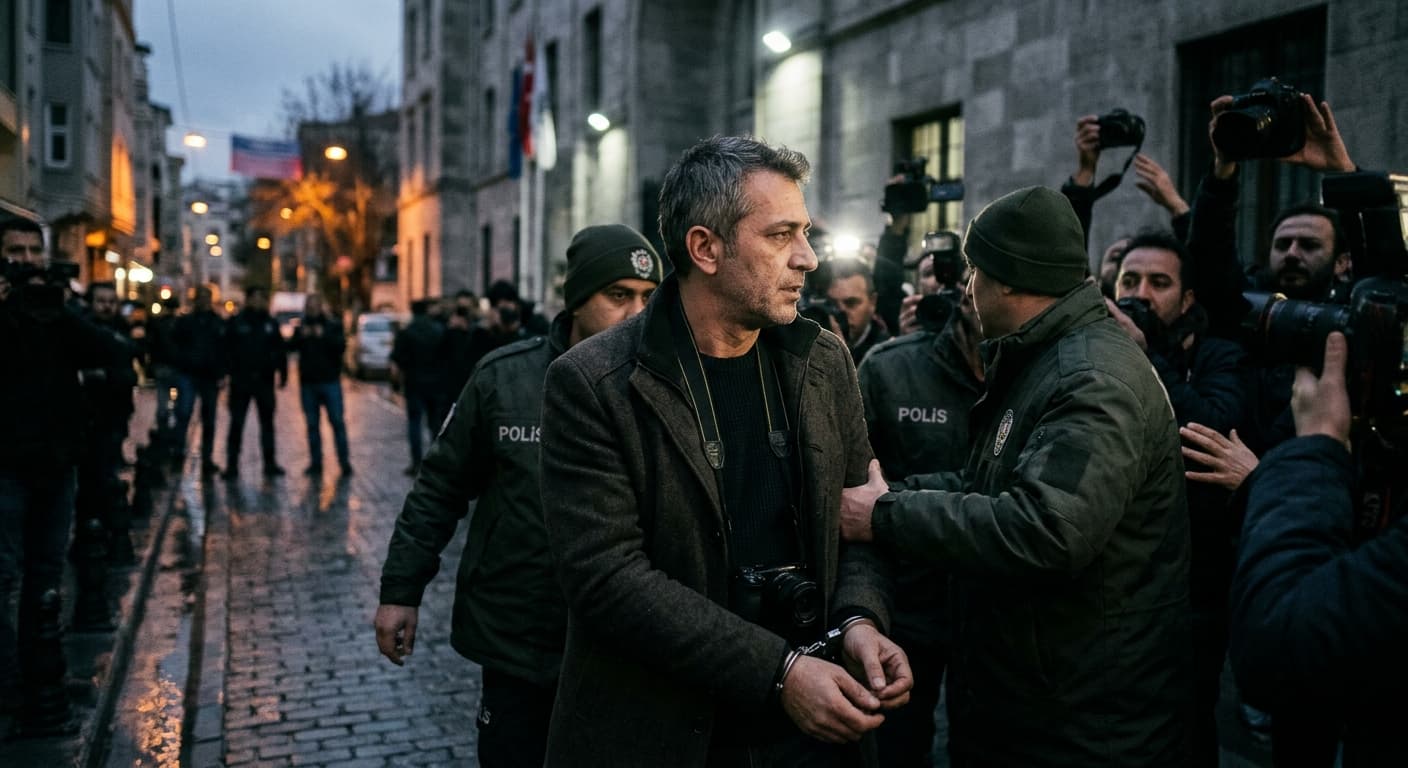
Turkey Jailed Journalists to Sanitise Its NATO Summit
Twenty-seven press-freedom groups say Turkey used counterterrorism and disinformation laws to detain at least 11 journalists in the two weeks before the Ankara NATO summit — an early stress test for how the alliance handles autocratic hosts.
Turkey's pre-summit crackdown was not collateral damage; it was the design. In the two weeks before NATO's 32 heads of state landed in Ankara on July 7–8, 2026, Turkish authorities detained at least 11 journalists, denied summit accreditation to five independent outlets, imposed a 13-day blanket protest ban and ordered broadcasters to adopt a "national security perspective" — a coordinated squeeze that 27 press-freedom groups on July 8 called a deliberate silencing operation. The alliance's decision to convene in Ankara anyway — and Washington's simultaneous move to unlock F-110 engine sales for Turkey's KAAN fighter — hands President Recep Tayyip Erdoğan the outcome he wanted: legitimation of a repression model at the exact moment NATO's other hosts have condemned it.
What the joint statement actually alleges
The joint letter, led by the European Centre for Press and Media Freedom and signed by the Committee to Protect Journalists, the International Press Institute, PEN International, Kaos GL, the P24 platform and 22 others, documents a pattern more specific than the usual denunciation. According to the ECPMF statement, the Media Freedom Rapid Response platform recorded 11 journalists and media workers taken into custody between June 23 and July 6, "many with no connection to the NATO event in Ankara."
The named cases fall into three buckets. First, disinformation charges under Article 217/A of the Turkish Penal Code, the 2022 statute that criminalises "publicly disseminating false information": Evrensel's Doğa Baskan, Sputnik Turkey radio host Ali Çağatay, Cumhuriyet's Gülnur Saydam, and BirGün's Kayhan Ayhan — the last known for live-tweeting the trial of jailed Istanbul Mayor Ekrem İmamoğlu. Second, terrorist-membership charges: Kaos GL editor-in-chief Yıldız Tar, arrested June 25 after being questioned specifically about the outlet's coverage of Erdoğan's "Year of the Family" campaign. Third, pretextual older cases and border stops: Ortak's Hazar Dost, detained on a 2018 warrant and, according to the joint statement,
physically mistreated in custody; and Azadiya Welat editor Berfin Ay, stopped in Şırnak on a lifted travel ban.
The signatories argue this is not a series of unrelated investigations but a single tactic: "The raids and arrests imply a broader pattern of anti-terror laws, disinformation law … and arbitrary police powers to criminalise journalism," the statement reads. They cite the European Convention on Human Rights — Turkey remains a party — as the framework the operations violate.
The scale beyond the newsroom
The journalist detentions sit inside a much larger sweep. On June 22, the Ankara Governorate imposed a province-wide ban on all public assemblies from June 28 through July 10, citing summit security. According to figures released by the Ankara Chief Public Prosecutor's Office and reported by Amnesty International, of 225 people detained in dawn raids on June 23 alone, 135 were referred to court for pretrial detention; 103 were remanded and 26 placed under house arrest. Amnesty's Esther Major called the ban "an excessive and unjustifiable attack on the rights to freedom of peaceful assembly and expression."
The BBC counted more than 200 detentions in the pre-summit period, ranging from environmental volunteers with the Tema Foundation to a stand-up comedian charged over jokes about Erdoğan. On July 7, riot police broke up a "No to NATO" gathering at Kurtuluş Park,
detaining 22 students and multiple lawyers even as opposition parliamentarians were kettled inside police cordons. A British citizen, 26-year-old Ella Vivier, was arrested on July 5 and held in a counter-terror cell on suspicion of "initiating provocative actions," according to
BBC News; her lawyers say no evidence has been disclosed.
The regulatory arm moved in parallel. On July 5, Turkey's Radio and Television Supreme Council (RTÜK) issued a written directive instructing broadcasters to observe a "national security perspective" in coverage, noting monitoring experts would be watching output live. RTÜK has form: in 2024 it revoked the license of Açık Radyo over an Armenian-genocide reference, and has imposed serial fines on Now TV and Tele1.
Why Erdoğan calibrated it this way
Turkey has jailed journalists for a decade; what is new is the timing. The Council on Foreign Relations' Henri Barkey wrote on the eve of the summit that Erdoğan intended to use Ankara as "a stage to elevate his standing at a time of harsh domestic crackdown on political dissent," presenting himself as "the indispensable ally" while achieving "near-total institutional capture at home" (CFR). The pattern of arrests suggests three specific objectives.
One: prevent Turkish journalists from framing the summit through anything other than the government narrative. The five outlets denied accreditation — Cumhuriyet, Sözcü, ANKA, T24 and Medyascope — are the ones most likely to cover İmamoğlu's imprisonment, Kurdish mayoral dismissals, or the F-35 backchannel. NATO's response, as its own spokesperson told the BBC, was that access decisions are the host nation's call.
Two: chill LGBTQ+ and Kurdish reporting under cover of security operations. Yıldız Tar's interrogation about "Year of the Family" coverage, Müberra Ünsal's detention while covering the banned Istanbul Pride, and access blocks on Azadiya Welat and Ajansa Welat all target strands of the press that Erdoğan's ruling coalition has spent 2025 and 2026 trying to erase from public discourse.
Three: normalise Article 217/A. The 2022 disinformation statute, jargon-explained: it criminalises "publicly disseminating false information" with up to three years' imprisonment, with sentencing enhancements for anonymous accounts. Press-freedom groups have warned since its passage that it is written broadly enough to convert routine reporting into a criminal act. Using it in the summit window — under the world's television cameras — establishes it as normal enforcement rather than exceptional overreach.
The RSF data — and what NATO didn't say
Turkey's ranking in the 2026 RSF World Press Freedom Index dropped four places to 163rd of 180 countries, its worst position in a decade, published a week after RSF declared global press freedom at its lowest level in 25 years. RSF specifically flagged Turkey — alongside Egypt, India and Hong Kong — as a "prime example" of state-imposed crackdowns. Turkey ranks 166th on RSF's economic indicator and 159th on the legal indicator, reflecting both the concentration of ownership in government-aligned conglomerates and the legislative arsenal — anti-terror law, Article 217/A, RTÜK sanctions — that prosecutors can lift off the shelf.
NATO Secretary-General Mark Rutte addressed the question obliquely from the summit podium. Asked about press restrictions, he told reporters:
"Democracy is not only free vote, democracy is also you, the free media. That you can report, that you can try to find out what happened behind the scenes… And a third pillar of democracy is that your societies have the ability to make their views known, and they do this sometimes through demonstrations, and that always should be possible, and that means that journalists should always be able, in person, to participate in big news events." —
NATO transcript, July 8, 2026
The Ankara Summit Declaration itself, running to a €70 billion Ukraine pledge, €50 billion in new procurement deals and a €27 billion fuel-infrastructure investment, contains no reference to the host country's civil liberties record. Rutte, hosting his second summit, thanked Erdoğan and the Turkish government at the opening
doorstep without qualification.
The gap between that silence and Rutte's abstract endorsement of free media is the story's real angle. In 2023 in Vilnius and 2024 in Washington, alliance communiqués named specific rule-of-law concerns in candidate and partner states. In Ankara, the host is a full member with the second-largest army — and, per Barkey, control over the Turkish Straits under the Montreux Convention that Europe cannot substitute. The signatories' letter, addressed in part to NATO officials, effectively asks the alliance to treat Turkey's press record the way it treats Hungary's or, until recently, Poland's. That did not happen.
What Washington and Ankara traded
The summit's second track — the arms and industrial track — clarifies the leverage. On the eve of the meeting, President Donald Trump notified Congress of intent to sell Turkey roughly 80 F-110 aircraft engines to power the KAAN fifth-generation fighter, a deal long stalled over Turkey's 2019 purchase of the Russian S-400 system. Vice President JD Vance has floated re-examining whether Turkey has "complied with U.S. laws" required to rejoin the F-35 program, from which it was ejected in 2019. Turkey forfeited $1.4 billion in F-35 down payments; those aircraft are, under current statute, barred as long as the S-400s remain on Turkish soil.
That is the exchange the crackdown makes visible. Erdoğan gets a summit in his capital, an F-110 pipeline, and a public embrace from Trump who said he "would not have attended" without Erdoğan's personal solicitation. Europe gets a Turkish defence-industrial base that produced the Bayraktar drones sustaining Ukraine, plus access to the Turkish Straits it has no alternative for. Turkish journalists get Article 217/A prosecutions. The 27 rights groups get a communiqué that does not mention them.
What to watch
- July–August 2026: the initial detention reviews for Yıldız Tar, Ali Çağatay and other still-jailed journalists. Under Turkish criminal procedure, pretrial detention is reviewable every 30 days; the CPJ's demand that all charges be dropped will be measured against release orders — or their absence.
- The F-110 congressional notification window: Senate Foreign Relations Committee members, including ranking Democrats, can invoke a joint resolution of disapproval on the engine sale within 30 days of notification. A vote — or its absence — will indicate whether the crackdown moves the needle inside Washington.
- RTÜK enforcement actions post-summit: whether the July 5 directive translates into fines or license reviews against outlets that covered protests and detentions, and whether the Constitutional Court accepts pending
Article 217/A challenges already filed by press-freedom groups.
- The European Court of Human Rights docket: Turkish journalists' applications alleging Article 10 (expression) and Article 5 (liberty) violations from the summit period. Strasbourg's response — and Turkey's compliance — will test whether the ECHR framework still constrains Ankara at all.
The Bottom Line
Turkey's crackdown was not a domestic sideshow to the Ankara summit; it was the price NATO paid to hold the meeting there, and the price Washington paid to sell Erdoğan the engines he wanted. The 27 rights groups' letter matters less as a plea for release than as a formal record of what the alliance chose not to raise. If NATO's Ankara declaration is remembered for anything beyond the 5% defence pledge, it will be as the summit at which the alliance's rule-of-law language ran out at the host's border — and where Article 217/A, not Article 5, defined how one member state treats the press.
Discover more
India
Rajnath Singh's Durga Squad for 2026 Polls
Rajnath Singh's Durga Squad promised women's safety in Bengal but has since disappeared from the agenda, revealing BJP's true priorities.
India
Romanian Coalition Party Demands PM Resign
Romania's Social Democrats withdrew from coalition, joining far-right AUR to topple PM Bolojan, risking €10 billion in EU funds by August 2026.
India
Congress Accuses Modi of Stalling Women's Law
Congress accuses Modi of stalling women's reservation law by linking it to delimitation, revealing a deeper electoral strategy.

Economics
Fed's Amex AML order puts correspondent banking on notice
Federal Reserve's Amex AML order requires board-level controls and a 90-day plan; OCC fined the bank $350 million over enterprise-wide deficiencies.