Tunisia's October Election Was a Coronation
A stage-managed election with low turnout and disqualified candidates.
Model Diplomat3 min readafrica
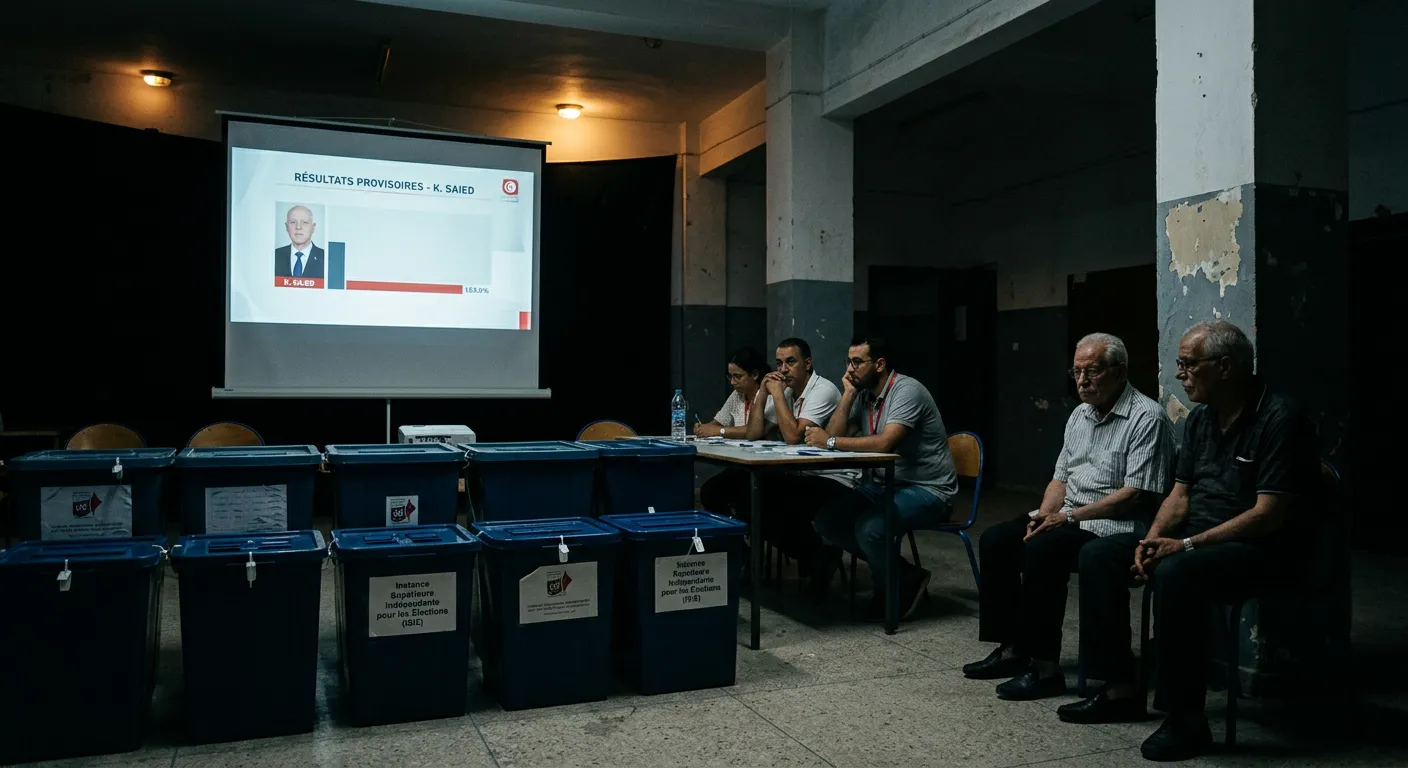
Tunisia's October Election Was a Coronation, Not a Contest
The July 2024 announcement that Tunisia would vote on October 6 was the starting gun for what became the most thoroughly stage-managed election in the country's post-revolution history.
When President Kais Saied's office issued the decree on July 2, 2024, summoning Tunisians to the polls for October 6, the outcome was already being engineered. What followed was not an election but an elimination — a methodical clearing of the field that reduced a once-vibrant democracy to a one-man show with 28.8% turnout. Africanews reported the decree. The numbers that followed tell the rest of the story.
The Candidate Cull
Seventeen candidates filed to run. Fourteen were disqualified. The Independent High Authority for Elections (ISIE), which Saied had restructured in 2022 and packed with loyalists under Chairman Farouk Bouasker, approved only three: Saied himself, Zouhair Maghzaoui — a longtime presidential ally who had defended Saied's 2021 power grab — and Ayachi Zammel, head of the little-known Azimoun party. Al Jazeera detailed the purge.
Then came the legal hammer. Tunisia's Administrative Court, the country's last independent judicial body, ruled that three of the barred candidates — former ministers Imed Daimi and Mondher Znaidi, and opposition leader Abdellatif Mekki — should be reinstated. The ISIE simply ignored the ruling. Days later, a parliament rebuilt under Saied's 2022 constitution stripped the Administrative Court of its power to adjudicate electoral disputes. Carnegie Endowment called it Saied "deftly using the law to ensure his victory."
Zammel, the sole candidate who represented anything resembling genuine opposition, was arrested, tried, and sentenced to 12 years in prison for allegedly falsifying voter endorsements — five days before the poll. His name remained on the ballot. He won 7% from a prison cell. BBC
The Results and What They Conceal
Saied secured 90.7% of the vote — 2,438,954 ballots — with turnout at 28.8%, the lowest in any Tunisian presidential election since the 2011 revolution. The contrast is brutal: 49.8% turnout in the first round of 2019, versus not even three in ten eligible voters bothering this time. NPR
The abstention was not just apathy. Five political parties called for a boycott. Ennahda, the country's largest opposition party, said its senior members had been arrested at levels "it had not seen before." Human Rights Watch documented that authorities excluded eight prospective candidates through prosecution and imprisonment. CSIS noted that at least 97 Ennahda members were arrested, and independent election monitors were denied accreditation.
The EU's response was telling. Brussels, which had struck a migration-control deal with Tunis worth $118 million, offered only that it "takes note of the position expressed by many Tunisian social and political actors regarding the integrity of the electoral process." As Hamza Meddeb of the Carnegie Middle East Center told Al Jazeera: "EU officials and diplomats will all recognise the election. They don't see themselves as having any alternative if they're going to fight migration." Al Jazeera
What to Watch
The margin is a trap. Saied will interpret 90.7% as a mandate to accelerate repression, not as the artifact of a hollowed-out field and mass abstention. The opposition enters his second term fractured — Ennahda's leadership imprisoned, the Free Destourian Party's Abir Moussi jailed under Decree 54, and no unified boycott or protest strategy among those who remain free.
The real pressure point is economic. Unemployment at 16%, inflation biting, the IMF's $2 billion loan frozen since 2021 because Saied refuses the required reforms. The European Investment Bank's €450 million in grants and loans — announced in June 2024 — offers a lifeline but not a solution. Young Tunisians are voting with their feet: UN figures showed at least 12,000 who landed on Italian shores in 2023 departed from Tunisia.
The next decision point is not electoral. It is whether economic deterioration — food shortages, water scarcity, collapsing purchasing power — triggers the kind of street mobilization that neither Saied's security apparatus nor his populist rhetoric about "traitors and conspirators" can contain. The slogan of 2011 has already reappeared at protests. The question is whether it can gather force against a president who has spent five years ensuring it cannot.
Discover more
India
700 Activists Accuse PM Modi of MCC Breach
Over 700 activists allege PM Modi breached election code with a televised address attacking opposition parties just before state elections.
India
Congress Accuses Modi of Stalling Women's Law
Congress accuses Modi of stalling women's reservation law by linking it to delimitation, revealing a deeper electoral strategy.
India
Rajnath Singh's Durga Squad for 2026 Polls
Rajnath Singh's Durga Squad promised women's safety in Bengal but has since disappeared from the agenda, revealing BJP's true priorities.

Economics
Fed's Amex AML order puts correspondent banking on notice
Federal Reserve's Amex AML order requires board-level controls and a 90-day plan; OCC fined the bank $350 million over enterprise-wide deficiencies.