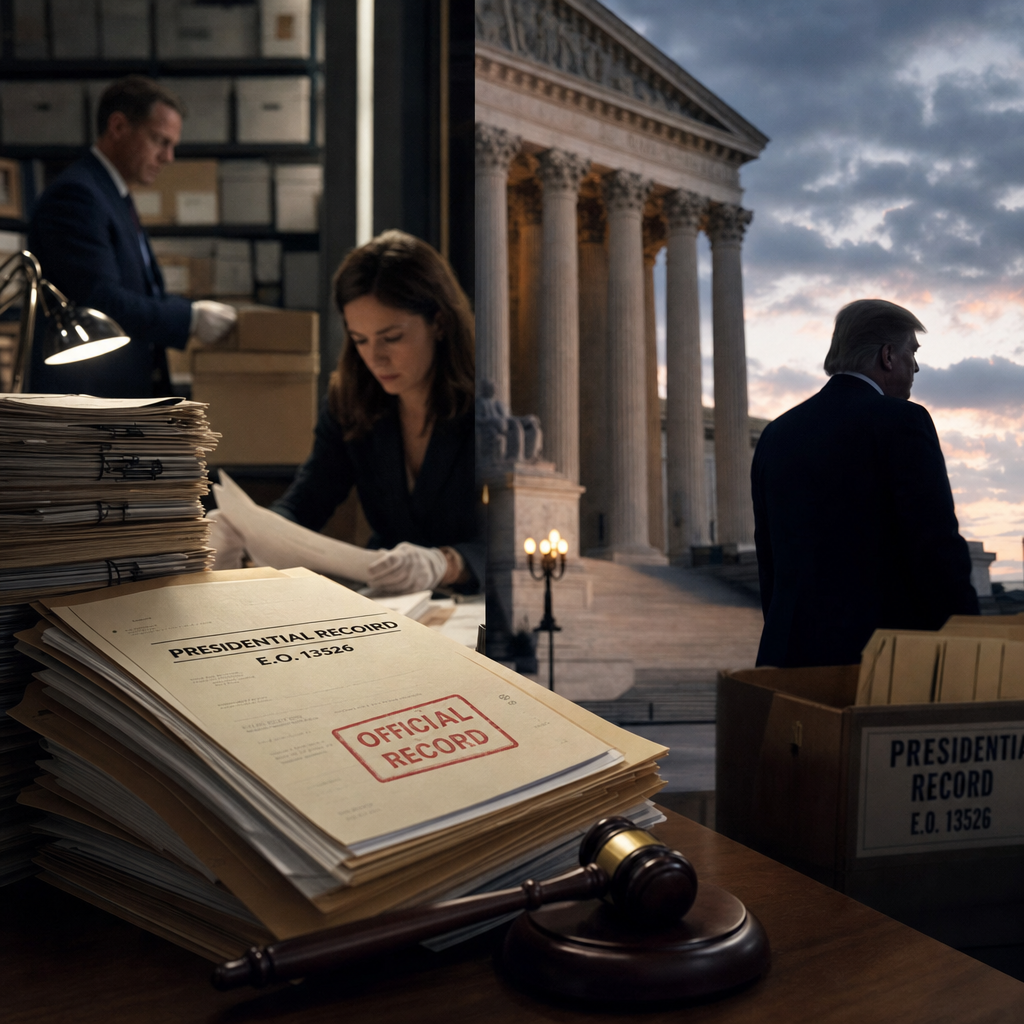
Trump’s Records Fight Hits a Judicial Wall
Judge John Bates ordered White House staff to preserve official records, boxing in Donald Trump’s effort to relax Watergate-era recordkeeping rules.
A federal judge said this week that the White House must preserve official records, including communications sent through non-official text services, pushing back on the Trump administration’s effort to loosen federal record-keeping obligations ( CNN). The power dynamic is clear: the court now has leverage over the administration’s documentary trail, and that matters because the record itself is often the first line of defense in oversight fights, lawsuits and congressional investigations (CNN).
The real issue is control of evidence
This is not mainly about archives. It is about who controls the evidence of presidential decision-making in real time. The Presidential Records Act was built after Watergate to ensure that White House and vice presidential records belong to the public, not to the president personally, and that electronic communications are preserved too (CNN;  The Washington Post). CNN reported in April that the Justice Department’s Office of Legal Counsel told Trump he no longer had to follow the law, and White House counsel David Warrington then issued guidance that narrowed preservation rules mainly to emails and text messages — while leaving unclear what happens to disappearing chats on apps like Signal (CNN; CNN).
That is where the stakes shift from bureaucratic to political. If the White House can decide which digital communications count, it gains room to hide the path of a decision while keeping the formal paper trail intact. If Judge Bates’s ruling stands, that discretion narrows sharply, especially for staff conversations that may never hit official systems but still shape policy (CNN; CNN). For a White House that has already tried to recast the law as unconstitutional, that is a major loss of operational freedom.
Who benefits, and who loses
The winners here are Congress, the National Archives, historians and watchdogs like American Oversight, which want a court order making clear that messaging apps fall under preservation rules (CNN). The losers are White House officials who prefer to conduct sensitive business on channels that can disappear or stay outside official systems. That is why the fight has wider institutional meaning: it is about whether Trump can expand executive autonomy by shrinking the record that future investigators can review. For more on the broader institutional stakes, see  Global Politics and United States.
The historical warning is straightforward. AP’s reporting, published by The Washington Post, noted that Trump could leave behind less documentation than almost any modern president, especially if staff rely on Signal, Teams or other tools that evade normal capture rules (The Washington Post). That is the deeper contest: not whether Trump speaks loudly in public, but whether the internal record survives in a form the next Congress, court or historian can use.
What to watch next
The next test is whether the administration keeps defending a narrowed preservation regime or is forced to broaden it to cover ephemeral messaging and other off-system communications. Bates has already signaled skepticism about any carve-out that leaves out the very tools most likely to erase a decision trail (CNN). Watch the next court filing or emergency appeal closely: that is where the practical boundary between presidential discretion and public recordkeeping will be set.