Trump's Immigration Crackdown Expands Quietly
ICE arrests surge as visibility decreases under new leadership.
Model Diplomat7 min readNorth America
Trump's Immigration Crackdown Goes Quiet — and Bigger Than Ever
ICE arrested 10,000 people in five days at the end of June 2026 as detention hit 60,000. The state crackdown didn't stop; it stopped being televised.
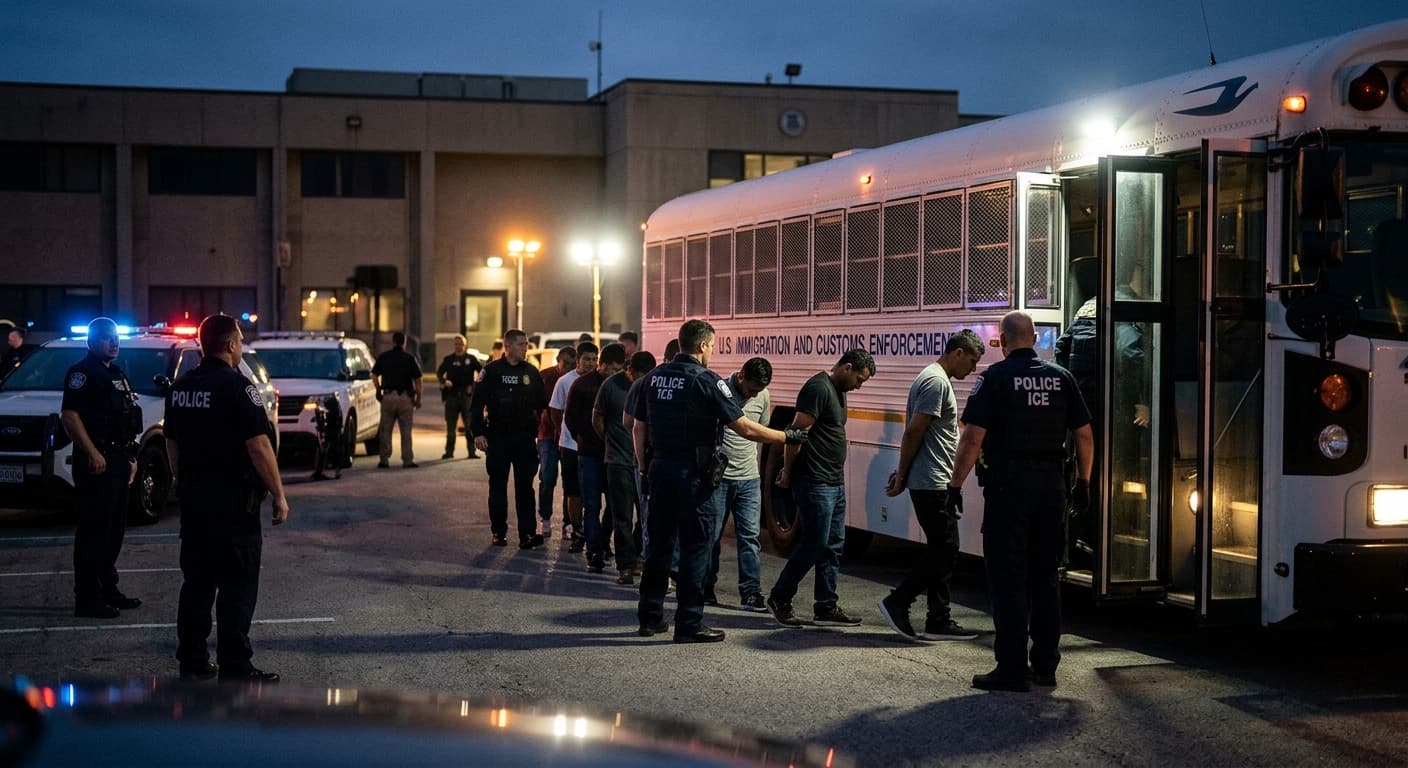
Immigration and Customs Enforcement arrested roughly 10,000 people in a five-day stretch at the end of June 2026 — a sustained pace of about 2,000 arrests a day — while the detained population sits above 60,000 and the UN's top human rights official has publicly called for independent investigations into deaths in ICE custody. The Trump administration's second-term crackdown has not eased since the January killings of two U.S. citizens in Minneapolis; it has been re-engineered. Kristi Noem is out. Markwayne Mullin is in. The black helicopters and masked squads that produced viral video and mass protest last year have been replaced by check-in traps, traffic-stop dragnets and 287(g) bounties paid to county sheriffs. The crackdown is bigger than it was under Noem — and, by design, quieter.
That is the shift previous administrations did not attempt. Barack Obama removed record numbers of migrants but did so through a criminal-priorities framework and a public argument about "felons, not families." Joe Biden paired enforcement with legal-status expansions such as parole programs. The Trump II model has abandoned both: no priorities framework, no lawful-pathway pairing, and — since March — no showmanship. According to the Council on Foreign Relations, the administration has "reshaped" enforcement around expedited removal, third-country deportation flights and a $170 billion multi-year budget passed in 2025's reconciliation package, topped up in June 2026 with another $70 billion carved out for ICE and CBP alone.
The Mullin doctrine: same volume, less video
Mullin, an enrolled member of the Cherokee Nation and a former MMA fighter, was confirmed on March 24, 2026, after Noem was pushed out over the Minneapolis killings. His pitch was procedural, not substantive. "We're purposefully trying to be a little bit more quiet," he told Newsmax in May, according to NPR. "I made this very clear when we were moving forward with my nomination that I wanted to get DHS out of the headlines." He then noted the agency had arrested more than 1,900 people on a single day that week and deported 2,700 the week before. "We haven't missed a beat."
The tactical redesign has three legs. First, ICE has "supercharged" its 287(g) program: partnerships with local sheriffs have jumped from 135 when Trump took office to more than 1,700, NPR reported, with DHS offering $100,000 vehicles, salary reimbursement and per-arrest bonuses that FWD.us estimated could total $2 billion in 2026 alone. Second, arrests have migrated from worksite raids and community sweeps to routine touchpoints — courthouse hallways, ICE check-ins, traffic stops — which produce fewer bystander videos. Third, CBP field commanders were moved into ICE field-office director slots in late 2025, importing Border Patrol's more aggressive posture into interior cities without the branding.
The result is a crackdown that generates fewer viral flashpoints per thousand arrests. Border czar Tom Homan told a Phoenix industry conference in May that the administration is "purposefully" less visible even as it prepares to add 10,000 ICE officers, 5,000 Border Patrol agents and 2,500 immigration-court prosecutors, according to NPR's coverage. "You ain't seen s*** yet," Homan said. "Mass deportations are coming."
The numbers the administration would rather you didn't add up
The most complete primary source is the Federal Register's March 26, 2026 mass-influx finding, which states that as of March 12, 2026 ICE held 63,482 people in detention against a stated capacity of 78,000, and that between September 1, 2025 and March 11, 2026 ICE removed 128,889 people with criminal convictions or pending charges. The same document, published at govinfo.gov, shows ICE's non-detained docket of people under final removal orders standing at more than 1.5 million — the pool from which check-in arrests are now drawn.
That population has grown fast. The Financial Times reported detention at 57,800 by June 2025; CFR cites nearly 69,000 by early January 2026; and the UN Human Rights Office said on June 26 that ICE is "currently holding over 60,000 individuals compared to approximately 40,000 in early 2025," with plans to expand capacity to 90,000 beds by year-end. In a statement from Geneva, High Commissioner Volker Türk cited 18 deaths in ICE custody in the first five months of 2026, plus one in June, against 33 in all of 2025 and 11 in 2024.
Türk's language was pointed:
"I call for prompt, independent, impartial and effective investigations into all deaths in ICE custody. Those responsible for violations of the law must be held to account, and the rights of the victims' families to truth, justice and reparation and guarantees of non-recurrence must be upheld."
The Congressional Record for February 4, 2026 documents the domestic parallel. House members on the floor put the toll at "45 individuals who have died within the custody of DHS since the start of 2025," calling 2025 "the deadliest year for ICE detention in two decades," per the debate archived at govinfo.gov. DHS disputes the framing, telling Al Jazeera in June that the rate remains "0.009% of the detained population" and that there had been "NO spike in deaths."
Who benefits — and who quietly loses
Trump's mass-deportation drive was sold as a labor-market policy. A May 29, 2026 Brookings study found the opposite. Across the 86 U.S. cities that saw the sharpest rise in ICE arrests in the first half of 2025, employment fell 0.73% below trend — 1.48% in cities observed at least six months out — for a total of roughly 668,000 lost jobs. Of those, Brookings estimates 51,000 to 297,000 would have been held by American-born workers. Each "excess" arrest is associated with 13 jobs lost. That is the cost the administration is now trying to spread out and hide, not reverse.
The Supreme Court is doing its part on the legal architecture. On June 25, 2026, the Court's 6-3 conservative majority cleared the way for the administration to terminate Temporary Protected Status for roughly 350,000 Haitians and 6,100 Syrians, and — in a companion ruling — revived the "metering" practice of physically turning back asylum seekers at the border. Justice Samuel Alito's TPS opinion held that federal law "plainly bars" judicial review of the executive's termination decision, and rejected the lower court's finding that Trump's Haitian move was likely animated by "racial animus." Haitian work authorizations expire July 10.
Congressional appropriators nailed the funding into place. The Congressional Research Service's DHS appropriations tracker confirms that on June 10, 2026 Trump signed P.L. 119-98, a reconciliation measure providing nearly $70 billion for ICE and CBP through FY2029 — on top of the $170 billion already delivered in the 2025 One Big Beautiful Bill Act. Of that, $45 billion goes to ICE detention capacity and roughly $30 billion to hiring. Al Jazeera reported that Democrats initially blocked the June bill after the Minneapolis killings but
ultimately lost the reconciliation fight after a 76-day partial DHS shutdown.
The winners are legible: private detention operators contracted to build 10,000-bed facilities toward the 92,600-bed goal; the 1,700 sheriff's offices now drawing federal money through 287(g); and border-state governors like Texas's and Florida's, whose grant programs stack on top of DHS payments. The losers are equally legible and mostly foreign-born: Venezuelans deported hours before the June 24 earthquakes that killed at least 2,200 people; Haitian TPS holders —
roughly one in seven of whom works in U.S. healthcare, according to Republican Rep. Mike Lawler; Somali TPS holders in Minneapolis whose status a federal judge has temporarily preserved; and the more than 74,000 people with no criminal record swept up in the first nine months of the term, per Deportation Data Project figures analyzed by
NPR.
There is also a treaty-body dimension the domestic press has largely underplayed. UN special procedures issued a joint allegation letter, AL USA 37/2025 archived at ohchr.org, citing "incommunicado detention and enforced disappearances" of Venezuelan nationals transferred to El Salvador's CECOT prison, "ill-treatment" in ICE facilities, and family separations affecting at least 66 Venezuelan children. The Human Rights Committee's prior concluding observations on U.S. compliance with the International Covenant on Civil and Political Rights, and the CERD's 2022 recommendations to end mandatory detention, remain formally unmet — and the current expansion moves the U.S. further from them, not closer.
For deeper context on the country at the center of this, see the United States profile.

What to watch
- July 10, 2026 — Haitian TPS work authorizations expire for roughly 330,000 people absent alternative status. Employer response in healthcare and construction will be the first economic tell.
- Late July 2026 — Whether DHS publishes updated in-custody death data and detention-population figures on a routine schedule, as it did through 2024, or lets the numbers go dark as ICE approaches its 90,000-bed target.
- Fall 2026 — Expected federal-court rulings on the constitutionality of the expanded 287(g) grants and on challenges to the administration's third-country removals to El Salvador and Venezuela, following the UN special procedures' allegation letter.
The Bottom Line
The bottom line: Trump's second-term crackdown has not softened — it has been professionalized. Under Mullin, ICE is arresting more people through less visible means, backed by $240 billion in multi-year funding, a Supreme Court that has cleared TPS and metering, and a 1,700-strong network of local sheriffs on the federal payroll. The story is no longer black helicopters over Minneapolis; it is 2,000 people a day disappearing into a detention system the UN says is killing them at record rates while the cameras look elsewhere.
Read today's full |
Discover more
US Politics
House Ethics Committee Pushes Sexual Miscond.
The House Ethics Committee has shifted responsibility for sexual harassment settlement records to the Office of Congressional Workplace Rights, complicating disclosure efforts.
US Politics
Congress Targets AI Chatbot Access for Terror
The House passed the Generative AI Terrorism Risk Assessment Act, focusing on AI's role in terrorism and potential surveillance implications.

Global Politics
US Seizes Iranian Ship, Tensions Surge
The US seizure of the Iranian ship Touska highlights a shift in control over the Strait of Hormuz, favoring Iran's strategic position.

Economics
Fed's Amex AML order puts correspondent banking on notice
Federal Reserve's Amex AML order requires board-level controls and a 90-day plan; OCC fined the bank $350 million over enterprise-wide deficiencies.