Trump's Drugmaker Deals
Examining Trump's pharma pricing strategy and its implications.
Model Diplomat7 min readNorth America
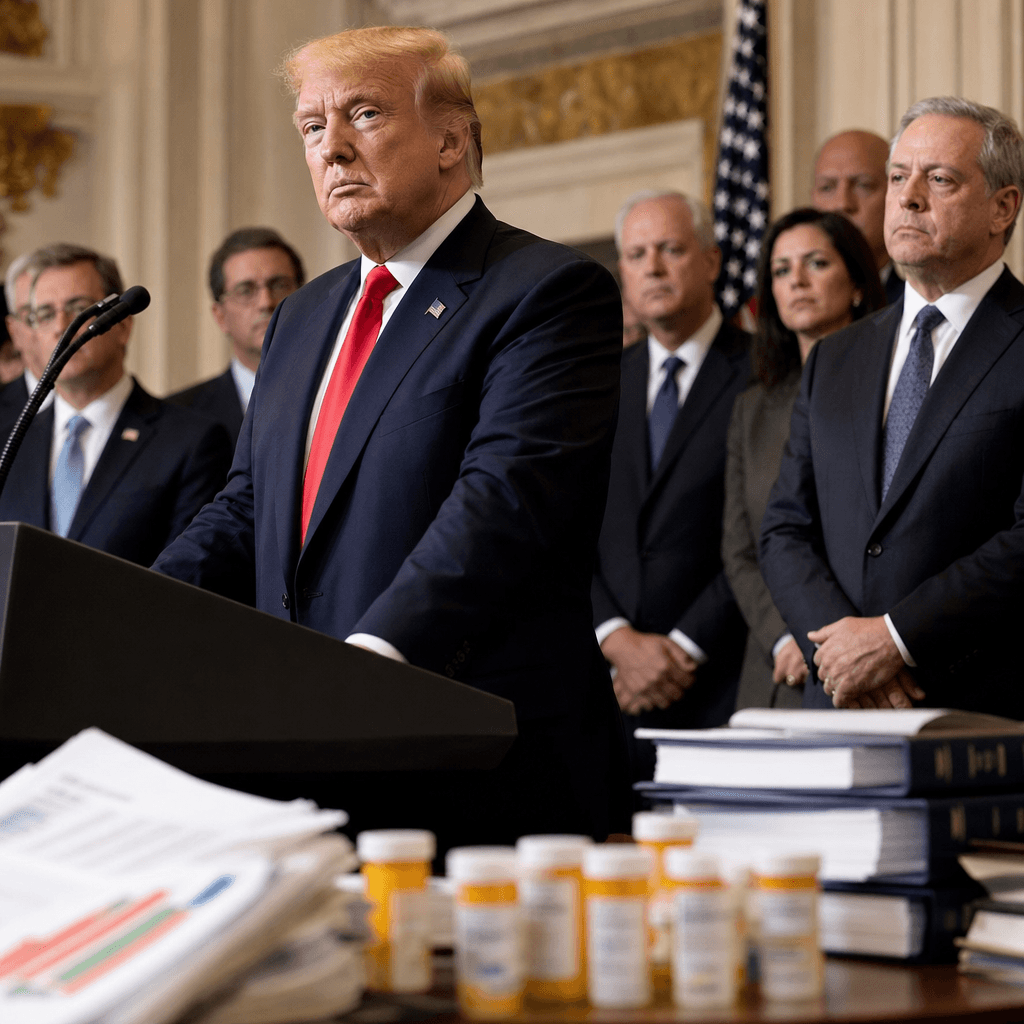
Trump's Drugmaker Deals: The Tariff-For-Discounts Trade
Trump has struck 17 "most-favored-nation" pricing deals with big pharma — but the discounts land narrowly, list prices are still rising, and the leverage is a tariff that expires in 2029.
The Trump administration's headline pharma achievement — 17 signed "most-favored-nation" (MFN) pricing deals covering roughly 86% of the U.S. branded-drug market by sales — is not really a drug-pricing policy. It is a tariff-for-discounts trade, backed by a Section 232 national-security order, that delivers real but narrow cash-price cuts to uninsured Americans and Medicaid programs while leaving list prices, private-insurance rates and mid-sized drugmakers largely untouched. According to a White House fact sheet dated April 23, 2026, Regeneron became the 17th signatory, capping the roster of large manufacturers. But an analysis by drug-pricing research firm 46brooklyn, reported by
NPR, found that all 16 signatories at the time raised list prices on some products in the first two weeks of January 2026 — a median hike of 4%, identical to the year before. The gap between the pitch and the pharmacy is now the story.
The architecture: an executive-order shortcut around Congress
Trump's May 12, 2025 executive order, "Delivering Most-Favored-Nation Prescription Drug Pricing to American Patients," directed the Department of Health and Human Services to align U.S. prices with the lowest paid by any OECD peer with per-capita GDP above 60% of the U.S. figure. A Congressional Research Service legal sidebar flagged the central legal problem: HHS possesses "only the authority that Congress has provided," and neither the 2025 order nor its predecessor identifies a statute authorizing MFN pricing across private markets.
The administration solved that problem by not litigating it. Instead of rulemaking, HHS sent demand letters on July 31, 2025 to 17 named manufacturers — AbbVie, Amgen, AstraZeneca, Boehringer Ingelheim, Bristol Myers Squibb, Eli Lilly, EMD Serono, Genentech, Gilead, GSK, Johnson & Johnson, Merck, Novartis, Novo Nordisk, Pfizer, Regeneron and Sanofi — with a 60-day ultimatum. The leverage was a Section 232 tariff on patented pharmaceuticals imposed on April 2, 2026:
15% on imports from the EU, Japan, Korea and Switzerland, but 0% for firms that sign MFN pricing and onshoring deals through January 20, 2029.
That is the deal in a sentence: cut prices where the White House wants, or lose your tariff carve-out.
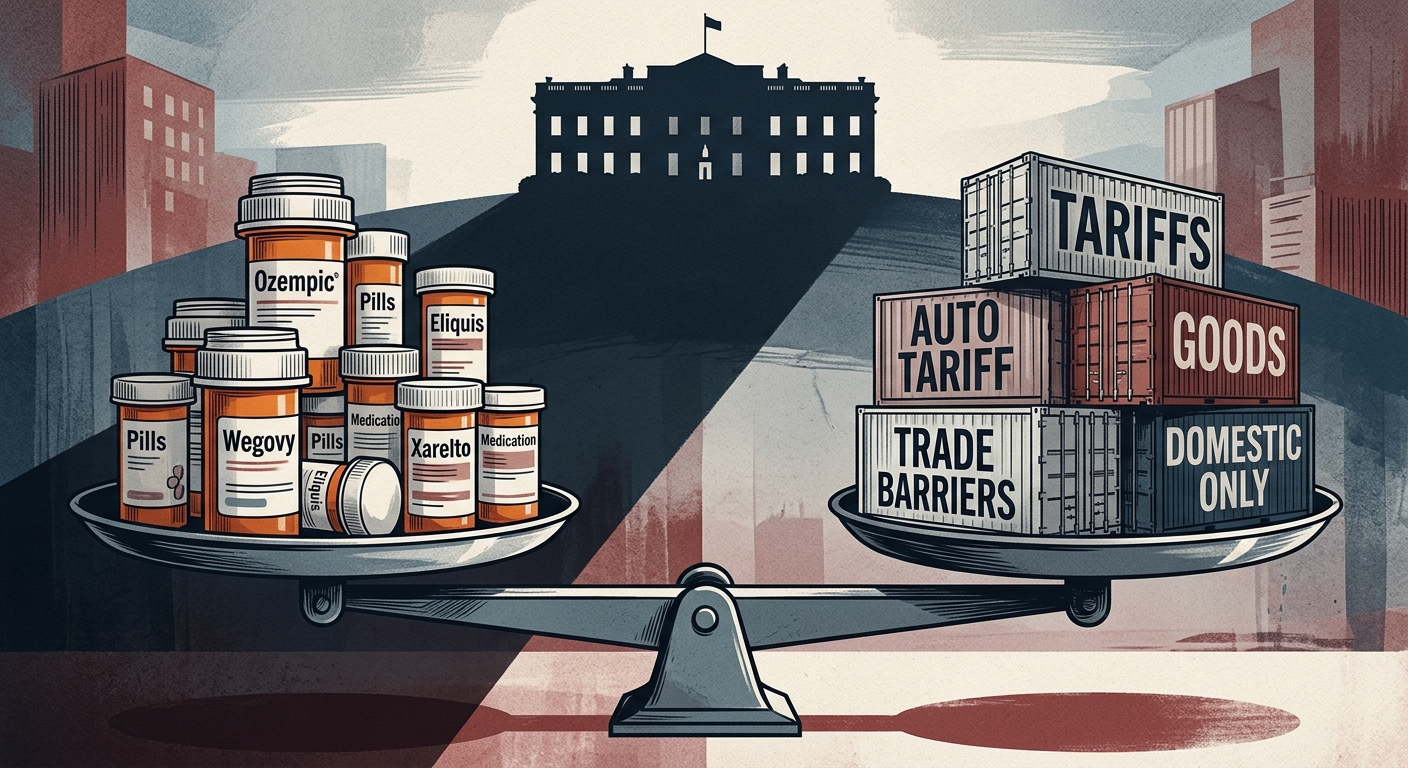
Who wins: cash payers, GLP-1 seekers, and Eli Lilly's stock
For patients paying out of pocket — the uninsured, the under-insured, and anyone whose plan does not cover weight-loss drugs — the numbers are genuinely material. According to the White House TrumpRx.gov launch release, Ozempic drops from $1,028 to an average of $350 per month, Wegovy injectable from $1,349 to $199 at the lowest dose, and the Wegovy pill to $149. Regeneron's cholesterol drug Praluent falls from $537 to $225. The GLP-1 concession is the crown jewel: Deutsche Bank analysts, cited by
Al Jazeera, estimated a $150 monthly cap could unlock the market to as many as 15 million new Americans.
The White House's own Council of Economic Advisers report projects $529 billion in domestic savings over 10 years from prospective MFN (new-drug launches at foreign-parity prices), plus $64.3 billion in Medicaid savings. Those figures are speculative; as the Philadelphia Inquirer noted, the underlying deal documents are not public, so no outside analyst can
independently verify the projection.
The commercial winners are clearer. Eli Lilly and Novo Nordisk secured fast-track regulatory vouchers for pipeline drugs and three-year tariff waivers in exchange for GLP-1 concessions that, per Deutsche Bank, expand their addressable market by an order of magnitude. Pfizer got a $70 billion domestic-investment credit and template-setter status. Investors, initially spooked by MFN language, recovered once the deal terms leaked —
the "spectre of tighter price controls," Reuters noted, was calmed by the actual scope.
Who loses: privately insured Americans, mid-sized biotech, and Europe
The people most likely to see nothing are the roughly 180 million Americans on employer-sponsored insurance. Cash prices on TrumpRx are gated behind an attestation that the buyer will not seek reimbursement or count the outlay toward a deductible; the site itself warns, "If you have insurance, check your co-pay first — it may be even lower." Dr. Ben Rome of Brigham and Women's Hospital told NPR the offering is "not dissimilar from other drug discount sites like GoodRx" — a middleman with a presidential logo. Juliette Cubanski of KFF, quoted by
Al Jazeera, warned that "in some cases, we could be looking at out-of-pocket costs that are still relatively unaffordable for a lot of people."
Ben Rome's other point matters more: Medicaid already gets discounts exceeding 80% on many branded drugs, so the "MFN prices to Medicaid" concession the White House has extracted from 17 firms is, in many cases, close to what the program already pays. Reuters noted analysts have flagged this: Medicaid represents only about 10% of U.S. drug spending, and its statutory rebates already put it near international benchmarks.
The second losing constituency is mid-sized biotech. Reuters reported on June 30, 2026 that after the CMS Medicaid MFN pilot's application window closed on June 11 — twice extended from March 31 — only Astellas, out of 19 of the next-largest drug companies contacted, confirmed applying. Bayer and Daiichi Sankyo said they were "still reviewing." The rest declined comment. One lobbyist told Reuters flatly: "There is no real upside." Mid-sized firms with fewer products cannot absorb the margin hit; big pharma can trade concessions on a handful of drugs for a tariff exemption worth billions.
The third loser is Europe — and the deal is structured to prove it. On December 1, 2025 the U.S. Trade Representative announced an agreement with the United Kingdom to raise net prices of new prescription drugs by 25%. Eli Lilly explicitly attributed a U.K. price hike on Mounjaro to Trump-administration pressure, according to
NPR. MFN, in practice, is a lever to compress the transatlantic price differential from both ends.
The legal and legislative fragility
The deals rest on two shaky pillars. The first is the Section 232 tariff itself, which the American Enterprise Institute's James Capretta described as a "national security rationale" asserting authority "Congress never granted" over private pharmaceutical pricing — a claim that "could yet be tested in courts." The second is the parallel legal fight over the Inflation Reduction Act's Medicare Drug Price Negotiation Program: on
December 19, 2025 Janssen filed a Supreme Court cert petition arguing the program's "1900% excise tax" for non-participation and its access requirements amount to a First Amendment compelled-speech violation and a Fifth Amendment taking. A Supreme Court ruling that constrains federal leverage over drug prices would gut both Biden's IRA program and Trump's tariff-hostage structure at once.
Legislation is the escape hatch. Trump's Great Healthcare Plan, announced January 15, 2026, asks Congress to codify the voluntary MFN deals. Without that vote, the
Center for Strategic and International Studies notes, the entire architecture "may expire at the end of the president's term" in January 2029, when the tariff carve-outs sunset. Pharmaceutical lobbying hit a record $187 million in 2025, according to
OpenSecrets data cited by Al Jazeera — a signal the industry is not planning to let codification happen on White House terms.
Diplomat View
The MFN deals will lower out-of-pocket prices for a specific, and politically potent, slice of Americans — the cash-paying GLP-1 buyer and the Medicaid enrollee in a participating state — while doing little for the 60% of the country on employer coverage. That trade-off is deliberate: it produces retail-visible price cuts, headline-friendly foreign-parity numbers, and a $187 million-lobbying industry that mostly complied. The forecast: TrumpRx will look like a policy success by the 2026 midterms and structurally weak by 2028. Codification will fail in Congress absent a Republican trifecta post-2026, mid-sized manufacturers will keep opting out of the Medicaid pilot, and the whole architecture will hinge on whether the Supreme Court's Janssen ruling — and any Section 232 tariff challenge — leaves the tariff hammer intact. If the Court strikes down IRA-style price coercion on First or Fifth Amendment grounds, the MFN deals collapse into voluntary marketing exercises overnight. Revise this call if (a) the Supreme Court denies cert or upholds the IRA, (b) Congress passes any part of the Great Healthcare Plan before the 2026 midterms, or (c) a second wave of 15+ mid-sized manufacturers signs the CMS Medicaid pilot after the September 30 state deadline.
What to watch
- September 30, 2026 — deadline for state Medicaid programs to opt in to the CMS MFN pilot. Roughly half the projected $64.3B in Medicaid savings depends on state uptake.
- October 2026 — CMS's two additional MFN Medicare pilot programs are expected to go live, potentially mandatory, per
Reuters; Medicare drug spending is two-to-three times Medicaid's.
- Supreme Court's 2026–27 term — a cert grant in Janssen v. HHS would put the constitutional foundations of federal drug-price coercion on the docket before the tariff waivers sunset.
- January 20, 2029 — the 0% tariff carve-out expires with Trump's term unless codified.
For deeper coverage of the domestic-policy tools at play, see Diplomat's US Politics topic page.
The Bottom Line
Trump's drugmaker deals are not a drug-pricing law — they are a tariff-hostage arrangement dressed as one. The winners are cash-paying GLP-1 buyers, Eli Lilly and Novo Nordisk's addressable market, and a president who now has a signed pledge from 86% of the branded drug market to point at. The losers are privately insured Americans who will keep paying insurance-mediated prices, mid-sized biotechs that see no upside in signing on, and any successor administration that inherits an architecture built on tariff waivers set to expire on January 20, 2029.
Discover more
Conflict & Security
De la Espriella's Razor Win Resets US-Colomb
De la Espriella's razor-thin election win signals a reset in US-Colombia relations, reshaping security ties and the agenda under a Trump-aligned approach.
International Relations
Colombia's Razor-Thin Rightward Pivot
Colombia swings right as Abelardo de la Espriella narrowly wins the presidential runoff by under one percent, exposing a deeply divided and polarized nation.
Global Politics
Iran Demands US Enforce Ceasefire
Iran insists the United States must enforce a ceasefire in Lebanon to uphold the memorandum of understanding, raising pressure on Washington and Netanyahu.

Conflict & Security
Trump's Iran Deal Faces Bipartisan Backlash
Trump's Iran deal draws fierce criticism from both Republicans and Democrats, exposing deep political divides over the ceasefire and the terms of the agreement.