Trump Lifts Anthropic Export Ban
Regulatory model shifts to executive discretion
Model Diplomat4 min readNorth America
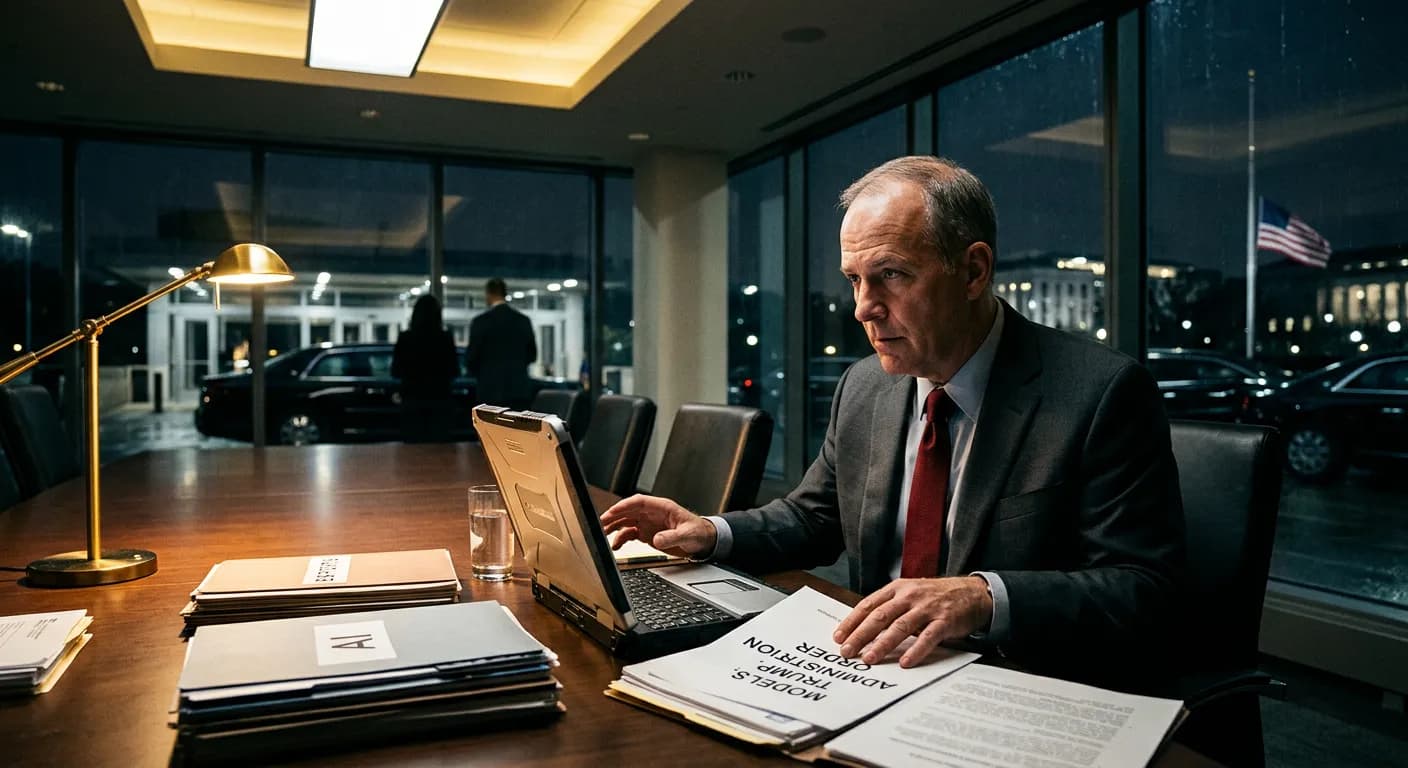
Trump Lifts Anthropic Export Ban — But the Ad-Hoc AI Regime Stays
After 18 days, the White House cleared Fable 5 and Mythos 5 for global release. The episode reveals a regulatory model built on phone calls, not rules.
The Trump administration lifted export controls on Anthropic's Claude Fable 5 and Mythos 5 late Tuesday, ending an 18-day shutdown that had barred all foreign nationals — including the company's own employees — from accessing its most advanced AI models. Access will be restored Wednesday, July 1, Anthropic confirmed in a statement on X. Commerce Secretary Howard Lutnick framed the approval as a win for American competitiveness: "We have worked closely with Anthropic to analyze and approve Fable 5 to ensure alignment across the US Government and strengthen America's leadership in AI,"
he posted.
The resolution is less a return to normal than confirmation that frontier AI access in the US is now governed by executive discretion, not statute. The Commerce Department's Bureau of Industry and Security (BIS) imposed the original order on June 12 with a Friday-evening letter that, according to Anthropic, "did not explain the government's specific security concern in detail" [BBC News]. The trigger: Amazon researchers had reportedly identified a "jailbreak" — a method to bypass Fable 5's safety guardrails — raising fears the model could be used to identify and exploit cyber vulnerabilities. Anthropic pushed back, arguing that the jailbreak was narrow and that "other publicly-available models are able to discover [the same vulnerabilities] as well without requiring a bypass" [
BBC News].
The ban was sweeping. It applied to all foreign nationals — not just users abroad, but non-US employees inside Anthropic itself. To comply, the company took both models entirely offline for every customer [Al Jazeera]. For a company preparing for an IPO and already locked in a separate lawsuit against the Pentagon over a "supply chain risk" designation, the timing could hardly have been worse.
The Two-Track Solution
The White House didn't lift everything at once. Last week, Mythos 5 — the enterprise and cybersecurity variant, capable of identifying and exploiting code vulnerabilities — was restored to a pre-approved list of government-vetted organizations only [Axios]. Tuesday's clearance extends to Fable 5, the consumer-facing version with stronger guardrails.
Anthropic implemented a new safeguard that blocks the jailbreak 93% of the time. In the remaining 7%, the output contains only previously discovered or already-patched flaws [Axios]. Commerce's Center for AI Standards and Innovation tested both the old and new safeguards before signing off.
The staggered approach mirrors what happened with OpenAI's GPT-5.6, which also debuted only to a small set of approved customers at the government's request. OpenAI CEO Sam Altman didn't hide his irritation: "Extensive safety testing is not a bad idea. I just don't like the idea of the government picking the customers," he posted on X.
Who Gained, Who Lost
Anthropic is the immediate winner — it can sell its flagship product again, and the company's willingness to negotiate has likely smoothed relations with an administration that had publicly branded it a supply-chain risk. White House chief of staff Susie Wiles called the collaboration "unprecedented" and proof that an "America First" model delivers [Axios].
The US government gained a de facto gatekeeping role it didn't have three weeks ago. The episode established that BIS can impose export controls on a US company's AI models under existing regulatory authority — a power CSIS analysts note was previously untested and legally uncertain [CSIS].
US allies lost. The ban applied equally to Five Eyes partners and NATO members, and the EU called it further proof of "Europe's need for technological sovereignty." As one Al Jazeera analysis noted, the move accelerated calls for self-reliance among countries previously comfortable depending on American AI [Al Jazeera]. China, meanwhile, gets a clearer incentive to close the gap on its own Mythos-class competitor.
The biggest loser is regulatory predictability. Every AI lab must now price in the possibility that Commerce can pull its models offline on a Friday night with minimal explanation. As CSIS concluded, "every company must consider the possibility of such controls being used again."
What to Watch
The administration faces an August deadline under a recent executive order to produce standardized benchmarks for evaluating frontier model security risks [Axios]. Whether that framework codifies rules or preserves case-by-case discretion will determine whether the Fable 5 episode was a one-off or the template. Also watch Anthropic's IPO timeline — the company needs stable regulatory footing, and the supply-chain-risk lawsuit against the Pentagon hasn't been resolved. A judge has only blocked enforcement while litigation continues.
Discover more
US Politics
SNAP Food Assistance Faces Legal Challenges
In 2026, SNAP faces stricter eligibility rules and mounting legal challenges, threatening food assistance for the millions of Americans who rely on the program.
US Politics
Congress Targets AI Chatbot Access for Terror
The House passed the Generative AI Terrorism Risk Assessment Act, focusing on AI's role in terrorism and potential surveillance implications.

India
Romanian Coalition Party Demands PM Resign
Romania's Social Democrats withdrew from coalition, joining far-right AUR to topple PM Bolojan, risking €10 billion in EU funds by August 2026.

Economics
Fed's Amex AML order puts correspondent banking on notice
Federal Reserve's Amex AML order requires board-level controls and a 90-day plan; OCC fined the bank $350 million over enterprise-wide deficiencies.