Tonga's Nobility Returns to Power Amid China
Tonga's new leadership raises concerns over China's influence.
Model Diplomat3 min readoceania
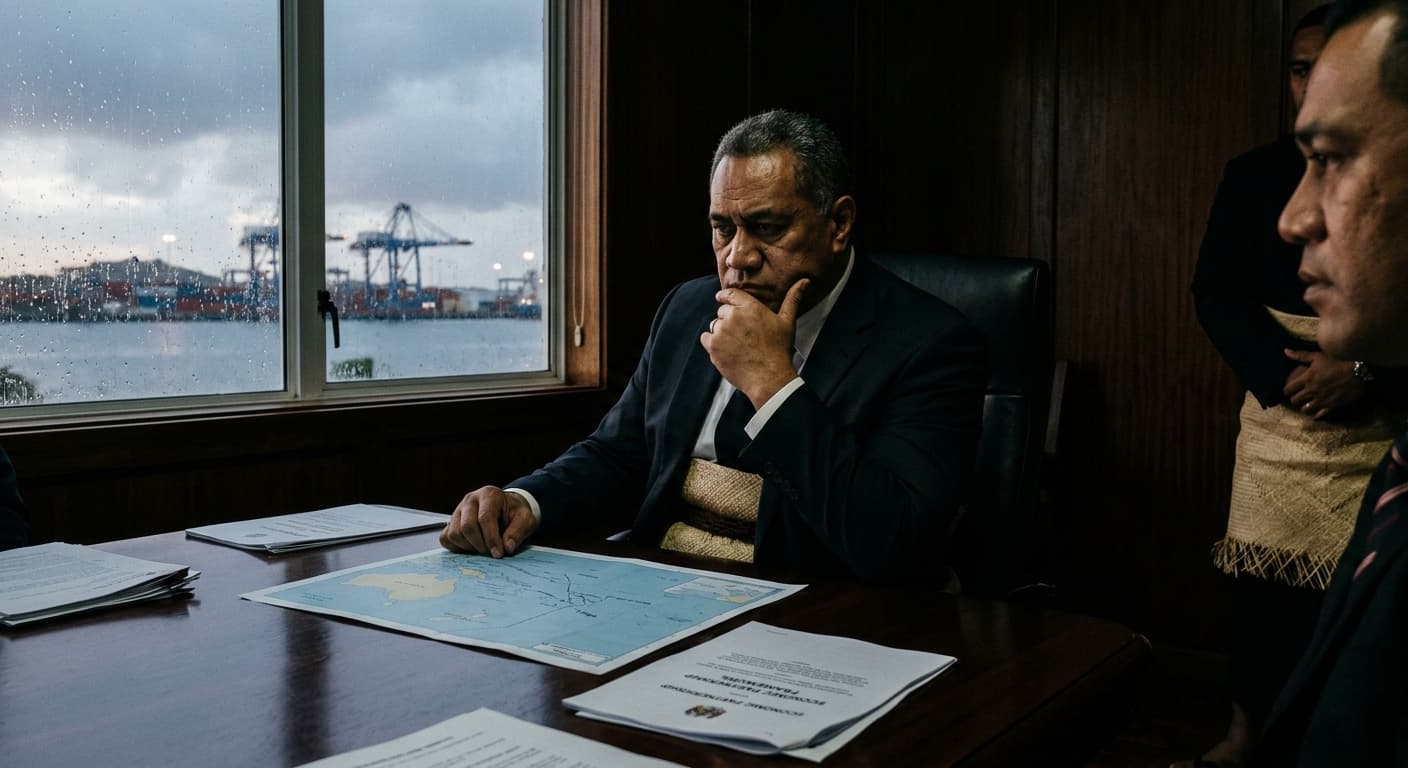
Tonga's Nobility Returns to Power — Just as Congress Was Warned About China's Grip
The January 2025 CRS report flagged Tonga's constitutional monarchy tensions and China's debt leverage. The November 2025 election that brought a noble to the premiership makes both warnings more urgent.
The Congressional Research Service published its latest assessment of Tonga on January 2, 2025 — the same month 'Aisake Valu Eke was being sworn in as prime minister after his predecessor's abrupt resignation in a power struggle with the King. The timing was prescient. The CRS report flagged the monarchy's retained constitutional powers, the November 2025 election, and China's hold on two-thirds of Tonga's $195 million external debt as the key variables Congress should watch. Eighteen months later, two of those three have already moved — and the third is now the inescapable question for the new government.
Every CRS Report
The sequence is important. In December 2024, Prime Minister Siaosi Sovaleni resigned hours before a no-confidence vote, telling parliament through tears that the country had not truly achieved freedom. He had spent months in open conflict with King Tupou VI, who had withdrawn "confidence and consent" from three ministries — including defence and foreign affairs — without explanation. Al Jazeera Eke, a former finance minister, won the parliamentary ballot 16–8 and governed through August 2025 as a caretaker, meeting with IMF officials who warned that Tonga remained at high risk of debt distress with major repayments to China's Export-Import Bank looming through 2028.
IMF 2025 Article IV Consultation
Then the November 2025 election reshuffled the deck. By May 2026, Lord Fatafehi Fakafānua — a hereditary noble — was signing World Bank grant agreements as Prime Minister and Acting Minister for Finance. World Bank His elevation represents a return of the traditional nobility to executive power after a decade in which commoners — first 'Akalisi Pohiva, then Sovaleni, briefly Eke — held the premiership. The CRS report had noted that the nine noble seats in Tonga's 26-member Legislative Assembly, combined with the monarch's authority to dissolve parliament and appoint judges, give the palace structural leverage over any elected government. That leverage has now been exercised.
China's waiting position
Beijing holds the most potent instrument of pressure on any Tongan government: the debt. Tonga ranks among the world's most aid-dependent countries, with remittances comprising over 45% of GDP, and China's Exim Bank holds roughly $130 million of the kingdom's obligations. The CRS report noted that debt-service repayments would remain elevated through 2028. Tonga has not defaulted or sought formal restructuring under the G20 Common Framework — but the IMF's October 2025 staff report explicitly recommended fiscal consolidation of 4.8% of GDP by FY2035 to stabilize debt. That math makes grant-dependent Tonga highly sensitive to donor posture. IMF 2025 Article IV Consultation
China's engagement tempo is accelerating. In May 2025, Foreign Minister Wang Yi hosted 11 Pacific Island delegations in Beijing, directly contrasting China's climate commitments with the US withdrawal from the Paris Agreement and the April 2025 "Liberation Day" tariffs that hit several Pacific states. CSIS Tonga, which switched recognition from Taiwan to Beijing in 1998 and signed onto the Belt and Road Initiative, has seen PLA Navy destroyers visit its ports and Chinese construction firms dominate its infrastructure sector.
Foreign Affairs
The US has moved — opening an embassy in Nuku'alofa in May 2023, launching a consular pilot program in August 2024, and coordinating with Australia and New Zealand on food security and law enforcement. But the CRS report's core warning stands: Pacific Island countries "appear to desire durable commitments in the form of programs and investments," and Congress holds the purse strings.
What to watch
The IMF's next review. Tonga's fiscal consolidation timeline requires it to begin tightening in FY2027. If grant inflows underperform — and if China offers flexibility on debt service that the US and its partners do not match — Fakafānua's government will face structural pressure to tilt toward Beijing regardless of its preferences.
The September 2026 Pacific Islands Forum. Solomon Islands, China's closest Pacific partner, is hosting. How Tonga positions itself on China-Taiwan language in the communiqué will signal whether the noble-led government intends to deepen or hedge its Beijing relationship.
Congressional action. The CRS explicitly notes that Congress can "exercise oversight" and "shape pertinent funding priorities." With the COFA agreements funded but Pacific infrastructure competition intensifying, Tonga is a test case for whether US engagement outlasts the Biden-era embassy-opening push.
Discover more
US Politics
Congress Targets AI Chatbot Access for Terror
The House passed the Generative AI Terrorism Risk Assessment Act, focusing on AI's role in terrorism and potential surveillance implications.

US Politics
US Launches $166B Tariff Refund Portal
The US is launching a $166 billion tariff refund portal to aid importers hit by Trump-era tariffs, with major implications for trade and supply costs.
Global Politics
Trump's Conflicting Messages on Iran War
Trump's mixed messages on Iran reflect a strategy of audience management, benefiting Tehran amid a complex geopolitical landscape.

Economics
Fed's Amex AML order puts correspondent banking on notice
Federal Reserve's Amex AML order requires board-level controls and a 90-day plan; OCC fined the bank $350 million over enterprise-wide deficiencies.