Tonga's China Debt Hits 4% of GDP
Congress weighs implications of Tonga's debt crisis.
Model Diplomat4 min readoceania
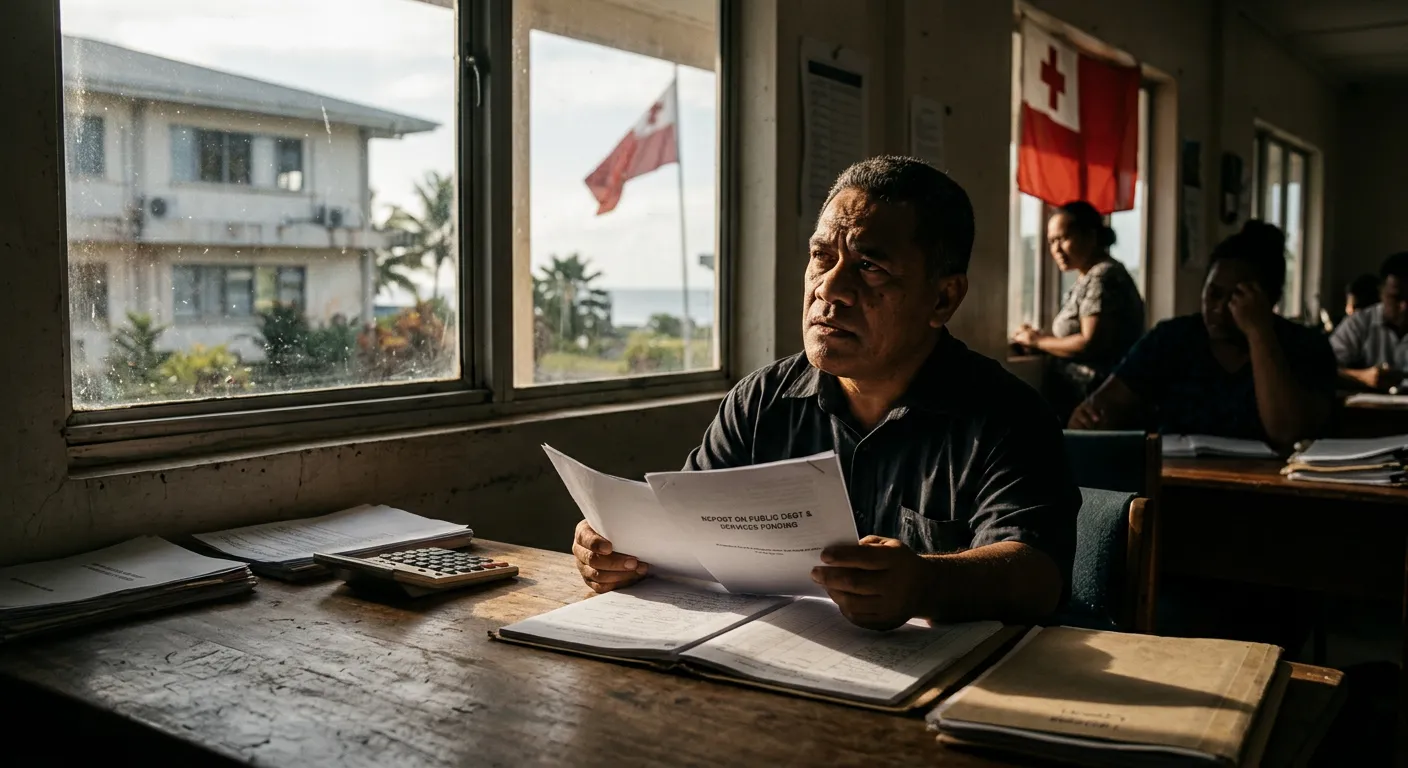
Tonga's China Debt Hits 4% of GDP — And Congress Is Now Weighing the Bill
The Congressional Research Service's updated September 2025 briefing on Tonga reveals a kingdom caught between Chinese debt dependency, U.S. deportation pressure, and a seabed-mining gamble that could reshape Pacific competition.
The Congressional Research Service updated its standing briefing on the Kingdom of Tonga on September 11, 2025, and the document — running four versions since January of that year — reads less like a country primer and more like an early-warning cable. Its central finding: Tonga owes roughly two-thirds of its $195 million external debt to Chinese entities, and annual repayments running near 4% of GDP through 2028 are "threatening to derail public services and climate priorities," according to the CRS report. That is a fiscal hemorrhage for a nation of roughly 105,000 people that the IMF has already classified at high risk of debt distress every year since 2022.
The briefing, authored by CRS analyst Jared G. Tupuola, arrives at a moment when Tonga sits at the intersection of three accelerating dynamics — China's Pacific creditor strategy, the Trump administration's deportation machinery, and a high-stakes seabed-mining play that could either unlock critical minerals for the U.S. supply chain or trigger an environmental and diplomatic backlash across the Pacific Islands Forum.
The debt as Beijing's lever
Tonga's debt profile is not an accident of geography. The China Export-Import Bank holds over half of Tonga's external obligations. In May 2022, PRC Foreign Minister Wang Yi met personally with King Tupou VI to discuss those repayment terms. By mid-2025, Beijing had translated that creditor relationship into something broader: at the third China–Pacific Island Countries Foreign Ministers' Meeting in Xiamen in May 2025, Wang Yi announced over 100 climate-related projects for the region and explicitly criticized Washington's withdrawal from the Paris Agreement — a calibrated message aimed at the Pacific's top stated security concern.
The IMF's October 2025 Article IV consultation confirmed the trajectory the CRS flagged. Without additional grant commitments, Tonga's present-value public debt-to-GDP ratio crosses the 70% benchmark by FY2035 under baseline projections. Debt service to China Exim Bank alone surged to 3.5% of GDP in FY2024, and the IMF staff report noted that elevated repayments persist until at least FY2028. Tonga's government has pledged to refrain from new non-concessional borrowing — but that pledge is, in practice, a promise to stop digging while standing in a hole Beijing already owns.
Deportations and the domestic squeeze
The CRS briefing flags a second strain on the bilateral relationship that has only intensified since the report's publication. Tonga's Prime Minister 'Aisake Valu Eke — who took office in December 2024 after his predecessor resigned amid a power struggle with King Tupou VI, as Al Jazeera reported — expressed concern that the Trump administration's deportation policies "could strain Tonga's capacity to reintegrate deportees."
That concern now looks prescient. By May 2026, White House border czar Tom Homan was promising that "mass deportations are coming," with ICE making roughly 1,200 arrests per day, according to NPR. The Tongan diaspora — concentrated in Hawaii, California, Utah, and Washington — is a critical remittance lifeline for the kingdom. Any spike in deportations of Tongan nationals with criminal records hits the country's fragile social-services capacity at precisely the moment its fiscal space is consumed by debt service to Beijing. The CRS report explicitly asks Congress to weigh the "implications of U.S. deportations of Tongan nationals back to Tonga on bilateral relations" — a question that will grow more acute as deportations accelerate through 2026.
The seabed-mining wildcard
The CRS briefing also asks Congress to consider "opportunities for U.S.-Tongan cooperation on seabed mining" — and here the timing matters. Tonga sponsors Tonga Offshore Mining Limited (TOML), a subsidiary of The Metals Company, whose exploration contract with the International Seabed Authority expires on January 10, 2027, per the Congressional Research Service's seabed-mining analysis. TOML and its Nauru-sponsored counterpart NORI have applied for five-year extensions. The Metals Company simultaneously filed domestic exploration applications with NOAA under the Deep Seabed Hard Mineral Resources Act — applications that overlap with ISA-contracted areas.
That puts Tonga in a unique position. It is both a gateway for U.S. firms seeking access to polymetallic nodules in the Clarion-Clipperton Zone and a sovereign whose own EEZ contains hydrothermal vents rich in copper, gold, lead, and zinc. For Washington, a bilateral seabed-mining agreement with Tonga could diversify critical-mineral supply chains away from Chinese dominance. For Tonga, it could mean revenue that eases the debt vice. For the broader Pacific, it means a fight: several PICs — and members of Congress — have called for a moratorium on seabed mining until the environmental risks are understood.
What to watch
The next inflection point is the ISA's June–July 2026 session, where TOML's extension application will be reviewed alongside NORI's. If the ISA grants those extensions, TMC's dual-track strategy — ISA contracts plus NOAA domestic permits — moves forward, and Tonga's bargaining position strengthens. If the ISA demurs or environmental opposition hardens, Tonga loses one of its few plausible paths out of Beijing's debt orbit.
Congress, meanwhile, now has a formal menu of questions from its own research arm. Whether it acts on any of them — foreign assistance reorganization, deportation safeguards, seabed-mining partnership — will signal whether the United States intends to be a creditor to Tonga's future or merely a bystander to China's.
Discover more
US Politics
US Military Strikes Drug Traffickers Pacific
A U.S. military strike in the eastern Pacific killed two amid an anti-drug trafficking campaign, raising questions over sovereignty and regional cooperation.

US Politics
US Launches $166B Tariff Refund Portal
The US is launching a $166 billion tariff refund portal to aid importers hit by Trump-era tariffs, with major implications for trade and supply costs.
US Politics
U.S. House Passes Alert Act for Aviation
The House passed the ALERT Act 396–10, replacing the ROTOR Act after Pentagon intervention, impacting aviation safety regulations.

Conflict & Security
Drone Warfare Killing Aid Workers at Unprec
Over 1,000 humanitarian workers killed in three years as cheap armed drones collapse legal protections. Gaza, Sudan, Ukraine, and DRC see deliberate targeting of aid convoys and hospitals with zero prosecutions.