The Hague Declaration: A POW Ledger
OSCE's binding demand for Russia on Ukrainian children
Model Diplomat7 min readEuro-Atlantic
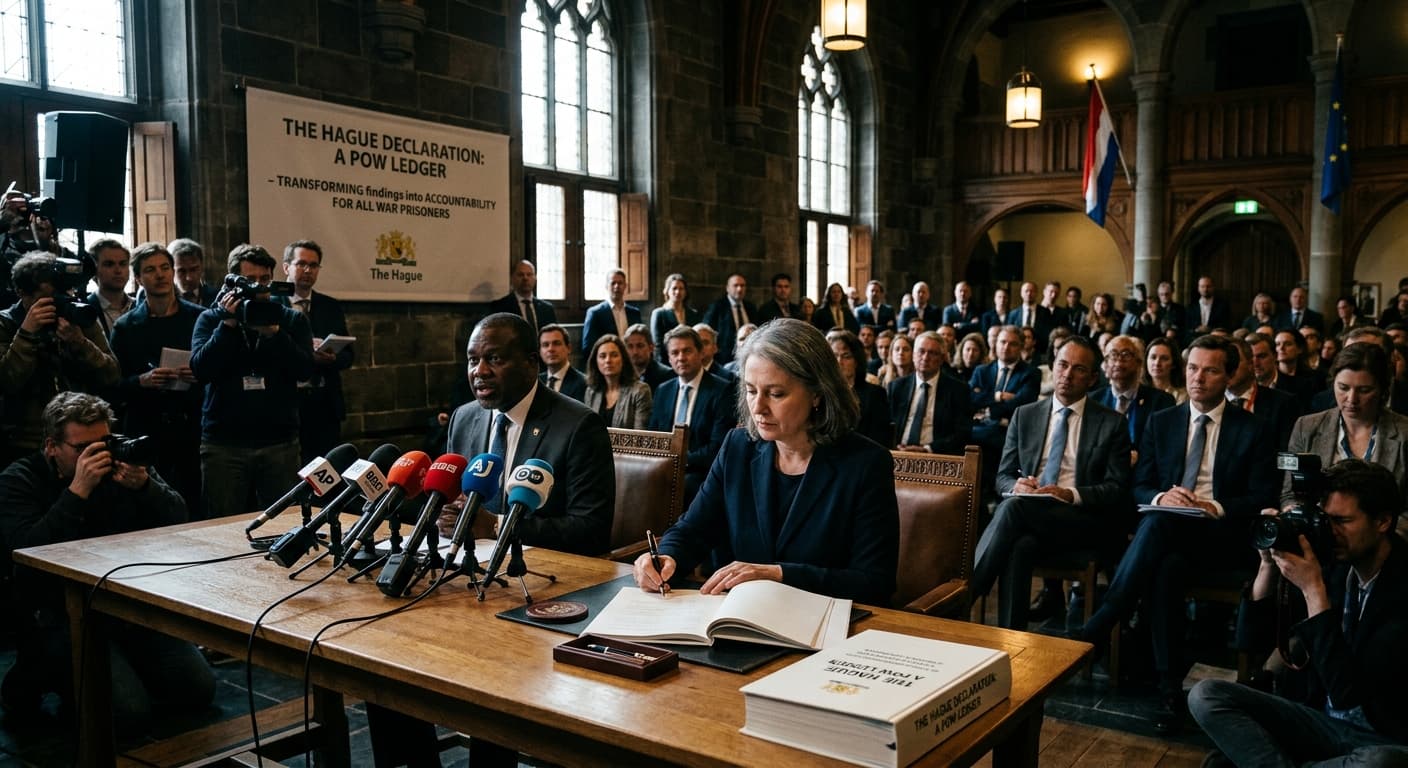
The Hague Declaration Turns Atrocity Findings into a POW Ledger
OSCE parliamentarians converted the UN's crime-against-humanity finding on deported Ukrainian children into a binding regional demand — and named three detained officials Moscow must release.
The OSCE Parliamentary Assembly adopted The Hague Declaration on July 8, 2026, converting a year of atrocity findings — most consequentially the UN's March 2026 conclusion that Russia's deportation of Ukrainian children constitutes a crime against humanity — into the Euro-Atlantic region's most detailed parliamentary ledger of the Ukraine war and demanding, by name, the release of three OSCE officials held by Russian-installed authorities. The document does not create new law. But it does something the OSCE's paralysed executive track cannot: it fuses treaty-body rulings, ICC warrants, and a Council of Europe reparations architecture into a single political instrument that 250 legislators from participating states put their signatures to. That is the shift worth reading: the Assembly is now the region's legitimising layer for accountability, because the Ministerial Council has ceased to function.
What the Declaration actually says
The text, adopted at the close of the 33rd Annual Session in The Hague under the theme "International Law and Shared Principles," runs across three chapters and a stack of stand-alone resolutions. The OSCE Parliamentary Assembly's own press release frames Russia's war of aggression as "a clear, gross and uncorrected violation of the Helsinki Final Act, the Charter of the United Nations and the fundamental principles of international law."
The operational core sits in a resolution titled "Crimes Against Humanity and War Crimes Committed by the Russian Federation: The Need to Release Prisoners of War and Civilian Detainees and to Ensure the Return of Ukrainian Children." According to the full text of the Declaration, parliamentarians:
"demanded that the Russian Federation immediately, completely and unconditionally ceases its war of aggression against Ukraine, withdraws all its forces and military personnel from the entire territory of Ukraine within its internationally recognized borders."
They also demanded the immediate release of three named detained OSCE officials — Vadym Golda, Maksym Petrov, and Dmytro Shabanov — abducted from the Special Monitoring Mission's Luhansk offices in 2022. Naming them is deliberate: it converts individual cases into a political precondition for any dialogue.
Three other resolutions carry weight the wire coverage largely missed. One targets Belarus specifically for "transnational repression." One documents "ongoing war crimes against media workers" during the Russian war of aggression. A third — politically the most sensitive — concerns "the situation of national minorities and indigenous peoples in the Russian Federation," a signal that the Assembly is willing to look inside Russia's federal system, not only at its border conduct.
Why the atrocity finding matters more than the resolution
The Declaration's political force borrows almost entirely from a document issued four months earlier in Geneva. On March 12, 2026, the UN Independent International Commission of Inquiry on Ukraine delivered a finding it had avoided for three years: that Russia's deportation and forcible transfer of Ukrainian children, and their enforced disappearance, amount to crimes against humanity under international law.
The Commission's conference-room paper, "I am still looking for my daughter", is unusually specific. It verified 1,205 individual cases from five oblasts. It found that four years on, 80% of documented children had not been returned. And it attributed the policy to "the highest level of the Russian Federation state apparatus" — language the ICC had used more cautiously in its 2023 arrest warrant for President Vladimir Putin and Children's Rights Commissioner Maria Lvova-Belova.
Kyiv's own registry, cited by Europol after an April 2026 investigative "hackathon" in The Hague, lists 19,546 children forcibly transferred; Yale's Humanitarian Research Lab, whose September 2025
report on Russia's re-education network mapped 210 facilities, estimates the true figure could reach 35,000. Around 2,000 have been returned. The gap between "verified" and "identified" numbers is what the OSCE resolution now demands be closed — with sanctions enforcement, third-country tracing, and a permanent return mechanism.
The treaty-body scaffolding parliamentarians are leaning on
The Declaration is not freelancing. It sits on top of the most consequential year of Ukraine-related treaty-body activity since 2022.
In July 2025, the European Court of Human Rights Grand Chamber issued judgment in the inter-state case Ukraine and the Netherlands v Russia, finding Russia responsible for a suite of violations including the organised removal of children, and ordering Moscow to cooperate in establishing a return mechanism — as Al Jazeera reported. Russia was expelled from the Council of Europe in 2022 and does not implement the court's judgments, but the ruling is now the anchor citation for every European sanctions package on child deportation.
In December 2025, European governments announced an international claims commission, layered on top of the Council of Europe's Register of Damage that had opened for filings in April 2024 and, per CSIS, is designed to route frozen Russian sovereign assets to Ukrainian victims. The EU's decision on December 12, 2025 to freeze Russian funds indefinitely,
reported by Al Jazeera, gives the commission something to distribute.
The Hague Declaration is the Assembly signing off on this architecture — and adding two political weight-bearing beams: sanctions on named perpetrators of transnational repression from Belarus, and an explicit call to preserve the ICC's jurisdiction at a moment when Hungary is withdrawing from the Rome Statute.
Who benefits — and where the leverage really sits
Read cynically, an OSCE Parliamentary Assembly declaration is a document with no enforcement power adopted by an organisation whose 2026 unified budget only passed after a five-year impasse, and even then at levels the Assembly itself called "insufficient." Russia and Belarus retain seats at OSCE ministerial meetings and block consensus routinely.
The beneficiaries of the Declaration are not, in the first instance, Ukrainian children. They are three institutional actors.
The first is the ICC. With Hungary's withdrawal moving forward and Washington's posture toward the court sharply cooler under President Trump, the ICC needs regional parliamentary bodies to launder its warrants into political consensus. The Hague Declaration does exactly that, referencing the deportation findings without needing US or Hungarian sign-off.
The second is Sviatlana Tsikhanouskaya's Belarusian democratic movement. The stand-alone resolution on Belarusian transnational repression, and a companion resolution on countering the "weaponization of INTERPOL," lands at a delicate moment: as the Carnegie Endowment noted in June 2026, Washington has been quietly negotiating prisoner releases with Minsk in exchange for selective sanctions relief. Kyiv sanctioned Alyaksandr Lukashenka on February 18, 2026 — Ukraine's
first personal sanctions on the Belarusian leader, according to Poland's OSW. The Assembly's language reinforces the European position that Belarus cannot be un-isolated through the back door.
The third is Ukraine's negotiating position in any future settlement. Kyiv has stated publicly that the return of children must be part of any peace deal. In June 2025 talks, Ukrainian diplomats handed Russian counterparts a list of 339 named children; Lvova-Belova responded that Russia would "work thoroughly on each child" but denied the wider figures. The Hague Declaration hardens the parliamentary floor beneath Kyiv's demand: no OSCE-region legislature can now credibly endorse a deal that treats deported children as a bargaining chip against sanctions relief.
The losers are narrower but real. Any European government considering unilateral engagement with Minsk — and, further out, with Moscow — must now do so against a document its own parliamentarians signed. Hungary, whose parliament triggered ICC withdrawal in May 2025, is the outlier the Declaration is written against.
The counter-view
The obvious criticism is that resolutions of this sort are performative. Russia has ignored every previous OSCE PA declaration since Vilnius 2009. The Bucharest Declaration of July 2024 and the
Porto Declaration of July 2025 contained substantially similar language on Ukrainian children, prisoners of war and Belarus. The war continued; the children did not come home.
The rejoinder is that these documents function cumulatively, not individually. They build the evidentiary and political record on which the eventual reparations commission — and, in the longer term, any successor tribunal — will draw. When Freedom House's 2026 transnational repression report, Collaboration and Resistance, documents 11 discrete incidents of Interpol abuse by authoritarian states in 2025, the Hague Declaration's INTERPOL resolution stops being a talking point and starts being usable in national legislation.
What to watch
- September–October 2026: The UN Commission of Inquiry on Ukraine delivers its next oral update and General Assembly report. Any expansion of the "highest level" attribution beyond Putin and Lvova-Belova would give the ICC prosecutor grounds for further warrants.
- November 2026: The 2026 OSCE Ministerial Council. Watch whether Russia and Belarus block the Assembly's recommendations from becoming formal OSCE positions, and whether the Ministerial adopts even a chair's statement on children.
- December 2026: EU deadline to convert its indefinite freeze on Russian sovereign assets into a mechanism that funds the European Reparations Commission. The Hague Declaration's endorsement gives that legally contested step political cover.
- Ongoing: The three named OSCE officials — Golda, Petrov, and Shabanov. Their release, or their continued detention, is now the test the Declaration set for itself.
The Bottom Line
The Hague Declaration matters not because 250 parliamentarians condemned Russia — they have done that annually since 2022 — but because it is the first OSCE-region document to knit the UN's crimes-against-humanity finding, the ECtHR's inter-state judgment, the Council of Europe's reparations architecture, and the ICC's warrants into a single political demand with named victims and named perpetrators. That makes it the reference text any future peace settlement will have to survive.
Discover more
US Politics
Congress Targets AI Chatbot Access for Terror
The House passed the Generative AI Terrorism Risk Assessment Act, focusing on AI's role in terrorism and potential surveillance implications.
US Politics
SNAP Food Assistance Faces Legal Challenges
In 2026, SNAP faces stricter eligibility rules and mounting legal challenges, threatening food assistance for the millions of Americans who rely on the program.
US Politics
House Ethics Committee Pushes Sexual Miscond.
The House Ethics Committee has shifted responsibility for sexual harassment settlement records to the Office of Congressional Workplace Rights, complicating disclosure efforts.

Conflict & Security
Drone Warfare Killing Aid Workers at Unprec
Over 1,000 humanitarian workers killed in three years as cheap armed drones collapse legal protections. Gaza, Sudan, Ukraine, and DRC see deliberate targeting of aid convoys and hospitals with zero prosecutions.