Chad's Triple Stress Test: Refugees, Drones
Chad faces a crisis with refugees, jihadist drones, and foreign influence.
Model Diplomat3 min readafrica
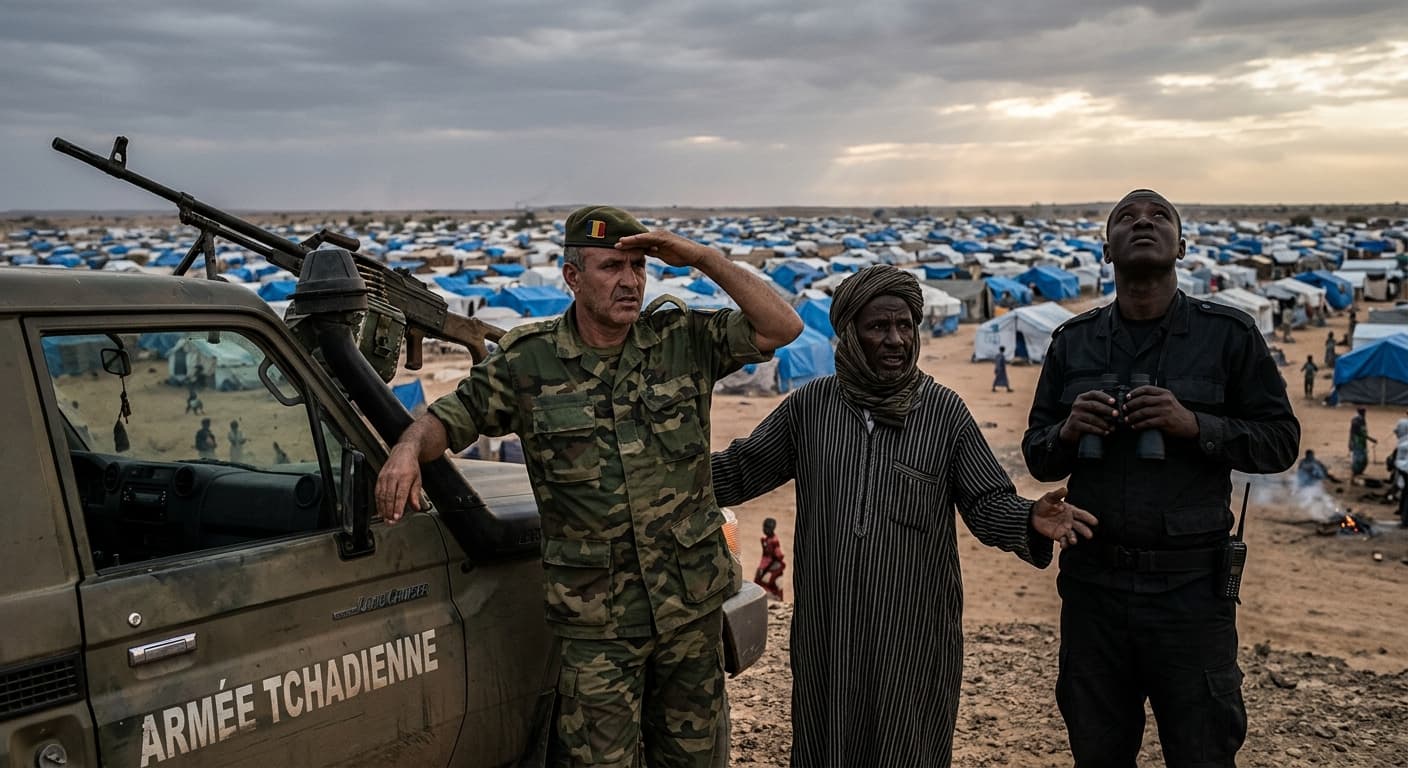
Chad's Triple Stress Test — Refugees, Jihadist Drones, and a Kremlin Courtship
One million Sudanese refugees, drone-armed insurgents, and Moscow's push into the Sahel are converging on N'Djamena just as French troops have left. The Deby regime is improvising.
Chad is absorbing pressure on three fronts simultaneously — and the convergence is testing a regime that has just lost its French military backstop after six decades. The Konrad-Adenauer-Stiftung (KAS) country report, authored by Sahel program head Ulf Laessing, frames the moment as a make-or-break stress test for President Mahamat Idriss Déby Itno, whose hold on power is being squeezed between a spiraling refugee crisis, a technologically escalating jihadist insurgency, and an internal elite split over which foreign patrons to trust KAS.
The numbers tell the story. More than one million Sudanese have crossed into eastern Chad since the civil war erupted in April 2023, with tens of thousands waiting to enter as the RSF consolidates control over Darfur. Chad closed its eastern border in February 2026 after fighting spilled across and killed five Chadian soldiers, then ordered a "total closure" in March after a drone strike on mourners in the border town of Tiné killed 17 civilians BBC. President Déby ordered the military to retaliate against any further attacks "starting from tonight" — a near-declaration of war that has not been tested since, but remains in effect
Al Jazeera.
The Lake Chad drone escalation
The jihadist threat is no longer the ragged insurgency of a decade ago. ISWAP has carried out at least 10 drone strikes across the Lake Chad basin since 2024, including in southern Chad, while its rival Boko Haram faction killed 23 Chadian soldiers in a May 2026 assault on Barka Tolorom island Al Jazeera. The BBC reports that jihadist groups across the Sahel have now deployed over 90 drone strikes collectively, with JNIM alone responsible for 69 in Mali and Burkina Faso
BBC. This is a qualitative shift: first-person-view (FPV) drones, the same technology reshaping warfare in Ukraine, are now dropping improvised explosives on Chadian military positions.
The KAS report flags this drone capability as a particular concern for Chad because it compounds the state's chronic weakness in border control. The country's 1,400 km frontier with Sudan is porous; its Lake Chad islands provide sanctuary to militants who can now strike from stand-off distances. Chad's armed forces, trained largely by French advisers who have now departed, lack counter-drone systems.
The Russia question and the elite split
This is where the stress test becomes existential. France completed its military withdrawal by the January 31, 2026 deadline, pulling 1,000 troops from bases in Faya-Largeau, Abéché, and N'Djamena Al Jazeera. The departure ended France's last military foothold in the Sahel — Mali, Burkina Faso, and Niger had already forced French withdrawals and pivoted to Russian security partnerships.
Russia is now courting Chad with the same playbook. President Déby visited Putin in the Kremlin in January 2025; Foreign Minister Lavrov reciprocated with a visit to N'Djamena in June. A Russian cultural center has opened in the capital, mirroring Moscow's soft-power entry point in other Sahel states BBC. But the KAS analysis notes that Déby's camp is divided: one faction favors deeper engagement with Moscow and Belarus (Chad signed a military cooperation memorandum with Minsk in January 2026), while another sees Russia as a useful bargaining chip to extract better terms from Paris and Washington, not a replacement.
Macron's invitation to Déby to visit Paris — delivered by France's ambassador in late January 2026 — signals that France is not ready to walk away entirely BBC. But the leverage has shifted. Déby knows that Russia's Africa Corps operates in Libya, CAR, and Sudan — countries ringing Chad's entire perimeter — and that Moscow does not lecture clients about democratic legitimacy.
What to watch next
Three decision points will shape Chad's trajectory. First, whether Déby accepts Macron's invitation to Paris and what he extracts: renewed intelligence-sharing without basing rights would be Paris's floor. Second, whether the RSF consolidates control of the Chad-Sudan border and tests Déby's March retaliation order — a second cross-border drone strike would force N'Djamena's hand. Third, whether Russia converts cultural diplomacy into a formal military accord before the end of 2026. Chad's neighbors all host Russian paramilitaries; the question is less whether Moscow will gain a foothold than what price Déby extracts for it.
Discover more

India
Women’s Reservation in India
India's 33% women's reservation law is enacted but won't take effect until after 2029 due to political setbacks and census delays.

US Politics
White House Pressures Congress for Crypto Leg
The Trump administration's push for the CLARITY Act aims to reshape crypto regulation, impacting trillions in market value and the Trump family's wealth.
Global Politics
Xi Jinping Calls China-Russia Ties 'Precious'
Xi Jinping's description of China-Russia ties as 'precious' reflects a strategic imbalance, with Beijing dictating terms in the partnership.

Conflict & Security
Drone Warfare Killing Aid Workers at Unprec
Over 1,000 humanitarian workers killed in three years as cheap armed drones collapse legal protections. Gaza, Sudan, Ukraine, and DRC see deliberate targeting of aid convoys and hospitals with zero prosecutions.