Taiwan's Plan for Asia's Nasdaq in AI
Taiwan aims to become a tech-financing hub amid geopolitical tensions.
Model Diplomat8 min readAsia
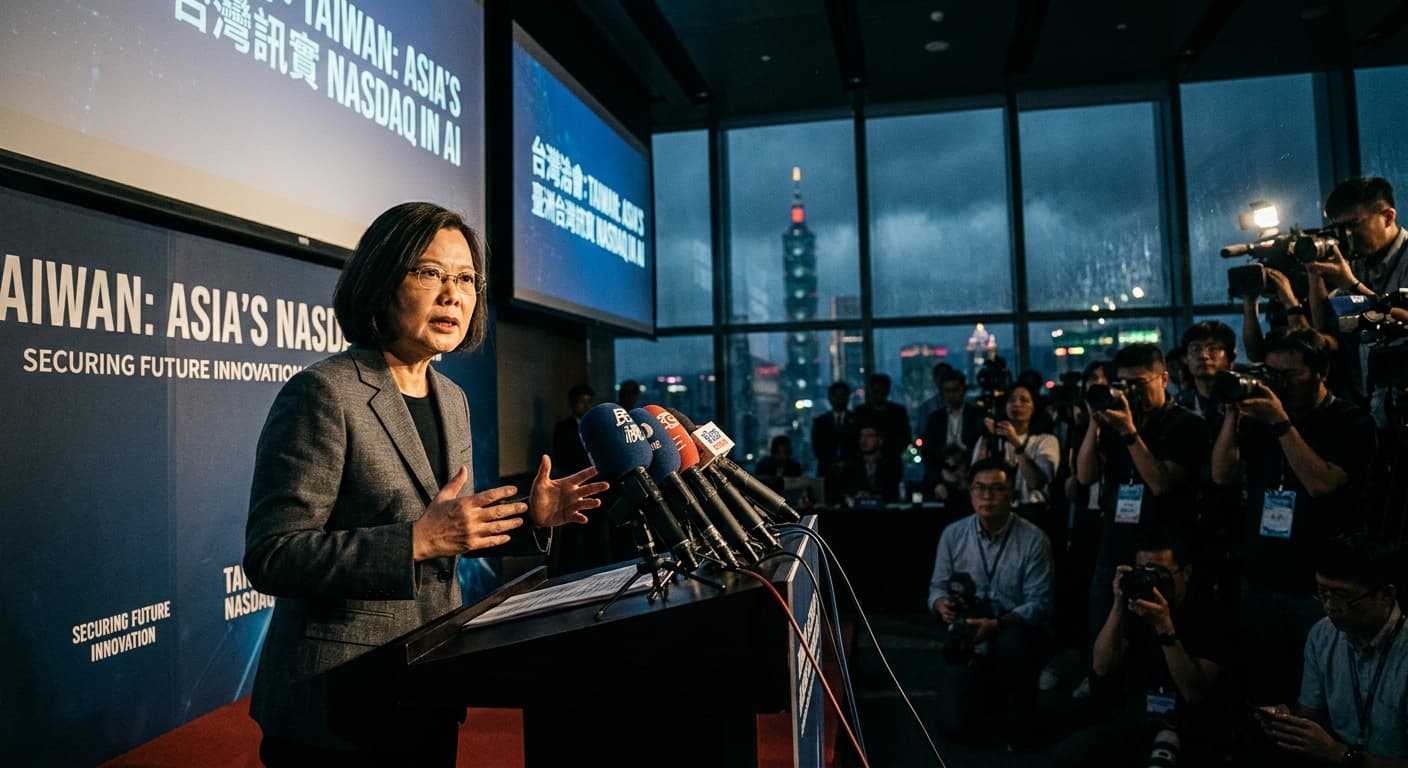
Taiwan bets on "Asia's Nasdaq" to anchor AI supply chain against Beijing
Lai Ching-te's July 7 plan to build Taiwan into Asia's tech-financing hub — NT$150bn/year via the Innovation Board — is a capital-market answer to cross-Strait pressure and US decoupling.
Taiwanese President Lai Ching-te on July 7, 2026, told the island's venture capital and private equity industry that Taipei will build a new equity-capital platform targeting NT$150 billion (about $4.7 billion) in annual fundraising by 2028 — his most concrete step yet to convert Taiwan's chokehold on advanced chips into a durable financial hub, and to make sure the next generation of AI-linked companies list, price and raise capital in Taipei rather than Hong Kong, Shanghai or New York. The pitch — "Asia's Nasdaq" — is not branding. It is a flanking maneuver: while Washington reshapes where chips are made, Lai is reshaping where the AI supply chain is funded, with the specific aim of denying Beijing and its offshore capital hub in Hong Kong any intermediary role in the value chain that runs through Hsinchu.
Speaking at the 2026 Taiwan Venture Capital and Private Equity Annual Meeting, Lai said the government would "turn Taiwan from a tech manufacturing center into a tech fundraising center," anchored by the semiconductor and AI industries, according to Taiwan's Central News Agency. He echoed the line in a June 5 television interview, telling reporters Taiwan "must walk the Asia's Nasdaq road," per the
Commercial Times. The vehicle is the Taiwan Innovation Board (TIB-創), already designated as the tenth pillar of the Executive Yuan's "AI New Ten Major Constructions." According to
SETN, the TIB's stated fundraising target is NT$150 billion per year by 2028.
The thesis: capital as the next battlefield
Lai's move is best understood as a response to a specific vulnerability. Taiwan's economy has become an AI-shaped monolith: Al Jazeera reports GDP grew 8.63% in 2025 and 13.69% in Q1 2026, exports hit $640.7 billion, and TSMC alone accounts for more than 40% of the value of the entire Taiwan Stock Exchange. The
HSBC-tracked bourse doubled to $2.2 trillion between 2019 and 2025. But this concentration cuts both ways. Taiwan makes the chips; other people's stock exchanges monetize the ecosystem around them. That gap is what Lai wants to close.
The plan has three moving parts, laid out in a June 24 speech to the 2026 Taiwan Capital Market Forum and posted on the Presidential Office site: an Asia Innovation Capital platform to keep unicorns on the island, continued financial-market opening tied to international standards, and directed investment into "future industries" — AI, biotech and defense. The president's office confirms the Financial Supervisory Commission launched the Asia Innovation Capital Platform initiative in October 2025 to loosen listing rules for early-stage firms and provide staged financing all the way to maturity. Total banking, insurance and securities assets have already surpassed NT$130 trillion, up nearly 70% in a decade, according to Lai's
2026 New Year's Address.
Who Lai is competing with — and why he can win only some of the fights
The regional league table is unforgiving. Financial Times data show Hong Kong logged 208 listing applications in the first half of 2025 and raised $13.9 billion, beating Nasdaq's $9.2 billion and the NYSE's $7.8 billion. Chinese battery giant CATL alone raised billions in a Hong Kong secondary listing in May 2025. Hong Kong's edge is structural: it is the only realistic offshore venue for mainland Chinese tech firms in a US-China cold war, and Chinese authorities are actively steering them there under the 15th Five-Year Plan, as the
BBC reported in June 2026. Singapore, by contrast, scraped 16 IPOs in 2025 and is spending S$6.5 billion of state money just to defend its stock market, per the
Financial Times. Shanghai's STAR Market, once billed as China's own Nasdaq analog, saw H1 2025 mainland fundraising fall 5% to Rmb53.7 billion, according to KPMG data cited by the FT.
Where Taiwan has a natural moat is exactly where Hong Kong does not: AI hardware. Taiwan produces roughly 90% of the world's most advanced chips and 90% of AI servers, according to Foreign Minister Lin Chia-lung in Foreign Affairs. That is the "brand," in Lai's own phrasing to the
Economic Daily News: "If Taiwan wants to be Asia's Nasdaq — more competitive than Korea, Japan, Singapore, China, Hong Kong — our brand is the most complete AI industry chain." A listing regime built around silicon photonics, robotics designers, chip-IP houses and AI infrastructure firms is a category Hong Kong cannot credibly own without physical exposure to the Taiwan supply base.
Why Beijing's pressure is accelerating the plan, not derailing it
Lai's timing is not coincidence. On December 30–31, 2025, the People's Liberation Army conducted large-scale blockade drills around Taiwan, prompting a rare rebuke from the US State Department that Beijing was engaging in "unnecessary" escalation, according to Al Jazeera. Two further "joint combat readiness patrols" followed in May 2026 after a Trump-Xi summit in Beijing, with 29 PLA aircraft and seven warships detected in one day, per
Al Jazeera's May 26 report. Premier Cho Jung-tai on July 7 flatly told a Taipei cybersecurity conference that Taiwan sits "on the front line of geopolitics," according to
CTS/CNA, citing the recent violent attack on a foreign national in Taipei as evidence that hybrid threats are no longer confined to networks.
That geopolitical noise is precisely the problem the Innovation Board is designed to counter. Every high-growth firm that leaves Taiwan for Hong Kong or New York exposes the supply chain to political and regulatory risk that Taipei cannot control. Every unicorn that stays and lists onshore deepens the "silicon shield" — the doctrine that Taiwan's indispensability to global tech raises the cost of any Chinese coercive move. Ryan Hass of Brookings has written that Lai's grand strategy explicitly links economic diversification to deterrence; the capital-market piece is the missing rail.
The vulnerability the plan does not solve is concentration. TSMC by itself represents more than 40% of TWSE market cap, and the Fubon FTSE TWSE Taiwan 50 ETF weights the chipmaker at nearly 50%, according to the Financial Times. Central Bank Governor Yang Chin-lung has publicly warned of a "K-shaped" economy in which tech captures capital and talent while traditional exporters suffer under Trump-era tariffs, as
Al Jazeera documented. Natixis chief Asia-Pacific economist Alicia Garcia Herrero has called it a "dual society" risk. A funding hub anchored on TSMC and its constellation could deepen that problem before it broadens the base.
The Washington complication
Lai must also thread a US needle. The US-Taiwan Reciprocal Trade Agreement, analyzed by the Council on Foreign Relations, commits Taiwanese firms to $250 billion in US semiconductor investment plus $250 billion in credit guarantees to route capital toward American fabs. TSMC alone lifted its Arizona commitment to $165 billion and now plans up to 12 US fabs. Commerce Secretary Howard Lutnick has stated the aim of shifting 40% of Taiwan's chip supply chain to the United States. If half of Taiwan's premier tech firms are relocating their next dollar of capex to Arizona, Ohio and Texas, why would their next equity-raise stay in Taipei?
Lai's implicit answer, delivered in his AmCham Taiwan speech on March 26, 2026, is that Taiwan and the US signed the "Pax Silica Declaration" as an economic-security co-production framework — meaning capital raised on the TIB can co-fund the American build-out rather than substitute for it. That is a bet that Trump's team will tolerate a Taipei financial hub as long as manufacturing continues to migrate. It is not obvious the bet holds. The CFR's read is that the deal "is unlikely to resolve" the deeper argument over how much of the chain must be reshored.
What comes next
The concrete catalysts are dated and short-fuse:
- Q3 2026: TIB-創 launch expansion. The Taiwan Stock Exchange has publicly committed to accelerating the Taiwan Innovation Board's expansion in 2026 as the tenth pillar of the AI New Ten Major Constructions, per
Economic Daily News. Watch first-batch issuers — a marquee AI-server or silicon-photonics listing would validate the "Asia's Nasdaq" pitch; a weak first cohort would confirm skeptics.
- November 2026: Taiwan local elections. The DPP's performance in mid-term local races determines whether the KMT-controlled Legislative Yuan continues to block Lai's special defense and industrial budgets. A weak result kneecaps the capital-market reforms that need legislative sign-off.
- First-half 2027: FSC listing-rule package. The Financial Supervisory Commission's "regulatory de-shackling" tranche under the Asia Innovation Capital Platform — foreign-issuer rules, dual-class shares, cross-listing — is due for finalization. This is the technical make-or-break.
- 2028: NT$150bn target year. The stated fundraising milestone for TIB coincides with Taiwan's next presidential race. Miss the number and the platform becomes a partisan liability.
Diplomat View
The likely outcome, on evidence, is a partial win. Taiwan will succeed in listing more mid-sized AI-adjacent firms onshore — silicon-photonics designers, AI-server assemblers, robotics IP — and will pull some Southeast Asian tech issuers who fear both mainland Chinese exposure and US delisting risk. That is enough to justify the "Asia's Nasdaq" tagline for domestic political purposes and to reinforce the silicon shield. What Lai will not do is dislodge Hong Kong as the primary offshore listing venue for Chinese tech, because HKEX's edge is political architecture, not product design. The forecast changes if two conditions revise. First, a serious PLA action against Taiwanese shipping or grey-zone infrastructure would collapse the risk-premium argument overnight and push issuers to Singapore or Tokyo, not Taipei. Second, if the Trump administration reads the Innovation Board as capital being retained in Taiwan rather than deployed to Arizona, tariff pressure or investment-screening retaliation becomes plausible by mid-2027. Neither risk is priced into the current TIB roadmap. Watch the first foreign issuer that files, and watch what the Commerce Department says the day it does.
The Bottom Line
Lai Ching-te's "Asia's Nasdaq" is not a stock-exchange rebrand — it is a capital-market containment strategy, designed to make Taiwan indispensable not just to the manufacture of AI hardware but to its financing, so that Beijing and Hong Kong cannot intermediate the value chain that runs through Hsinchu. The plan is coherent, the timing is forced by PLA pressure and US reshoring demands, and the ceiling is set by Taiwan's own concentration in a single company. If the Innovation Board raises anything close to NT$150 billion a year by 2028, the silicon shield gains a financial layer; if it does not, Taipei will have advertised a hub it cannot deliver, in a neighborhood where Hong Kong is already winning the listings race.
Discover more

US Politics
US Launches $166B Tariff Refund Portal
The US is launching a $166 billion tariff refund portal to aid importers hit by Trump-era tariffs, with major implications for trade and supply costs.
Global Politics
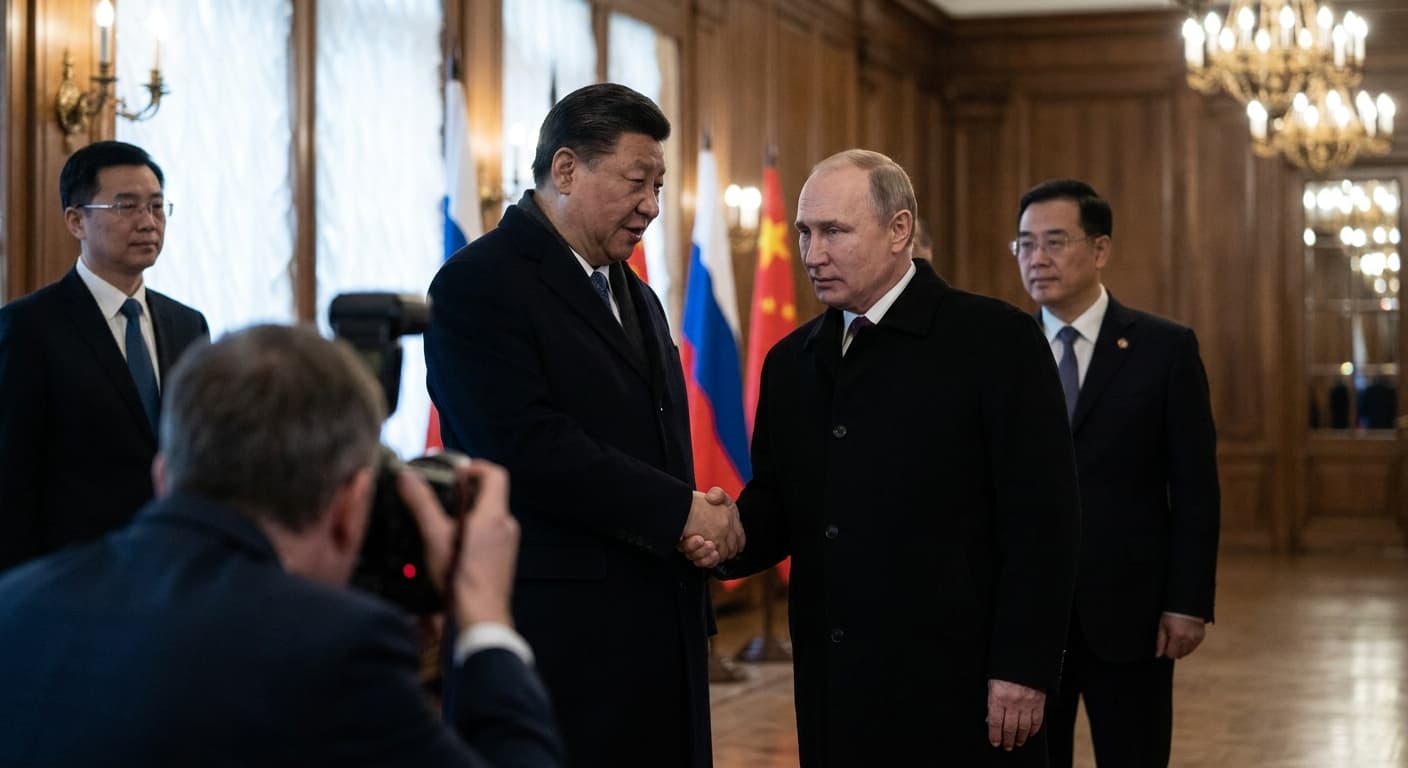
Xi Jinping Calls China-Russia Ties 'Precious'
Xi Jinping's description of China-Russia ties as 'precious' reflects a strategic imbalance, with Beijing dictating terms in the partnership.
US Politics
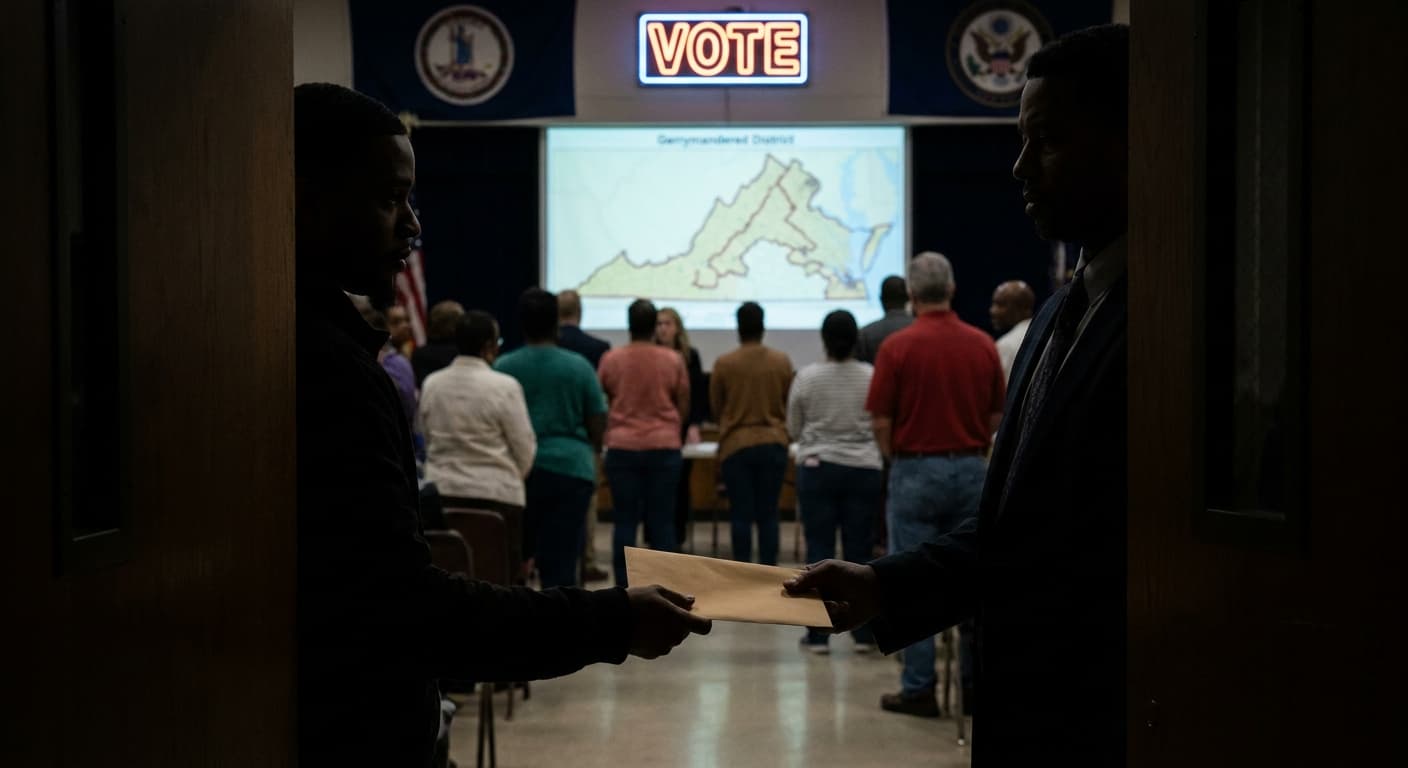
Virginia's Redistricting Referendum
Virginia's redistricting referendum is drawing a flood of dark money, shaping future elections and the fight for congressional control amid party stakes.

Economics
Fed's Amex AML order puts correspondent banking on notice
Federal Reserve's Amex AML order requires board-level controls and a 90-day plan; OCC fined the bank $350 million over enterprise-wide deficiencies.