Taiwan's Nvidia Smuggling Probe and AI Ex
Taiwan prosecutes Nvidia smuggling under forgery laws.
Model Diplomat7 min readAsia
Taiwan's Nvidia smuggling probe forces the AI export-control reckoning
Taipei is prosecuting an alleged Nvidia AI-server diversion to China using forgery statutes — because it has no law against the smuggling itself. That gap is now the story.
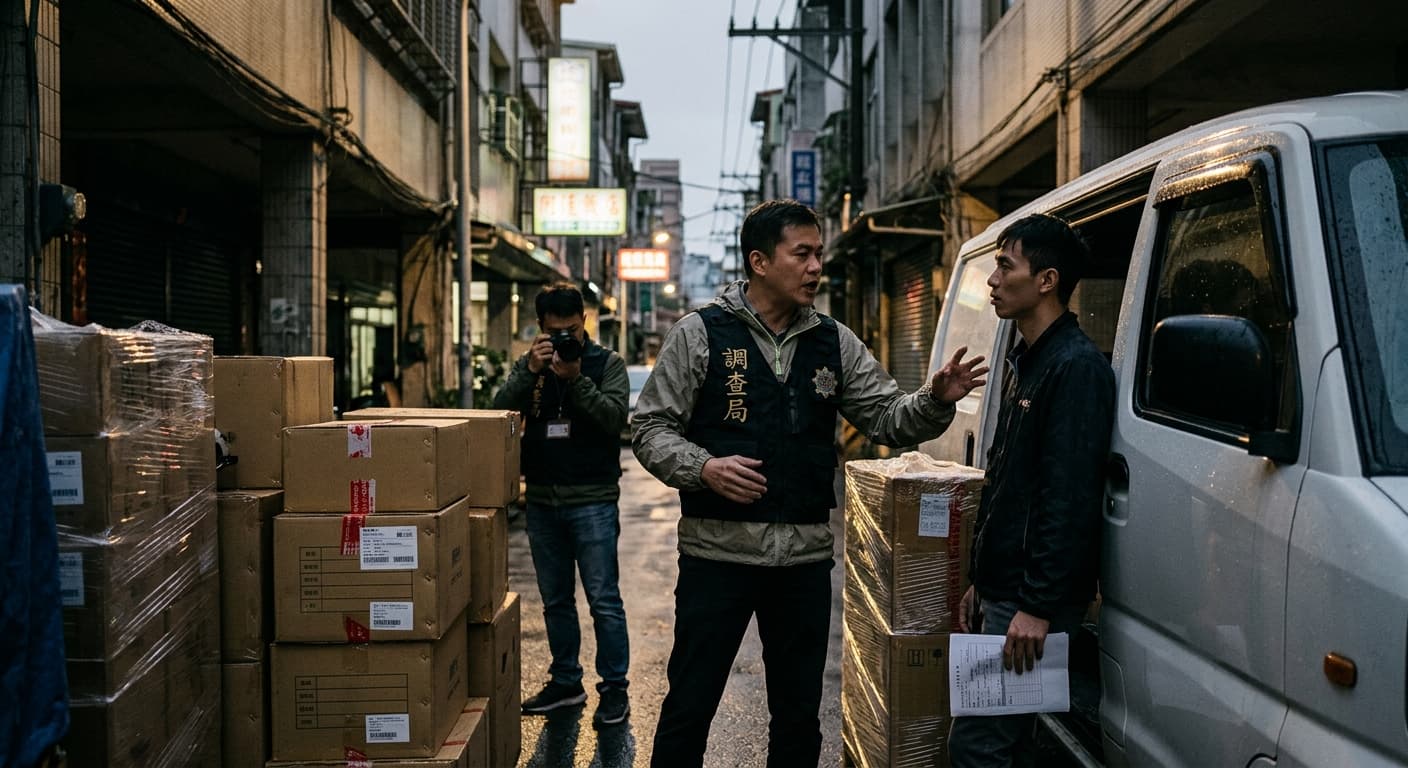
Taiwan's Keelung District Prosecutors Office widened its investigation into the alleged smuggling of Supermicro AI servers containing Nvidia GB300 chips to China on June 29, 2026, raiding 12 locations including Super Micro Computer's Taiwan office, data-centre operator Chief Telecom and distributor Albatron Technology, and detained two Supermicro employees on July 2. The load-bearing fact is not the raid — it is the charge sheet. Taiwanese prosecutors are relying on document forgery and breach of trust under the Criminal Code because exporting AI chips to China is not, in itself, a crime in Taiwan. That is the hole US and Taiwanese enforcers have spent 2026 trying to close, and this case is the pressure test that will decide whether Taipei writes the AI-diffusion regime into statute — or leaves Washington to enforce it extraterritorially through the Bureau of Industry and Security.
What the June 29 raids actually uncovered
The Keelung prosecutors' account, reported by The Online Citizen, is unusually detailed. Investigators from the Ministry of Justice Investigation Bureau's Taipei Field Office, the Coast Guard Administration's Keelung unit and Keelung police searched the homes of six new suspects — surnamed Wang and others — after an initial 20 May sweep that produced three earlier detentions of suspects surnamed You. Prosecutors said they suspect the group shipped at least one batch of Nvidia servers to China via Japan and attempted to move about 50 more before authorities intercepted them at port.
The Financial Times reported that Supermicro shares fell about 8% on news of the raids. Super Micro said in a statement that it is "cooperating with law enforcement and government officials in Taiwan and other jurisdictions" and that its "products continue to be targeted in these matters." Reuters,
via WHTC, confirmed on July 2 that two Taiwan-unit workers were held pending a court hearing and two others released on bail.
The tell is the choice of targets: Chief Telecom is a colocation and data-centre operator, not a chip broker. Its inclusion signals prosecutors believe the route ran through a domestic staging site — servers commissioned as if for local hosting, then re-exported. That is the same architecture US prosecutors described in the March 2026 indictment of Supermicro co-founder Yih-Shyan "Wally" Liaw and two associates, in which Al Jazeera reported that an unnamed Southeast Asian "Company-1" bought roughly $2.5 billion in Nvidia-equipped equipment, repackaged it in unmarked boxes, and used thousands of dummy servers — with labels transferred by hair-dryer — to slip past compliance audits.
The law Taipei does not yet have
Taiwan runs export controls through the Strategic High-Tech Commodities (SHTC) list, authorised under Article 13 of the Foreign Trade Act. The Institute for National Defense and Security Research notes that the Ministry of Economic Affairs added 601 entities — including Huawei and SMIC — to that list on June 10, 2025, forcing Taiwanese exporters to obtain prior approval for shipments of advanced semiconductor equipment. But the SHTC regime was written for wafers, lithography tools and dual-use components; it does not clearly cover assembled AI servers built abroad and re-exported from Taiwan.
That is why prosecutors are reaching for the Criminal Code. The Online Citizen's reporting makes the gap explicit: "Taiwan currently does not classify exports of AI chips to China as a criminal offence. Instead, authorities have relied on existing provisions covering offences such as document forgery and breach of trust." A Congressional Research Service report, U.S. Export Controls and China: Advanced Semiconductors, authored by Karen M. Sutter, confirms that BIS has been quietly coordinating licensing enforcement with Taiwan — but the underlying deterrent, criminal liability for the diversion itself, has been a US Export Control Reform Act matter, not a Taiwanese one.
Taipei is now drafting legislation to close that gap. The proposed changes, according to prosecutors' briefings summarised in the Online Citizen account, would criminalise unauthorised export of restricted AI technology and align Taiwan's regime with US Entity List enforcement. That is a material sovereignty concession: Taiwan would be codifying US export policy into ROC criminal law, in exchange for enforcement leverage its prosecutors currently lack.
The number that makes the regulation stick
The scale of the diversion problem is the load-bearing evidence for the legal change. A June 2025 CNAS report modelled total Nvidia AI-chip smuggling to the PRC in 2024 at a median of around 140,000 units — between 1% and 30% of China's inference compute capacity, and between 1% and 40% of its training compute. That is not a marginal leak. That is a parallel supply chain.
The Taiwan case matters because the island is the physical chokepoint. TSMC fabricates the wafers; Supermicro, Foxconn and Quanta assemble the servers; Keelung and Kaohsiung ports handle the outbound freight. Every credible smuggling architecture reported to date — from the ALX Solutions case that shipped Nvidia H100 GPUs through Malaysia and Singapore, to the Singapore prosecution that saw police
seize a $42.5 million mansion allegedly bought with smuggling proceeds — has passed either the Taiwanese assembly or the Southeast Asian trans-shipment leg. RAND analysts have documented that Chinese firms are willing to
pay up to double the market price for banned Nvidia hardware, with ByteDance, Alibaba and Tencent reportedly spending $16 billion to stockpile roughly 1.3–1.6 million H20 units before the April 2025 US ban.
Who benefits — and who is quietly relieved
The counter-intuitive beneficiary of this probe is Nvidia. The company has repeatedly told regulators, most recently in Al Jazeera's reporting on the June 1 BIS clarification, that its "sales and vetting process is correct — consistent with our existing approach, licences are required to ship controlled products to PRC-headquartered companies." A Taiwanese prosecution that pins liability on Supermicro's distribution chain and a data-centre operator, not on Nvidia's licensing regime, protects the chipmaker's position that diversion happens downstream — even as Chinese state media raises H20 backdoor concerns designed to force Beijing's tech giants toward Huawei's Ascend line.
The loser is Supermicro. Its stock dropped 33% after Liaw was charged in March; a second Taiwanese criminal investigation compounds the compliance overhang. Two US-listed Supermicro affiliates in Taiwan and the Singapore parallel case involving
Dell, Supermicro and Asus servers suggest a systemic distribution problem — one that BIS's Foundry Due Diligence Rule,
analysed by CSIS, is designed to close but which relies on Taiwanese fabs and OSATs doing know-your-customer work that current statute does not compel.
The quieter beneficiary is Huawei. Every headline about smuggled Blackwell-class servers reinforces Beijing's argument, articulated in CSIS's April 2026 assessment, that reliance on Nvidia is a strategic vulnerability. In January 2026, Chinese customs officials told brokers that H200 chips were "not permitted" to enter China despite BIS export licences. Beijing is treating Nvidia dependency as the risk — not the prize. Huawei's
CloudMatrix 384 system, which SemiAnalysis judged to outperform Nvidia's GB200 NVL72 on compute, memory bandwidth and networking, is the industrial-policy answer.
Diplomat View
The Taiwan probe is not really about 50 servers. It is about whether Taipei accepts becoming the enforcement arm of US AI-diffusion policy or continues to prosecute diversion as ordinary white-collar crime. Our call: the amendment to criminalise AI-hardware diversion passes the Legislative Yuan before year-end, driven by three converging pressures — US congressional scrutiny of BIS licensing of the H200 and Nvidia's B30A chip, the reputational damage to TSMC from the Huawei-diversion investigation flagged by Reuters, and Taipei's own strategic interest in demonstrating alignment with Washington ahead of any second-term Trump-Xi bargain over Blackwell exports. What would falsify this call: a KMT-led legislative bloc using the amendment to force reciprocal SHTC restraint from the executive, or a US decision — telegraphed by the CNAS-documented 25% H200 tariff arrangement — to simply monetise diffusion rather than block it. If Washington sells the frontier, Taipei has less reason to criminalise the smuggling.
The second-order signal to watch is procedural. Prosecutors chose Keelung, not Taipei, as the venue. Keelung is the port. That framing — smuggling as a customs offence rather than a national-security one — gives the government room to prosecute without formally politicising TSMC, Supermicro or Nvidia. It also constrains how far the case can go. A national-security framing would demand indictments against corporate officers; a customs framing lets the case end with mid-level sales staff and forged bills of lading. Which framing survives the amendment will tell you whether Taipei is serious.
What to watch next
- Q3 2026 Legislative Yuan session: first reading of the Foreign Trade Act amendment that would criminalise unauthorised AI-hardware exports; the sponsor list will reveal cross-party appetite.
- Keelung District Court bail hearings, mid-July 2026: the two detained Supermicro Taiwan employees face the first substantive judicial test of the forgery-and-breach-of-trust theory.
- BIS Entity List updates, autumn 2026: whether Washington adds Chief Telecom, Albatron or any Taiwanese distributor named in the probe will signal how deeply US enforcers judge the diversion network penetrates the Taiwan supply base.
- US v. Liaw, SDNY: the Manhattan trial of the Supermicro co-founder will produce discovery on "Company-1" — the Southeast Asian pass-through — that Taiwanese prosecutors will need to complete their own map.
The Bottom Line
Taiwan's Nvidia smuggling probe is the moment the island's export-control regime gets written into criminal law — because forgery statutes were never designed to police a $2.5 billion parallel AI supply chain. The story is not the raid; it is that Taipei is preparing to codify US AI-diffusion policy as Republic of China criminal code, and that Huawei, not Nvidia, is the quiet beneficiary of every headline about diverted Blackwell servers.
Discover more
India
Rajnath Singh's Durga Squad for 2026 Polls
Rajnath Singh's Durga Squad promised women's safety in Bengal but has since disappeared from the agenda, revealing BJP's true priorities.
US Politics
House Ethics Committee Pushes Sexual Miscond.
The House Ethics Committee has shifted responsibility for sexual harassment settlement records to the Office of Congressional Workplace Rights, complicating disclosure efforts.
India
700 Activists Accuse PM Modi of MCC Breach
Over 700 activists allege PM Modi breached election code with a televised address attacking opposition parties just before state elections.

Economics
Fed's Amex AML order puts correspondent banking on notice
Federal Reserve's Amex AML order requires board-level controls and a 90-day plan; OCC fined the bank $350 million over enterprise-wide deficiencies.