Taiwan's Armored Drill Targets Decapitation
Taiwan's 202nd MP Command rehearses decentralized capital defense against PLA decapitation.
Model Diplomat10 min readEast Asia
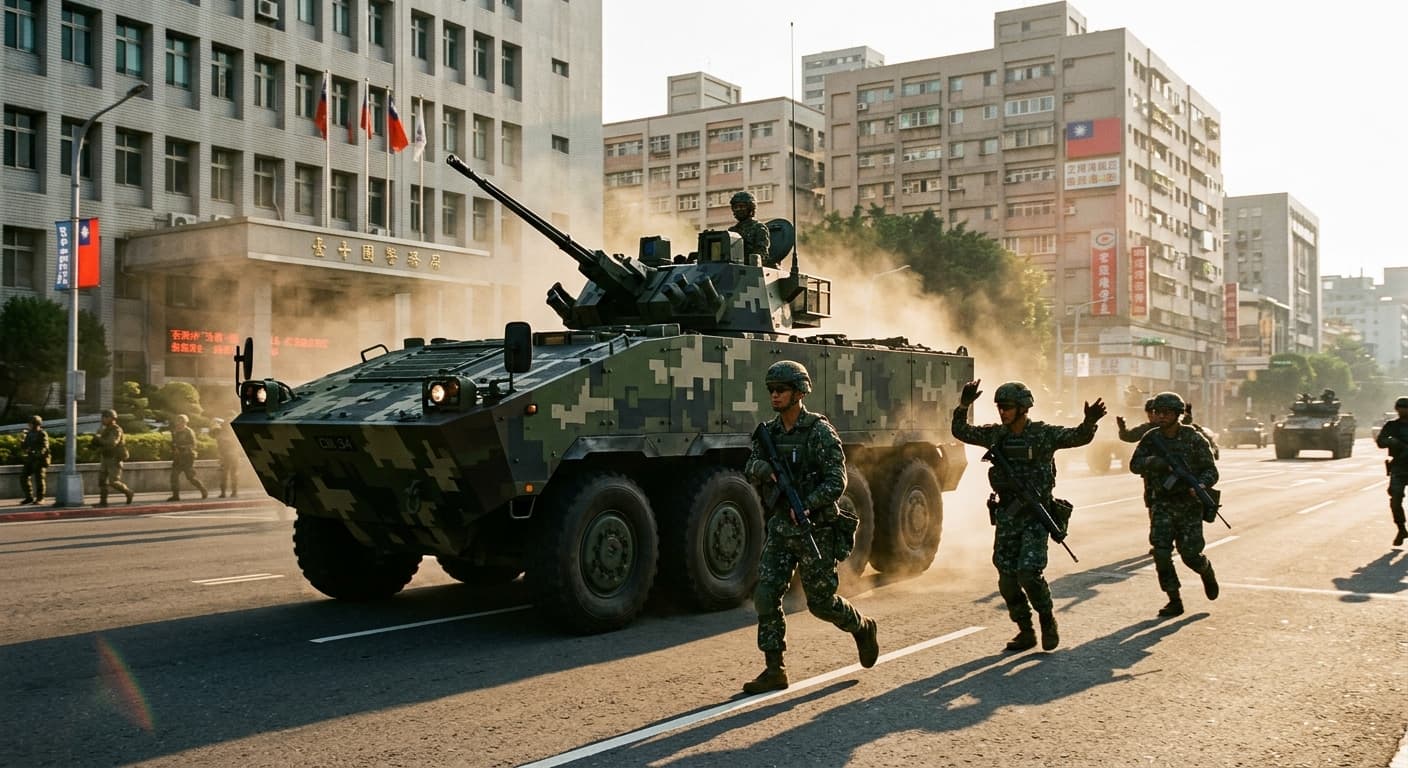
Taipei's Armored Drill Targets the Scenario Most Likely to Work: A Decapitation Strike
Taipei's July 15 Clouded Leopard drill rehearses the defense of the government's command quarter, the exact target Chinese planners have spent two decades optimizing to seize in a single blow.
On July 15, 2026, Clouded Leopard armored vehicles from Taiwan's 202nd Military Police Command rolled through downtown Taipei from the Bo'ai Special Zone — the fortified government quarter housing the Presidential Office — to the Ministry of National Defense, in a drill that rehearsed the one scenario most cross-strait analysts consider most likely to succeed against Taiwan: a lightning decapitation strike on the capital's leadership and command nodes. The exercise, part of Taiwan's July 13–17 Joint Defense Exercises, tested decentralized command, mobile force assembly, and the protection of critical facilities under wartime rules of engagement, according to Focus Taiwan. The drill matters less for its armored optics than for what it reveals: the Lai administration is quietly pivoting Taiwan's capital-defense doctrine from static garrison to survivable, distributed command-and-control, and that pivot, not the headline-grabbing HIMARS launches, is the operational change most likely to determine whether Taiwan's leadership survives the opening hours of a conflict.
The Decapitation Problem
The Bo'ai Special Zone is the nerve center of Taiwan's government. The Presidential Office, the Ministry of National Defense, and key command facilities sit within blocks of each other in central Taipei. The 202nd Military Police Command is the unit tasked with defending this quarter. Its July 15 drill rehearsed moving armored assets from the Presidential Office area to the MND building under simulated combat conditions, with traffic controls and decentralized sector command. That is the precise movement a capital-defense force would execute if Chinese special forces or airborne units attempted to seize or decapitate the leadership in a conflict's opening hours.
This is not a hypothetical. Chinese military planners have spent two decades refining exactly this kind of operation. The PLA has officially adopted "systems-destruction warfare" as its preferred approach against Taiwan, according to the International Institute for Strategic Studies, which assesses that Beijing seeks a "coup de main" that paralyzes Taiwanese command and seizes the island before U.S. forces can intervene effectively (IISS). Stanford University's Freeman Spogli Institute identifies four PLA campaign designs for Taiwan, the first of which consists of "joint missile and airstrikes to disarm Taiwanese targets — initially military and government, then civilian" to force Taipei's submission (
Stanford FSI). The IISS scenario describes a "massive multi-domain joint firepower strike" beginning with cyber and electronic warfare to disable critical-information infrastructure, followed by hypersonic missiles against high-value targets. The explicit aim is achieving capitulation before a PLA occupation force even lands.
The 202nd's drill is the defensive answer to that opening move. And it is the one Taiwan has historically been least prepared to handle. The U.S. Naval Institute's analysis of Taiwan's defense reforms notes that Taiwan's command system "remains rigid, more akin to the hierarchical, top-down structures seen in Russia and many Arab states," lacking the decentralized decision-making and lower-echelon initiative that make U.S. and Israeli militaries tactically superior (USNI / Defense.gov). A rigid, top-down command structure is precisely the vulnerability a decapitation strike exploits. The July 15 drill, with its emphasis on "decentralized command structure" and mobile deployment by operational sectors, is the first visible evidence that the 202nd is training to fight through the loss of its own higher headquarters.
From Set-Piece to Survivable Command
The drill is not a one-off. It is the visible artifact of a deeper doctrinal shift that President William Lai's administration has been engineering since taking office in May 2024. Taiwan's Ministry of National Defense, in its 2021 Quadrennial Defense Review, formally adopted "Resolute Defense and Multi-Domain Deterrence" as its strategy, with "resolute defense" explicitly seeking to "ensure the security of our [command and control] nodes, critical assets, and critical information infrastructure, and improve our force protection and preservation," according to the USNI analysis. The 2023 National Defense Report went further, incorporating lessons from the Russo-Ukraine war to emphasize "enhanced mobility, dispersion, concealment, redundant and decentralized command during the course of operations."
The July drill operationalizes that language. Military officials told Focus Taiwan the exercise evaluated units' ability to "prepare forces, assemble by operational sectors, and conduct mobile deployments under a decentralized command structure" while integrating critical-facility protection and combat-capability preservation. The phrase "decentralized command structure" is the load-bearing term: it means the 202nd practiced operating when higher headquarters may be degraded or destroyed, the exact condition a PLA decapitation strike would create.
This represents a break from Taiwan's historical garrison model. The MND announced in December 2022 and January 2024 that conscripted soldiers would primarily serve as "garrison troops" focused on infrastructure protection — a static defense concept. The July 15 drill suggests the capital-defense mission is moving toward mobile, distributed operations, not fixed-point defense. That shift directly addresses the institutional inertia the USNI analysis identifies: Taiwan's armed forces, dominated by the Army's legacy structures, have "failed to integrate key elements of organizational culture — such as decentralized decision making and lower-echelon initiative." The 202nd's rehearsal of sector-by-sector mobile deployment under decentralized command is, in doctrinal terms, a down payment on fixing that gap where it matters most: in the capital.
Why the Capital, Not the Coast
Most public attention on Taiwan's defense focuses on coastal anti-landing operations, HIMARS rocket strikes on Chinese amphibious forces, and the porcupine strategy of distributed anti-ship missiles. Those matter. But the decapitation scenario bypasses them entirely. A PLA strike on Taipei's command quarter does not require crossing the strait. It requires precision-guided munitions, special forces infiltration, and possibly airborne insertion — all capabilities China has demonstrably built and rehearsed.
The PRC's gray-zone activity has already tested the perimeter. In December 2025, the PLA conducted "Justice Mission 2025," a comprehensive encirclement exercise around Taiwan, and as of April 2026 signaled forthcoming far-sea training for the Fujian carrier, expected to reach full combat capability this year, according to the European Parliamentary Research Service (EPRS). More pointedly, the China Coast Guard has been maintaining permanent patrols east of Taiwan since June 2026, turning off AIS transponders to complicate tracking — a posture that the AEI/ISW assesses positions Beijing to "more easily launch a quarantine or blockade of Taiwan on short notice" (
AEI/ISW).
The maritime and the capital-defense tracks are two halves of the same coercive design: squeeze the island's economy from seaward, and present the leadership with a fait accompli before Washington can respond. Taiwan's government has clearly recognized the linkage. On June 25, 2026, the National Security Council, MND, and Coast Guard Authority held a tabletop exercise simulating a PRC maritime quarantine — with CCG ships boarding, inspecting, and detaining vessels going to or from Taiwan and forcing customs declarations through the PRC customs system, according to AEI/ISW's reporting (AEI/ISW June 26 2026). President Lai then ordered agencies to strengthen maritime and air intelligence, expand drone use for reconnaissance and escort missions, and update energy and critical-supplies stockpile plans. The July 13–17 Joint Defense Exercises, which included the 202nd's armored drill, build directly on the operational scenarios from that quarantine tabletop and from the five-day Immediate Combat Readiness Exercise launched on June 22.
The Historical Parallel: Kyiv, Not Normandy
The clearest analogue for what Taiwan is preparing is not D-Day. It is the opening hours of Russia's February 2022 assault on Kyiv — specifically, the airborne assault on Hostomel airport and the armored columns that drove toward the Ukrainian capital to decapitate the Zelensky government. That operation failed because Ukrainian forces maintained decentralized command, distributed anti-armor capabilities across urban terrain, and kept their leadership alive and communicating. The Russian plan assumed top-down paralysis would deliver capitulation. It did not.
Taiwan's drill calendar shows it has absorbed that lesson. The 2025 Han Kuang exercises — the largest and longest ever, lasting 10 days with 22,000 reservists, roughly 50% more than the previous year — were explicitly unscripted to test troops' response to surprise attacks, according to the BBC (BBC). The exercises incorporated urban warfare training in Taipei's subway and exhibition centers, and used the MRT system to transport Javelin missiles and food across the capital, as AEI/ISW documented (
AEI/ISW July 21 2025). The July 15 Clouded Leopard drill extends that logic to the Bo'ai Zone itself: if the capital is the battlefield, the government quarter is the objective, and the 202nd is the force that must hold it long enough for the national command authority to survive and continue directing the fight.
The Brookings Institution's Ryan Hass has documented the Lai administration's "Whole-of-Society Defense Resilience" framework, which established a presidential-level committee with three objectives: maintaining continuous government operations, sustaining critical social services, and providing civil support to military operations — organized around five pillars including civilian training, strategic material stockpiles, and critical-infrastructure protection (Brookings). The German Marshall Fund's February 2026 assessment reports that the Lai government has verified defense plans for 35 critical-infrastructure facilities, including through exercises, and has tasked the Second Special Police Corps, the military, and local police with joint security missions that include countering drone attacks — though local governments have flagged manpower shortages for patrolling large areas around facilities like Taichung's LNG terminals (
GMF).
Who Benefits, Who Loses
The winner from this doctrinal shift is the 202nd Military Police Command and the capital-defense apparatus more broadly. The drill gives them a training rep that matches the threat they are most likely to face, not the set-piece coastal-defense scenario that has dominated Taiwan's exercise calendar for decades. The Lai administration benefits politically: it can demonstrate to Washington that Taipei is serious about the hardest defense problem, at a moment when the U.S. Congress has grown impatient with the pace of Taiwan's reform. The Congressional Research Service notes that Taiwan's legislature passed a $24.8 billion, eight-year special defense budget in May 2026 — reduced from the proposed $40 billion after opposition lawmakers argued the original package risked excessive spending and heightened cross-strait tensions (Congress.gov CRS). The EPRS confirms the political dynamic: the DPP holds the presidency but the KMT and Taiwan People's Party control the legislature, creating a deadlock that delayed the package for months (
EPRS). The drill is a signal to that legislature — and to U.S. senators who in June 2026 urged the Trump administration to advance a delayed $14 billion arms package — that the executive is not waiting for budget politics to begin preparing.
The loser, if the doctrine matures, is the PLA's Eastern Theater Command. A decapitation strike only works if the target's command structure is rigid enough to paralyze. If the 202nd can execute decentralized sector defense, and if Taiwan's national command authority has rehearsed devolving authority before a strike lands, the PLA's fastest and cheapest coercive option loses much of its leverage. China would then be forced to choose between a prolonged blockade — which risks international intervention and economic blowback — or a full amphibious invasion, which is far costlier, slower to assemble, and easier for the United States and its allies to detect and counter.
What the Drill Does Not Solve
The exercise reveals gaps as well as progress. Decentralized command requires redundant communications that survive electronic warfare and cyber attack — a vulnerability the Center for a New American Security identifies as critical, noting that Beijing's opening move in any Taiwan contingency would seek to impose a "communications blackout" by cutting undersea cables, jamming satellite links, and dominating the electromagnetic spectrum (CNAS). Taiwan has taken initial steps — subsidizing telecom operators to harden cable landing stations and satellite reception stations against EMP attacks, and empowering the Ministry of Digital Affairs to enforce cybersecurity standards — but the GMF assessment notes that island-wide drills have been criticized as "too perfect," with tents set up in advance rather than mobilized under realistic wartime conditions.
The Stimson Center's March 2026 analysis of Taiwan's air-defense vulnerabilities reaches a similar conclusion about the gap between doctrine and implementation: Taiwan needs "redundant, decentralized command-and-control networks designed to function even under sustained attack," but building them requires "mobile radars, passive sensors that detect without emitting, and networked civilian radars — systems designed to operate independently when communication links are degraded or destroyed" (Stimson). The 202nd's July 15 drill tested the command concept. It did not test the communications infrastructure that would make it work under fire. That gap is the next problem.
Diplomat View
Taipei's July 15 armored drill is a down payment on a doctrinal shift that, if it holds, makes China's cheapest path to victory — a decapitation strike that paralyzes the government before Washington can respond — significantly less likely to succeed. The decisive variable is whether the 202nd can execute decentralized command under real electronic-warfare conditions, not just on a Wednesday morning with traffic controls in place. The August 2026 Han Kuang exercises, which AEI/ISW reports are expected later this summer, will be the next test of whether the capital-defense concept scales beyond a single corridor in Taipei.
The forecast: if Taiwan's national command authority completes a verified devolution-of-authority protocol — pre-delegating launch authority and continuity-of-government procedures to regional commanders — before the end of 2026, the PLA's decapitation option degrades from a war-winning move to a war-lengthening one. If it does not, the armored vehicles rolling through Taipei are theater, not strategy. The revision condition is concrete: a PLA exercise that rehearses a combined airborne-and-special-forces seizure of a foreign capital complex, observed in satellite imagery or intelligence reporting, would signal that Beijing believes the decapitation window is still open and is refining its plan to exploit it.
- August 2026 (expected): Han Kuang 42 live-fire exercises. The question is whether capital-defense and devolution-of-authority protocols are tested under EW conditions.
- Fall 2026: Taiwan's quarterly Whole-of-Society Defense Resilience Committee meeting — agenda will signal whether critical-infrastructure hardening is accelerating or stalled.
- Ongoing: U.S. Senate pressure to release the delayed $14 billion arms package — the Trump administration's decision will signal whether Washington is matching Taipei's doctrinal shift with the hardware to sustain it.
Discover more
India
Modi's Women’s Convention in Varanasi
Modi's Varanasi rally frames women's reservation as a national mission, targeting the 2027 Uttar Pradesh elections with a strategic narrative.

US Politics
White House Pressures Congress for Crypto Leg
The Trump administration's push for the CLARITY Act aims to reshape crypto regulation, impacting trillions in market value and the Trump family's wealth.

India
Congress Accuses Modi of Stalling Women's Law
Congress accuses Modi of stalling women's reservation law by linking it to delimitation, revealing a deeper electoral strategy.

Economics
Fed's Amex AML order puts correspondent banking on notice
Federal Reserve's Amex AML order requires board-level controls and a 90-day plan; OCC fined the bank $350 million over enterprise-wide deficiencies.