Taiwan Tracks Record 110 Chinese Warships
Taiwan monitors unprecedented Chinese naval activity.
Model Diplomat7 min readAsia
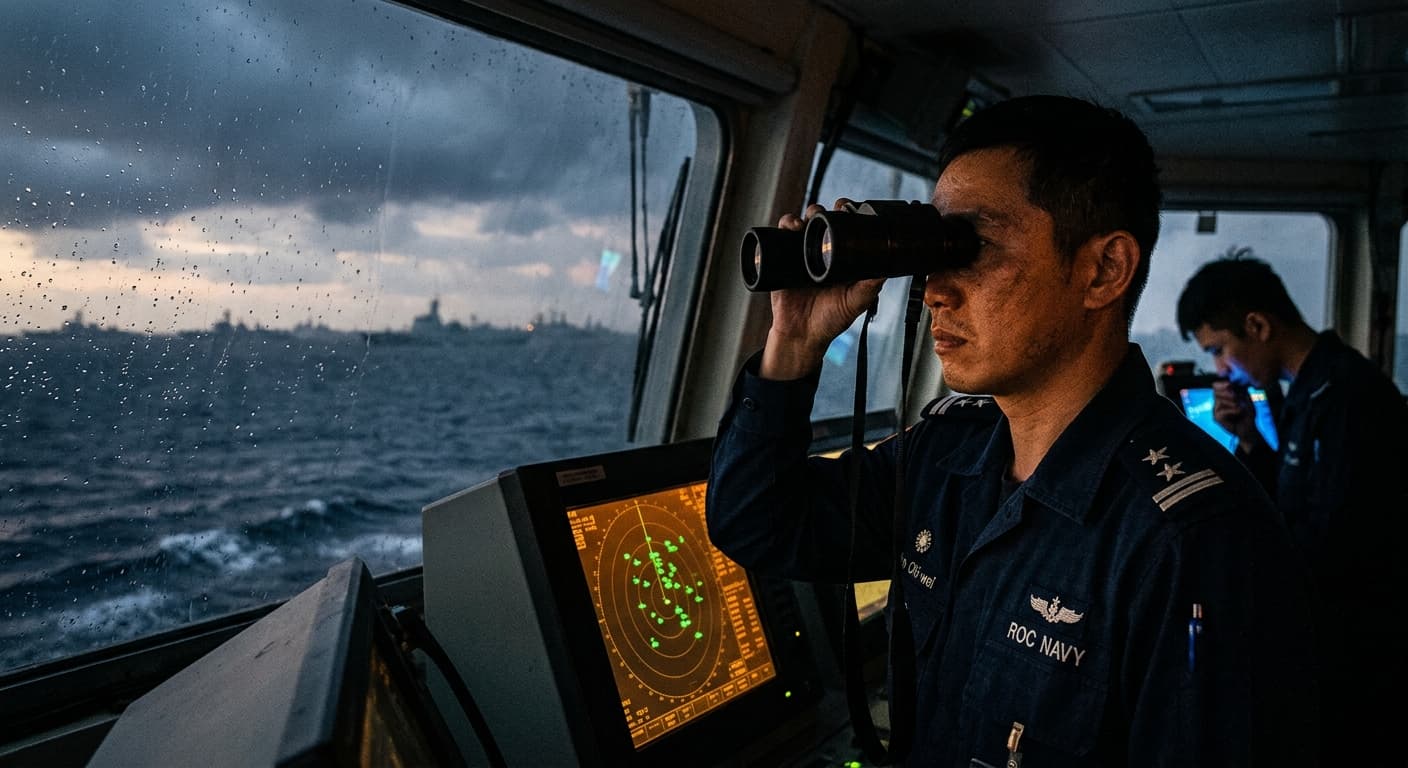
Taiwan Tracks Record 110 Chinese Warships Along First Island Chain
Taiwan is tracking 110-plus PLA Navy and coast guard vessels along the First Island Chain in July 2026 — the highest daily count Taipei has ever disclosed as China enters peak exercise season.
Taiwan's top intelligence official confirmed on July 6, 2026 that four People's Liberation Army Navy (PLAN) formations are now operating in the western Pacific, with additional groups off Okinawa, Santa Ana in the northern Philippines, and one in the South Pacific — the largest concurrent PLAN surge Taipei has publicly disclosed and the clearest sign yet that Beijing is treating the waters east of Taiwan, not the Taiwan Strait, as the decisive theatre. The angle that matters is not the number. It is the geography: China is deliberately pushing its center of naval gravity across the First Island Chain, and it is doing so while its coast guard normalizes jurisdiction on Taiwan's Pacific-facing coast. That is a blockade rehearsal in slow motion.
What Taipei actually said
National Security Bureau (NSB) Director-General Tsai Ming-yen briefed the Legislative Yuan's Foreign Affairs and National Defense Committee on July 6, telling reporters that "the mobilisation of Chinese Communist naval and maritime forces has indeed shown an upward trend," according to the Taipei Times. Tsai listed four PLAN formations in the western Pacific, two groups near Okinawa, one off Santa Ana in the Philippines, and one in the South Pacific — a footprint that spans roughly 4,000 kilometres north-to-south.
Two days earlier, National Security Council Secretary-General Joseph Wu posted on X that Taiwan was tracking "a record number of over 110 PLA Navy and coastguard vessels" along the First Island Chain, calling it "a clear sign of [China's] expansionism," as The Straits Times reported. Taiwan's Ministry of National Defense daily bulletins, published in English at
air.mnd.gov.tw, corroborate the surface picture: 30 PLA sorties, seven PLAN warships and five "official ships" tracked in the 24 hours to 6 a.m. on July 3 alone.
The July 6 briefing coincided with the opening of "Maritime Joint Exercise 2026," a China–Russia drill in the Yellow Sea announced by Beijing's Ministry of National Defense on July 5, per Al Jazeera. Tsai framed the Sino-Russian component as strategic messaging: Beijing and Moscow, he said, are seeking to counter "the denial and defence strategy constructed by the US and its allies in the First Island Chain" — a direct reference to the posture codified in the Trump administration's
2025 National Security Strategy and the January 2026 National Defense Strategy.
The typhoon caveat — and why it doesn't hold
Chang Ching, a retired ROC Navy captain now at the Society for Strategic Studies, offered the deflationary read: many PLAN hulls likely sortied to escape Super Typhoon Bavi, which the BBC reported struck Guam and the Northern Marianas on July 5 with sustained winds near 290 km/h before angling toward Taiwan. Warships routinely put to sea to ride out storms in home port.
That explanation is real but partial. It can account for a sudden bulge in vessel counts at Chinese east-coast bases. It cannot explain a task element off Santa Ana in the northern Philippines, a South Pacific deployment, or the concurrent Yellow Sea exercise with Russia. Nor does it explain the June 26 AEI China & Taiwan Update, which documented that the PLAN carrier Liaoning returned to Qingdao on June 23 after a 40-plus-day deployment through the South China Sea and West Pacific — the longest PLAN carrier deployment on record, and one that ended well before Bavi formed.
The real story: Beijing is normalizing the eastern approach
The trend line that recontextualizes the July 6 briefing runs through Taiwan's Pacific coast, not the Strait. According to CSIS's "Geometry of Coercion" report, published May 5, 2026, the daily average of distinct China Coast Guard (CCG) vessels in Taiwan's near waters rose more than 500% between January 2020 and December 2025, while incursions into Taiwan's second maritime security ring quadrupled. AEI's tracker adds, citing Starboard Maritime Intelligence, that CCG vessels have patrolled east of Taiwan "almost continuously since June 1" — the first sustained non-strait presence.
State-linked media are laying the rhetorical groundwork. On June 20, the CCTV-affiliated account Yuyuan Tantian — the same outlet that in 2024 unveiled Beijing's "Kinmen model" of coast-guard boarding — claimed the waters east of Taiwan should be treated as PRC "near-shore" jurisdiction. Between June 16 and 18, the Ministry of Natural Resources' Xiang Yang Hong 22 conducted what Beijing called a "marine environmental survey" in the same area. Taipei's Institute for National Defense and Security Research assessed that the vessel's 48-hour AIS blackout southeast of Taiwan was consistent with laying deep-sea sensor arrays useful to PLAN submarines transiting the Bashi Channel.
That is the operational logic. As the Atlantic Council documented, the CCG now takes operational cues from the PLA Eastern Theater Command's Joint Operations Command Center. Every CCG mile of jurisdiction the PRC normalizes east of Taiwan is a PLAN warship freed to sortie past the First Island Chain. Baird Maritime's reporting on the latest patrols calls this what it is:
salami-slicing that shortens the political step to a selective quarantine.
What Beijing is buying with the record surge
The U.S. Department of Defense's 2024 China Military Power Report — the most recent primary US assessment — pegs the PLAN at "over 370 ships and submarines, including more than 140 major surface combatants," and notes that in 2023 the Shandong deployed to the Philippine Sea three times, a record. The Office of Naval Intelligence trajectory has the fleet at 440 by 2030. In that context, the 110+ figure Wu disclosed is not a spike — it is the operational realization of a fleet that has grown into permanent presence.
What Beijing extracts from the July surge is coverage, not conquest. By fielding formations simultaneously off Okinawa, the Bashi Channel, the South Pacific, and the Yellow Sea, Beijing forces every allied navy in the region to spend readiness monitoring rather than training. Brookings analysts Ryan Hass and Stephen Tan warned in March 2026 that Taipei's reflex — scrambling frigates and F-16s at every incursion — is a losing exchange rate that "wears down Taiwan's military readiness" while Beijing operates "with near impunity." Taiwan's answer, articulated by Tsai in the same July 6 briefing, is a September drone-training course under the NSB aimed at pushing more surveillance onto unmanned platforms — the "cheaper uncrewed systems" the Brookings authors argued should replace manned intercepts.
The Sino-Russian layer serves a separate purpose. According to CSIS's ChinaPower project, the two navies now conduct annual "Joint Sea" drills and multiple joint Pacific patrols, with a sixth "Maritime Security Belt" exercise held in February 2026. The Yellow Sea drill nested inside a US-allied threat perimeter — roughly 400 km from South Korea and within reach of Japanese ISR — is meant to complicate any US decision cycle that assumes an isolated PRC contingency.
Who benefits, who pays
The immediate beneficiary is the PLAN's Eastern Theater Command, which now trains under conditions closer to a real blockade: multi-axis, sustained, and with CCG cover on the eastern flank. The second beneficiary is Beijing's information campaign — every day the 110-vessel figure sits at the top of the news is a day Taiwanese voters absorb the message that resistance is expensive.
The losers are named. Taiwan's Coast Guard Administration, whose vessels are outnumbered on a ship-to-ship basis east of the island, absorbs the operational load. The Philippine Coast Guard, whose spokesperson Jay Tarriela flagged the Scarborough Shoal deployment of PRC research vessel Tong Ji on June 18, is being tested simultaneously on two flanks. And US Indo-Pacific Command must now plan for a First Island Chain where PLAN formations east of Taiwan are the baseline, not the alarm.
Diplomat View
The July 2026 surge is not the prelude to invasion. It is the operational baseline Beijing wants the region to accept as normal — and the evidence says Beijing is winning that fight. The 110+ figure will fall when Bavi passes; the coast-guard patrols east of Taiwan will not. The forecast: by year-end 2026, CCG presence in the waters east of Taiwan becomes continuous rather than episodic, and PLAN carrier deployments to the Philippine Sea exceed the four Shandong sorties of 2023. What would revise this call: a public US-Japan-Philippines joint patrol inside Taiwan's 24-nautical-mile contiguous zone, or a Chinese leadership-succession shock in Beijing that redirects theater command attention inward. Absent those, the "gray zone" east of Taiwan is being painted black — one CCG cutter and one carrier sortie at a time.
What to watch
- July 10–11, 2026 — Typhoon Bavi's closest approach to Taiwan (per Taiwan's Central Weather Administration). The real test comes when PLAN hulls that sortied for weather do not return to port.
- Late July 2026 — Duration and geography of the China–Russia "Maritime Joint Exercise 2026" post-drill patrol; any transit south of the Miyako Strait would signal a new joint pattern.
- September 2026 — Launch of Taiwan NSB's drone-training course; first indicator that Taipei is shifting incursion-response from manned to unmanned platforms as Brookings recommended.
The Bottom Line
Taiwan's record 110-vessel tracking figure is not the story — the story is that China is quietly rebuilding the map of who governs the water east of Taiwan, and doing it with coast guard cutters rather than carriers. Beijing is not preparing to invade this summer; it is normalizing the operational architecture of a future quarantine. The First Island Chain, as a US-allied defensive perimeter, is being dissolved from the inside.
Discover more

US Politics
US Launches $166B Tariff Refund Portal
The US is launching a $166 billion tariff refund portal to aid importers hit by Trump-era tariffs, with major implications for trade and supply costs.

US Politics
U.S. House Passes Alert Act for Aviation
The House passed the ALERT Act 396–10, replacing the ROTOR Act after Pentagon intervention, impacting aviation safety regulations.

US Politics
White House Pressures Congress for Crypto Leg
The Trump administration's push for the CLARITY Act aims to reshape crypto regulation, impacting trillions in market value and the Trump family's wealth.

Economics
Fed's Amex AML order puts correspondent banking on notice
Federal Reserve's Amex AML order requires board-level controls and a 90-day plan; OCC fined the bank $350 million over enterprise-wide deficiencies.