Taiwan Labels China a 'Troublemaker' After JL
Taiwan reacts to China's missile test over the Philippines.
Model Diplomat8 min readAsia
Taiwan Calls China a "Troublemaker" After JL-2 Pacific Test
Taiwan's defense minister labels Beijing a "troublemaker" after a July 6 submarine-launched missile arced over the Philippines — a signal the Indo-Pacific bastion strategy is going open-ocean.
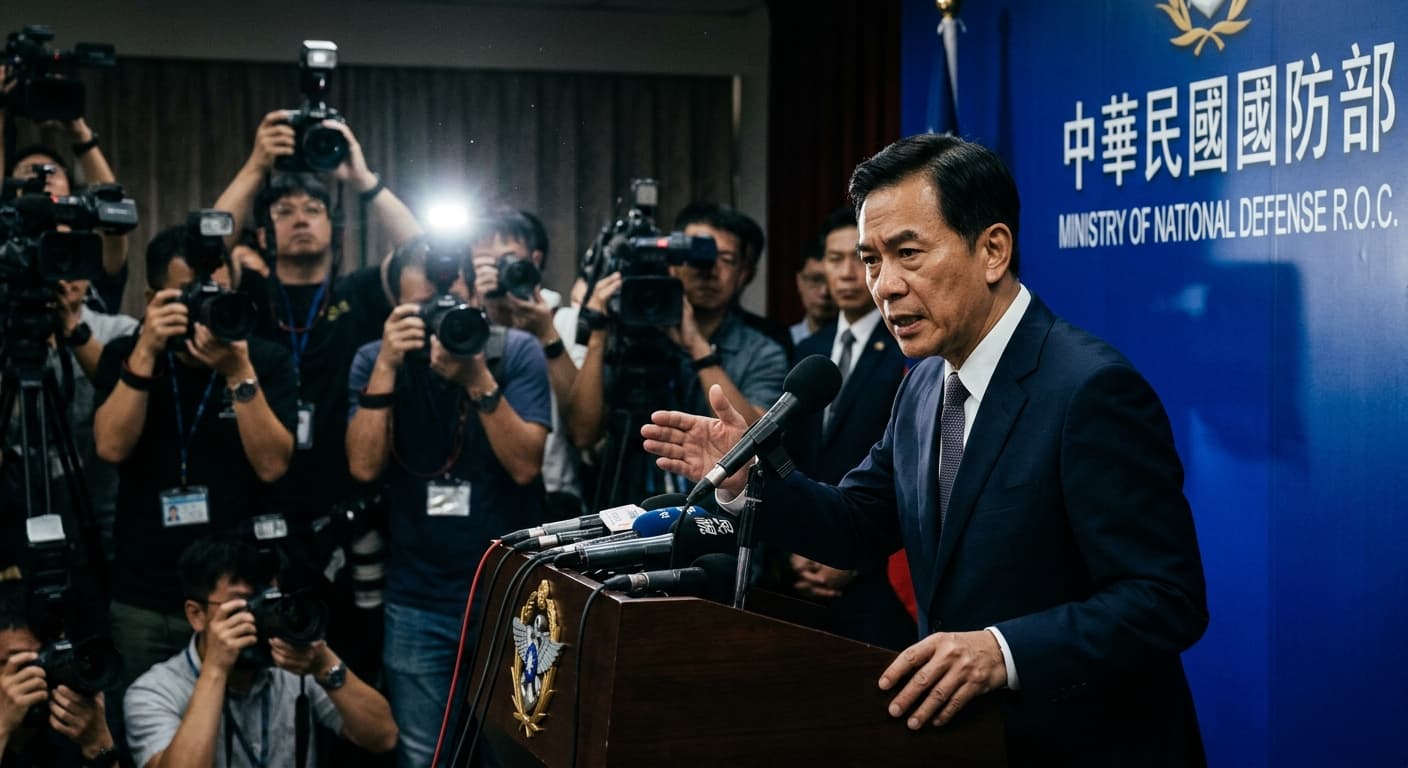
Taiwan's Defense Minister Wellington Koo Li-hsiung told the Legislative Yuan on July 8, 2026 that China's July 6 submarine-launched ballistic missile — a JL-2 fired from the South China Sea across roughly 7,300 kilometers of Pacific — "confirms the Chinese Communist Party is a troublemaker." The language matters less than what it signals: Taipei is now willing to publicly attach its defense case to the anxieties of Manila, Canberra and Tokyo rather than argue Taiwan's threat picture alone. That reframing lands as President Lai Ching-te tries to move a NT$1.25 trillion special defense budget through an opposition-controlled parliament, and as Beijing's boomers begin testing not in coastal waters but over other nations' sovereign territory.
What actually happened on July 6
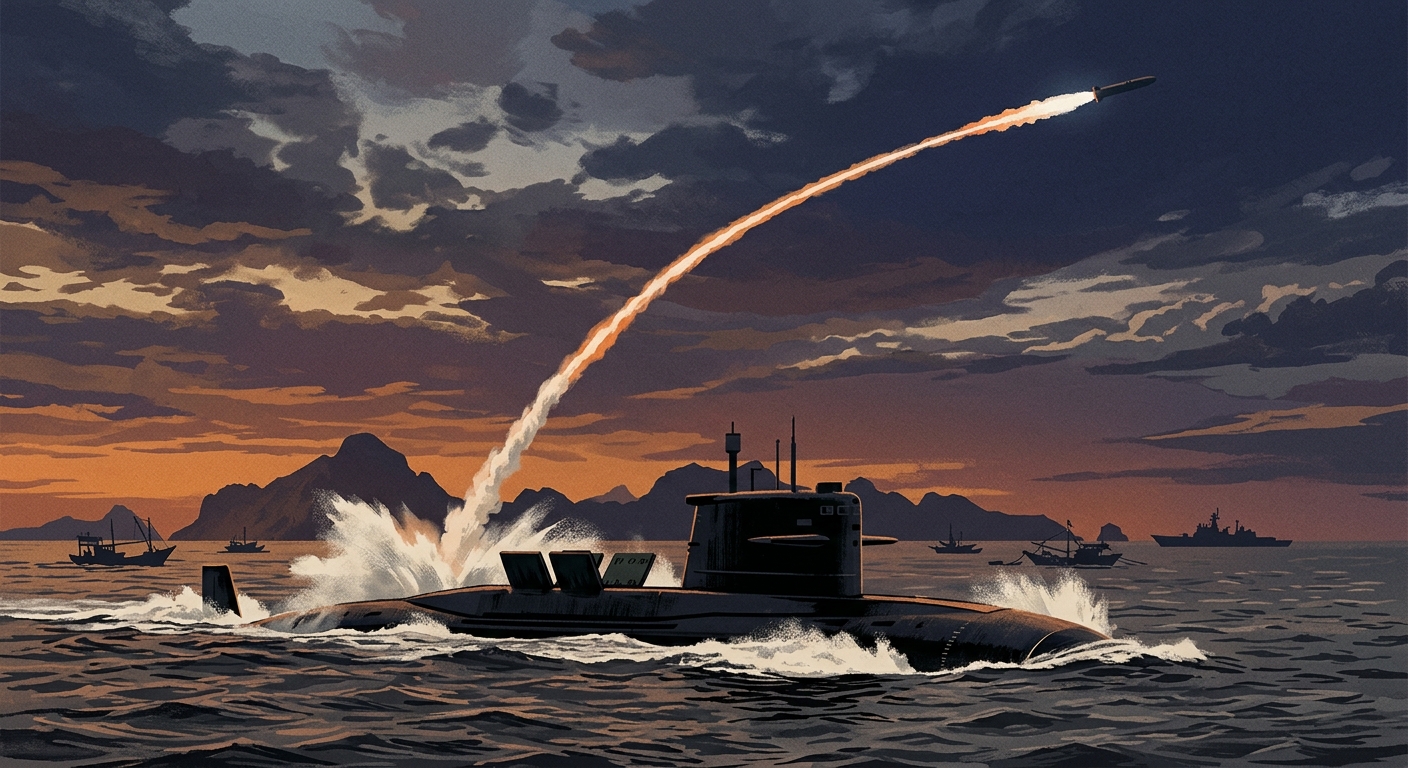
At 04:01 UTC on July 6, a People's Liberation Army Navy strategic nuclear submarine launched a submarine-launched ballistic missile from the South China Sea carrying a "training simulated warhead," according to a CSIS Missile Defense Project analysis published the following day. The missile flew approximately 7,300 kilometers and "likely overflew parts of the Philippines," splashing down inside the South Pacific Nuclear Free Zone — the treaty area covering the waters south of the equator that Australia, New Zealand and the Pacific Islands Forum have long treated as off-limits to nuclear activity.
Koo told reporters ahead of a Foreign Affairs and National Defense Committee briefing that Taiwan's Ministry of National Defense had assessed the missile as a JL-2 — the older Julang-2 variant — and that the launch "did not enter our Air Defense Identification Zone," but that the act itself "damages regional peace and stability and confirms the Chinese Communist Party is indeed a troublemaker." His comments were reported by NOWnews and
CNA via CTS. Koo added that the aircraft carrier Fujian's movement toward the Paracel (Xisha) Islands was for typhoon avoidance, while the older Liaoning was conducting carrier-based aircraft drills after departing Qingdao — where China and Russia had just opened the annual
Joint Sea 2026 exercise.
Beijing's Taiwan Affairs Office spokesperson Chen Binhua accused the ruling Democratic Progressive Party of "overreacting" and called the test a "routine arrangement of the annual military training program," according to ETtoday. Foreign Ministry spokesperson Mao Ning told reporters, per the
BBC's Chinese service, that "launch activities are always conducted in a safe and professional manner" and urged foreign governments "not to over-interpret."
Every government in the region did anyway.
The bastion goes open-ocean
The technical fact that reframes this event: the missile was launched from the South China Sea itself. That water is what Chinese nuclear strategists call a "bastion" — a protected sanctuary for the six-boat Type 094 Jin-class fleet based at Yulin on Hainan Island. A 2021 CSIS spotlight on Chinese SSBNs explained that the JL-2, with a range of 7,200–9,000 km, cannot reach the continental United States from Chinese littoral waters — it can only threaten Guam, Hawaii and Alaska. To hold Washington at risk, a Jin-class boat has traditionally had to break through the First Island Chain and into the open Pacific undetected, a hard task given that the U.S. Office of Naval Intelligence has described the Type 094 as noisier than late-Soviet Delta III boats.
Two things have changed that math. First, the International Institute for Strategic Studies documented in February 2026 that China now launches nuclear submarines faster than the United States does — a seventh and eighth Type 094 hull in 2024 and 2025 respectively — and is fielding the longer-range JL-3, which was publicly displayed for the first time at the 2025 Victory Day parade. As a separate
CSIS analysis on that parade noted, the JL-3's estimated range above 5,400 nautical miles means Type 094s can hit the western continental United States from Chinese coastal waters — no bastion breakout required.
Second, Beijing is now practicing the trajectory. The July 6 launch was China's first-ever SLBM test into international waters and the first PLA missile test in the Pacific since a September 2024 DF-41 shot. CSIS notes the flight profile "mirrored a real missile attack in several ways" — realistic distance, realistic trajectory, likely overflight of a treaty ally of the United States. That is not a range test. It is rehearsal.
Who's losing leverage
The concrete loser is the Philippines, and its lack of response tells its own story. The missile likely flew over Philippine sovereign territory; Manila did not join the chorus of protest that Australia, New Zealand, Japan and Taiwan produced within twenty-four hours. Australian Prime Minister Anthony Albanese, in Honiara to sign a new "Ocean of Peace Alliance" defense treaty with Fiji, called the test "destabilising and provocative" — a line reported by the BBC Chinese service alongside condemnations from Wellington and Tokyo. Japan says it received 90 minutes' advance notice and "strongly urged" Beijing to reconsider. CSIS assessed that the Philippine overflight was likely deliberate, framing it as punishment for Manila becoming the first foreign coast guard to participate in RIMPAC 2026.
Two months earlier, on June 11, 2026, Beijing had already sanctioned Philippine Defense Secretary Gilberto Teodoro over his South China Sea rhetoric, banning him and his family from entering the mainland, Hong Kong and Macau, according to Al Jazeera. Reading the two moves together, Beijing is telling Manila that RIMPAC participation and rhetorical solidarity with Taipei carry direct, physical costs: a nuclear-capable missile flying through Philippine skies.
The winner, awkwardly, is Wellington Koo. A civilian defense minister with a legal rather than uniformed background, Koo has spent 2026 struggling to get his special defense budget through a legislature controlled by the Kuomintang (KMT) and Taiwan People's Party. NPR reported in January that the opposition had blocked Lai's NT$1.25 trillion special budget "at least eight times." In June, Al Jazeera noted that parliament ultimately
approved only two-thirds of the $40 billion package, gutting the drone and domestically-produced-weapons portions. A JL-2 test over an allied democracy, condemned by four Indo-Pacific capitals, changes the political texture of that fight overnight.
The number that matters: 3.32%
Taiwan's Executive Yuan has proposed a 2026 defense budget of NT$949.5 billion — 3.32% of GDP, according to BBC Chinese, and a record high. Lai has separately committed to 5% of GDP by 2030, a threshold that would put Taiwan behind only Ukraine and Israel among major economies and would break the NT$1 trillion mark in absolute terms. Trump officials, including Under Secretary of Defense Elbridge Colby, former NSC advisor Robert O'Brien and President Trump himself, have publicly demanded Taipei reach 10% of GDP, a figure no democracy has sustained in peacetime.
The Ministry of National Defense's own numbers make the ramp visible. MND's April 2 press conference warned that the unpassed 2026 general budget of NT$561.4 billion had left NT$78 billion — 21% of executable spending — stranded, delaying HIMARS (NT$20 billion), Javelin replenishment (NT$41.5 billion) and F-16 follow-on training (NT$8.8 billion). Koo has told U.S. congressional delegations, including one led by
Senator Jim Banks on April 8, that delays would trigger "doubts from allied countries about Taiwan's self-defense resolve" — the exact worry the July 6 launch now reframes into public argument.
The rules Beijing is quietly rewriting
The July 6 test's second-order effect is legal. China has never signed the Hague Code of Conduct against Ballistic Missile Proliferation (HCOC), which since 2002 has bound its 140 subscribers to at least 24 hours' pre-launch notification with information on launch area, direction and missile class. In this test, per CSIS, China gave "mere hours" of notice to the United States and Japan and about 23 hours to Australia. In 2024, notice was under 24 hours to all five affected states — the United States, Japan, Australia, New Zealand and France — all of which publicly rebuked Beijing afterward.
CSIS puts the diplomatic play bluntly: at the 2026 NPT Review Conference, Chinese diplomats cited their 2024 pre-launch notice as evidence of transparency and "strategic risk reduction" — claiming credit for notifying without accepting the rules that would require it. Beijing wants credit for notifying — without accepting the rules that would require it. As a permanent UN Security Council member, its refusal to join the HCOC also provides political cover for North Korean and Iranian testing behavior. State Department spokesperson Tommy Pigott, per the BBC, framed the message the U.S. wants regional partners to internalize: "At a moment when the United States is more committed than ever to preventing nuclear proliferation, China is going in the opposite direction."
Diplomat View
The July 6 test is not primarily about Taiwan — which Koo himself noted was outside the ADIZ track — but Taipei is the political actor best positioned to convert it into a domestic and international argument. Expect three things over the next quarter.
First, Lai's team will use the Manila overflight to reopen the debate over the frozen tranches of the special defense budget when the Legislative Yuan reconvenes; the KMT and TPP will find it harder to portray defense as a partisan luxury when Japan, Australia and New Zealand are on the record with condemnations of the same launch. Watch whether the NT$210 billion surveillance and unmanned-surface-vessel package proposed on June 18 moves in the fall session.
Second, the U.S. State Department's public label of the missile as "nuclear-capable" — a formulation Beijing rejects — gives Washington a lever to press for a bilateral pre-launch notification regime, an idea CSIS is now actively promoting. Expect a Track 1.5 push before the September UN General Assembly.
Third, the forecast revises if China conducts a second Pacific-facing test within six months, or if the missile is confirmed as a JL-3. Either would suggest deliberate routinization. If neither occurs and 2027 passes without follow-up, this reads as a one-shot signal timed to the Marco Polo Bridge anniversary and Joint Sea 2026, not the doctrinal shift analysts are now bracing for.
What to watch next:
- July 13, 2026 — Joint Sea 2026 concludes near Qingdao; watch for follow-on China-Russia Pacific patrols in the announced but unspecified area.
- September 2026 — Legislative Yuan fall session opens; the KMT-TPP majority's stance on the frozen NT$78 billion and the NT$210 billion surveillance package is the first test of whether the July 6 test has actually moved Taiwan's domestic politics.
- September–October 2026 — UN General Assembly and possible U.S.–China strategic-stability track; watch for any Chinese offer on missile-launch notification.
The Bottom Line
China's July 6 SLBM test is the moment Beijing's undersea nuclear force stopped hiding — firing from the South China Sea over a U.S. treaty ally into a nuclear-free-zone treaty area, with mere hours of notice and no legal framework binding it. Wellington Koo's "troublemaker" line is not rhetoric; it is Taipei betting that the Indo-Pacific coalition condemning this test will now carry Taiwan's defense-budget argument for it. If the JL-3 flies next, the bastion strategy is dead and the second nuclear age has a Pacific address.
Discover more
Global Politics
Xi Jinping Calls China-Russia Ties 'Precious'
Xi Jinping's description of China-Russia ties as 'precious' reflects a strategic imbalance, with Beijing dictating terms in the partnership.

US Politics
White House Pressures Congress for Crypto Leg
The Trump administration's push for the CLARITY Act aims to reshape crypto regulation, impacting trillions in market value and the Trump family's wealth.

India
Women’s Reservation in India
India's 33% women's reservation law is enacted but won't take effect until after 2029 due to political setbacks and census delays.

Conflict & Security
Drone Warfare Killing Aid Workers at Unprec
Over 1,000 humanitarian workers killed in three years as cheap armed drones collapse legal protections. Gaza, Sudan, Ukraine, and DRC see deliberate targeting of aid convoys and hospitals with zero prosecutions.