Taiwan Calls China 'Troublemaker' After SLBM
Taiwan's defense minister rebukes China over missile test.
Model Diplomat8 min readAsia
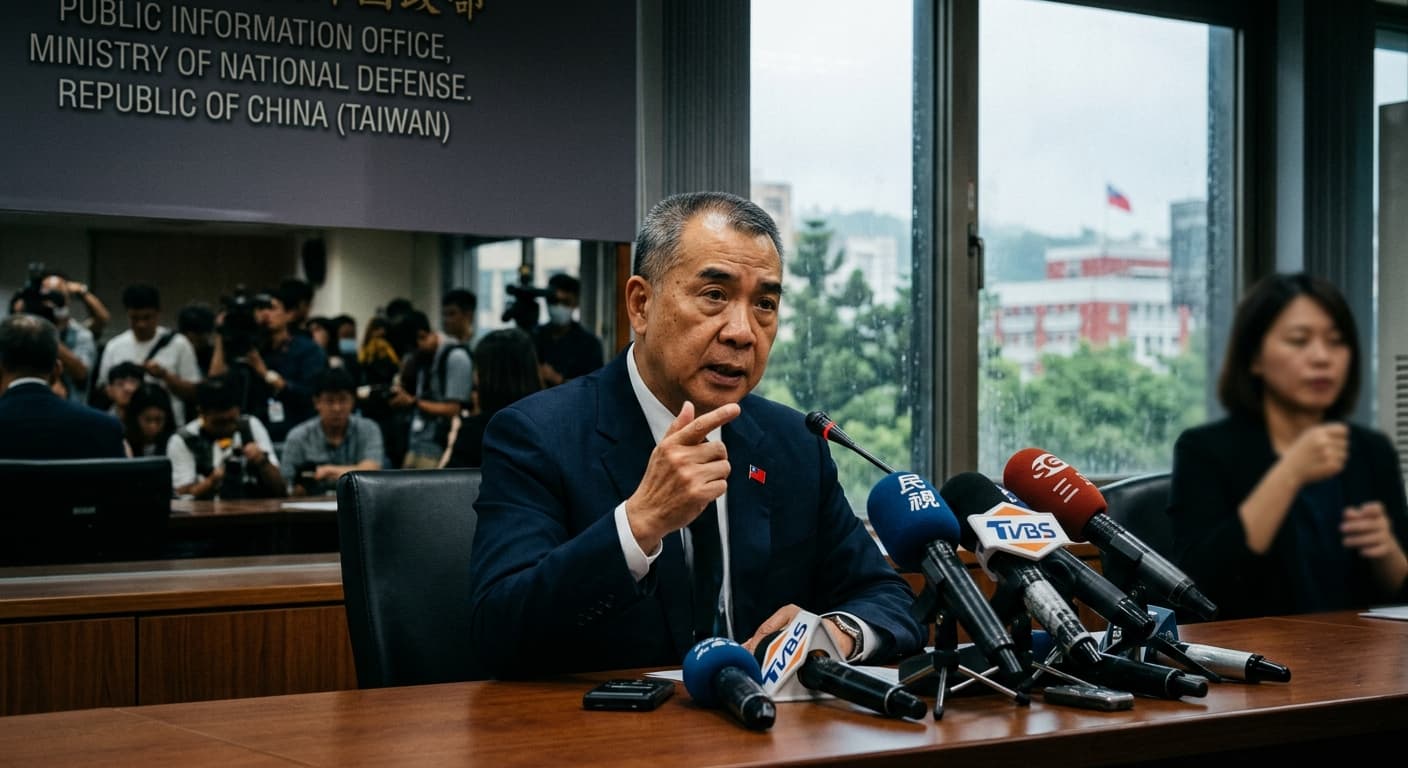
Taiwan calls China a 'troublemaker' after JL-2 SLBM test rattles Pacific
Wellington Koo's July 8 rebuke, delivered as Australia signed a Fiji defence pact, reframes China's submarine-launched missile test as the pivot of Indo-Pacific alignment.
Taiwan's Defence Minister Wellington Koo Li-hsiung on July 8, 2026, publicly identified as a JL-2 the submarine-launched ballistic missile China fired 7,300 kilometres into the South Pacific two days earlier, calling the test proof that Beijing is a "troublemaker" — a Taiwanese line that has, in 48 hours, become the connective tissue linking a Chinese nuclear-triad demonstration, a new Australia–Fiji defence union, and a fresh round of Philippine, Japanese and US condemnation into a single Indo-Pacific realignment story. The thesis is straightforward: Beijing's first-ever open-ocean SLBM launch did not deter the Pacific coalition it was designed to intimidate; it hardened it, and Taipei is now positioned as the political voice of that hardening rather than its lonely subject.
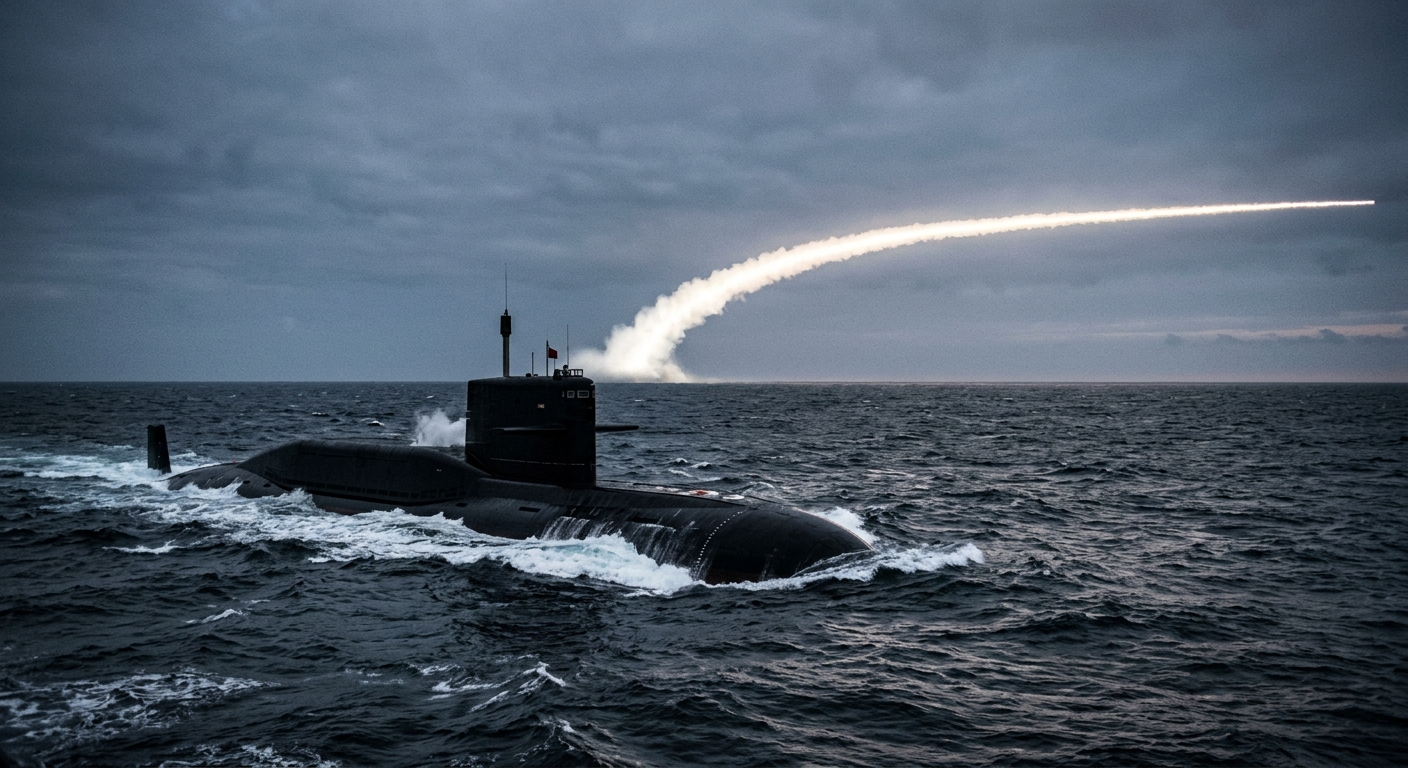
What actually happened on July 6
At 12:01 pm Beijing time on July 6, 2026, a People's Liberation Army Navy Type-094 strategic submarine launched a ballistic missile carrying a training simulated warhead from the South China Sea toward "designated waters" in the South Pacific, according to a Xinhua-carried PLA statement quoted by Al Jazeera. The Center for Strategic and International Studies reconstructed the flight path at roughly 7,300 km, noting the missile "likely overflew parts of the Philippines" and landed inside the South Pacific Nuclear Free Zone — the first time Beijing has ever fired an SLBM into international open waters, and only its second ballistic-missile launch into international waters since 1980, per
CSIS analysis.
Speaking before a Legislative Yuan Foreign Affairs and National Defense Committee session on manpower policy, Koo told reporters the Ministry of National Defense had "fully grasped" the missile type through joint ISR and multi-source intelligence, concluding it was a JL-2 (巨浪-2), Taiwan's Central News Agency reported via CTS News. He acknowledged the launch did not cross Taiwan's Air Defense Identification Zone but said "an act like this that undermines regional peace and stability confirms that the CCP is indeed a troublemaker," according to
NOWnews. Koo separately confirmed that the aircraft carrier Fujian's movement near the Paracels (Xisha) was typhoon-avoidance, and that the Liaoning was conducting carrier-based aircraft drills after departing Qingdao.
CSIS analysts note the missile itself could have been either the older JL-2 or the longer-range JL-3; both share stages and shape, and the 7,300 km flight is within either envelope. Taiwan's Institute for National Defense and Security Research has previously assessed that the JL-3 is designed for the newer Type-096 (Tang-class) SSBN under construction and can exceed 10,000 km, per an INDSR study. If Taiwanese intelligence is correct that this was a JL-2, the missile was tested near full range from a Type-094 — a lesser but still politically potent statement about the reliability, rather than the reach, of Beijing's sea-based deterrent.
Why Koo's line lands harder than it looks
The "troublemaker" framing is not rhetorical throat-clearing. Since taking the defence portfolio under President Lai Ching-te, Koo has fought a two-front campaign: pushing an eight-year, roughly US$40 billion special defence budget through a Kuomintang- and Taiwan People's Party–controlled legislature, and convincing Washington that Taipei's political will matches its shopping list. NPR reported in January 2026 that opposition parties had blocked the special budget at least eight times since December, prompting warnings from Atlantic Council analyst Kitsch Liao that failure "sends a very dangerous message to security partners like the U.S." Koo's ministry has already told the Legislative Yuan that NT$78 billion — 21% of the 2026 defence budget excluding personnel costs — cannot be executed on schedule because of the impasse, according to a
Ministry of National Defense press release issued April 2, 2026.
The July 6 launch hands Koo something he has struggled to manufacture domestically: a visual, undeniable Chinese action that vindicates the special budget's core assumptions. That is why he moved so fast on July 8 to name the missile, quote the intelligence provenance ("joint ISR and multi-source intelligence"), and pin the "troublemaker" label — a phrase the US State Department has itself deployed against Beijing in South China Sea contexts. The Ministry of National Defense's ongoing procurement package — Javelins, HIMARS, TOW 2Bs, M109A7s and 200,000 drones — is explicitly framed around asymmetric denial, per Koo's May 25, 2026 MND briefing. An open-ocean SLBM test is not the kind of threat those systems are designed to defeat; but politically, it is exactly the kind of threat that unlocks the legislative votes to buy them.
The Pacific coalition China wanted to intimidate
The launch was timed inside a diplomatic window that could not have been more damaging to Beijing. Hours before the missile flew, Prime Minister Anthony Albanese and Fiji's Sitiveni Rabuka signed the Vuvale Union, an "Ocean of Peace" treaty-level defence pact — Fiji's first alliance-style arrangement — as BBC reported from Suva. Four days earlier, Albanese had signed a similar full-spectrum strategic partnership with Vanuatu that bars foreign military bases. CSIS previously called the Vuvale package part of a "significant push" by Australia to lock in bespoke security agreements — with Papua New Guinea in 2025, Nauru in 2024, Tuvalu in 2023 — that "obliquely limit China's reach," per its
State of Play brief.
Beijing's response was to shoot a nuclear-capable missile into the neighbourhood. USSC chief executive Michael Green, speaking to The Australian, called it "a clear attempt by Beijing to intimidate Pacific island nations and Australia, and to demonstrate there will be punishment" when such deals are signed, according to a United States Studies Centre summary. The reaction ran the other way. Foreign Minister Penny Wong, standing next to Rabuka in Suva, called the test "destabilising" and framed it against "a rapid military build-up by China, which is lacking in the transparency and reassurance as to intent that the region expects." Winston Peters, New Zealand's foreign minister, described it as "an unwelcome and concerning development." Japan said it had been notified only 90 minutes before launch and "strongly urged" reconsideration. The US State Department spokesperson labelled the missile a "nuclear-capable ballistic missile" and used the incident to accuse Beijing of "opaque" nuclear expansion, per
BBC Chinese.
CSIS argues the notification pattern itself is the story. In both the September 25, 2024 land-based test and this week's launch, Beijing provided "mere hours" of advance notice to the United States and Japan and roughly 23 hours to Australia — far short of the 24-hour, 140-recipient standard set by the Hague Code of Conduct against Ballistic Missile Proliferation, an instrument China has never ratified. That, CSIS argues, is designed to "routinize" open-ocean testing on Chinese terms while claiming diplomatic transparency — a claim Beijing pressed at the 2026 NPT Review Conference. National Security Council Secretary-General Joseph Wu, on X on July 7, said the missile had flown over the Philippines and called the act "an act that destabilises the Indo-Pacific," per the Taiwan Post.
The Philippine overflight is the sleeper story
Buried inside CSIS's technical read is the sharpest political fact: navigation warnings suggest Beijing had planned two launches on July 6 — one from the Bohai Sea overflying Japan, one from the South China Sea overflying the Philippines — and executed only the second. The Philippine Coast Guard is participating in RIMPAC 2026 for the first time as a foreign coast guard, and Manila is the region's most kinetic South China Sea flashpoint: China sanctioned Defence Secretary Gilberto Teodoro and his family in June 2026, barring them from entering China, Hong Kong or Macau, per Al Jazeera. Whether the missile physically crossed Philippine sovereign territory is not yet publicly confirmed by Manila; the CSIS assessment that it "possibly crossed over Philippine territory" is the analytic baseline, and it will drive the diplomatic protests to come.
Beijing's own framing is instructive. Taiwan Affairs Office spokesperson Chen Binhua on July 8 dismissed the DPP's condemnation as "over-reaction" that exposes "Taiwan independence provocation, arrogant on the outside and hollow on the inside," according to ETtoday. Mao Ning at the Foreign Ministry said "relevant countries should not over-interpret" the launch. But the Global Times, more candid than the ministry, told readers that "our national nuclear triad had another upgrade" and that the PLA "sea-based nuclear force is capable of carrying out stable, reliable strategic counterstrikes from anywhere in the vast open seas of the Pacific Ocean" — reporting via
Carnegie's Proliferation News, which flagged the claim as "hyperbole."
The military balance shift underneath
Strip out the diplomacy, and the July 6 test is a marker on a curve that has been rising for a decade. The International Institute for Strategic Studies noted in February 2026 that Bohai shipyards are ramping up Type-094 and Type-096 SSBN production, and that the JL-3 is progressively replacing the JL-2 — allowing PLAN boomers to hit the western continental United States from the South China Sea bastion, per an IISS Military Balance analysis. Taiwan's INDSR assesses that the Type-096 (Tang-class), which can carry 24 JL-3s, will bring Beijing's sea-based deterrent close to US and Russian parity. That is the strategic pipeline Koo's asymmetric-defence special budget is designed to compensate for — not directly, because Taipei will never counter Chinese SSBNs, but by making the surface and littoral fight so costly that Beijing's growing nuclear confidence does not translate into conventional freedom of action across the Strait.
Read together, Koo's July 8 rebuke, the Vuvale signing, and Manila's near-overflight point to a coalition that has stopped hedging. Every capital that condemned the test — Taipei, Canberra, Wellington, Tokyo, Washington, and by implication Manila — is a partner Beijing has spent the past year trying to peel off either through sanctions, coercion or Pacific chequebook diplomacy. The visible result on July 8, 2026, is the opposite.
Diplomat View
The July 6 SLBM test is the clearest evidence yet that Beijing has misread the Pacific: it fired a nuclear-capable missile into a region that has spent two years quietly hardening against exactly this behaviour, and got in return a new Australia–Fiji treaty, a fresh US "opaque nuclear expansion" line, and a Taiwanese defence minister empowered — not chilled — into calling China a "troublemaker." The forecast: Koo's special-budget fight becomes materially easier in the Legislative Yuan within 60 days, and the Philippines will move from private protest to formal diplomatic démarche on the overflight question, likely aligned with Japan and Australia at the September UN General Assembly. What would revise the call: if Beijing follows this test with a second, JL-3 open-ocean launch before year-end — indicating the July 6 shot was a proof-of-concept rather than a signalling one-off — the political story flips from Chinese misstep to sustained coercive campaign, and Pacific partners fragment on how tolerable "routinised" nuclear testing has become.
What to watch next
- Taiwan Legislative Yuan, late July 2026: whether Koo can leverage the "troublemaker" moment into unblocking the frozen NT$78 billion in 2026 defence procurement.
- Manila, by end-July 2026: whether the Philippine Department of Foreign Affairs formally protests the overflight, or lets CSIS's finding stand as the international narrative.
- September 2026 UN General Assembly: coordinated Australia–Japan–NZ–Philippines statement on the Hague Code of Conduct and Beijing's non-ratification, the diplomatic hook CSIS and the US State Department have already put on the table.
Discover more
Global Politics
Xi Jinping Calls China-Russia Ties 'Precious'
Xi Jinping's description of China-Russia ties as 'precious' reflects a strategic imbalance, with Beijing dictating terms in the partnership.

US Politics
US Launches $166B Tariff Refund Portal
The US is launching a $166 billion tariff refund portal to aid importers hit by Trump-era tariffs, with major implications for trade and supply costs.
India
Women’s Reservation in India
India's 33% women's reservation law is enacted but won't take effect until after 2029 due to political setbacks and census delays.

Conflict & Security
Drone Warfare Killing Aid Workers at Unprec
Over 1,000 humanitarian workers killed in three years as cheap armed drones collapse legal protections. Gaza, Sudan, Ukraine, and DRC see deliberate targeting of aid convoys and hospitals with zero prosecutions.