Suriname's Oil Countdown: A Year In
Geerlings-Simons presidency faces oil readiness challenges
Model Diplomat3 min readamericas
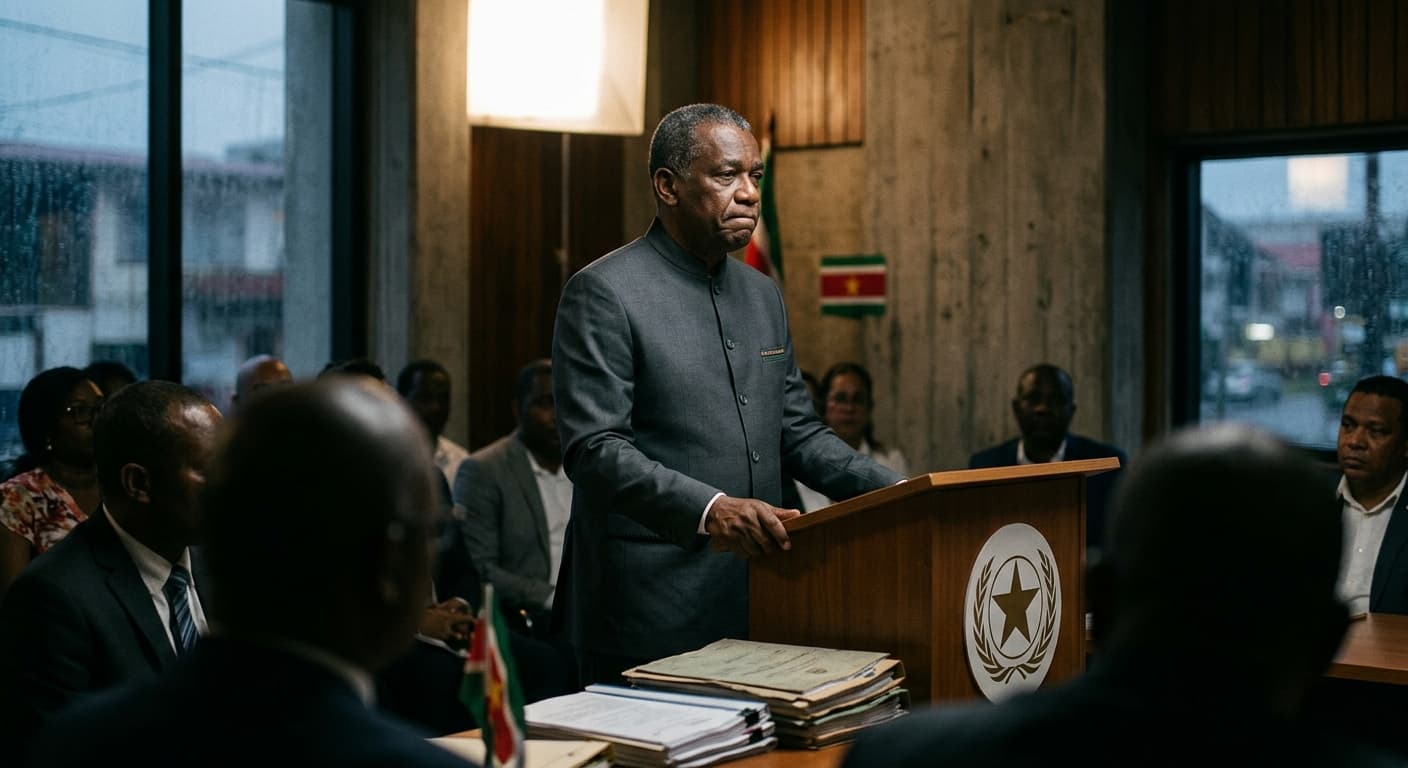
Suriname's Oil Countdown: One Year Into the Geerlings-Simons Presidency, the Clock Is Ticking
A year after Jennifer Geerlings-Simons became Suriname's first female president, the gap between oil-fueled expectations and institutional readiness is widening — and the IMF is warning.
When Suriname's opposition National Democratic Party (NDP) edged out the incumbent VHP by a single seat in May 2025 — 18 to 17 in the 51-seat National Assembly — the vote was widely read as a referendum on austerity. The Foreign Policy analysis at the time captured it plainly: "Discontent with the economy may help explain the results." President Chandrikapersad Santokhi had delivered an IMF restructuring but cratered his popularity in the process. Voters handed the narrowest of pluralities to the party of the late Desi Bouterse, the convicted former dictator.
A five-party coalition quickly coalesced behind the NDP's Jennifer Geerlings-Simons, giving her 34 votes — exactly the two-thirds required — and installed her as president on July 6, 2025. She became the first woman to lead the country. The coalition's stated rationale, per AS/COA, was to "work together on a new model in which the wealth given by God benefits everyone." That wealth sits roughly 150 kilometers offshore in Block 58, where TotalEnergies and APA Corp are developing the $10.5 billion GranMorgu project, slated to begin pumping 220,000 barrels per day in 2028.
Staatsolie's Edge, and the Fiscal Test
Suriname holds one structural advantage over its oil-boom neighbor Guyana: Staatsolie, the state oil company, participates in upstream operations — drilling, not just collecting royalties. That means it can claim a seat at the table for GranMorgu, and Staatsolie says its contract guarantees Suriname a 60 to 70 percent share of proceeds after costs, depending on the oil price. Guyana's deal with ExxonMobil, by contrast, delivers roughly half that. This is the single most consequential number in Surinamese politics, and it explains why the NDP campaigned on local-content mandates and stronger social programs rather than tearing up contracts.
But the IMF's December 2025 Article IV consultation delivered a sober counter-narrative. Pre-election spending and loose monetary policy had pushed inflation back up, eroding hard-won gains from the Fund-supported program that concluded in March 2025. The current account deficit is projected to hit 50 percent of GDP in 2026–27 as imports surge to support oil-field development. The IMF warned that fiscal consolidation of roughly 1 percent of GDP was "urgently needed" and that Suriname's public financial management frameworks — despite a 2024 PFM law and a revamped sovereign wealth fund — remained largely unoperationalized.
A follow-up IMF technical report in May 2026 sharpened the point: implementing decrees were delayed, governance bodies unstaffed, and macro-fiscal analytical capacity thin.
Who's Watching
Three external actors are tracking Paramaribo's every move, each for different reasons. China secured two offshore blocks for PetroChina in 2024 and brought Suriname into the Belt and Road Initiative in 2019 — the NDP's historical comfort with Beijing makes further energy-sector deals likely. Washington sent Secretary of State Marco Rubio to Suriname in March 2025 explicitly to counter Chinese influence, treating the hemisphere as a sphere of interest under the Trump administration. TotalEnergies, a French giant, anchors the European stake, and its Q1 2026 results showed $218 million in supplier financing flowing into GranMorgu. As The National Interest noted, the new government "will have to balance American, Chinese, and European geopolitical interests."
Then there is the OAS dimension: Albert Ramdin, Suriname's former foreign minister, took the organization's helm in May 2025 — the first Caribbean national to hold the post — pledging to make the fractious body "inclusive" and "results-driven." It gives Paramaribo diplomatic heft disproportionate to its 646,000 citizens.
What to Watch
Geerlings-Simons has pledged to honor existing oil contracts while pushing local-content rules. The tension between that promise and investor confidence is now the central fault line. The GranMorgu project remains on track — TotalEnergies confirmed as much — but the IMF's institutional warnings carry a clear subtext: Suriname has roughly 18 months left to build the governance architecture that determines whether the 2028 windfall transforms the country or entrenches the extractive patronage that defines the NDP's political lineage. The 2027 budget cycle will be the first real test of whether the spending ceilings and sovereign-wealth-fund rules exist on paper or in practice.
Discover more

US Politics
SNAP Food Assistance Faces Legal Challenges
In 2026, SNAP faces stricter eligibility rules and mounting legal challenges, threatening food assistance for the millions of Americans who rely on the program.
India
Rajnath Singh's Durga Squad for 2026 Polls
Rajnath Singh's Durga Squad promised women's safety in Bengal but has since disappeared from the agenda, revealing BJP's true priorities.
US Politics
Congress Targets AI Chatbot Access for Terror
The House passed the Generative AI Terrorism Risk Assessment Act, focusing on AI's role in terrorism and potential surveillance implications.

Economics
Fed's Amex AML order puts correspondent banking on notice
Federal Reserve's Amex AML order requires board-level controls and a 90-day plan; OCC fined the bank $350 million over enterprise-wide deficiencies.