Suriname's New President Balances Oil and Aid
Geerlings-Simons faces challenges in a petro-state landscape.
Model Diplomat4 min readamericas
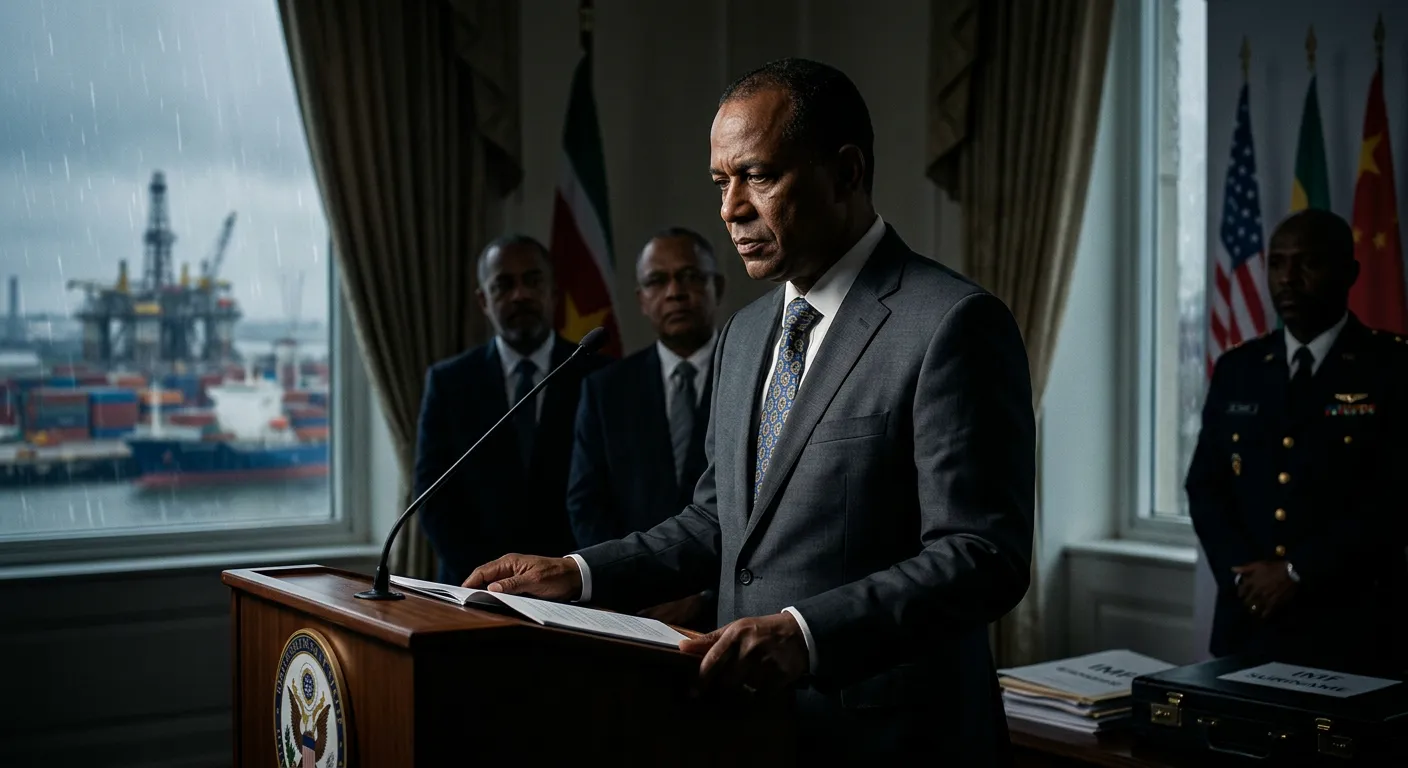
Suriname's New President Inherits a Petro-State Balancing Act
Geerlings-Simons takes power at the intersection of an oil boom, IMF austerity hangover, and intensifying US-China competition for influence in South America's smallest state.
On July 6, 2025, Suriname's National Assembly elected Jennifer Geerlings-Simons as the country's first female president, installing the National Democratic Party (NDP) at the helm of a six-party coalition with 34 of 51 seats Al Jazeera. The 71-year-old physician and former parliamentary speaker inherits a country that completed its IMF program just months earlier — and that expects to begin pumping offshore oil at 220,000 barrels per day by 2028.
The change in government matters less for what Suriname's foreign policy is than for who now controls it. The Model Diplomat country profile makes clear that under Suriname's constitutional system, the presidency dominates external policy — and that coalition arithmetic constrains how far any leader can move Model Diplomat. Geerlings-Simons commands a fragile coalition spanning ideologies from the left-nationalist NDP to smaller centrist factions, meaning her foreign-policy room for maneuver is narrower than her electoral mandate suggests.
The Oil Overhang
Every diplomatic decision Paramaribo makes between now and 2028 will be read through the lens of Block 58. TotalEnergies and APA Corporation took final investment decision on the $10.5 billion GranMorgu project in October 2024, targeting an estimated 750 million barrels of recoverable oil Financial Times/GlobeNewswire. Staatsolie, the national oil company, holds an option to take up to 20% equity.
The IMF projects oil revenues could reach $3.1 billion annually by 2033 — roughly seven times current mineral revenues — transforming a $4.4 billion economy IMF Country Report No. 25/12. Geerlings-Simons has said little about how she will manage this windfall beyond promising tighter tax collection. Her predecessor, Chan Santokhi, had pledged a "Royalties for Everyone" program distributing $750 savings notes to every citizen — a promise the new government has neither endorsed nor scrapped
Al Jazeera.
This ambiguity is politically useful. The NDP's coalition partners will demand their share of oil patronage, while the IMF — which completed its ninth and final EFF review in March 2025 — expects the new government to resist "political and social pressure to relax fiscal policy" IMF Country Report No. 26/037. How Geerlings-Simons triangulates between coalition demands, IMF expectations, and the sheer scale of incoming revenue will determine whether Suriname follows Guyana's breakneck growth trajectory or succumbs to the resource curse.
The China Question
The NDP's return to power revives an uncomfortable dynamic for Washington. The party was founded by the late Dési Bouterse, a former military dictator who positioned Suriname as one of China's most reliable partners in the hemisphere. Under Bouterse, Suriname joined the Belt and Road Initiative in 2019, and Chinese firms — Zijin Mining, PetroChina, China Aluminum Corporation — have since embedded themselves deeply in the country's extractive sector, acquiring gold assets for $360 million and bauxite operations for $426 million under the Santokhi government itself CSIS.
Yet Geerlings-Simons has not revived Bouterse's ideological anti-Americanism. CSIS notes that her government has "maintained a cooperative stance toward Washington" CSIS. Secretary of State Marco Rubio visited Paramaribo in April 2025, explicitly offering "benefits" for countries that align with the US. The NDP-led government has an incentive to keep both channels open: Chinese capital for infrastructure and mining, American goodwill for energy investment and security cooperation.
The UN voting record reflects this hedging. In February 2025 — before Geerlings-Simons took office but after the election results were clear — Suriname voted in favor of the UN General Assembly resolution condemning Russia's invasion of Ukraine, joining 93 countries including the European bloc, rather than abstaining like most of the non-aligned world Al Jazeera. This was not a Bouterse-vintage vote. It signals that whoever governs Suriname, small-state pragmatism — not ideology — drives the UN calculus.
What to Watch
Three decision points will define Suriname's foreign-policy trajectory over the next 12 months. First, whether Geerlings-Simons resolves the arrears on $476 million in Chinese infrastructure debt — a liability that gives Beijing leverage but also constrains new borrowing. Second, how Staatsolie exercises its 20% equity option in GranMorgu, which requires debt financing the IMF has already flagged as needing a carve-out from fiscal rules. Third, whether Alberto Ramdin — Suriname's former foreign minister, elected OAS Secretary General in March 2025 — uses his platform to amplify or moderate the hemisphere's pushback against US pressure.
Suriname matters now because oil makes it matter. The country of 634,000 people sits on reserves that will reshape its fiscal future. Who helps Paramaribo manage that transformation — Washington, Beijing, or both — is the contest to watch.
Discover more
India
Rajnath Singh's Durga Squad for 2026 Polls
Rajnath Singh's Durga Squad promised women's safety in Bengal but has since disappeared from the agenda, revealing BJP's true priorities.

US Politics
SNAP Food Assistance Faces Legal Challenges
In 2026, SNAP faces stricter eligibility rules and mounting legal challenges, threatening food assistance for the millions of Americans who rely on the program.
Global Politics
Trump's Conflicting Messages on Iran War
Trump's mixed messages on Iran reflect a strategy of audience management, benefiting Tehran amid a complex geopolitical landscape.

Conflict & Security
Drone Warfare Killing Aid Workers at Unprec
Over 1,000 humanitarian workers killed in three years as cheap armed drones collapse legal protections. Gaza, Sudan, Ukraine, and DRC see deliberate targeting of aid convoys and hospitals with zero prosecutions.