Supreme Court Reviews Election Commission Law
Court examines implications of new election commission law.
Model Diplomat3 min readAsia
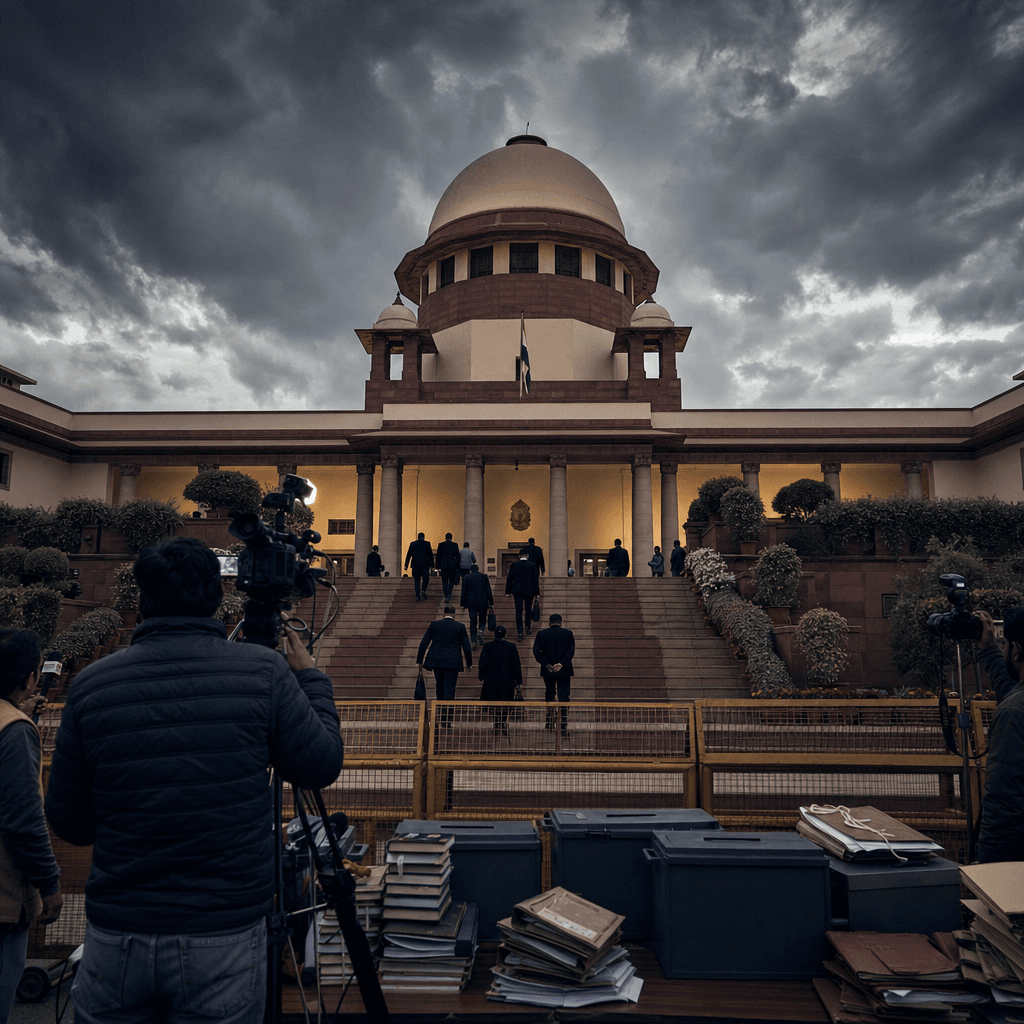
Supreme Court Tests EC Appointments Law’s Limits
The court is probing whether its 2023 fix was only a stopgap. If so, Parliament’s new law survives; if not, the executive’s grip on EC appointments comes back under attack.
The Supreme Court on Wednesday pushed straight at the core of the challenge to the Chief Election Commissioner and Other Election Commissioners (Appointment, Conditions of Service and Term of Office) Act, 2023: was the court’s own 2023 appointment formula meant only to fill a legislative vacuum, or did Parliament have to legislate in line with its principles? Justice Dipankar Datta asked whether the earlier Constitution Bench judgment in Anoop Baranwal was “for a short period till the law is made,” and whether the new law must still follow those observations (
The Indian Express).
The leverage lies with the executive
That is the real power contest. Under Article 324(2), appointments to the Election Commission are subject to a law made by Parliament; in March 2023, the Supreme Court filled the gap by directing that the CEC and ECs be chosen by a panel of the Prime Minister, the Leader of Opposition, and the Chief Justice of India until Parliament acted (The Hindu). Parliament then enacted the 2023 law, but replaced the CJI with a Union Cabinet minister nominated by the Prime Minister, leaving the selection committee with a government majority of 2-1 (
The Indian Express;
Business Standard).
That structure clearly benefits the incumbent government. It preserves formal compliance with the Supreme Court’s direction to create a law, but keeps the appointment process inside the executive’s orbit. The petitioners — including Congress leader Jaya Thakur, the Association for Democratic Reforms and Lok Prahari — argue that is precisely what the 2023 judgment was meant to end (The Indian Express;
Business Standard).
What the court is really deciding
The court is not just weighing a recruitment rule. It is deciding whether a constitutional bench can lay down a temporary governing standard and expect Parliament to preserve its substance, or whether a statute can reset the field once enacted. Senior advocate Gopal Sankaranarayanan’s line — that Parliament could undo Anoop Baranwal only through a constitutional amendment — reflects the petitioners’ larger bet: that ordinary legislation cannot restore executive primacy over an institution meant to referee elections (The Indian Express).
For the government, the advantage is obvious: if the court treats the 2023 judgment as temporary, the law stands and the current appointment system holds. For the opposition and election-reform groups, the prize is bigger: a ruling that forces a genuinely insulated selection mechanism for the Election Commission, a key institution for India’s electoral credibility and, more broadly,
Global Politics.
What to watch next
The immediate test is whether the bench treats the 2023 judgment as a stopgap or a constitutional benchmark. The hearing was set to continue on Thursday, and any indication from the court on whether Parliament has crossed a line will shape not just this case, but the next fight over how far legislatures can dilute court-made safeguards by statute (The Indian Express;
Business Standard).
Discover more
India
CPI(M) Calls to Decouple Quota from Delimita
CPI(M) demands the Indian government to separate quota policies from delimitation to enhance representation for marginalized communities.
Global Politics
Iran Demands US Enforce Ceasefire
Iran insists the US must enforce a ceasefire in Lebanon to uphold the MoU.
India
India Takes Vice-Presidency at FATF
India's Vivek Aggarwal becomes FATF vice president, paving the way for future leadership.

Global Politics
Israel's Red Sea Gambit: Why Somaliland
Israel's partnership with Somaliland aims to counter Houthi threats and enhance Red Sea influence.