Sudan Army Retakes Al-Kurmuk, Cuts RSF Supply
SAF's recapture of Al-Kurmuk impacts RSF's operations.
Model Diplomat7 min readAfrica
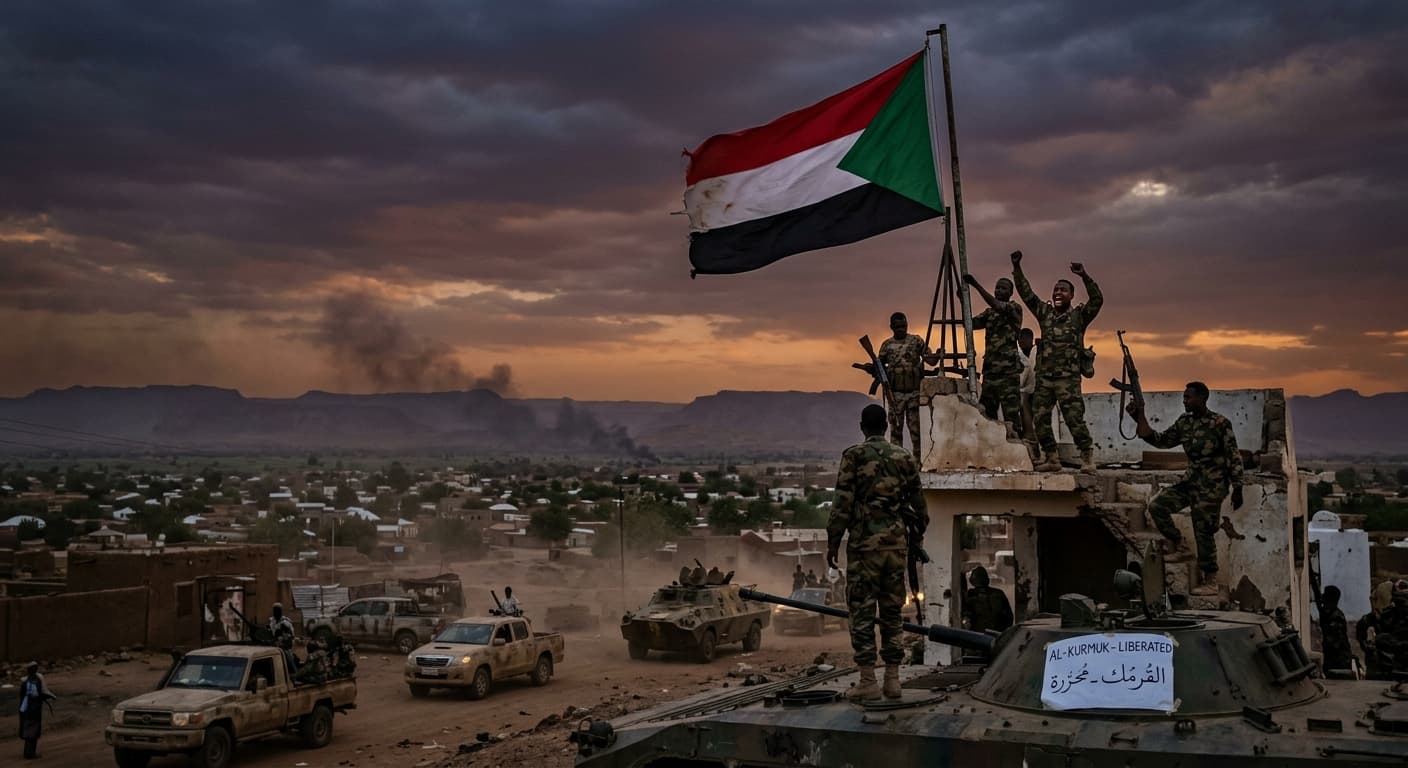
Sudan Army Retakes Al-Kurmuk, Cutting RSF's Ethiopia Corridor
Sudanese Armed Forces recaptured Al-Kurmuk in Blue Nile State on July 8, 2026, closing an RSF cross-border supply route as UN investigators warn of impending atrocities in El Obeid.
The Sudanese Armed Forces (SAF) said on July 8, 2026, that they had "liberated" Al-Kurmuk, the Blue Nile State border town the Rapid Support Forces (RSF) and their Sudan People's Liberation Movement-North (SPLM-N) allies had held since March. The recapture matters less for the terrain it returns to Khartoum than for what it takes away from the RSF: a graveled corridor to the Ethiopian frontier that, according to The Economist, had for the first time allowed the paramilitary to stage a Sudanese offensive from deep inside a neighbour's territory. The move tightens the SAF's eastern flank at the exact moment UN investigators warn the RSF is preparing to do to El Obeid what it did to El Fasher.
What Khartoum announced, and what it does not yet control
In a statement released on Facebook, the Sudanese government said its forces, "alongside allied forces, seized the town after what it described as fierce fighting that ended in the army's favour," according to The Eastleigh Voice. The military affirmed that "protecting civilians, working to restore essential services, and creating the conditions necessary for the return of normal life are priorities for the coming phase." The RSF has not commented.
The claim follows a two-month grinding advance up the Blue Nile-Ethiopian frontier. On May 16, 2026, SAF took Khor Hassan, the last significant approach town before Al-Kurmuk. Al Jazeera reported at the time, citing the Sudan Tribune, that the operation was explicitly "part of the army's strategy to recapture the town of Kurmuk," which controls a "vital corridor for cross-border trade" and access to the Al-Roseires Dam — Sudan's largest hydroelectric facility.
Independent battlefield verification remains limited. In 2011, when SAF last took Kurmuk from SPLM-N, rebel spokesman Sulaiman Othman told Reuters via BBC News that his forces had "pulled out of the town for strategic reasons," adding: "The Sudanese army controls Kurmuk but this is not the end of the war in Blue Nile." That precedent — a garrison town that changes hands but not the war around it — is the frame analysts are watching now.
Why Al-Kurmuk is worth more than its population
Al-Kurmuk is a garrison town of a few thousand people, but sits on three overlapping geographies that make it disproportionately valuable.
First, it is a border town. The RSF used it, after the March 2026 seizure, as a rear area accessible from Ethiopia's Benishangul-Gumuz region. The American Enterprise Institute's Liam Karr and Cameron Hudson documented "a surge in suspected Emirati-linked weapons shipments and possible mercenary deployments to Ethiopia" beginning in late 2025, with open-source intelligence tracking at least one shipment to the Sudan border. Losing Al-Kurmuk closes the near end of that pipe. Sudan has already recalled its ambassador from Addis Ababa and accused Ethiopia of enabling drone attacks flown out of Bahir Dar airport, per
Al Jazeera.
Second, Blue Nile is the RSF's shortest path back to Sudan's centre. In its April 2026 briefing Divided Sudan, Elusive Peace, the International Crisis Group noted the RSF "is also trying to widen a new front in the south east, in Blue Nile state, jutting between the borders with South Sudan and Ethiopia," partly to offset SAF pressure in the Kordofans. RSF leader Mohamed Hamdan "Hemedti" Dagalo said as much on a Uganda visit cited by the
BBC: "The distance there is short. It's not like Darfur."
Third, the town is the political spine of the SPLM-N. Kurmuk was the SPLM-N's headquarters town in the 2011–12 border wars, and its capture by the RSF-SPLM-N alliance in March 2026 was the alliance's most concrete territorial payoff since the two groups signed the Tasis (Foundation) charter. Losing it back is a political embarrassment for Abdelaziz al-Hilu, deputy chair of the RSF-led parallel government proclaimed in Nyala in August 2025, International Crisis Group reported.
The humanitarian ledger
Recapture does not equal safety. In the four months before the SAF took the town back, Al-Kurmuk locality was the single largest source of new displacement inside Blue Nile State. The International Organization for Migration's Displacement Tracking Matrix recorded 30,025 people newly displaced from Al Kurmuk between January 11 and May 21, 2026 — half of them children, and 53 percent female. Total Blue Nile State displacement in that window rose 21 percent to 59,742 people. Most sheltered in informal gathering sites in Ed Damazine and Baw.
The town's hospital was looted by RSF fighters on March 25, 2026, its equipment destroyed and patients expelled, according to reporting by Al Jazeera citing Sudan's Emergency Lawyers. Any "restoration of essential services" the SAF now promises begins from that baseline.
The nationwide picture remains catastrophic. The UN Office for the Coordination of Humanitarian Affairs' 2026 Response Plan records 9.3 million people internally displaced and 4.4 million refugees in neighbouring countries. At least 59,000 have been killed and 33.7 million require humanitarian assistance.
The El Obeid problem the recapture does not solve
Even as Khartoum celebrated Al-Kurmuk, the UN Independent International Fact-Finding Mission for Sudan issued its starkest warning of the war. In a statement carried by UN News on July 8, mission chair Mohamed Chande Othman said the RSF is deploying in and around El Obeid the exact tactics documented in El Fasher.
"The patterns we documented in El Fasher — including encirclement, attacks on civilian infrastructure, restrictions on humanitarian access, and widespread abuses against civilians — serve as a stark warning. The international community must heed these lessons and act to prevent further catastrophe."
The mission's February 2026 report, Sudan: Hallmarks of Genocide in El-Fasher, found that RSF forces killed more than 6,000 people in three days after breaking the city's 18-month siege in October 2025. On July 6, 2026, the Human Rights Council adopted a resolution extending the mission's mandate to investigate El Obeid.
The UN human rights chief, Volker Türk, on July 3 said El Obeid has faced "siege-like conditions" for 18 months, with UN monitors verifying 15 drone strikes killing at least 45 civilians in a three-week window in June. Save the Children reported that more than 11,000 people, including 5,500 children, fled the city in the two weeks to July 6, Al Jazeera noted, and UN officials warn that up to 500,000 civilians could be at immediate risk.
That is the real strategic accounting of July 8. The SAF has closed a supply door in the southeast. The RSF is opening a killing floor in central Sudan. The two events are connected: with the Blue Nile pipeline constrained, RSF pressure on the SAF's western positions — El Obeid, Kadugli, Dilling — becomes the paramilitary's clearest path to leverage in any negotiated settlement.
Regional stability: a narrower window, not a wider one
The optimistic reading in Port Sudan is that Al-Kurmuk closes off Ethiopia as a viable RSF base and reduces the risk of a Sudan-Ethiopia proxy war. That reading is thin. Chatham House's April 2026 briefing noted that fighting has moved to "the country's centre and southeast: in the three Kordofan states as well as Blue and White Nile" — meaning the front is broadening, not narrowing.
The Italian Institute for International Political Studies warned in April 2026 that Middle Eastern turmoil has "drastically reduced the willingness of regional actors to invest political capital in peripheral scenarios" — including the Quad mediation mechanism of the US, Egypt, Saudi Arabia and the UAE. The likely outcome of the SAF's Blue Nile push is therefore a squeezed but not defeated RSF pivoting hard to Kordofan, with UAE-supplied Chinese CH-95 drones — as
BBC reporting has documented — carrying the offensive.
The German Konrad-Adenauer-Stiftung's April 2025 analysis of Sudan's fragmented alliances is worth revisiting here: the SPLM-N split in 2017 between al-Hilu's South Kordofan faction and Malik Agar's Blue Nile faction. Agar today sits on Sudan's Sovereignty Council as al-Burhan's deputy. The taking of Al-Kurmuk is, in that sense, one SPLM-N faction reclaiming its historic capital from the other — a civil war within a civil war, running underneath the SAF-RSF headline.
What to watch
- UN Security Council action on El Obeid: Volker Türk has publicly called for "urgent Security Council action" and cooperation with the ICC. Watch for whether the UK or US, as penholders, table a resolution before the RSF's encirclement of El Obeid becomes an assault.
- The Al-Roseires Dam corridor: With Al-Kurmuk retaken, SAF's next logical objectives are the localities of Geisan and Baw, which control the road to Ed Damazin and the dam. IOM has already flagged both as displacement hotspots.
- Ethiopia's diplomatic response: Sudan recalled its ambassador from Addis Ababa in May. Watch whether Ethiopian PM Abiy Ahmed publicly disavows RSF operations from Benishangul-Gumuz or doubles down; Addis Standard reported on July 8 that Abiy accused Tigrayan youth of being forcibly recruited to fight in Sudan.
- The Quad's next round: A ceasefire round involving Egypt, Saudi Arabia, the UAE and the US last convened in late July 2025 without SAF or RSF at the table. A follow-up is expected but unscheduled; UN envoy Pekka Haavisto's schedule is the leading indicator.
The Bottom Line
The recapture of Al-Kurmuk shows that the SAF, armed with new drone capacity and a hardened alliance with Egypt and Eritrea, can still take ground on Sudan's eastern flank — but the RSF has already redeployed westward and is executing the El Fasher playbook against El Obeid, where the UN Fact-Finding Mission on July 8 warned of an impending "next crime scene." For Sudan, Al-Kurmuk is a tactical victory that closes one border pipeline while a mass-casualty siege ripens 700 kilometres to the west. Regional stability turns not on whether Khartoum holds Blue Nile, but on whether the
Security Council and the ICC act on El Obeid before the RSF's encirclement becomes an assault.
Discover more

US Politics
House Ethics Committee Pushes Sexual Miscond.
The House Ethics Committee has shifted responsibility for sexual harassment settlement records to the Office of Congressional Workplace Rights, complicating disclosure efforts.

Global Politics
U.S. Naval Blockade Heightens Iran Tensions
The U.S. naval blockade of Iran collapsed oil exports, creating a new maritime regime in Hormuz that favors Tehran.
US Politics
Congress Targets AI Chatbot Access for Terror
The House passed the Generative AI Terrorism Risk Assessment Act, focusing on AI's role in terrorism and potential surveillance implications.

Economics
Fed's Amex AML order puts correspondent banking on notice
Federal Reserve's Amex AML order requires board-level controls and a 90-day plan; OCC fined the bank $350 million over enterprise-wide deficiencies.