South Sudan's Youth Demand Political Change
Children push for a voice as elections face delays
Model Diplomat7 min readAfrica
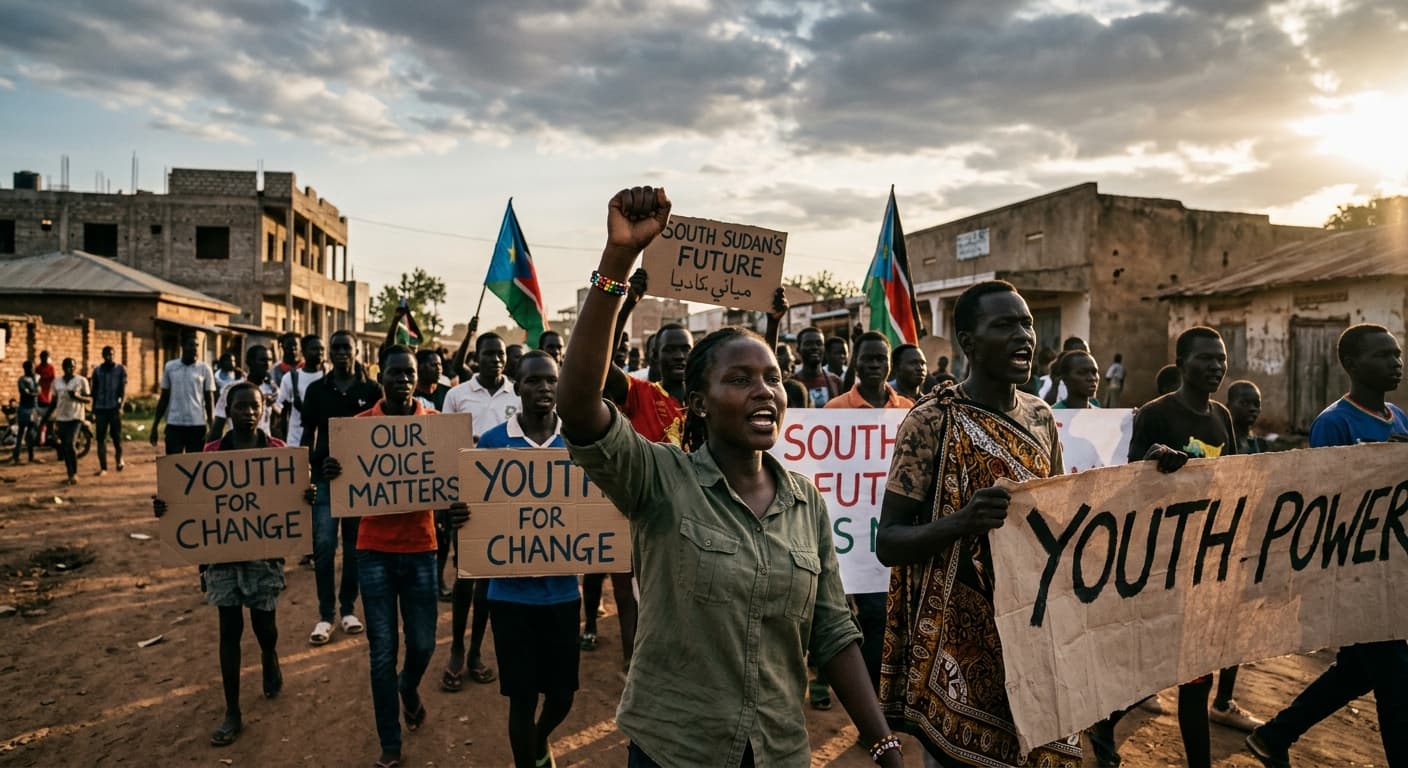
South Sudan at 15: The Children Demanding a Seat at the Table
A generation born into independence has never voted, never known peace, and — as elections slip again to December 2026 — is now building parallel institutions to force their leaders to listen.
Fifteen years after South Sudan raised its flag, the country's demographic centre of gravity has flipped against the men who built it: roughly 45% of the population is under 15 and 65% is under 25, according to a Konrad-Adenauer-Stiftung country profile drawing on national statistics, giving South Sudan a median age of about 17. The thesis of this anniversary is simple and unflattering to Juba's ruling class. The independence generation is aging out of legitimacy while a child-majority electorate — 70% of whom are out of school — is beginning to organise politically for the first time, from UN-backed "Hear Us, Act Now" rallies in Yambio to a Children's Parliament in Kapoeta that now broadcasts weekly on Eye Radio. Whether the December 22, 2026 vote happens or slips a fifth time, the youth pressure is the one new variable in a system Kiir and Machar have otherwise frozen in place since 2018.
A generation raised on postponement
Salva Kiir has been president for the entire life of every South Sudanese under 15. The country's leaders "have not been tested at the ballot box since independence in 2011," the BBC noted when electoral chief Abednego Akok Kacuol confirmed the December 22, 2026 date — the fourth postponement of a vote that was originally scheduled for 2015, then 2022, then 2024. The transitional period was extended to February 2027 in September 2024, a step UN Special Representative Nicholas Haysom, in remarks
to the Security Council, called "inevitable but regrettable given the deep frustration and fatigue felt by the South Sudanese people at the apparent political paralysis."
That paralysis curdled into open confrontation. In March 2025, First Vice President Riek Machar was placed under house arrest; by September he faced charges of murder, treason and crimes against humanity. A Juba court rejected his bid to halt the trial on September 29, 2025, the BBC reported. Al Jazeera's Joseph Falzetta wrote in October 2025 that a conviction would bar Machar from office under the provisional constitution — precisely the outcome,
his camp believes, the prosecution is engineered to produce ahead of the 2026 vote. In December 2025 opposition forces seized government outposts in Jonglei; the army retaliated in late January 2026, prompting the International Crisis Group to declare the country had "returned to war." The UN's Commission on Human Rights in South Sudan warned in February that the country risks "a return to full-scale war,"
Al Jazeera reported, citing 280,000 newly displaced.
The generation caught in this fifth breakdown of the peace has no memory of the fourth, third or second. They have grown up with the postponement itself as the country's dominant political fact.
What "youth voice" actually looks like in 2026
The organised expression of that generation is no longer confined to talk shops. On July 7, 2026 in Yambio, capital of Western Equatoria State, UNMISS and the state government launched the "Hear Us, Act Now" campaign explicitly positioning children and adolescents as peacebuilding principals rather than beneficiaries. Student Gamboripai Flora opened proceedings by singing "Oh, peace, we have been looking for you day and night," according to Ghana Eye Report. Civil society representative Emmanuel Wanga framed the shift bluntly: "Youth have been used for a long time as perpetrators of conflict. Now they are taking the lead in calling for peace. That is already a sign of transformation."
In Kapoeta, Eastern Equatoria, Save the Children ran a June 2026 workshop with 57 members of Child Rights Clubs and a Children's Parliament — 34 girls and 23 boys — funded by the EU's INTPA programme. According to Access Radio Yei, the children produced advocacy messages that have been formally transmitted to the Speaker of the Children's Parliament, who now hosts a live weekly programme on Eye Radio in which young parliamentarians question officials. That is not symbolism: it is a parallel accountability channel, on public airwaves, that did not exist for the independence generation.
In Juba, Eye Radio's African Child Day coverage recorded a specific policy ask: pupils demanded that the government increase education spending, reduce school fees, and improve teacher welfare. Thirteen-year-old Edward Tongo, quoted
by the same broadcaster, openly questioned "what independence has delivered." These are not vague peace sentiments; they are budget demands from voters who cannot yet vote.
The numbers under the slogans
The humanitarian ledger explains the anger. The World Bank's country brief projects that in 2026, more than 10 million people — two-thirds of the population — will require humanitarian assistance, per its country page. The WHO's 2026 Health Emergency Appeal puts 6.3 million people in need of health assistance amid cholera, measles and mpox outbreaks,
according to its published appeal. In April 2026, UN humanitarian chief Tom Fletcher
told the Security Council he feared his next briefing would speak of famine.
Education is the load-bearing failure. South Sudan's own National Report to the UN Office of the High Representative for the Least Developed Countries acknowledges that an estimated 2.8 million children are out of school, that only 15% complete primary and 8% complete secondary, and that adult literacy stands at 34.5%, per the government submission. Amnesty International's March 2026 public statement recorded that "70% of children, most of them girls, were out of school" as of late 2025,
in its filing to the Human Rights Council. The 2026 "Back to Learning" initiative aims to reach 900,000 learners and build 3,300 classrooms — an ambitious plan whose credibility, on the government's own admission, hinges on school-feeding programmes competing with the hunger crisis for a child's attention.
Britain's Foreign Office has hedged its bet accordingly. In January 2026 it closed submissions for the Education for All South Sudan (EFASS) programme — a £27 million grant over four years targeting the most vulnerable out-of-school children, according to the GOV.UK notice. EFASS shifted from the nation-wide model of its predecessor to a "hybrid" targeted approach — a quiet acknowledgement that donor capacity to scale across a fragmenting state is receding.
Why the political class is suddenly listening — a little
Youth organising alone is not moving Kiir or Machar. What is moving them is that international patience and international money are contracting simultaneously. The Stimson Center's July 16, 2026 panel, "A Nation at 15: South Sudan, Peacekeeping, and the UN Funding Crisis," frames the anniversary in exactly those terms: UNMISS capabilities are shrinking, Sudan's civil war is bleeding across the border, and Iran, Ukraine and Gaza are pulling attention away. Chatham House's April 2025 assessment argued that Kiir "used this time to consolidate power and sideline the opposition," dismissing SPLM-IO governors and elevating US-sanctioned businessman Benjamin Bol Mel to vice president and deputy SPLM chair,
in its analysis of R-ARCSS.
In that environment, youth-led civic energy is one of the few assets donors can still fund credibly. UNMISS chief Anita Kiki Gbeho — appointed in April 2026 after the death of Nicholas Haysom, per the Secretary-General's announcement — has continued Haysom's line that constitution-making and civic education must include "IDPs and refugees, women, youth, persons with disabilities and other marginalized communities." Haysom's earlier Security Council briefing was more pointed:
"Slow implementation comes at a cost. Peace dividends remain elusive. Nowhere is this more clearly reflected than in the frustration of marginalized youth, many of whom have joined tribal militias — as we see in Jonglei and the Greater Pibor Administrative Area — or channel their anger at humanitarians and peacekeepers."
That is the UN's own record, and it captures the strategic point. The same youth demographic can be organised into a peace constituency — as in Yambio and Kapoeta — or into militias and gangs, as Al Jazeera documented in Malakal where 22-year-old gang member "Akol" told a reporter, "If I had a job, I would not be in a gang,"
in its March 2025 feature. Which way it breaks is the single most consequential political question of the next 18 months.
The historical parallel Juba should fear
Radio Tamazuj columnist Lilian Riziq, in her July 2026 opinion piece, argued that South Sudan should be compared not to Western democracies but to Ghana in 1957 or Rwanda after 1994. That is the parallel Juba's political class should fear most: Ghana's independence generation eventually pushed a founding party out through the ballot box; Rwanda's post-genocide state was built on the explicit premise that youth without opportunity become a security threat. South Sudan's leaders absorbed the threat lesson and discarded the opportunity half.
What to watch
- December 22, 2026 — Scheduled first-ever national elections. Kacuol has already flagged funding and legal gaps; a fifth postponement would test both the R-ARCSS framework and international donor patience.
- Machar verdict. A conviction bars him from office under the provisional constitution. Timing is the single largest variable in whether the SPLM-IO participates or the country splits again along Dinka-Nuer lines.
- February 2027 — End of the extended transitional period. UNMISS has said the clock "does not reset." If key benchmarks — unified forces, voter registration, constitutional drafting — are not met, the mission's mandate renewal debate at the Security Council will be sharper than at any point since 2013.
- South Sudan Humanitarian Fund and EFASS disbursements through 2027. These are the two channels through which youth-led civil society is being systematically capitalised. Watch which counties get money — and which are cut off by fighting in Jonglei and Upper Nile.
The Bottom Line
South Sudan's fifteenth anniversary is not a story about Kiir and Machar. It is the first year in which the country's under-25 majority — 65% of the population, most of them out of school, none of them ever having voted — has begun to build parallel institutions, from Children's Parliaments to radio accountability shows, that speak in their own name. If the December 2026 vote holds, that generation becomes an electorate the ruling class cannot manage. If it slips again, the same demographic becomes the recruitment pool for the next war. Juba's political elite has 18 months to decide which one it wants.
Discover more

US Politics
White House Pressures Congress for Crypto Leg
The Trump administration's push for the CLARITY Act aims to reshape crypto regulation, impacting trillions in market value and the Trump family's wealth.
India
Women’s Reservation in India
India's 33% women's reservation law is enacted but won't take effect until after 2029 due to political setbacks and census delays.
India
Women's Reservation Bill 2026: A Political Sh
India's Lok Sabha rejected the Women's Reservation Bill, exposing a political maneuver to redraw electoral maps favoring the north over the south.

Economics
Fed's Amex AML order puts correspondent banking on notice
Federal Reserve's Amex AML order requires board-level controls and a 90-day plan; OCC fined the bank $350 million over enterprise-wide deficiencies.