South Korea Secures UAE Oil Supply Pact
Seoul and ADNOC forge a strategic energy alliance
Model Diplomat7 min readAsia
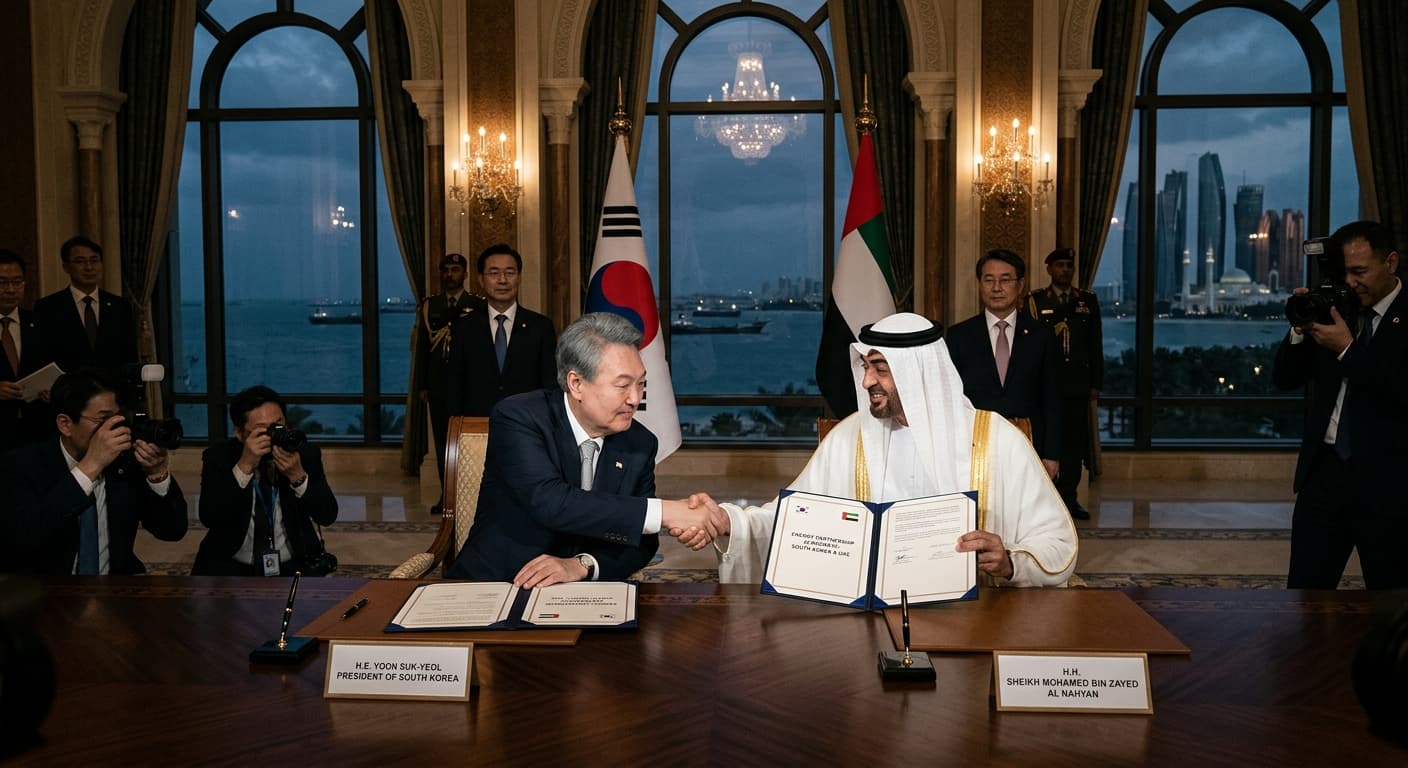
South Korea locks in UAE oil supply as Hormuz stays broken
Seoul and ADNOC signed a strategic oil supply chain pact on July 8, 2026 — turning a wartime scramble into a permanent Fujairah-anchored energy security architecture.
South Korea and the United Arab Emirates on July 8, 2026 signed a Strategic Cooperation Agreement on Oil Supply Chain that converts four months of emergency crude purchases into a permanent alliance — and quietly writes the epitaph for the country's climate-first energy plan. The pact between Seoul's Ministry of Trade, Industry and Energy (MOTIE) and Abu Dhabi National Oil Company (ADNOC), reported by Aju Press, commits both sides to joint stockpiling, emergency response, and infrastructure that bypasses the Strait of Hormuz. It matters because it locks Asia's fourth-largest economy into hydrocarbon dependency for the decade after the Hormuz closure — and because it hands ADNOC, freshly out of OPEC, a captive high-value refining customer at the precise moment it is racing China and India for the same barrels.
What was actually signed
Industry Minister Kim Jung-kwan met ADNOC group CEO Sultan Al Jaber in Seoul on the morning of July 8, and the two governments signed what MOTIE calls a framework "that can function effectively even in crisis situations such as conflicts in the Middle East," according to Aju Press. Three tracks sit inside it. The first is stable long-term supply — an evolution of the 4-million-barrel joint stockpiling arrangement Seoul already ran with the UAE, described in the Gulf Research Center's
country profile. The second is an AI track linking ADNOC's oil-wide AI strategy to Korea's M.AX manufacturing-AI programme and the Ulsan–Mipo petrochemical AI transformation. The third — and the one the
Korea Herald op-ed from Ambassador Abdulla Balalaa flagged as the strategic prize — is Korean EPC participation in ADNOC's Hormuz-bypass build-out.
Kim's public message paired the deal with a warning. "Recent changes in the Middle East situation have entered a new phase, but securing the stability of key resource supply chains remains the most important task for our economic security," he said, per Aju Press. Translation: the June 17 US–Iran memorandum did not fix Hormuz, and Seoul is no longer waiting for it to.
Why Seoul is signing under duress
The context is a stress test South Korea failed publicly. Iran's response to the February 28, 2026 US–Israel strikes closed the Strait of Hormuz to any vessel without a fresh insurance re-price or an IRGC "toll," according to Brookings. The IEA calls the resulting shock the "largest supply disruption in the history of the global oil market," with more than 14 million barrels per day removed from circulation. About 70 percent of Korean crude imports pass through that strait;
RAND puts the exposure at up to 95 percent because most alternative Middle Eastern grades still route via Hormuz.
The numbers behind Seoul's panic are worse than the headline suggests. A CSIS analysis calculated that after Korea contributed 22.5 million barrels to the IEA's coordinated 400-million-barrel release on March 12, government-only strategic reserves fell to roughly 26 days of actual refinery throughput at 2.9 million bpd. That is not a strategic reserve; that is a rounding error. The emergency 24-million-barrel UAE procurement on March 18, reported by
ORF, bought Seoul another eight to nine days. The KOSPI took its worst single-session loss in 43 years; the won hit a 17-year low.
The result is that the UAE's share of Korea's crude jumped from 11.4 percent in 2025 to 14.6 percent by March 2026, per data compiled by Korea's KIEP. That is a structural, not cyclical, shift — and it explains why an emergency contract needed a treaty-style wrapper.
The Fujairah pivot — and who else is bidding
The pact's most consequential clause is what MOTIE calls "expansion of oil and gas storage and transportation facilities to bypass the Strait of Hormuz." That is code for the Fujairah corridor. ADNOC's Habshan–Fujairah pipeline runs 380 km outside Hormuz at 1.8 million bpd; a second West-East Pipeline, half complete as of May 2026 per Gulf International Forum, will double capacity to more than 3.6 million bpd by 2027. That is the single most important piece of energy infrastructure being built in the world today, and Seoul just secured design-and-build rights for its refiners and EPC contractors.
But the queue at Fujairah is crowded. India signed a Strategic Collaboration Agreement in May 2026 targeting UAE participation of up to 30 million barrels in India's strategic petroleum reserve, a near-fivefold increase, according to the Observer Research Foundation. China is drawing on the world's largest strategic stock — nearly 1.4 billion barrels, per
Brookings — and negotiating dedicated Fujairah loading windows. Japan began releasing from its 470-million-barrel reserves in March, according to
Al Jazeera. ORF's assessment is unsentimental: "In a supply scramble, proximity helps; it does not guarantee preferential access."
Seoul's leverage is industrial, not geographic. ADNOC's $2.5 billion order in July 2024 for 8–10 LNG carriers from Samsung Heavy Industries and Hanwha Ocean, and the February 2026
$65 billion strategic partnership covering defence, nuclear and high-tech, are what Seoul is cashing in. The UAE gets Korean shipyards and Korean EPC; Korea gets a seat at the Fujairah terminal.
The climate story nobody is telling
The overlooked dimension is what this pact does to Korean climate policy. President Lee Jae-myung took office in June 2025 on an "inclusive growth" agenda that assumed hydrocarbons could be gradually phased down. The Hormuz crisis annihilated that assumption. Carnegie documents the pivot in real time: the Ministry of Climate, Energy and Environment ordered nuclear reactors restarted ahead of schedule, coal caps were relaxed, and the government backtracked on its nuclear phase-out by approving two new plants.
The July 8 agreement writes that pivot into law. By locking Korea into UAE crude through joint stockpiling and infrastructure co-investment, Seoul is making a 10- to 15-year hydrocarbon bet at exactly the moment its 2030 climate targets require the opposite. The RAND policy game held in Seoul in September 2025 concluded that 70 to 80 percent of Korean refining capacity is optimised for Middle Eastern heavy crude — a lock-in that, per RAND, cannot be unwound without retrofitting Ulsan and Onsan complexes at a cost of tens of billions. S-Oil's Onsan refinery is 90 percent dependent on Middle Eastern feedstock because Saudi Aramco owns it; there is no unilateral Korean exit, according to
ORF.
The UAE, meanwhile, has decoupled from OPEC production discipline. Al Jaber told the Atlantic Council on May 20 that ADNOC is targeting 5 million bpd — a goal pulled forward by three years — with room to push to 6 million:
"We didn't move away from something. We moved towards something… demand for oil staying well above 100 million barrels into the 2040s, the world needs more of what the UAE produces."
That is the position Seoul just signed onto: a bet that Al Jaber is right and net-zero is wrong.
The primary document that anchors this
The US legal framing matters because it defines Seoul's constraint. A June 2026 Congressional Research Service report on Iran and the Strait notes that of the roughly 20 million bpd of crude that transited Hormuz pre-crisis, the destinations were "China, India, South Korea, and Japan" — the exact quartet now competing for UAE bypass capacity. The CRS also confirms that IEA spare capacity of 4.4 million bpd is largely stuck inside Hormuz, meaning conventional emergency mechanisms cannot compensate. That legal-analytical baseline is why Kim's ministry describes the July 8 agreement as an "oil security cooperation system" rather than a commercial supply deal: MOTIE is signalling to markets, allies and its own refiners that this is treaty-adjacent.
Combined with the Comprehensive Economic Partnership Agreement Seoul and Abu Dhabi signed in May 2024 — described in ISPI's analysis as eliminating tariffs on 90 percent of goods within a decade — the two countries now have the deepest bilateral energy-security architecture the UAE holds with any Northeast Asian state. Only India's ISPRL–ADNOC framework is comparably deep, and that one is anchored on Indian territory. Seoul's version is anchored on Emirati territory. The asymmetry matters.
Diplomat View
The consensus reading of the July 8 pact — that this is a routine deepening of a longstanding partnership — is wrong. Three specific developments make this a strategic rupture, not continuity. First, the UAE's May 1 OPEC exit means ADNOC now sells outside quota discipline; Korea is buying at the moment the seller has maximum flexibility to price against China and India. Second, Seoul is co-investing in Fujairah infrastructure it does not own, in a jurisdiction that has been hit by Iranian missiles at least twice in 2026, per RSIS — this is not diversification, it is concentration at a target. Third, the AI clause hides an industrial subsidy: Korean refiners, whose petrochemical margins are collapsing, get ADNOC digitisation contracts in return for locking in Emirati feedstock.
The forecast: by early 2028, UAE crude will supply at least 20 percent of Korean imports, and Seoul's 2030 nuclear-free renewables target will be formally abandoned. Revise this call if — and only if — Iran and the US finalise a durable Hormuz protocol before Q1 2027 and insurance markets normalise, or if Chinese SPR buying prices Korea out of Fujairah's second-pipeline capacity.
What to watch
- August–September 2026: MOTIE is expected to publish implementing details on joint stockpiling volumes; watch for a number above the existing 4 million barrels — anything at 10 million or higher confirms the "captive customer" thesis.
- Q1 2027: ADNOC's West-East Pipeline scheduled operational date. Slippage past mid-2027 blows up Al Jaber's own timeline and forces Seoul back into spot-market panic.
- Late 2026: Korean local elections. Lee's coalition faces its first electoral test since the fuel-cap subsidies; if his party loses on cost-of-living grounds, the UAE-anchored energy pivot accelerates.
- June 17, 2026 MoU review: The US–Iran Hormuz passage understanding has a 60-day review window per
BBC Korean; a breakdown puts every clause in the July 8 agreement into immediate operational use.
Seoul has spent four months learning that the Trump-era US alliance did not price Korean energy security into its Middle East calculations. The July 8 signature with Abu Dhabi is what happens next.
Discover more
US Politics
Congress Targets AI Chatbot Access for Terror
The House passed the Generative AI Terrorism Risk Assessment Act, focusing on AI's role in terrorism and potential surveillance implications.

US Politics
US Launches $166B Tariff Refund Portal
The US is launching a $166 billion tariff refund portal to aid importers hit by Trump-era tariffs, with major implications for trade and supply costs.
US Politics
SNAP Food Assistance Faces Legal Challenges
In 2026, SNAP faces stricter eligibility rules and mounting legal challenges, threatening food assistance for the millions of Americans who rely on the program.

Conflict & Security
Drone Warfare Killing Aid Workers at Unprec
Over 1,000 humanitarian workers killed in three years as cheap armed drones collapse legal protections. Gaza, Sudan, Ukraine, and DRC see deliberate targeting of aid convoys and hospitals with zero prosecutions.