Somalia's Hunger Crisis Silences GBV Services
Food insecurity impacts gender-based violence response.
Model Diplomat8 min readAfrica
Somalia's Hunger Crisis Is Silencing GBV and SRH Services
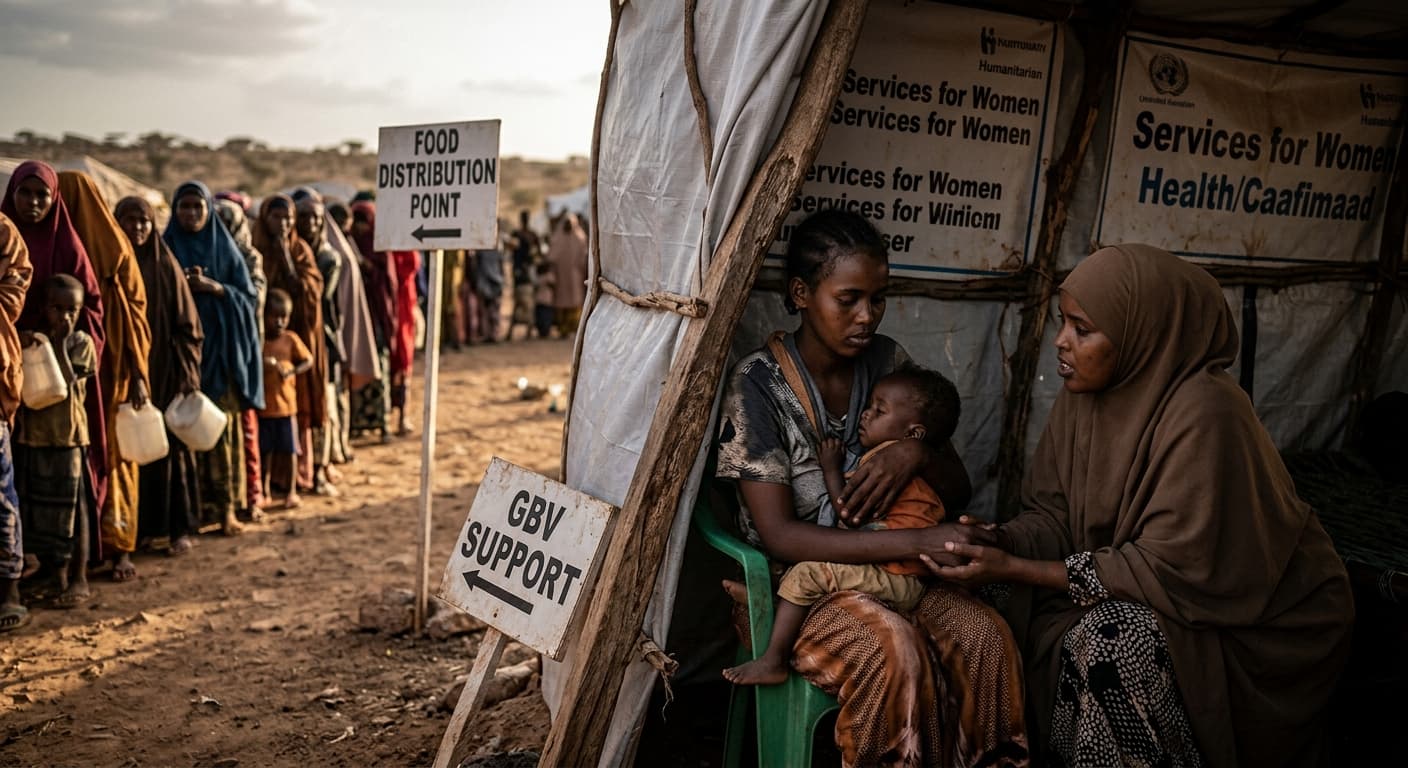
The closure of 120 women's safe spaces in Somalia has cut reported conflict-related sexual violence by 42% — a drop the UN links to lost reporting channels, not falling violence.
The 6.5 million Somalis in acute food insecurity dominate the wire copy, but the more consequential story sits one layer below the headline number. On February 20, 2026, the World Food Programme warned it would run out of money by April. On April 22, the UN Secretary-General's annual report on conflict-related sexual violence disclosed that 120 of Somalia's roughly 200 one-stop centres and women-and-girls' safe spaces had already closed, and reported cases had fallen 42 percent against 2024 — not because rape had declined, the report said, but because the reporting infrastructure had. The Somali hunger crisis is functioning as a delivery vehicle for the dismantling of the protection system built over a decade around it — sexual and reproductive health (SRH), gender-based violence (GBV) response, and youth reintegration — with second-order effects on al-Shabaab recruitment and Somalia's legal framework on sexual violence that will outlast the drought.
The primary shock: hunger returns to 2022 levels, coverage collapses to a fraction
The Integrated Food Security Phase Classification (IPC) analysis released in February 2026 confirmed 6.5 million people — a third of Somalia's population — at IPC Phase 3 or worse. More than 2 million are at IPC Phase 4 (Emergency). The World Bank's May 2026 Somalia Economic Update reported growth slowing to 3 percent in 2025, inflation projected at 6 percent in 2026, and poverty reduction stalled — the macro ledger of three consecutive failed rainy seasons.
Four UN agencies — OCHA, FAO, WFP and UNICEF — jointly warned on April 22 that famine risk had re-emerged for the first time since 2022, this time in agropastoral livelihoods in Burhakaba district, Bay region. Their joint news release stated:
"More than 500 health and nutrition facilities have been closed across the country due to lack of funding, with disease outbreaks not being controlled and mortality risks rising… Nearly 90 percent of people [are] receiving little or no support. The 2026 Somalia Humanitarian Needs and Response Plan is currently only 15.2 percent funded."
Coverage figures released by WFP in February 2026 capture the compression: emergency food beneficiaries down from 2.2 million to 600,000, and nutrition support for pregnant and breastfeeding women and young children slashed from 400,000 in October 2025 to 90,000 by December. In April 2026, the US State Department
suspended all assistance to the Somali government over a WFP warehouse dispute, and OCHA chief Tom Fletcher
told AFP that his Somalia programme had been cut from $2.6bn in 2023 to $852m for 2026 — a 67 percent reduction in three years. "Often we're having to choose which lives to save and which lives not to save," he said.

The secondary shock: the safe-space network is being wiped out
The most under-reported figure of 2026 sits in paragraph 57 of the UN Secretary-General's April 2026 report on conflict-related sexual violence. The UN Transitional Assistance Mission in Somalia (UNTMIS) verified conflict-related sexual violence against 201 girls and 21 women in 2025 — cases attributed to unidentified armed actors, al-Shabaab and clan militias. The report then notes:
"Funding cuts significantly affected monitoring and service delivery, requiring a reduction in geographical coverage. The closure of 120 one-stop centres and women's and girls' safe spaces nationwide left only 80 such facilities operating, which affected the provision of services for survivors of gender-based violence in rural areas, displacement settings and conflict zones and contributed to a 42 per cent decrease in reported cases of conflict-related sexual violence as compared with 2024."
Read in isolation, that 42 percent decline could pass as good news. The Secretary-General explicitly rules that reading out: reported cases fell because survivors have nowhere to report. UNFPA-supported one-stop centres are the entry point for clinical management of rape (CMR), post-exposure prophylaxis (PEP), emergency contraception and psychosocial support — the UK-funded IRC programme covering 39 facilities across Banadir, Bay, Mudug, Lower Shabelle and Galgaduud is one of the few surviving networks of scale, and UK support to Somali GBV organisations reached almost 130,000 women and girls between 2024 and 2025 alone.
The underlying risk is rising while capacity is falling. In Somalia, 99 percent of women aged 15–49 have undergone female genital mutilation, maternal mortality stands at 621 per 100,000 live births, and — per an
IMF selected-issues paper drawing on Somali National Bureau of Statistics data — an estimated 45 percent of girls are married before 18. The IMF paper is explicit that "poverty significantly contributes to child marriage, with low-income families marrying off their daughters as a harmful coping mechanism." Drought is that poverty, industrialised.
The knock-on: youth services, coping strategies, and the al-Shabaab bid
The collapse hits youth programming from both directions. UNICEF's 2026 Somalia appeal warns of a "reduction of at least 35 per cent in the number of functioning [health] facilities by mid-2026," with two-thirds of children already out of school. Save the Children's country director, Mohamud Mohamed Hassan, told AFP that more than 200 health centres and 400 schools have closed since 2025.
That closure has an operational customer. A UN Peacebuilding Fund evaluation of the IOM/UNICEF youth reintegration programme for young people formerly associated with al-Shabaab notes that "over 67 per cent of Somali youth in general and 74 per cent of Somali women are unemployed," and that "poverty and unemployment compel children and youth to opt for negative coping strategies such as joining armed groups." The Vivekananda International Foundation, drawing on Institute for Economics & Peace data,
reported in March 2026 that al-Shabaab is "offering a monthly salary and financial benefits to the recruits" in drought-affected areas — a direct arbitrage against the collapse of aid.
The BBC's reporting from displacement camps around Baidoa captured what that arbitrage looks like at household level. Halima Ibrahim Ali Mohamud, whose husband and four sons took paid militia work, told the BBC: "They were desperate, and when you are without food long enough, and your children are looking at you, you will do anything." Safe spaces and youth centres were the interruption in that chain. Their closure removes the only institutional interruption that existed.
The legal ratchet: a rape bill that omits consent
Behind the humanitarian arithmetic, a legislative process is quietly moving in the opposite direction. In November 2025, Somalia's Federal Parliament held the first reading of an "offences of rape and indecency" bill that the Secretary-General's report notes "omits absence of consent in the definition of rape and criminalizes adultery, contrary to international human rights standards."
The bill is the successor to the 2020 "Sexual Intercourse Related Crimes Bill" that UN Special Representative Pramila Patten had publicly urged Mogadishu to withdraw, in favour of the 2018 Sexual Offences Bill drafted with civil society. That 2018 bill — which would provide free health care for survivors and criminalise obstruction of justice — has sat with the House of the People since May 2018 without being tabled. Advancing a weaker bill during a humanitarian emergency — when survivor-serving civil society is starved of funding and unable to lobby at scale — is a documented pattern in post-conflict legislative cycles. The GBV coalition that pushed back on the 2020 draft is materially smaller in 2026.
The Somali federal state's own capacity is constrained by fiscal reality. Amnesty International noted in November 2025 that Somalia's health budget remains "less than 5% of overall government expenditure," well below the 15 percent Abuja Declaration target. This is the fiscal frame in which the UNTMIS handover to the Federal Government is now proceeding — with, per the SG's report, "no progress" on a national action plan implementing the 2013 Joint Communiqué on sexual violence.
Why this reads differently than 2022
Somalia has been here before. The World Bank's February 2026 statement on the activation of the National Preparedness Plan explicitly compared current conditions to 2011, 2017 and 2022–23. Two features distinguish 2026 from those precedents.
First, the funding baseline is not stretched — it has been cut. In 2022, WFP was reaching more than 4 million people at peak; in early 2026 it is reaching 600,000. The Council on Foreign Relations noted that in Somalia thirty districts no longer receive emergency food aid at all following US cuts, with supply chain disruptions from the US–Iran war compounding costs of therapeutic peanut paste. Somalia was excluded from Washington's $2bn humanitarian pledge for the year because of the WFP warehouse dispute — meaning the country most exposed to the funding collapse is also the one locked out of the largest available offset.
Second, protection services are being cut alongside — not after — food services. UN Women's 2020 review of GEEWG humanitarian funding in Somalia already showed GBV projects funded at 28 percent in the reference year — the lowest coverage of any cluster. In every previous drought, food and nutrition took the first cut and GBV/SRH survived. The 120 closed safe spaces are the sign that this donor sequencing has broken.
The Bottom Line
The bottom line: Somalia's 2026 crisis is not a repeat of 2022 dressed up in worse rainfall data — it is the first drought in a decade in which the survivor-serving protection network has been dismantled in parallel with the food pipeline, producing a statistical illusion of falling sexual violence that the UN itself now describes as a reporting collapse. If the "offences of rape and indecency" bill advances to a second reading while UNFPA-supported safe spaces remain shuttered, the legal and operational backbone of Somalia's GBV and SRH response will be measurably weaker at the end of this drought than at the start — a structural loss no next-cycle rainy season will reverse.
What to Watch
- Gu-season IPC update, expected mid-2026: The next IPC classification will confirm whether Burhakaba district in Bay region crosses into IPC Phase 5 (Famine). The April joint UN release conditioned that risk on failed Gu rains and continued underfunding of the response.
- Second reading, "offences of rape and indecency" bill: No date set. The UN Secretary-General has formally called for the Federal Government to withdraw the bill and revive the 2018 Sexual Offences Bill; a scheduled tabling in the House of the People is the trigger event.
- WFP funding gap, September 2026 pipeline break: WFP has stated it requires $95 million to sustain assistance through August 2026. Without new pledges by the July-August window, a further reduction from the current 600,000 caseload is projected by the agency.
- UNTMIS transition: The handover of UN mission responsibilities — including women's protection advisers and human rights monitoring — to the Federal Government of Somalia and UN Country Team is ongoing; the Security Council review in the second half of 2026 is the last formal checkpoint before the mission's mandate expires.
Discover more
Global Politics
US-Iran Tensions Rise
Tensions escalate in the Strait of Hormuz as Iran and the US clash over maritime control, with a ceasefire hinging on a contested MoU paragraph.

Global Politics
U.S. Naval Blockade Heightens Iran Tensions
The U.S. naval blockade of Iran collapsed oil exports, creating a new maritime regime in Hormuz that favors Tehran.
Global Politics
Xi Jinping Calls China-Russia Ties 'Precious'
Xi Jinping's description of China-Russia ties as 'precious' reflects a strategic imbalance, with Beijing dictating terms in the partnership.

Conflict & Security
Drone Warfare Killing Aid Workers at Unprec
Over 1,000 humanitarian workers killed in three years as cheap armed drones collapse legal protections. Gaza, Sudan, Ukraine, and DRC see deliberate targeting of aid convoys and hospitals with zero prosecutions.