Somalia Famine Risk Soars as US Aid Suspended
Six million face hunger as humanitarian funding dries up
Model Diplomat10 min readAfrica
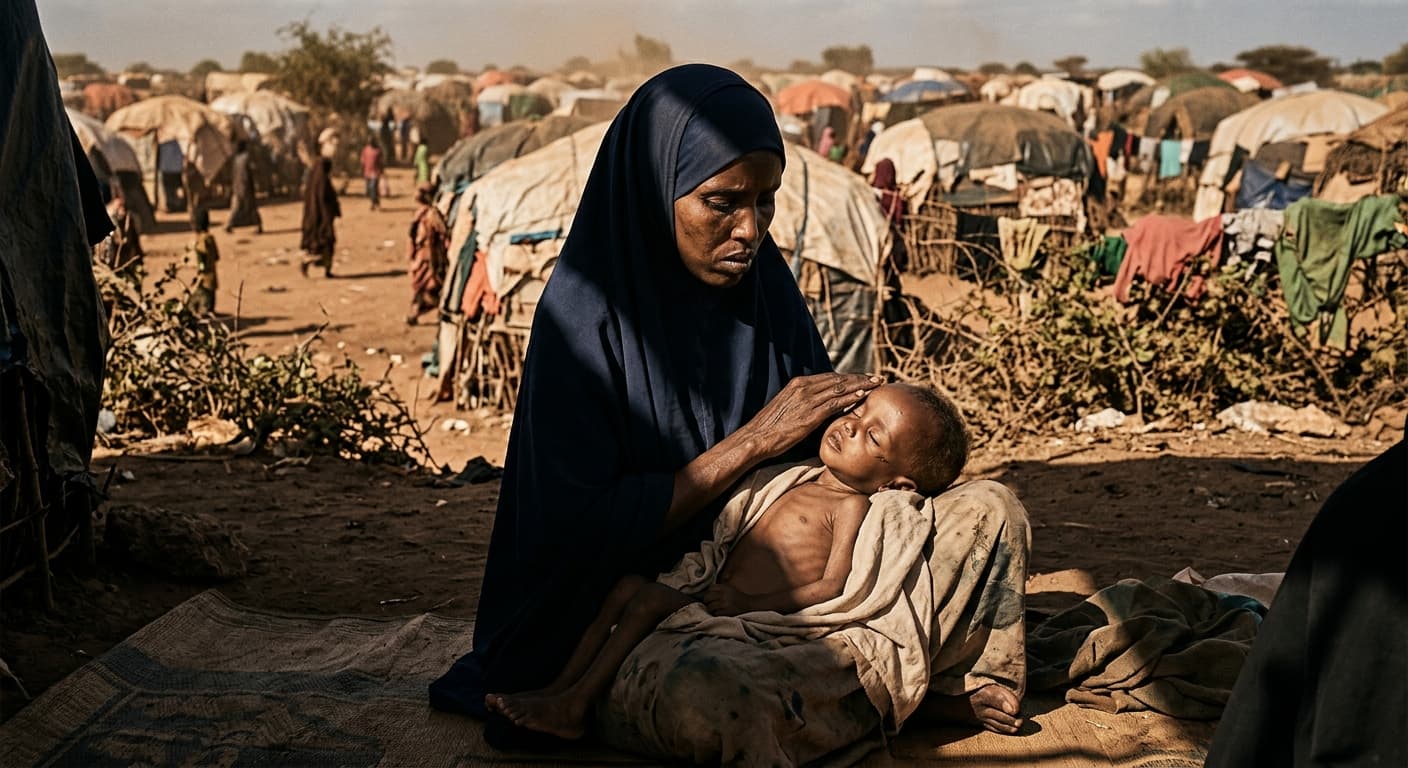
Fifteen Years After Famine Killed 258,000 Somalis, the Money to Stop the Next One Has Evaporated
In 2011, a quarter-million Somalis died in a famine the world saw coming but chose not to prevent. In 2026, the early-warning systems are better than ever — but the funding has collapsed, and the largest donor has walked away entirely.
The 2011 Somalia famine killed an estimated 258,000 people, more than half of them children under five. It was, by broad consensus, a preventable catastrophe: early-warning systems had flagged the crisis by late 2010, but the international community waited until July 2011 to declare famine, by which point the worst of the mortality had already peaked. Fifteen years later, the early-warning architecture is vastly improved — and it is screaming. But the money that turned warnings into action in 2017 and 2022 is no longer there, and the single largest humanitarian donor, the United States, has suspended all assistance to Somalia over an allegation that both the UN and the Somali government say is unsubstantiated. The result is not a repeat of 2011. It is something structurally more dangerous: a crisis in which the system works but the will to fund it has been withdrawn.
The Numbers Are Worse Than They Look
The Integrated Food Security Phase Classification (IPC) analysis published in February 2026 found that 6.5 million Somalis — roughly one-third of the population — are facing acute food insecurity at IPC Phase 3 (Crisis) or above. Of these, more than 2 million are at IPC Phase 4 (Emergency), meaning households face extreme food shortages and are selling assets, skipping meals, and displacing in search of survival. An estimated 1.84 million children under five are projected to suffer from acute malnutrition in 2026, including 483,000 with severe acute malnutrition, according to the IPC analysis.
At first glance, 6.5 million in IPC 3+ might register as a statistical blip — a bad year in a country that has had many. That reading is wrong. The World Bank's Somalia Economic Update, released in May 2026, notes that the number of people in IPC 3+ has nearly doubled since early 2025. GDP growth has slowed to an estimated 3% in 2025, inflation is projected to hit 6% in 2026, and poverty reduction has stalled entirely. The World Bank's conclusion: "The outlook has weakened and risks to the outlook have worsened."
World Vision has recorded a 60% increase in severe malnutrition cases across its facilities as of April 2026, with more than 3,500 children diagnosed with severe acute malnutrition at its health sites alone. In a July 2026 statement, World Vision Somalia National Director Kevin Mackey put the situation in terms that echo the warnings ignored in 2011:
"For many Somali families, this is no longer a warning about what could happen, it is a daily struggle to survive. Parents are skipping meals so their children can eat. Mothers are walking for hours in search of water." — Kevin Mackey,
World Vision Somalia
The 2026 Somalia Humanitarian Needs and Response Plan (HNRP), published by UN OCHA in January, set a funding requirement of $852 million — a 40% reduction from the $1.42 billion requested in 2025, reflecting what the plan itself calls "constrained resources, not diminished needs." The number of people targeted for assistance was slashed from 4.5 million in 2025 to 2.4 million in 2026, a 47% cut. As of July 2026, just 20% of even that reduced target — $180 million — has been received.
Washington Pulls the Plug
The proximate cause of the funding collapse is not ambiguous. On January 8, 2026, the United States suspended all assistance to the government of Somalia, alleging that Somali officials had destroyed a US-funded World Food Programme warehouse and illegally seized 76 metric tonnes of food aid. A US State Department statement posted on social media declared: "The Trump Administration has a zero-tolerance policy for waste, theft, and diversion of life-saving assistance."
The allegation did not hold up to scrutiny. A WFP staff member in Mogadishu, speaking anonymously to Agence France-Presse, confirmed that the warehouse had been partially demolished during weekend expansion work at Mogadishu port without the WFP team's knowledge, but "there was no looting involved." The Somali government stated that all humanitarian aid remained "under the custody and control of the World Food Programme." Nevertheless, the US suspension stood.
The consequences cascaded. According to Al Jazeera, Somalia was "intentionally left out of the $2 billion global humanitarian aid pledge announced by the United States for this year due to allegations of aid diversion, corruption and the destruction of a US-funded World Food Programme warehouse." Multiple international organizations ceased operations in displacement camps, particularly around the southern city of Kismayo. Save the Children's Somalia director, Mohamud Mohamed Hassan, described the cuts as having "a huge impact on our work."
What makes this sequence particularly consequential is that the US had been the largest single contributor to WFP globally, providing $2 billion in 2025 — nearly a third of the agency's total funding. Removing that funding from Somalia at the onset of a drought cycle did not merely reduce capacity; it dismantled the architecture of response. The World Food Programme was forced to cut the number of people receiving emergency food assistance from 2.2 million in early 2025 to approximately 600,000 — meaning the agency can now support only one in every seven people in need. Nutrition programmes for pregnant and breastfeeding women and young children were slashed from nearly 400,000 in October 2025 to 90,000 by December.
The World Health Organization has warned that 618 health facilities — 51 district hospitals, 413 health centres, and 154 primary health units — are likely to close in 2026 due to funding cuts, in a country where 95% of the health budget depends on external financing. Doctors Without Borders (MSF) reported that more than 200 health and nutrition facilities had already closed by early 2025.
A War on the Other Side of the Gulf
The funding crisis has been compounded by a supply-chain shock that no humanitarian planner could have anticipated when the 2026 HNRP was drafted. The US-Israel war on Iran has driven fuel prices sharply upward across the Middle East and Horn of Africa. MSF reported that transport costs in parts of Somalia rose by up to 50%, making it harder for patients to reach health facilities and for aid agencies to deliver care. UNICEF described the Iran conflict as a "shock to the system," estimating that transport costs for humanitarian supplies had increased by 30% to 60%, with shipments facing delay risks from rerouting.
UN humanitarian chief Tom Fletcher told Reuters in March 2026: "These constraints will damage our humanitarian supply chains, reduce the humanitarian supplies we can get to people who need them, but they'll also drive up energy costs and food costs across the region. This really is a perfect storm of factors right now, and I'm seriously worried." Speaking to AFP in May, Fletcher was blunter still: "Often we're having to choose which lives to save and which lives not to save."
Somalia imports the vast majority of its food and fuel. Higher global prices and disrupted shipping lanes translate directly into higher prices at markets in Mogadishu, Baidoa, and Kismayo — at a time when drought has already destroyed domestic harvests and killed off livestock. The IPC report noted that failed Deyr rains in late 2025 led to "near-total crop failure" in key agricultural zones, with river levels along the Shabelle and Juba basins running at historic lows. More than half a million people have been displaced by drought in 2026 alone, adding to the 3.3 million already uprooted.
The System Works — But It Has Nothing to Fund
There is a peculiar and bitter irony at the core of this crisis. After the 2011 famine, Somalia and its international partners built an early-warning and preparedness architecture that is, by any technical measure, the most sophisticated the country has ever had. The Food Security Crisis Preparedness Plan (FSCPP), in place since 2023, provides a structured, government-led framework to identify major food security and nutrition crises. The Joint Monitoring Report (JMR), produced by the Somali National Bureau of Statistics with FAO, WFP, and the World Bank, uses statistical modelling to flag districts at risk of deteriorating into Emergency (IPC 4) or worse conditions. The Integrated Food Security Phase Classification analysis is now produced on a regular cycle with forward projections.
On February 5, 2026, the Federal Government of Somalia activated its National Preparedness Plan for Food and Nutrition Security Crises — the first time the plan has been used since it was established. The World Bank's Global Leadership Roundtable, convened on February 26, acknowledged the government's leadership and called for rapid, coordinated action. The plan was designed to "combine urgent humanitarian assistance with longer-term measures that support agriculture, protect livelihoods, and strengthen public institutions."
But a preparedness plan without funding is a fire alarm in a station with no trucks. The IPC analysis, the JMR modelling, the FSCPP activation — all of these produced warnings that, in any previous cycle since 2011, would have triggered a surge in donor funding. In 2017, when Somalia faced a comparable drought cycle, a rapid injection of international support averted famine. In 2022–2023, an appeal of $2.6 billion kept the country from the brink. In 2026, the appeal is $852 million, and it is 20% funded.
The academic literature on the 2011 famine is instructive here. Research published by the London School of Economics found that "the worst of the mortality had already peaked by the time that the famine was declared" in July 2011 — meaning the declaration itself, while it mobilised resources, came too late for the vast majority of victims. A key insight from that research: the crisis was "predicted as early as late-2010, but not enough was done to mitigate the onset of the disaster."
The same dynamic is at play in 2026, with a critical difference. In 2011, the international system failed to act on warnings because of a combination of bureaucratic inertia, counter-terrorism legal restrictions, and sluggish donor coordination. In 2026, the warnings are being heard — the Preparedness Plan has been activated, the IPC data is unambiguous — but the mechanism for converting warning into action has been stripped of its financial engine.
Who Loses
The human geography of this crisis mirrors 2011 with unsettling precision. The LSE's post-famine analysis found that the highest mortality in 2011 was concentrated among the Rahanweyn and Bantu/Jarer communities — the same groups hit hardest in the famine of 1991–92. The IPC's February 2026 analysis identified 38 of 48 analysed areas in Acute Malnutrition Phase 3 or above, with 21 areas in Phase 4. The Bay, Bakool, Lower Shabelle, and Middle Shabelle regions — the same areas where famine conditions were found in July 2011 — are again among the worst affected.
Children bear the most acute risk. The PCR analysis projects 1.84 million children under five acutely malnourished in 2026. The Independent, reporting from Kismayo in April 2026, described a hospital — the only facility in the region capable of treating severe malnutrition — turning patients away due to lack of space. "Every bed is occupied by starving babies, some on ventilators with intravenous drips in their fragile arms. Cases have tripled since last year."
MSF's country representative in Somalia, Elshafie Mohamed, stated in January 2026: "This situation is unacceptable because it is predictable and largely preventable. The current humanitarian response is leaving millions without access to basic healthcare, food or water."
The geopolitical loser is the Somali federal government, which activated its preparedness architecture and has been left holding a plan that the international community is not funding. The diplomatic rift with Washington — triggered by an allegation that neither the WFP nor the Somali government substantiates — has placed Mogadishu in an impossible position: unable to access the largest source of humanitarian funding at the moment of greatest need, and with no clear path to restoring the relationship. The BBC reported in January 2026 that the US suspension of assistance was part of a broader deterioration in relations, including Trump's criticism of Somali migrants in the US and Israel's recognition of the breakaway republic of Somaliland.
The Bottom Line
Somalia in July 2026 is not in famine. But the question is not whether conditions are as bad as 2011 — it is whether the international system can still prevent them from getting there. The early-warning architecture built over fifteen years is the best it has ever been. The funding mechanism is the weakest. That inversion — better knowledge, fewer resources — makes this crisis fundamentally different from 2011. In 2011, the world failed to see. In 2026, the world can see perfectly well and has chosen, for reasons rooted in a Washington political dispute that has nothing to do with hunger in the Horn, to look away.
The bottom line: 6.5 million Somalis are in acute food insecurity, 1.84 million children are projected to suffer acute malnutrition, and the humanitarian response plan is 20% funded — because the largest donor has suspended assistance over an allegation its own implementing agency does not support. If a famine is declared in the coming months, it will be the first in modern history where the early-warning system functioned perfectly and the funding system failed entirely.
This story draws on primary documents from the UN OCHA 2026 HNRP, the
February 2026 IPC analysis, the
World Bank Somalia Economic Update, the
WHO Somalia health appeal, and the
World Vision statement that anchors this report.
Discover more

US Politics
US Military Funding Request for Iran Looms
The White House Budget Director signals a formal funding request for military operations against Iran, foreshadowing rising tensions and congressional clashes.
US Politics
House Ethics Committee Pushes Sexual Miscond.
The House Ethics Committee has shifted responsibility for sexual harassment settlement records to the Office of Congressional Workplace Rights, complicating disclosure efforts.
US Politics
Congress Targets AI Chatbot Access for Terror
The House passed the Generative AI Terrorism Risk Assessment Act, focusing on AI's role in terrorism and potential surveillance implications.

Conflict & Security
Drone Warfare Killing Aid Workers at Unprec
Over 1,000 humanitarian workers killed in three years as cheap armed drones collapse legal protections. Gaza, Sudan, Ukraine, and DRC see deliberate targeting of aid convoys and hospitals with zero prosecutions.