Singapore, Japan Build a Digital Bloc
Two middle powers build a digital governance architecture independent of US and China
Model Diplomat5 min readAsia
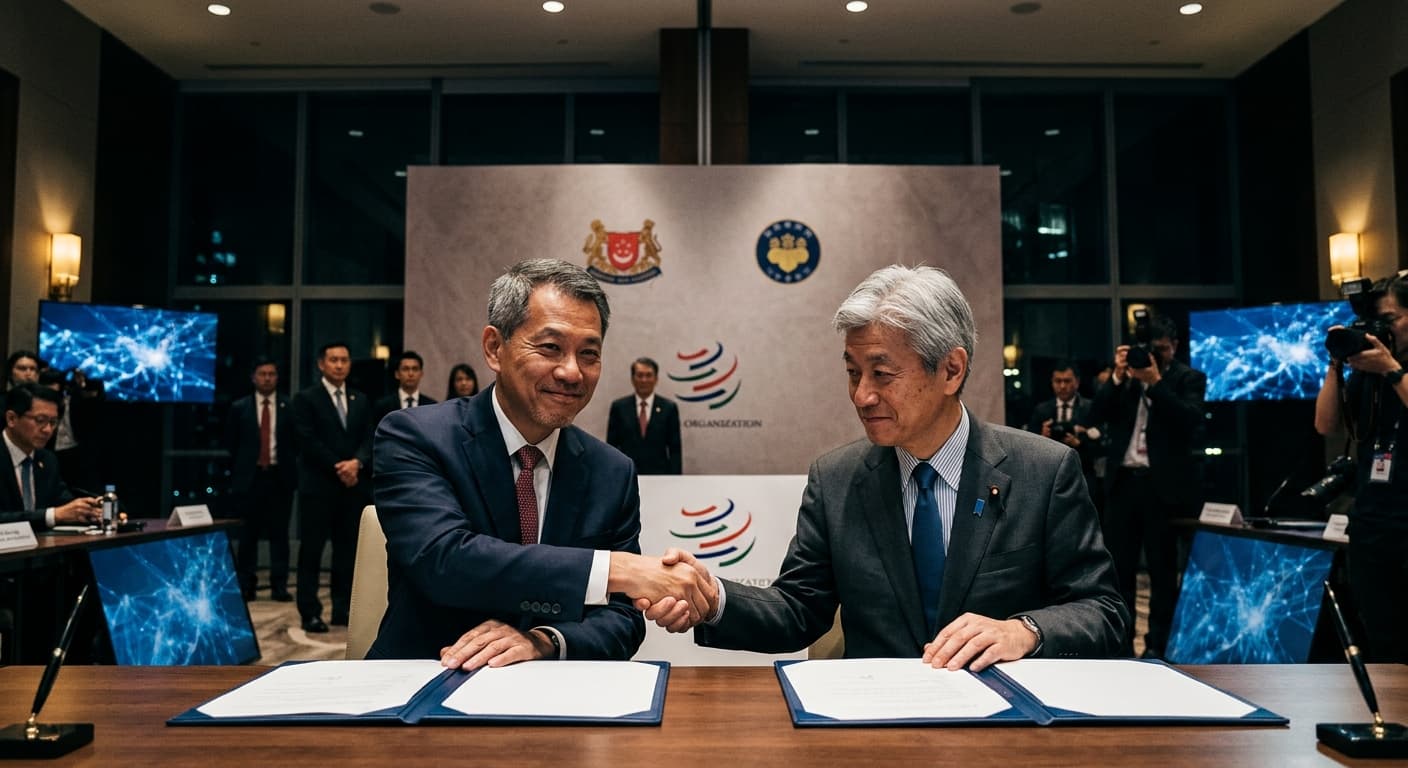
Singapore, Japan Build a Digital Bloc That Neither Washington Nor Beijing Controls
Two middle powers are stitching together a rules-based digital governance architecture that hedges against great-power unpredictability — and the WTO agreement they co-convene gives it multilateral muscle.
Singapore and Japan elevated their bilateral relationship to a Strategic Partnership on March 18, 2026, committing to tear down cross-border data barriers, align AI governance standards, and coordinate on semiconductor and quantum supply chains. Four months later, the full architecture is visible — and it is not simply another trade deal. The partnership, anchored by the two countries' role as co-conveners of the WTO Joint Statement Initiative on E-Commerce alongside Australia, amounts to the most ambitious middle-power bid yet to write the rules of the Indo-Pacific digital economy before Washington or Beijing can impose their own.
The WTO E-Commerce Agreement, for which 67 members adopted interim implementation arrangements on March 28 — covering roughly 70% of global trade — gives Singapore and Japan an unusual lever: they are simultaneously negotiating bilaterally what they are codifying multilaterally. The cost of not implementing the agreement, according to WTO and OECD research cited in the IBTimes report, could reach US$159 billion annually in foregone trade. IBTimes Singapore
"The combination is what makes this different from Singapore's other digital economy agreements," said one trade official familiar with the negotiations, speaking on condition of anonymity. "Every bilateral commitment is a building block for the multilateral text. Every multilateral consensus feeds back into the bilateral framework. It is a ratchet mechanism."
That ratchet now has real commercial teeth.
The Architecture: Modular, Interoperable, and Deliberately Not American or Chinese
Singapore has built the world's densest network of digital economy agreements. It has concluded five legally binding DEAs — with Australia (2020), the UK (2022), South Korea (2023), the EU (in force February 1, 2026), and now the Japan Strategic Partnership framework. It co-founded the Digital Economy Partnership Agreement (DEPA) with Chile and New Zealand, an agreement China formally applied to join in December 2021 and which has since attracted accession requests from Canada, Costa Rica, Peru, the UAE, El Salvador, and Ukraine.
But the Japan partnership is structurally different. It is not a standalone DEA. It is an overarching Strategic Partnership that embeds digital trade within a broader framework spanning economic security, supply-chain resilience, green transition, and defense cooperation. The joint statement, published by Singapore's Prime Minister's Office, explicitly links digital governance to "the enduring value of free trade, resilient supply chains, and open innovation" and anchors the partnership within both the ASEAN Outlook on the Indo-Pacific (AOIP) and Japan's Free and Open Indo-Pacific (FOIP) construct. PMO Singapore
A direct ICT policy dialogue channel has been established between Singapore's Ministry of Digital Development and Information (MDDI) and its Japanese counterpart. A memorandum of cooperation is expected later in 2026 between Singapore's Personal Data Protection Commission and Japan's Personal Information Protection Commission — a step that would create formal regulatory coordination on how personal data moves between the two markets.
For the roughly 4,500 Japanese companies operating in Singapore and the hundreds of Singaporean firms with Japan exposure, the practical implication is straightforward: fewer compliance headaches when moving data between the two jurisdictions, clearer rules on AI deployment, and a more predictable environment for cloud services and data analytics investments.
The partnership also commits both governments to cooperate on AI safety and governance, including "building of AI models that are culturally and linguistically reflective" — a direct nod to the dominance of English-language models developed by American firms and the growing push for sovereign AI capability. The ASEAN-Japan Co-Creation Initiative for AI provides the regional scaffolding.
What Japan Gets That the US-Japan Deal Cannot Provide
Japan's digital trade position is paradoxical. Tokyo has the US-Japan Digital Trade Agreement, a high-standard pact that prohibits data localization and protects cross-border data flows. It has infused the Data Free Flow with Trust (DFFT) concept — first introduced by former Prime Minister Abe Shinzo — into the G7, G20, and multiple bilateral deals. Japan's 2026 Article IV consultation with the IMF notes that Tokyo committed up to $550 billion in investment in the US economy as part of a July 2025 bilateral trade deal. IMF
But the US relationship comes with a hard ceiling. Washington's trade policy has oscillated wildly between administrations. The Biden-era USTR withdrew US support for cross-border data flow provisions at the WTO JSI talks in October 2023 — blindsiding co-conveners Japan, Singapore, and Australia — only for the Trump administration to reverse course and pursue a permanent moratorium on customs duties for electronic transmissions. CSIS
Singapore offers Tokyo something the US cannot: a partner whose digital governance playbook is designed for interoperability across divergent regimes, not the imposition of a single standard. As the EU's own impact assessment of its DTA with Singapore noted, Singapore's approach to digital trade is "modular," allowing partners to "address new issues quickly without getting bogged down in cumbersome trade negotiations." European Commission
Japan's semiconductor revival — anchored by Rapidus, the government-backed consortium racing to produce 2-nanometer chips in Hokkaido by 2027 — depends on secure supply chains, trusted data flows for chip design collaboration, and reliable export markets. The BBC reported that Japan has invested $12 billion in Rapidus, part of a broader $65 billion AI and semiconductor package unveiled in late 2024. BBC Rapidus announced a partnership with Cadence on July 16, 2026 to integrate agentic AI into semiconductor design — exactly the kind of advanced manufacturing collaboration that requires the cross-border data flows the Strategic Partnership guarantees.
BusinessWire/FT
On the quantum front, a Memorandum of Understanding signed in January 2026 between Japan's Cabinet Office and Singapore's MDDI on quantum science and technology provides the foundation. In April 2026, IQM Quantum Computers announced the first enterprise quantum computer purchase in Japan — a 20-qubit system for TOYO Corporation — part of Japan's national target of 10 million domestic quantum technology users and 50 trillion yen in quantum-generated production value by 2030. BusinessWire/FT
Discover more

US Politics
SNAP Food Assistance Faces Legal Challenges
In 2026, SNAP faces stricter eligibility rules and mounting legal challenges, threatening food assistance for the millions of Americans who rely on the program.
India
Rajnath Singh's Durga Squad for 2026 Polls
Rajnath Singh's Durga Squad promised women's safety in Bengal but has since disappeared from the agenda, revealing BJP's true priorities.
Global Politics
Trump's Conflicting Messages on Iran War
Trump's mixed messages on Iran reflect a strategy of audience management, benefiting Tehran amid a complex geopolitical landscape.

Economics
Fed's Amex AML order puts correspondent banking on notice
Federal Reserve's Amex AML order requires board-level controls and a 90-day plan; OCC fined the bank $350 million over enterprise-wide deficiencies.