Sudan's Economic Collapse Amid Ongoing War
UNDP report reveals dire economic impacts of Sudan's civil war.
Model Diplomat4 min readafrica
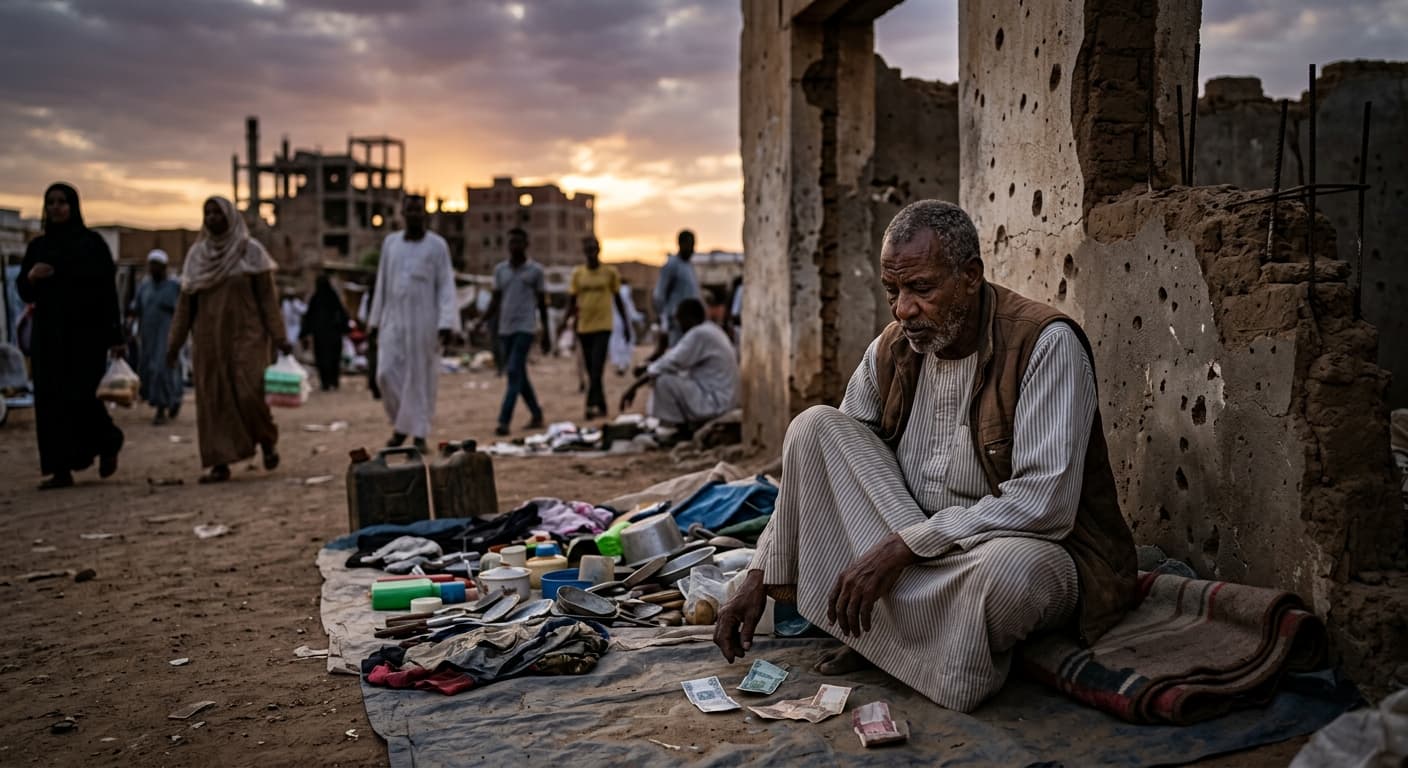
Sudan's War Has Erased Three Decades of Economic Progress — and the Worst May Be Ahead
A joint UNDP–ISS report quantifies Sudan's collapse: $6.4 billion in GDP lost in 2023 alone, 90% of manufacturing destroyed, and incomes back to 1992 levels. Even if peace arrives tomorrow, the damage is locked in for a generation.
Three years into the civil war between the Sudanese Armed Forces and the paramilitary Rapid Support Forces, a landmark report from the United Nations Development Programme and the Institute for Security Studies has quantified what was already visible from satellite imagery: Sudan's economy has been hollowed out. The report, titled Beyond the Conflict and released in April 2026, concludes that Sudan's GDP fell to roughly $26 billion in 2023, with a single-year loss of $6.4 billion — a contraction reflecting what UNDP resident representative Luca Renda called "a simultaneous collapse across all major parts of Sudan's economy" Al Jazeera. The
World Bank corroborates the trajectory, estimating real GDP contracted by 29.4% in 2023 and a further 14% in 2024 — among the steepest peacetime-to-wartime collapses in modern history.
The report's headline figures are dire, but the structural damage is worse. The destruction is not a temporary interruption of output; it is the dismantling of productive capacity itself. Cultivated land has shrunk by 15%, with satellite analysis by Al Jazeera confirming the near-total collapse of irrigated farming in the Gezira scheme — Sudan's agricultural heartland — during RSF control in 2024 Al Jazeera. Agriculture had employed roughly 65% of the workforce. Meanwhile, manufacturing activity in key economic hubs has been destroyed at a rate of roughly 90%, eliminating thousands of formal-sector jobs
The Middle East Insider. Khartoum, which hosted approximately 80% of Sudan's formal economy and state institutions, has been substantially destroyed. The Central Bank fled to Port Sudan with limited operational capacity. Commercial banking has ceased across most of the country.
The currency tells the same story in a single data point. The Sudanese pound traded at roughly 570 to the dollar before the war. It now trades between 3,500 and 3,600 — a sixfold collapse that has rendered imports catastrophically expensive and pushed average incomes back to levels last seen in 1992 UNDP.
Whose interests are served
The economic data clarifies something the battlefield maps obscure. Neither faction has an economic incentive to stop. The SAF, under General Abdel Fattah al-Burhan, controls Port Sudan and the east, retaining access to customs revenue and what remains of state institutions. The RSF, under Mohamed Hamdan Dagalo ("Hemedti"), controls much of Darfur and — critically — key gold-producing regions. Gold exports, routed largely through the UAE, have become the RSF's fiscal backbone, sustaining its war effort independently of any state budget CSIS. The war economy has bifurcated: each side finances itself through extractive control of territory rather than through productive economic activity. That makes peace economically costly for both commands, even as it becomes existentially urgent for the population.
Three futures, one closing window
The UNDP/ISS report models three trajectories. Under the "Protracted Conflict" scenario — war continuing to 2030 — Sudan's economy in 2043 would be $34.5 billion smaller than it would have been without war, GDP per capita would fall by roughly $1,700, and an additional 34 million people would be pushed into extreme poverty, equivalent to the entire population of Ghana Al Jazeera.
Even under the most optimistic scenario — peace in 2026 — Sudan still faces a cumulative GDP loss of $18.8 billion by 2043. The damage is already locked in. But the report also models a "Sudan Rising" pathway: peace combined with coordinated governance reform, agricultural rehabilitation, and infrastructure investment. Under that scenario, GDP reaches $58.2 billion by 2043, 17.3 million people are lifted out of extreme poverty, and average growth hits 5% annually UNDP.
The gap between the worst and best scenarios is not marginal. It is the difference between a country poorer in 2043 than it was in the 1990s, and one that has recovered.
What to watch
The next decision point is whether either faction shows a genuine willingness to negotiate in 2026. Both Burhan and Hemedti have publicly signaled readiness for years of continued war. External patrons — the UAE for the RSF, Egypt, Saudi Arabia, and Iran for the SAF — show no sign of cutting off support. The single most addressable external lever remains the UAE's facilitation of Sudanese gold exports, which keeps the RSF solvent. Absent international pressure on that channel, the conflict's economic logic points toward protraction, and the "Protracted Conflict" scenario becomes the baseline, not the warning. *
Discover more

Global Politics
US Proposes Pakistan for Iran Talks Amid Ties
The US-Iran negotiations are now mediated by Pakistan, highlighting Islamabad's strategic role and the implications for regional diplomacy.
International Relations
Economist Impact Sustainability Week 2026
Economist Impact Sustainability Week 2026 spotlights the energy transition, AI in clean technology, and supply chain resilience as themes for global leaders.
US Politics
House Ethics Committee Pushes Sexual Miscond.
The House Ethics Committee has shifted responsibility for sexual harassment settlement records to the Office of Congressional Workplace Rights, complicating disclosure efforts.

Conflict & Security
Drone Warfare Killing Aid Workers at Unprec
Over 1,000 humanitarian workers killed in three years as cheap armed drones collapse legal protections. Gaza, Sudan, Ukraine, and DRC see deliberate targeting of aid convoys and hospitals with zero prosecutions.