Sara Duterte's Impeachment Trial Begins
Senate trial opens amid constitutional challenges.
Model Diplomat8 min readAsia
Sara Duterte's Senate Trial Opens as Philippine Impeachment Law Is Rewritten in Real Time
Philippine Senate opens VP Sara Duterte's impeachment trial on July 6, 2026 with Escudero presiding; conviction needs 16 of 24 senators. Analysis of the constitutional stakes.
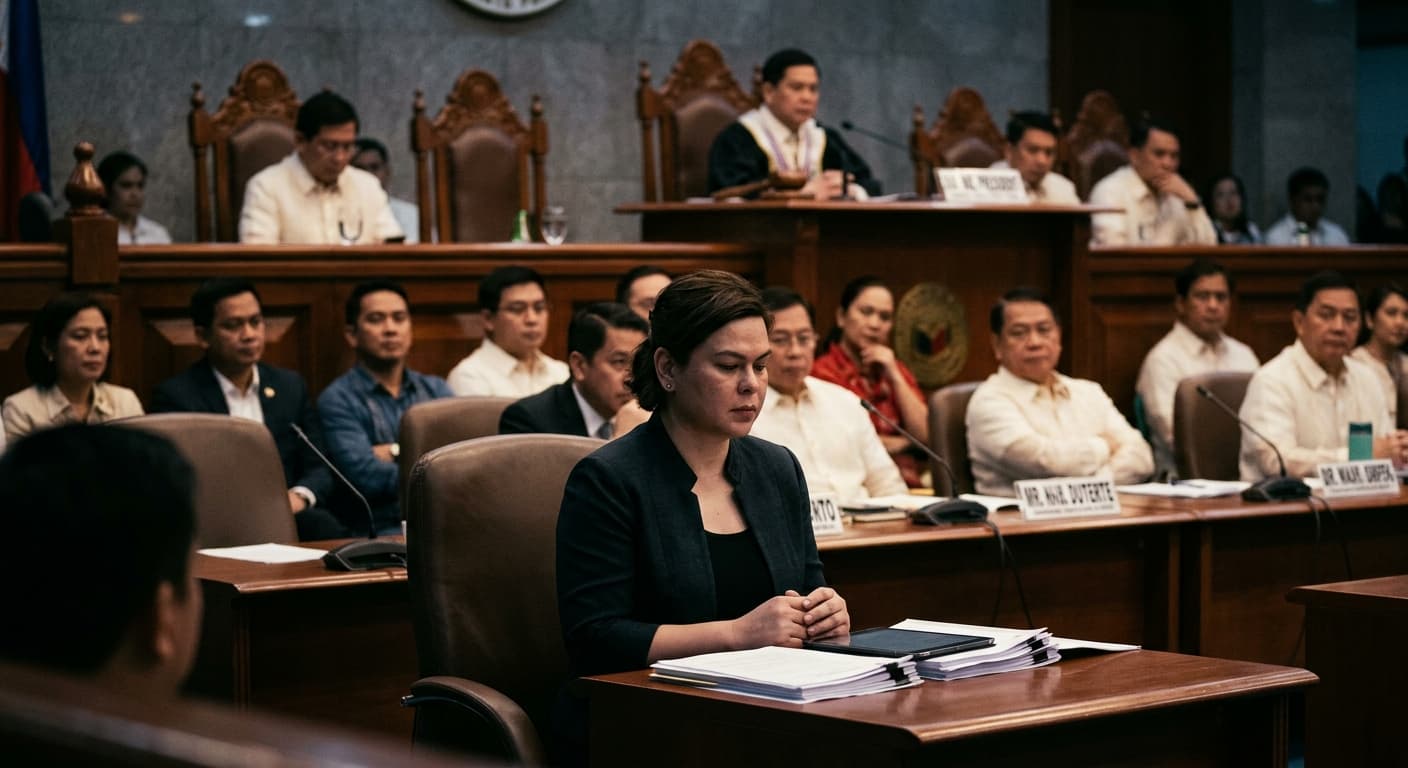
The Philippine Senate opened the impeachment trial of Vice-President Sara Zimmerman Duterte-Carpio on July 6, 2026, and did so only after voting 12-8 to install Senator Francis "Chiz" Escudero — not Senate President Sherwin Gatchalian — as presiding officer, a departure from the practice followed in every previous Philippine impeachment. The switch, together with Escudero's opening ruling that conviction still requires 16 of 24 senator-judges regardless of who is absent, has turned the second-ever impeachment trial of a Philippine national official into a live test of how the 1987 Constitution's accountability clauses interact with a Supreme Court that has already voided one attempt to remove Duterte-Carpio, and with an International Criminal Court that is simultaneously preparing to try her father. The trial's real subject is not only whether the vice-president will be barred from the 2028 presidential race; it is whether Philippine institutions can process a political conflict of this magnitude without being restructured by it.
Duterte-Carpio, 47, did not attend the opening. She was represented by lead counsel Sheila C. Sison, who argued in her opening that the impeachment complaint is constitutionally defective and invoked the 2025 Supreme Court ruling that struck down the previous complaint against her client. Lead prosecutor and Batangas Representative Gerville R. Luistro told the court that evidence would show more than P612 million in confidential funds entrusted to the Office of the Vice-President and the Department of Education had been "disbursed and liquidated under questionable circumstances," according to
BusinessWorld.
A trial rebuilt from the wreckage of the last one
The Senate is trying Duterte-Carpio under a complaint filed after the Philippine House of Representatives voted 257-26 on May 11, 2026 to impeach her a second time. The first impeachment, on February 5, 2025, carried 215 signatures in a 313-member House but never reached trial. On July 25, 2025 the Supreme Court declared that complaint
null and void ab initio, holding that the House had violated the one-year bar in Article XI, Section 3(5) of the 1987 Constitution and that "the Senate did not acquire jurisdiction to constitute itself into an impeachment court" — language quoted by Senator Pia Cayetano in her
August 6, 2025 explanation of vote to archive the case.
That ruling reshaped the terrain the House had to re-cross. When Representative Luistro's Judiciary Committee endorsed the new complaint 53-0 in May 2026, it did so on essentially the same substantive grounds — misuse of confidential funds, unexplained wealth, bribery, and the November 2024 broadcast in which Duterte-Carpio said she had "contracted an assassin" to kill President Ferdinand Marcos Jr., First Lady Liza Araneta-Marcos, and former Speaker Martin Romualdez if she were killed first. The Verified Complaint for Impeachment lodged with the Senate lists four articles built on Sections 2 and 3 of Article XI of the 1987 Constitution and on the House's own impeachment rules of the 19th Congress. Sison's defence rests on the argument that the second complaint inherits the "grave abuse of discretion" the Supreme Court identified in the first.
Escudero's chair — and the ruling that already shapes the endgame
The single most consequential act of the opening day was procedural. Senate Minority Leader Alan Peter Cayetano — a Duterte loyalist installed as Senate president on May 11, 2026 before losing that post — objected that the Constitution reserves the presiding-officer role for the Senate president in every impeachment except that of the president, when the Chief Justice takes over. "It is very clear in the Constitution that the presiding officer is the Senate president," Cayetano said, warning that "changing the arrangement could expose the proceedings to legal challenges," per BusinessWorld's account.
Senator Francis Pangilinan, one of only two lawyer-senators in the majority, countered that the Constitution does not expressly require the Senate president to preside over impeachments of officials other than the head of state. The Senate's Revised Rules of Procedure on Impeachment Trials — promulgated under Article XI, Section 3, paragraph 8 — reserve the Chief Justice's role for a presidential trial but do not, on their face, prohibit the Senate from electing an alternative presiding officer for other cases. Senator Panfilo Lacson moved Escudero's name; the chamber voted 12-8 in favour, according to
GMA News Online.
Escudero then delivered a ruling that will define the arithmetic of the verdict. He held that the two-thirds threshold in Article XI, Section 3(6) is measured against the full 24-member Senate — meaning 16 affirmative votes are required to convict — "unless the Supreme Court rules otherwise." The 1987 Constitution says a person "shall not be convicted without the concurrence of two-thirds of all the Members of the Senate," and the Senate's Revised Rules restate the same standard in the judgment clause. Escudero's reading closes what could have been a loophole: if senator-judges recuse or are arrested, the conviction bar does not fall with them.
That is not a hypothetical. Hours before the trial opened, the Sandiganbayan ordered the arrest of Senator Rodante Marcoleta on a plunder charge for allegedly accepting 75 million pesos ($1.2 million) in undisclosed campaign donations, Al Jazeera reported, citing Reuters. Marcoleta had been due to sit as a senator-judge and is widely counted as a Duterte vote. His removal from the bench narrows the vice-president's margin — but under Escudero's ruling, does not reduce the number of "yes" votes the House prosecutors must still assemble.
The Marcos–Duterte war, translated into Article XI
The trial is inseparable from the collapse of the 2022 UniTeam ticket. Marcos and Duterte-Carpio campaigned as running mates and won by 31 million and 32 million votes respectively. Their alliance disintegrated in 2024 over the Department of Education's confidential fund and Duterte-Carpio's opposition to the Marcos administration's ICC posture. On November 23, 2024, in a livestream on social media, she said she had spoken with "an assassin" and instructed him to kill Marcos, the First Lady and Speaker Romualdez if she herself were killed — a statement the House used as Article I of both impeachment complaints.

The president has not testified but has publicly said the executive will "not interfere," and his allies drove the House votes. The vice-president, in a written statement quoted by BusinessWorld, framed her non-appearance as constitutional entitlement: "Choosing to appear through counsel rather than testify personally does not diminish accountability or imply a lack of transparency. The opinion of a President in an impeachment proceeding is of no importance. Impeachment proceedings must be guided by the Constitution and due process." Rappler reported that she had "consistently snubbed" House hearings on the same grounds.
More than 6,000 police officers, including anti-riot squads, were deployed around the Senate complex in Pasay, per the Manila Bulletin and the
AP wire carried by DAR News. The Philippines has completed only one impeachment trial to verdict since democratic restoration in 1986 — that of Chief Justice Renato Corona in 2012 — and no vice-president has ever stood trial.
The ICC shadow: two Dutertes, two courtrooms, one legitimacy question
The trial's second gravitational body sits 10,500 kilometres away. On April 23, 2026, ICC Pre-Trial Chamber judges confirmed three counts of murder as crimes against humanity against former president Rodrigo Duterte, finding "substantial grounds" to believe he played a key role in 76 murders and two attempted murders as part of the "war on drugs." The trial is scheduled to open on November 30, 2026, according to the
BBC. Rodrigo Duterte has been held at Scheveningen since his March 2025 arrest.
That parallel is what makes the vice-president's impeachment a landmark in more than domestic politics. Sara Duterte-Carpio's ICC-linked ally, Senator Ronald "Bato" dela Rosa — the former police chief who executed her father's drug war and against whom an ICC warrant was reported in late 2025 — was the swing vote that installed Cayetano as Senate president in May 2026 before, per Al Jazeera, fleeing a police detention attempt inside the Senate itself. The ICC has ruled it retains jurisdiction over crimes committed on Philippine territory between 2011 and 2019, notwithstanding the country's 2019 withdrawal from the Rome Statute.
Two propositions are being tested simultaneously in Manila and The Hague. The Senate is asking whether the Philippine constitution's accountability mechanism can be executed against a politically dominant figure without being neutralised by the Supreme Court she inherited. The ICC is asking whether an international tribunal can complete a crimes-against-humanity trial against a former head of state whose successor government has cooperated with arrest but not, formally, with the court's jurisdiction. Both cases will move on overlapping calendars through 2026 and 2027.
Evidence, evidentiary rulings, and what the numbers actually say
On the merits, the prosecution's strongest documentary claim is quantitative. It says P612.5 million in confidential funds — the equivalent of roughly $10.3 million at 2024 exchange rates, per NPR's AP wire — was disbursed through the Office of the Vice-President and the Department of Education while Duterte-Carpio held both posts, with acknowledgement receipts that Commission on Audit examiners have flagged. Al Jazeera has reported that Article III references
more than $110 million in private bank transactions flagged by the Anti-Money Laundering Council.
The evidentiary skirmishes on day one signal how the defence will operate. Sison objected to the reading of the four articles and a plea on each; Escudero ruled the articles will be read only when the court votes on them at trial's end, per BusinessWorld. The court then ordered a sealed box containing Duterte-Carpio's and her husband Manases Carpio's tax records returned to the Bureau of Internal Revenue after finding the records had not been formally offered as evidence at pretrial. That is a small ruling with a large signal: Escudero intends to police the record tightly, and the prosecution will need to re-offer its documentary base under the rules of court rather than rely on materials collected during House investigations.
What to watch
- Supreme Court challenge to Escudero's election — Cayetano's warning that the change of presiding officer "could expose the proceedings to legal challenges" points to a certiorari petition. The court that voided the 2025 impeachment is dominated by appointees of Rodrigo Duterte, per the
BBC; its next intervention would determine whether trial hearings can proceed uninterrupted.
- Sandiganbayan proceedings against Senator Marcoleta — his arrest on July 6, 2026 removes a probable "no" vote. A conviction, acquittal or bail order in the plunder case in the coming weeks will directly change the arithmetic on the impeachment bench.
- Presentation of prosecution evidence — Representative Luistro's team must formally re-offer the confidential-fund documentation and AMLC-flagged bank records under the Senate's rules of evidence. Expect defence motions to suppress based on the 2025 Supreme Court ruling's "grave abuse of discretion" finding.
- ICC trial opening on November 30, 2026 — the elder Duterte's trial in The Hague will begin during, not after, his daughter's Senate proceedings. The optics of that overlap will shape the vote count on both sides of the aisle.
The Bottom Line
Sara Duterte's impeachment trial is not primarily about P612 million in confidential funds or a November 2024 assassination monologue — it is about whether the Philippines' post-1986 accountability architecture still binds a Duterte, at the same moment the International Criminal Court is answering that question about her father. Escudero's rulings on July 6 — a majority-elected presiding officer and a 16-vote conviction bar measured against the full Senate — set a template that will outlast this defendant and will govern every future impeachment of a Philippine official who commands a fraction, but not a majority, of the upper house.
Discover more

US Politics
Virginia GOP Rallies Rural Voters Against Red
Virginia Republicans are mobilizing rural voters against a Democratic-led redistricting referendum, a fight seen as pivotal to control in the 2026 midterms.
India
Rajnath Singh's Durga Squad for 2026 Polls
Rajnath Singh's Durga Squad promised women's safety in Bengal but has since disappeared from the agenda, revealing BJP's true priorities.
India
Women's Reservation Bill 2026: A Political Sh
India's Lok Sabha rejected the Women's Reservation Bill, exposing a political maneuver to redraw electoral maps favoring the north over the south.

Economics
Fed's Amex AML order puts correspondent banking on notice
Federal Reserve's Amex AML order requires board-level controls and a 90-day plan; OCC fined the bank $350 million over enterprise-wide deficiencies.