Russia's Mali Airlift: Moscow's Gamble
Moscow rushes weapons to Mali amid escalating conflict
Model Diplomat8 min readAfrica
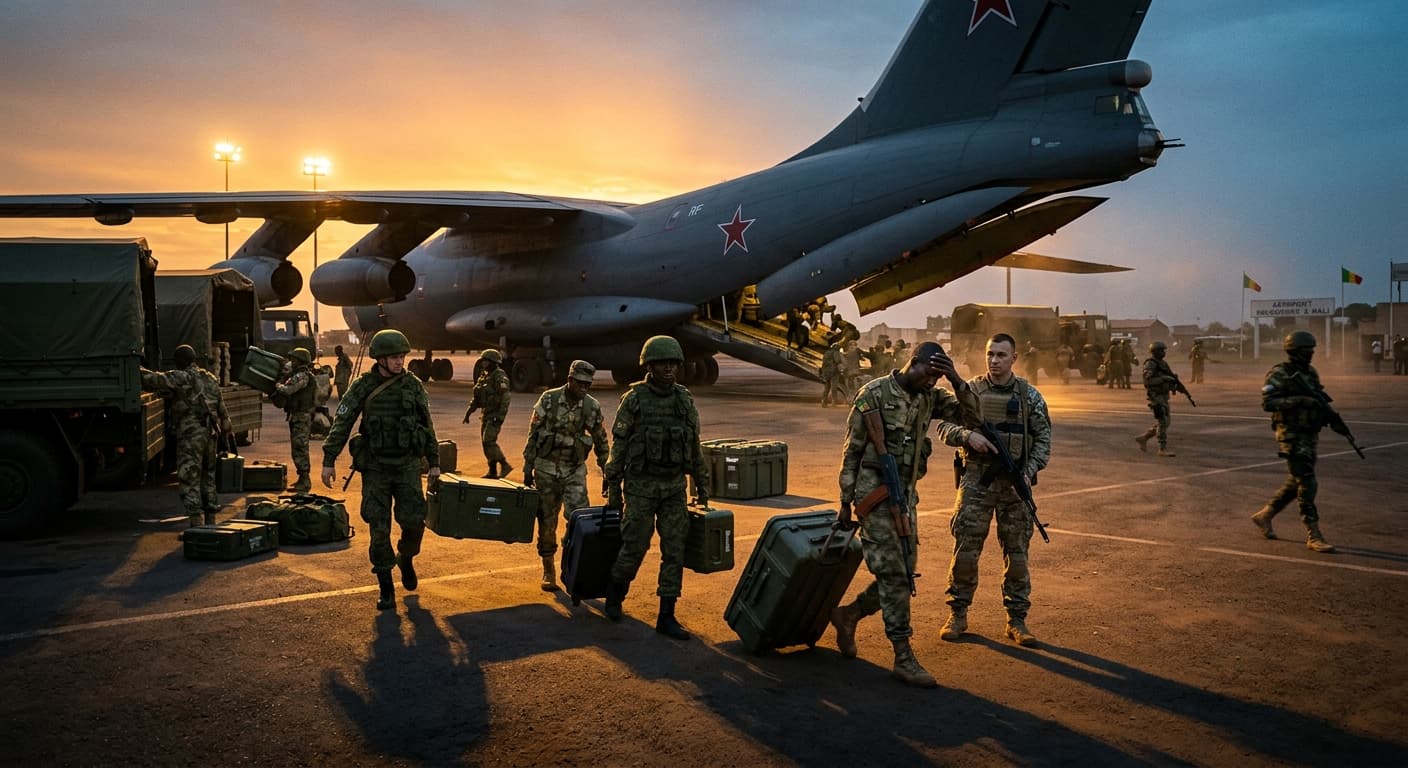
Russia's Mali airlift: Moscow doubles down as junta's siege deepens
Russia is rushing weapons to Mali as al-Qaeda's JNIM and Tuareg FLA rebels tighten a siege — the Kremlin's biggest African bet is being stress-tested in real time.
Russia began airlifting weapons and equipment to Mali on July 7, 2026, according to Al Jazeera, 72 hours after a joint al-Qaeda–Tuareg offensive shattered the junta's northern defences and separatists released footage of a downed Africa Corps Mi-24 helicopter. The thesis of this story is simple: the airlift is not a rescue — it is Moscow refusing to accept the verdict of the battlefield, because the collapse of Assimi Goïta's government would end Russia's entire Sahel model, cost Wagner-era gold and uranium concessions, and hand a template of successful Islamist–separatist coordination to insurgents from Burkina Faso to the Gulf of Guinea. Every actor in the region — the Alliance of Sahel States (AES), ECOWAS, France, Ukraine — is reading this shipment as a signal, and each is drawing a different lesson.
The battlefield reversal Russia is trying to erase
The immediate trigger is a two-stage collapse of the junta's security position. On April 25–26, 2026, the al-Qaeda-linked Jama'at Nusrat al-Islam wal-Muslimin (JNIM) and the Tuareg-dominated Azawad Liberation Front (FLA) mounted coordinated assaults across Bamako, Kati, Kidal, Gao and Ségou. Defence Minister Sadio Camara was killed by a suicide truck bomb at his residence in Kati, and Kidal — the linchpin of the northern theatre, retaken in a bloody 2023 battle by Wagner and the Malian army — fell after the Africa Corps negotiated a withdrawal with FLA fighters, BBC News reported.
On July 4, the two groups struck again — hitting Anefis, Aguelhok, Gao, Sévaré and a prison at Kéniéroba, 74 km from the capital, according to Al Jazeera. Two days later, the FLA released video of what it said was an Africa Corps Mi-24 crashing after being shot down. That is the context in which the Ilyushin transports began arriving in Bamako. Russia is not sending weapons because things are going well. It is sending them because its 2,500-strong Africa Corps contingent —
BBC Verify's estimate sourced from a senior French military official — has been comprehensively out-manoeuvred.
Why Moscow can't walk away
The Kremlin's Sahel doctrine, articulated by spokesman Dmitry Peskov in June 2025, is that Russia's African footprint is "growing" and that this "extends to such sensitive areas as defence and security," Al Jazeera reported. Africa Corps replaced Wagner in 2024, run out of the Defence Ministry by Deputy Minister Yunus-Bek Yevkurov with operations under GRU Major-General Andrey Averyanov. That transition made the mission an official Russian military operation, not a plausibly-deniable private one — which is precisely why Moscow now cannot allow a rout.
The economics reinforce the politics. Dr Sorcha MacLeod, formerly of the UN working group on mercenaries, told the BBC that Africa Corps has inherited Wagner's arrangement of "providing security services in exchange for payments and access to valuable natural resources" — chiefly Malian gold. Fighters are paid at least $3,000 a month, financed through those concessions. Ulf Laessing of the Konrad-Adenauer-Stiftung's Sahel programme has warned that "Africa Corps has really lost credibility" and that Russia will "struggle to attract new clients" if Mali collapses,
Al Jazeera reported. The Central African Republic, Burkina Faso, Niger, Libya and reportedly Sudan all watch the invoice — and the outcome.
Moscow's April 28 statement — issued directly by the Russian Ministry of Defence — captured the stakes in unusually blunt language:
"In fierce battles with overwhelming enemy forces, the units of the Africa Corps inflicted irreparable losses on the enemy in personnel and hardware, forcing them to abandon their plans and preventing them from carrying out the coup d'état, retaining the authority of the legitimate government."
The framing matters. The Ministry described the rebel offensive as an attempted coup — signalling that any political challenge to Goïta will be treated as an armed insurrection meriting Russian escalation. It also, without evidence, accused Ukrainian and European "mercenaries" of training the attackers. Kyiv's GRU-equivalent HUR had previously claimed a role in the July 2024 Tinzaouaten ambush that killed dozens of Wagner fighters — giving Moscow a narrative frame it is now recycling.
The junta closed its own escape hatches
Understanding why Russia must double down requires understanding what Goïta has done to Mali's political system since the April 2025 shock. On May 13, 2025, the transitional president signed a decree dissolving all political parties and "organisations of a political nature." On July 8, 2025, he signed a law making presidential terms indefinitely renewable "until peace is restored," according to the UN Human Rights Office. High Commissioner Volker Türk's spokesperson stated that these measures "have slammed the door shut on democratic elections in Mali for the foreseeable future."
That legal architecture eliminates the compromise track ECOWAS and Senegalese mediator Bassirou Diomaye Faye were pushing throughout 2024–25. There is no civilian pathway back into the tent. UN independent expert Eduardo Gonzalez and two Special Rapporteurs called the party dissolution "a step in the wrong direction" that opened the door to "arbitrary arrests and detentions, judicial harassment, and prosecution of people merely exercising their rights." OHCHR later documented "hundreds of extrajudicial executions, arbitrary arrests and detentions, enforced disappearances and other abductions by all parties" since April 2026 — attributing violations to Malian troops and Africa Corps as well as to JNIM and the FLA.
For Moscow, the junta's authoritarian consolidation is a feature, not a bug. There is no risk of a Malian government pivoting back to Paris. There is also no risk of the alliance being renegotiated by a new civilian cabinet. The cost is that Russia is now inseparable from a government that Türk's office says has produced a "further deterioration in the human rights situation."
The regional stress test: AES, ECOWAS and the coastal spillover
The shipment lands as the Alliance of Sahel States — the Mali–Burkina Faso–Niger mutual defence pact that formally became a confederation on July 6, 2024 — faces its first serious battlefield test. The Institute for Security Studies reports that the AES Unified Force, a 6,000-strong contingent headquartered in Niamey, was launched in December 2025 and financed by a 0.5% import levy agreed on March 28, 2025. Its brief is precisely the kind of cross-border JNIM operation now underway. The AES states procure equipment from Russia, Turkey, Iran and China; in Mali, Africa Corps is the operational partner, while in Burkina Faso and Niger the Russians "focus more on training."
That distinction — combat in Mali, training elsewhere — is what makes the current airlift regionally consequential. If Africa Corps fails to hold the line for Goïta, Ibrahim Traoré in Ouagadougou and Abdourahamane Tiani in Niamey face an uncomfortable question: what exactly is Moscow's security guarantee worth? The Stimson Center warns that JNIM claimed its first attack on Nigerian territory in October 2025 and that violence along the Benin-Niger-Nigeria border triangle rose sharply between 2024 and 2025. The
Institute for Security Studies puts the jump in jihadist violence in Nigeria's Borgu-Kainji axis at 86% year-on-year, with a 262% increase in fatalities. This is not a Malian problem contained by borders.
The regional numbers underline the point. According to the West Africa Security Tracker mid-year 2025 report from the Centre for Democracy and Development, West Africa recorded 12,964 conflict-related fatalities in the first half of 2025, with Mali, Burkina Faso, Niger and Nigeria accounting for almost 96%. Mali's 2,157 deaths came with a notable feature — 118 deaths from air and drone strikes, reflecting exactly the Africa Corps tactic on display in the Kati footage BBC Verify geolocated in April.
Who wins if Bamako holds — and who wins if it doesn't
The unexpected beneficiary of Russia's escalation is not the Malian government. It is JNIM's political narrative. Every Russian airstrike that produces civilian casualties feeds a jihadist recruitment argument that the junta has surrendered sovereignty to Christian foreigners in exchange for indiscriminate violence — the same argument JNIM used to peel Fulani communities away from Bamako's authority across the Mopti and Ségou regions after 2019. FLA spokesman Sayed Bin Bella has meanwhile drawn a careful line, telling the BBC that "the flags we have raised are our own, not those of al-Qaeda. If they wish to merge with us, they must withdraw from the global al-Qaeda organisation." The FLA is signalling to Algeria, Mauritania and potentially to Western capitals that a Tuareg-led northern polity would not be a jihadist emirate.
If Goïta survives the siege, Moscow's Sahel franchise stabilises — and the AES has a proof-of-concept for authoritarian counterinsurgency without Western oversight. If he does not, three scenarios present themselves, per BBC analysis: a counter-coup by disaffected officers; an FLA–JNIM push south that fractures on ideological lines; or a negotiated partition in which the north drifts into a Tuareg-run zone and JNIM consolidates rural central Mali. All three end Russia's current business model.
Diplomat View
Moscow's airlift is a bet that firepower can substitute for legitimacy in a war it is losing on the ground. The bet is likely to buy Goïta months, not victory. Africa Corps has 2,500 troops for a country the size of Western Europe, no ally willing to send infantry, and a JNIM–FLA coalition that has already demonstrated it can strike five towns simultaneously and blockade a capital of three million. The realistic ceiling is defending Bamako, Kayes, Sikasso and the airport — accepting that Kidal, Ménaka and much of the north are lost. The forecast changes if two conditions are met: Russia deploys air-defence systems capable of neutralising the shoulder-fired weapons that downed the Mi-24, and the AES Unified Force generates a genuine 6,000-strong offensive capability rather than a paper headquarters. Neither is visible today. What is visible is that Ukraine has an incentive to keep supplying targeting intelligence to the FLA, and JNIM has an incentive to escalate before the airlift changes the balance. The next 60 days will be bloody.
What to watch:
- UN Security Council Mali briefing later this quarter — the first primary-source read on whether the airlift includes air-defence systems and whether Chapter VII language returns to the file.
- AES summit outcome — any deployment of Burkinabé or Nigerien troops to Malian territory would signal the confederation is a real military bloc, not a diplomatic one.
- FLA political posture — a public break with JNIM would open the door to Algerian mediation; continued coordination locks in a longer war.
For deeper regional context, see our conflict coverage.
Discover more
US Politics
Virginia's Redistricting Referendum
Virginia's redistricting referendum is drawing a flood of dark money, shaping future elections and the fight for congressional control amid party stakes.

US Politics
US Launches $166B Tariff Refund Portal
The US is launching a $166 billion tariff refund portal to aid importers hit by Trump-era tariffs, with major implications for trade and supply costs.

US Politics
SNAP Food Assistance Faces Legal Challenges
In 2026, SNAP faces stricter eligibility rules and mounting legal challenges, threatening food assistance for the millions of Americans who rely on the program.

Conflict & Security
Drone Warfare Killing Aid Workers at Unprec
Over 1,000 humanitarian workers killed in three years as cheap armed drones collapse legal protections. Gaza, Sudan, Ukraine, and DRC see deliberate targeting of aid convoys and hospitals with zero prosecutions.