Refugee Convention at 75: Hollowed Out From
75 years on, the Refugee Convention is being hollowed out from within
Model Diplomat11 min readGlobal
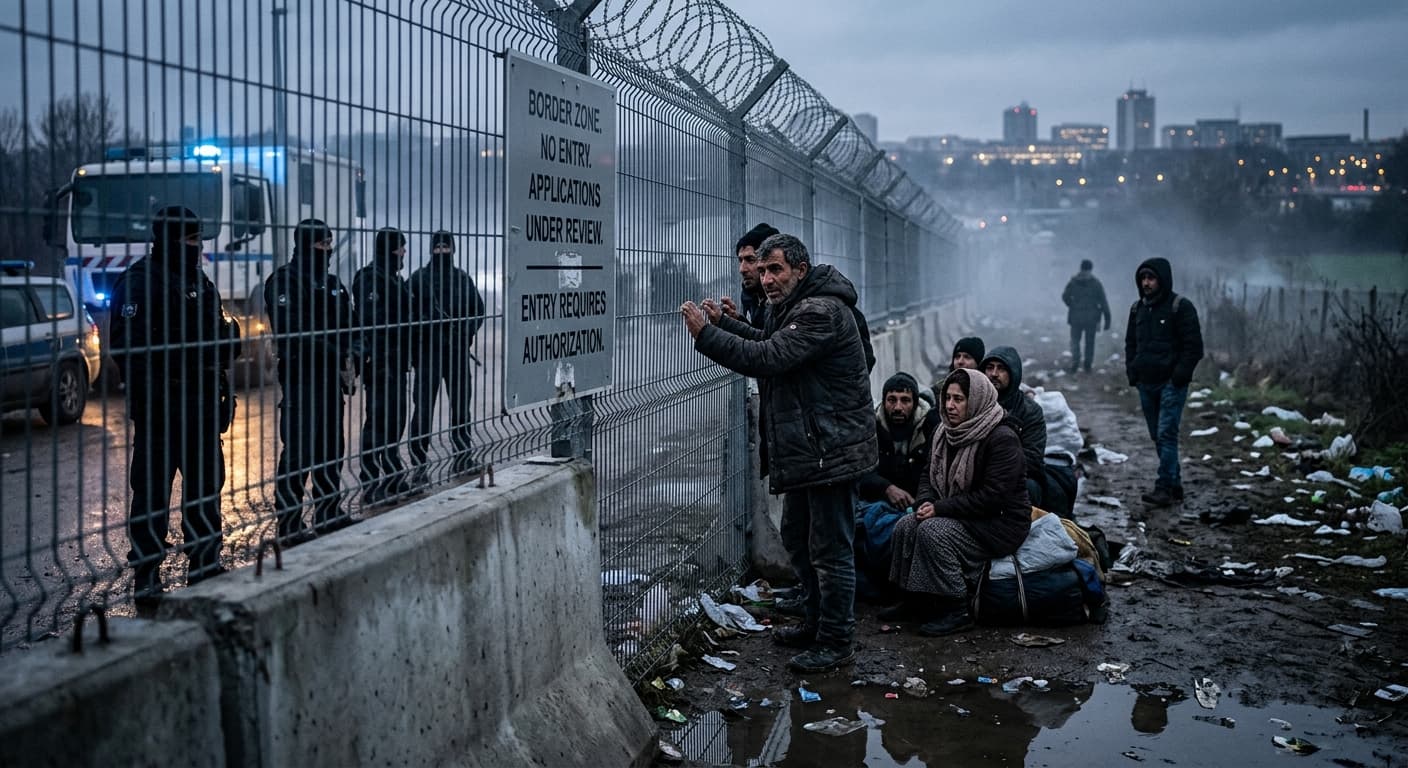
The Convention That Won't Die But Won't Protect: 75 Years On, Refugee Returns Are Becoming Weaponized
The 1951 Refugee Convention turns 75 on July 28, 2026 — but its core protection is being hollowed out not by withdrawal, but by a record wave of "voluntary" returns engineered through coercion, funding collapse, and externalization to states with dismal rights records.
The International Rescue Committee marked the Convention's 75th anniversary on July 13, 2026, with Protection Under Pressure, a seven-page brief. The report's central finding reframes the anniversary: 14.7 million displaced people returned home in 2025 — the second-highest annual figure in 60 years of records — yet these returns are not evidence the Convention is working. They are, per both the IRC and UNHCR, the clearest signal of its erosion: engineered desperation, not restored safety, as states weaponize "voluntary" repatriation, defund asylum systems, and externalize protection obligations to third countries. The Convention's death isn't coming by formal withdrawal or repeal — it is happening through a system where protection exists on paper but has been hollowed out from within.
The Numbers Behind the Paradox
UNHCR's Global Trends Report, launched June 10, 2026 in Geneva by High Commissioner Barham Salih, recorded 41.6 million refugees at the end of 2025 — a modest 3% decline from 2024, the first drop in a decade. Total forced displacement stood at 117.8 million people, roughly one in 70 of the world's population, according to UN News. The headline decline masks the mechanism: 14.7 million displaced people returned in 2025 — 4.4 million refugees and 10.3 million internally displaced — with returns to just six countries (Afghanistan, Sudan, Syria, DRC, Ukraine, and Myanmar) accounting for 92% of the total, as
Al Jazeera's Human Rights desk reported.
The problem, as UNHCR itself acknowledges, is that most of these returns occurred under duress. Approximately 2.9 million Afghans returned in 2025, many pushed by restrictive host-country policies in Iran and Pakistan rather than improvements in Afghanistan, where the Taliban government restricts women's education and employment. Roughly 1.3 million Syrians returned after the fall of Bashar al-Assad's regime in December 2024, but to a country that remains fragile and lacks basic infrastructure, as The National reported. By mid-May 2026, an additional 549,800 Syrians and 678,500 Afghans had returned from host countries, many "reportedly under pressure from deteriorating security situations" in their countries of asylum.
What makes this moment structurally different from earlier periods of strain is that states are not openly defying non-refoulement — a principle scholars consider customary international law and arguably jus cogens, a peremptory norm from which no derogation is permitted, as analysis in the Leiden Journal of International Law outlines. Instead, governments across the income spectrum have converged on a strategy scholars call "return-without-refoulement": making conditions in host countries so unbearable, and legal pathways so narrow, that refugees "choose" to go back. Stephanie Schwartz, writing in the International Migration Review in 2025, identified this as a prevalent state strategy in the Global South, where the legal standard for distinguishing coercive pressure from genuine voluntary return remains "opaque," as her
LSE-published analysis demonstrates.
"For too many refugees, displacement starts as a lifeline but lasts a lifetime," Salih said at the Geneva launch. "We need a fundamental shift that creates a new sense of hope and opportunity for people fleeing war and persecution." On non-refoulement, he was blunt: "The principle of non-refoulement, the prohibition on returning a person to a country where they face a real risk of persecution or serious harm is the heart of the Convention. It is non-negotiable." (
UNifeed transcript)
The IRC's framing is sharper still. "The Refugee Convention was a promise, made in the shadow of one of the darkest chapters of history, that nobody fleeing persecution should ever be sent back to danger," said David Miliband, IRC president and CEO. "Yet we are witnessing the most serious assault on that commitment in a generation, with governments across the world turning away asylum seekers at borders and normalizing forced returns in violation of the Convention." (ReliefWeb/IRC)
The Funding Collapse
Humanitarian funding fell by more than $31 billion in 2025, according to the IRC brief. UNHCR's own figures are equally stark: as of July 2025, the agency had received only 23% of its $10.6 billion annual goal, projecting an actual budget of just $3.5 billion to meet the needs of 122 million people, as Al Jazeera reported. The United States, which historically provided 40% of UNHCR's funding — over $2 billion — slashed its contribution as part of the broader gutting of US foreign assistance under the second Trump administration. UNHCR was forced to suspend or cut approximately $1.4 billion in aid programs, including a 60% reduction in emergency relief supplies to Sudan, Myanmar, and Afghanistan. In Bangladesh, education for 230,000 Rohingya refugee children faced suspension. Dominique Hyde, UNHCR's director of external relations, warned that up to 11.6 million refugees risked losing access to humanitarian assistance entirely.
A UK parliamentary report published in 2025 corroborated the scale of the crisis, noting that global forced displacement rose 187% from 42.7 million in 2012 to 123.2 million at the end of 2024, "against a backdrop of catastrophic cuts to international development programming, most notably the near-total obliteration of the United States' international development budget." The UK Parliament International Development Committee report also noted that the UK's own aid cut — from 0.5% to 0.3% of gross national income — compounded the damage, with particular impact on countries hosting large refugee populations that were not designated as protected programs.
The second-order effect is decisive. When asylum systems are defunded, the choice between remaining in a camp without food, education, or medical care and returning to a fragile country of origin is not a choice — it is coercion by budget. The IRC brief identifies this as a primary driver of the 2025 return surge.
The Externalization Architecture
The second mechanism is the systematic relocation of asylum processing and deportation beyond the territories where Convention obligations are most enforceable. This is not new — the EU-Turkey deal of March 2016, in which the EU paid €6 billion for Turkey to intercept and retain Syrian asylum seekers, was the template. But the 2025–2026 period has seen an acceleration in both scope and brazenness.
The Trump administration has arranged agreements with over 30 countries for third-country removals, according to Amnesty International, sending asylum seekers to nations where they have no ties, do not speak the language, and may face detention upon arrival. A Migration Policy Institute estimate cited by Amnesty placed approximately 15,000 third-country removals in 2025, about 13,000 to Mexico alone. An
AP investigation revealed a clandestine operation in Equatorial Guinea, where a hotel in Malabo serves as a detention facility for asylum seekers deported from the US under a secretive $7.5 million arrangement. At least 32 people who had previously obtained protection in US courts were held there; 25 were subsequently repatriated to countries including Eritrea, Ethiopia, and Mauritania — states the deportees feared. The US State Department's own 2024 human rights report had cited "credible reports of torture" in Equatorial Guinea.
In June 2026, an international coalition of lawyers filed suit at the African Commission on Human and Peoples' Rights to block further deportations to Equatorial Guinea, noting that six deportees had already been "forcibly repatriated" despite expressing fear of persecution or torture, as Al Jazeera reported. The lawsuit argues the deportees are held in conditions "amounting to arbitrary and indefinite detention."
In Europe, Italy's five-year deal with Albania, signed in 2024, allows the transfer of up to 36,000 intercepted asylum seekers per year to detention facilities in Albania, where Italian officials process their claims. In April 2026, under a revised version of the plan, Italy sent 40 migrants to the Albanian facilities for forced repatriation after their asylum applications were rejected — the first known instance of an EU member state sending rejected asylum applicants to a third country outside the bloc, as Foreign Affairs documented. Italian courts had previously ordered some asylum seekers sent to Albania returned to Italy, citing refoulement risks; the outcome of pending challenges before Italy's Supreme Court of Cassation and the European Court of Human Rights remains unresolved.
Greece, meanwhile, passed what Migration Minister Thanos Plevris called "the strictest returns policy in the whole EU" in September 2025, criminalizing irregular entry as a felony, extending detention for undocumented arrivals to two years, and fitting rejected asylum applicants with ankle monitors, as Al Jazeera reported. The law permits returns to countries the deportee has no connection to, provided they are "geographically close" to the country of origin — a provision Greece's own Ombudsman characterized as "no longer a returns procedure but a displacement procedure." The Council of Europe's commissioner for human rights condemned the law, arguing it "would legalise returning people to face a risk of torture."
A BBC investigation revealed that Greek police have been recruiting migrants to violently push back other migrants across the land border with Turkey, using masked individuals described internally as "boatmen." Witnesses reported migrants being stripped, robbed, beaten, and sexually assaulted. Greece's human rights commission has recorded more than 100 incidents of alleged forced returns in the Evros region dating back to 2020, with the most recent involving third-country nationals in October 2025.
In June 2025, a Berlin court ruled that Germany's new border turnback policy — implemented under Chancellor Friedrich Merz — violated EU asylum law when it deported three Somali nationals at the Polish border without processing their claims. Interior Minister Alexander Dobrindt defended the practice: "The numbers are too high. We are sticking to our practice," as Al Jazeera reported. The court found the expulsions illegal under the Dublin Regulation, which requires Germany to assess asylum claims if it is the responsible state.
The Resettlement Chasm
Resettlement arrivals fell by more than half in 2025, to just 81,800 — a widening gap between available places and the 2.4 million refugees UNHCR has identified as in need of resettlement. The United States saw a decline of roughly 89% in its refugee admissions program in 2025. The UK, which once resettled more refugees than any EU state, has seen its program gutted alongside its foreign aid budget.
The burden has shifted decisively to the Global South. Low- and middle-income countries host 68% of the world's refugees, according to the IRC brief, with Colombia, Germany, and Türkiye as the largest hosting countries. Chad, Uganda, and Iran rank among the top hosts relative to GDP — countries that receive a fraction of the support per refugee that European states once provided.
The EU's Pact on Migration and Asylum, moving toward full implementation in 2026, accelerates this trend by fast-tracking admissibility checks and expanding "safe third country" returns. A European Commission proposal in 2025 to permit member states to reject asylum seekers who passed through a "safe" third country — still awaiting parliamentary approval — drew criticism from rights groups who note that the definition of "safe" is being determined by the receiving state, not by the conditions the deportee will actually face.
Named Winners and Losers
The winners of this reconfiguration are identifiable and specific. The Trump administration gains a transactional foreign-policy tool: a February 2026 US Senate Foreign Relations Committee report documented how third-country deportation deals have become a central instrument of US leverage, with payments to "predominantly corrupt or unstable governments" lacking "robust monitoring or enforceable follow-up." Italy's Giorgia Meloni government gains a domestic political win — the Albania deal is the first concrete implementation of a model far-right parties across Europe have advocated for years. Greece's Mitsotakis government gains deterrence credibility ahead of further EU pact implementation. Third countries like Equatorial Guinea, Rwanda, and Albania receive hard currency and security cooperation in exchange for hosting detention facilities.
The losers are equally specific. The 11.6 million refugees facing loss of humanitarian access are the immediate casualties. The 2.4 million refugees identified by UNHCR as needing resettlement face a system with 81,800 places — a ratio of roughly 30:1. The 230,000 Rohingya children whose education was suspended in Bangladesh lose their future prospects. Low- and middle-income countries hosting 68% of the world's refugees lose the international solidarity that the Convention's framers envisioned as essential to burden-sharing. And the precedent — if non-refoulement, a norm scholars consider jus cogens, can be hollowed out through creative interpretation — destabilizes the broader architecture of customary international law.
The Historical Parallel
The 1951 Convention was drafted in direct response to the failure of the 1938 Évian Conference, where 32 countries met to discuss Jewish refugees from Nazi Germany and almost all refused to raise their admission quotas. The Convention's framers sought to ensure that the world would never again turn its back on people fleeing persecution. The irony of the 75th anniversary is that the Convention remains formally intact — no state has withdrawn, no article has been repealed — while its core promise is being undone through the same dynamic it was designed to prevent: states finding reasons, mechanisms, and intermediaries to avoid offering protection to those who need it.
As an academic analysis in International Organization argues, the global refugee regime is undergoing a fundamental transformation from a rights-based framework to what the authors call "an architecture of containment" — characterized by "border externalization, procedural delays, and institutional delegation" in which states "recalibrate their obligations without renouncing them, preserving the appearance of compliance while limiting access to asylum."
What to Watch
- July 28, 2026: The 75th anniversary of the 1951 Refugee Convention. UNHCR and IRC are expected to use the date to press for government recommitments. The question is whether any state announces concrete pledges under the Global Compact on Refugees or the EU's Union Resettlement Framework.
- September 2026: The European Commission's proposed "safe third country" mechanism, which would permit member states to reject asylum seekers who passed through a "safe" third country, awaits approval from national parliaments and the European legislature. If passed, it would provide legal cover for practices currently challenged in courts.
- Pending rulings: Italy's Supreme Court of Cassation and the European Court of Human Rights have yet to rule on the legality of the Italy-Albania deportation model. The US Supreme Court has signaled willingness to permit "metering" and third-country removals, but lower-court challenges continue. A federal judge ruled in February 2026 that the Trump administration's third-country deportation policy was unlawful, as
Al Jazeera reported. The administration is expected to appeal to the Supreme Court, which has previously overturned similar rulings.
The Bottom Line
The bottom line: The 1951 Refugee Convention at 75 is not being killed by the states that would tear it up — it is being hollowed out by the states that still nominally uphold it. The mechanism is elegant and devastating: defund the asylum system, externalize the processing, redefine coercion as voluntary return, and let the numbers do the political work. If this pattern holds, the Convention's 75th anniversary will be remembered not as a milestone of protection but as the moment its architects' successors perfected the art of compliance without commitment.
Discover more

India
Rajnath Singh's Durga Squad for 2026 Polls
Rajnath Singh's Durga Squad promised women's safety in Bengal but has since disappeared from the agenda, revealing BJP's true priorities.
US Politics
House Ethics Committee Pushes Sexual Miscond.
The House Ethics Committee has shifted responsibility for sexual harassment settlement records to the Office of Congressional Workplace Rights, complicating disclosure efforts.
US Politics
SNAP Food Assistance Faces Legal Challenges
In 2026, SNAP faces stricter eligibility rules and mounting legal challenges, threatening food assistance for the millions of Americans who rely on the program.

Conflict & Security
Drone Warfare Killing Aid Workers at Unprec
Over 1,000 humanitarian workers killed in three years as cheap armed drones collapse legal protections. Gaza, Sudan, Ukraine, and DRC see deliberate targeting of aid convoys and hospitals with zero prosecutions.

