Pentagon's $100B Critical Minerals Loan Plan
Pentagon uses private funds to lend $100B for critical minerals.
Model Diplomat6 min readNorth America
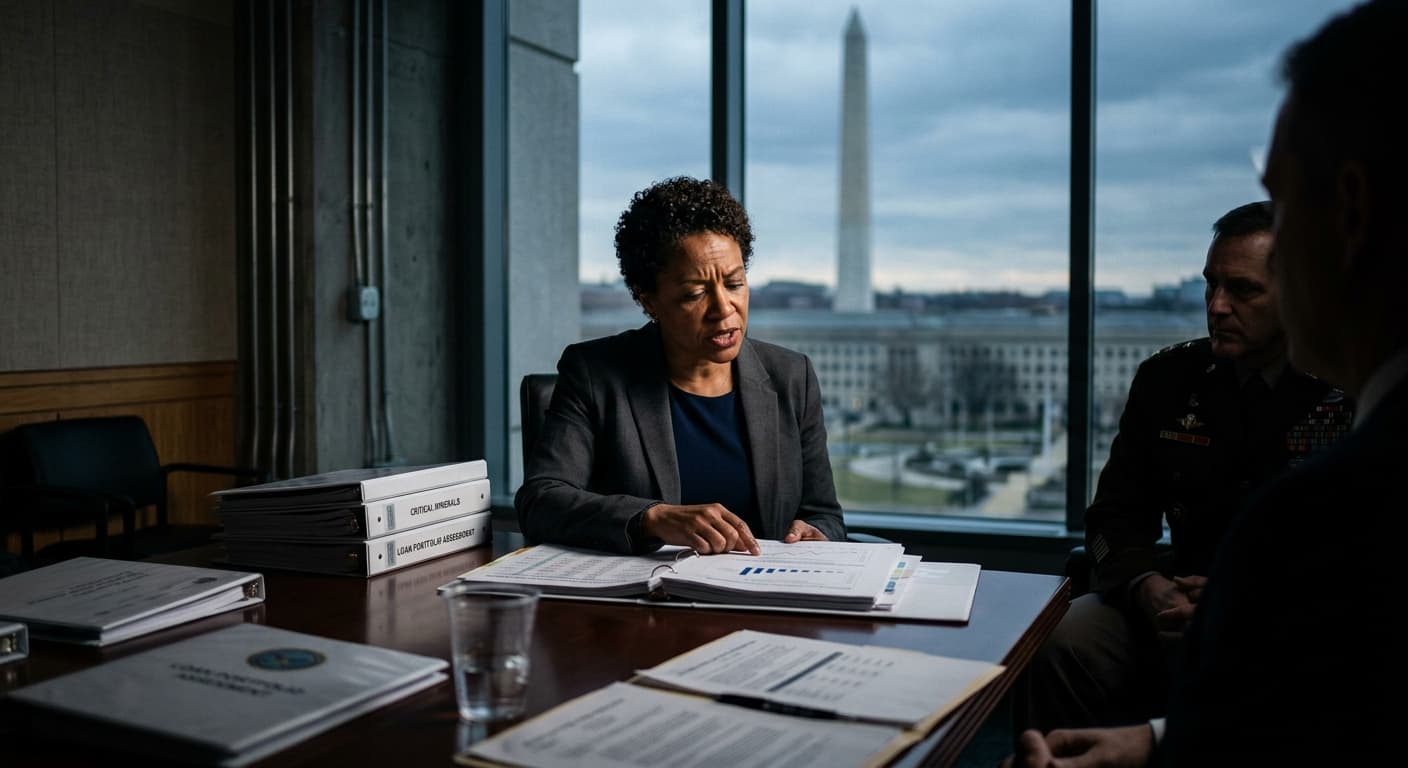
Pentagon Routes Critical Minerals Loans Through Private Funds Under $100B Authority
The Pentagon's new National Security Fund Finance program routes up to $100 billion in government-backed loans through private credit funds to build a domestic rare earth supply chain. The statutory math assumes default rates a fraction of what the Defense Department's own books show.
The Office of Strategic Capital unveiled the financing vehicle on July 14, 2026, changing how the U.S. government bankrolls critical minerals production. The National Security Fund Finance program, announced by what the Department of Defense now calls the Department of War, lets qualified private credit fund managers tap federal loans, blend them with their own private capital, and deploy the combined pool into critical minerals companies. The authority backing it is enormous on paper: $500 million in credit subsidy appropriated under the One Big Beautiful Bill Act, authorized to subsidize up to $100 billion in loans. The gap between those two numbers, $500 million and $100 billion, is where the politics, the risk, and almost certainly the disappointment live.
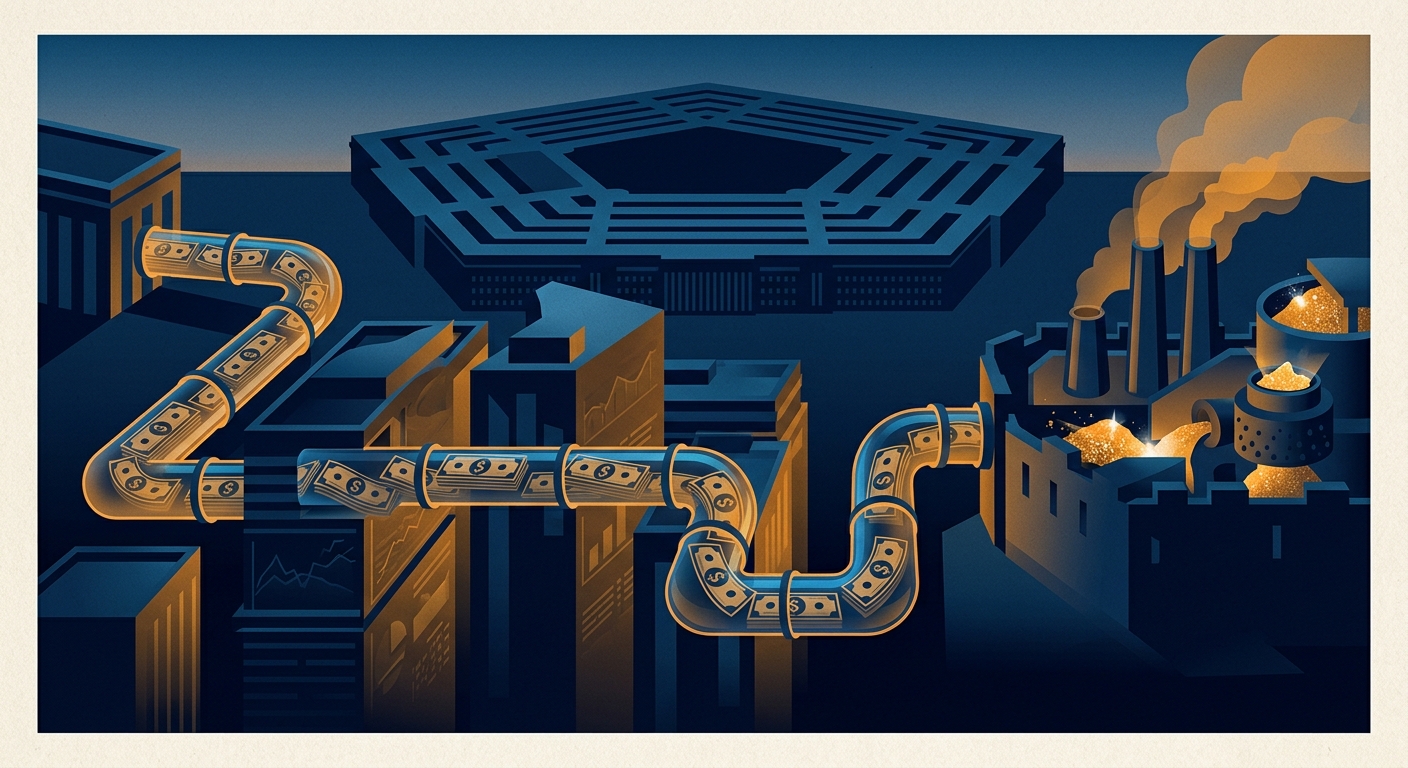
A structural shift, not a cash drop
The NSFF is not a new tranche of money arriving tomorrow. As of July 16, the formal Notice of Funding Opportunity had not been published; private fund managers cannot apply or receive loans until it goes live. What the program represents is a structural shift in how OSC operates. Since its founding under the Biden administration in December 2022 and its codification in the fiscal 2024 National Defense Authorization Act, OSC functioned as a direct lender, evaluating individual companies and extending loans project by project, with $10 million to $150 million per facility and a total $984 million equipment-finance portfolio. The NSFF adds a fund-finance layer, letting OSC act as a senior creditor to private credit vehicles whose managers apply their own underwriting across a portfolio of companies, according to TechTimes.
The pitch from OSC Director David A. Lorch, who also serves as Senior Advisor to Deputy Secretary of War Steve Feinberg, is straightforward: the program "advances OSC's goal of crowding-in private capital to address shortages that are vital to U.S. national security," as quoted in TechTimes. Under Secretary of War for Research and Engineering Emil Michael framed it as another tool to "establish true U.S. independence in the critical minerals supply chain," leveraging U.S. capital markets, a theme he and Lorch elaborated at the
CSIS Global Security Forum on June 30, 2026.
The shift matters because OSC's direct-lending pipeline is already oversubscribed. The office received more than 200 loan applications representing $8.9 billion in financing requests against a $984 million lending cap, according to the Congressional Research Service. Routing capital through private fund managers lets OSC scale without building a sprawling underwriting bureaucracy inside the Pentagon. The private funds do the company-level diligence; OSC lends at the fund level.
The $100 billion question: how far does $500 million go?
The statutory architecture rests on a number that demands scrutiny. Section 20004(d) of the One Big Beautiful Bill Act (P.L. 119-21) appropriated $500 million to the DOD Credit Program Account, available through September 30, 2029, "to subsidize up to $100 billion in loans, loan guarantees, and technical assistance for critical minerals and related industries and projects," as confirmed in the CRS analysis by analyst Marcy E. Gallo.
The Federal Credit Reform Act of 1990 does not require the government to appropriate the full face value of its loans. It appropriates the net present value of expected losses, the "credit subsidy." The $500 million is what Congress assumes the government will actually lose, on a probability-weighted basis, across the entire portfolio. The $100 billion is the maximum face value of loans that loss estimate is supposed to cover. That implies a subsidy rate of approximately 0.5 percent, meaning the government expects to recover 99.5 cents of every dollar lent.
That assumption is, to put it plainly, aggressive. OSC's existing capital assistance program received $97.8 million in FY2026 appropriations to subsidize up to $4.4 billion in loans — a roughly 2.2 percent subsidy rate, per the Congressional Research Service. But the government's own official estimate is even higher. The
OMB Federal Credit Supplement for FY2027 scores OSC's direct loan program at a 9.97 percent subsidy rate — roughly 20 times the rate implied by the critical minerals authorization.
If the critical minerals tranche carries risk anything like OSC's existing book, the $500 million in credit subsidy would support roughly $5 billion in face-value loans — not $100 billion, and not even the $22 to $23 billion you'd get at the 2.2 percent rate. The program is a large bet that lending through diversified private credit funds, rather than to individual companies, will produce default rates far lower than the Pentagon's own loan portfolio to date suggests.
Processing is the bottleneck, not mining
To understand why the NSFF exists at all, look at where China's leverage actually sits — and it is not in the ground. China dominates the midstream: roughly 91 percent of global rare earth separation and metal production, and about 94 percent of sintered NdFeB permanent magnet production, according to RUSI analyst Henry Sanderson's June 2026 assessment. While China's share of rare earth mining has fallen over the past decade as Australia, the U.S., and others ramp extraction, its share of midstream and downstream markets has increased.
The European Parliamentary Research Service notes that China controls 60 percent of global rare earth production and 90 percent of refining — a position "unlikely to change." The EU sources all of its heavy rare earths and 98 percent of its rare earth magnets from China. The IEA reports that China leads refining for 19 of 20 strategic minerals it tracks, and that the U.S. produces less than a quarter of its own refined rare earth demand, per
ORF analysis.
This is why the NSFF targets the middle of the supply chain. Even when the U.S. or its allies successfully diversify mining — as MP Materials has at Mountain Pass, California — the concentrate still gets shipped to China for separation. USA Rare Earth's magnet plant has yet to reach commercial production. The processing gap is both capital-intensive and technically complex, and China has restricted the export of rare earth processing technology since 2023, with further tightening proposed in October 2025, as Sanderson documents.
A weaponized choke point
The urgency behind the NSFF is not hypothetical. In April 2025, China imposed export controls on seven heavy rare earth elements — samarium, gadolinium, terbium, dysprosium, lutetium, scandium, and yttrium — in response to the Trump administration's tariffs, according to CSIS. Within weeks, auto industries in the U.S., Europe, and Japan reported supply disruptions that threatened to halt domestic manufacturing.
In October 2025, China expanded controls to cover five additional rare earths, processing equipment, and — for the first time — asserted extraterritorial jurisdiction, requiring foreign entities to obtain Chinese licenses when exporting items containing even trace amounts (0.1 percent) of Chinese-sourced rare earths, the European Parliamentary Research Service reported. A Trump-Xi agreement suspended the second wave of controls until November 10, 2026. But on June 22, 2026, China added ten U.S. companies — including MP Materials and USA Rare Earth, both of which have received billions in federal support — to its export-control list, as
ORF reported. The message: even under the truce, Beijing retains selective leverage.
The U.S. has mobilized in response. According to CSIS, announced non-equity U.S. government investment in rare earth projects reached $7.
Discover more

US Politics
House Ethics Committee Pushes Sexual Miscond.
The House Ethics Committee has shifted responsibility for sexual harassment settlement records to the Office of Congressional Workplace Rights, complicating disclosure efforts.
International Relations
Economist Impact Sustainability Week 2026
Economist Impact Sustainability Week 2026 spotlights the energy transition, AI in clean technology, and supply chain resilience as themes for global leaders.
US Politics
Congress Targets AI Chatbot Access for Terror
The House passed the Generative AI Terrorism Risk Assessment Act, focusing on AI's role in terrorism and potential surveillance implications.

Economics
Fed's Amex AML order puts correspondent banking on notice
Federal Reserve's Amex AML order requires board-level controls and a 90-day plan; OCC fined the bank $350 million over enterprise-wide deficiencies.