Pakistan's Quiet Siege on Afghan Students
KEMU eviction order signals end of exemption for Afghan students
Model Diplomat9 min readSouth Asia
Pakistan's Quiet Siege: How a Hostel Eviction Order at KEMU Reveals a State Strategy of Expulsion
The 48-hour eviction of Afghan medical students from King Edward Medical University hostels is not a bureaucratic glitch — it is the next phase of a campaign that has already expelled over 1.5 million Afghans since 2023, now systematically severing the one pathway still legitimizing Afghan presence in Pakistan: higher education.
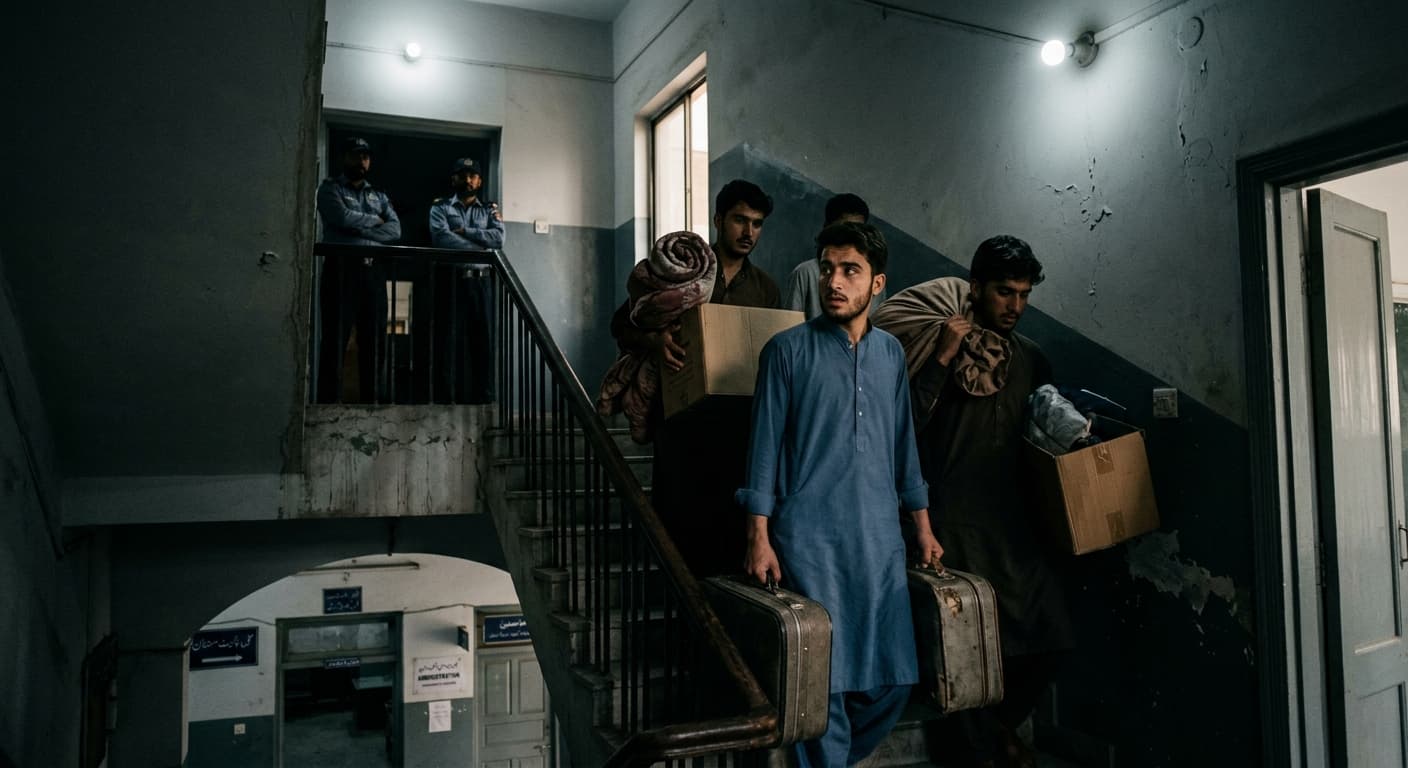
LAHORE — On July 21, 2026, the office of the chief warden at King Edward Medical University (KEMU) issued a directive that reads like an administrative formality: all Afghan nationals residing in university hostels — students, doctors, and other residents — must vacate within 48 hours unless their visa extensions are approved by the government. The language is clipped, procedural, final.
What it actually signals is the arrival of Pakistan's deportation drive at the gates of the country's oldest and most prestigious medical school, and with it, the collapse of the tacit exemption that Afghan students — unlike refugees, unlike undocumented laborers, unlike card-holders — believed they still held.
The Machinery Behind the Memo
To read the KEMU eviction as a standalone event is to misunderstand its mechanics. It is the product of a multi-year, multi-phase enforcement architecture that has been tightening since October 2023.
That is when Pakistan launched the Illegal Foreigners Repatriation Plan, an initiative that has, according to the UN refugee agency UNHCR, driven more than 1.5 million Afghans from Pakistan — voluntarily or forcibly — by mid-October 2025, Al Jazeera reported. The plan was structured in phases. Phase one, beginning November 2023, targeted the estimated 1.3 million Afghans lacking valid visas or documentation. Phase two, launched in March 2025, cancelled Afghan Citizen Cards (ACCs) — the very documents the Pakistani government itself had issued since 2017 — and ordered holders to leave by March 31 or face deportation, according to
Human Rights Watch. Phase three targets those awaiting third-country resettlement.
Each phase has been punctuated by a deadline, and each deadline has been enforced more ruthlessly than the last. The most recent — July 10, 2026 — was a nationwide instruction from the Interior Ministry for police and local authorities to arrest and deport any Afghan national without valid legal status. According to the BBC, in the five days between July 11 and July 16, 2026, the daily rate of Afghans returning through the Torkham border crossing surged from 400–600 to between 3,400 and 4,100 — a near-tenfold increase.
The KEMU directive, arriving eleven days after the July 10 deadline, is not coincidence. It is the institutional cascade reaching higher education.
The Leverage: Hostel Accommodation as Visa Enforcement
The eviction order works because hostel accommodation is not a convenience for medical students at KEMU — it is an operational necessity. "Hostel accommodation is closely tied to their ability to attend clinical rotations, perform emergency duties and sit examinations at teaching hospitals," Pakistan Today noted in its report on the directive. A medical student without a hostel room in Lahore cannot simply rent an apartment and continue. Clinical training at public teaching hospitals operates on rigid attendance schedules, often with overnight and emergency shifts that require proximity to the hospital complex. The university is not merely offering a living arrangement; it is supplying the logistical infrastructure that makes the degree physically possible.
What the KEMU wardens are enforcing, then, is not merely compliance with immigration regulations. They are converting administrative uncertainty — pending visa renewals — into academic impossibility.
The mechanism is precise. "Universities are expected to comply with government regulations. Hostel accommodation cannot be allowed where immigration status is no longer valid," a senior official told Pakistan Today, speaking on condition of anonymity. This is the legal logic: the obligation falls on the educational institution to verify status, and to withdraw services when status lapses. There is no carve-out for students whose renewal applications are pending, even when that delay originates within Pakistan's own immigration bureaucracy.
Several Afghan students in Lahore, Islamabad, and Karachi told the newspaper they had applied for visa renewals before their documents expired but were "still waiting for immigration authorities to process those applications." An Afghan medical student quoted in the report said: "We entered Pakistan legally and have continued our education according to university rules. If visa renewals remain pending due to administrative delays, students should not be penalised."
Who These Students Are
Afghan medical students in Pakistan occupy a distinct legal and social category. Unlike the broader refugee population — the 1.2 million UNHCR Proof of Registration (PoR) cardholders and the 800,000 former Afghan Citizen Card holders, according to UNHCR data cited by Al Jazeera — these students entered Pakistan on valid student visas, enrolled in accredited programs, and paid fees. They are not covered by refugee protections because they are not, legally, refugees. And because Pakistan is not a signatory to the 1951 Refugee Convention — a fact noted by
Al Jazeera — they have no international legal framework to invoke.
Their vulnerability is structural: they depend on a visa category that requires periodic renewal, and every renewal now occurs inside a political climate where the state has declared all undocumented Afghans illegitimate and where bureaucratic delay functions as a de facto denial.
The number of students affected at KEMU is not yet publicly quantified. But the phenomenon is broader. The Pakistan Today report notes that "student representatives from universities in Islamabad and Karachi said a number of Afghan students were continuing to attend classes while awaiting decisions from immigration authorities." The KEMU eviction is the first documented case of a university acting on the government's implicit instruction that educational institutions police their students' immigration status — but it will not be the last.
The Bilateral War That Swallowed the Students
The eviction order cannot be separated from the armed conflict unfolding along the Pakistan-Afghanistan border. Pakistan and the Afghan Taliban are in what Pakistan's own Defence Minister Khawaja Asif, on February 27, 2026, called "open war," Al Jazeera reported. Since February 2026, cross-border airstrikes, ground operations, and drone incursions have killed hundreds of people on both sides. The United Nations reported in May 2026 that at least 372 Afghan civilians had been killed and 397 injured in the first three months of the year alone,
Al Jazeera said.
Pakistan's casus belli is the presence of the Tehreek-e-Taliban Pakistan (TTP) on Afghan soil. The Afghan Taliban deny providing sanctuary. But the military logic has been relentless: Pakistan has struck targets as far as Kabul, Kandahar, and Paktia. On June 29, 2026, after a TTP-claimed attack on a paramilitary compound in Karachi killed three personnel — with a captured suspect identified as an Afghan national — Pakistan launched strikes on Paktia, Paktika, and Kunar provinces. The Taliban government said 36 civilians died. Pakistan claimed 25 fighters were killed, according to Al Jazeera.
The Afghan Taliban have retaliated. On July 1, 2026, the Pakistani military confirmed it had intercepted four drones launched from Afghanistan into Balochistan, Al Jazeera reported. The Taliban defence ministry said it carried out strikes against what it called ISIL (ISIS) centers in Pishin district and parts of Khyber Pakhtunkhwa.
In this context, every Afghan in Pakistan — regardless of legal status, regardless of whether they arrived decades ago or last year — has become a liability to the state. The International Crisis Group captured the logic in a May 2025 policy brief: Pakistani authorities "argue Afghan refugees pose a security risk, accusing the Taliban government of sheltering armed groups, a charge Kabul denies." The interior minister's allegation — that 14 of 24 suicide bombings in 2023 involved Afghan nationals — was never supported with evidence, but the narrative had already been operationalized into policy.
Medical students on valid visas are not suicide bombers. But the state's enforcement apparatus is not calibrated for nuance. It is calibrated for volume.
The Academic and Humanitarian Cost
For Afghan medical students, returning to Afghanistan is not a return to normal life; it is entry into a country where the Taliban have banned women from higher education entirely and where medical education itself has been systematically dismantled for female students. Human Rights Watch noted in a March 2025 report that "since taking power, the Taliban have banned education for girls and women beyond primary school. In December 2024, the authorities closed one of the last remaining loopholes in their ban on education for older girls and women by forbidding them from attending institutions offering medical education." For female Afghan medical students at KEMU — and there are many — the eviction is not a housing problem. It is the foreclosing of their last remaining educational pathway on the subcontinent.
Male students face a different but comparable abyss. Afghanistan's healthcare infrastructure is shattered. The same Human Rights Watch report found that "14 million people have limited access to basic healthcare services, including medicine." A returning medical student, far from contributing to the system, would have no system to enter.
The broader dynamic is captured by the IMF in a September 2025 working paper on the macroeconomic implications of the Afghan exodus: "In Pakistan, where the literacy rate among Afghan refugees is below 50 percent, most are dependent on precarious daily labor." Medical students are a tiny, elite exception to that demographic reality — and they are being swept into the same net.
The Punjab Health Department's Warning
There is a quiet fissure inside the Pakistani state that the KEMU eviction exposes. A senior Punjab Health Department official, quoted by Pakistan Today, said: "Universities are obliged to comply with immigration laws but there should also be coordination between educational institutions and immigration authorities so that genuine students with pending visa extensions are not forced to interrupt their studies." The official added: "A temporary mechanism for students awaiting renewal decisions could prevent unnecessary disruption."
This is not dissent from the policy. It is a practical plea from the institution that will bear the cost of losing trained medical personnel. Punjab's public health system relies on KEMU and its network of teaching hospitals — Mayo Hospital, among them — to produce doctors for a province of over 120 million people. Every Afghan student who leaves mid-training is a clinical capacity loss that cannot be backfilled on short notice.
The gap between the Interior Ministry's enforcement logic and the Health Department's operational logic is the space where students fall. The Interior Ministry imposes compliance deadlines. The immigration bureaucracy fails to process renewals. Students become undocumented through no fault of their own. And universities are instructed to evict. No single actor coordinates the sequence — but the sequence is devastatingly effective.
What Happens Next: The Contagion Risk
The KEMU order is a model. Other universities have already "reportedly stepped up checks of immigration documents in recent months," Pakistan Today noted. University hostels across Islamabad, Karachi, Peshawar, and Lahore house thousands of Afghan students across disciplines — medicine, engineering, business, computer science. If the KEMU template spreads, each institution will face the same choice: verify visa status, and evict when status is ambiguous.
The timing compounds the damage. Medical programs are structured in sequential blocks. Missing clinical rotations in July and August means losing an entire academic year. A student evicted this week will not simply return when the visa is approved; the training pathway will have fractured.
The Punjab Health Department official's proposed solution — a temporary mechanism for students with pending renewals — is technically simple but politically improbable. It would require the Interior Ministry to instruct immigration authorities to prioritize student renewals and to issue provisional documentation while applications are processed. In the current political climate, where the government has just completed a record week of deportations and where cross-border military strikes remain an active option, a carve-out for Afghan students is not a priority. It is a liability.
The Bottom Line
The KEMU hostel eviction is not about visa administration. It is the final mechanism in a strategy that has used deadlines, document cancellations, police raids, and — now — academic expulsion to make Afghan presence in Pakistan structurally untenable. The students targeted are not undocumented migrants who slipped across the border; they entered legally, enrolled legally, and are stalled legally in a bureaucratic system that the state controls. The state is choosing not to clear them.
The beneficiary is the security apparatus, which gains a demonstrable victory in the optics of enforcement at no political cost — students do not vote, and Afghans have no constituency. The loser is Pakistan's medical training pipeline and, downstream, the patients in Punjab's public hospitals who depend on the clinical labor that these students provide. The next decision point is not a deadline. It is whether another university issues the same directive before the end of July — and whether the Punjab Health Department is willing to say so publicly.
Discover more

US Politics
US Launches $166B Tariff Refund Portal
The US is launching a $166 billion tariff refund portal to aid importers hit by Trump-era tariffs, with major implications for trade and supply costs.
India
CPI(M) Calls to Decouple Quota from Delimita
CPI(M) advocates for a 33% women's quota in Lok Sabha by 2029, removing the need for delimitation and census linkage.
US Politics
House Ethics Committee Pushes Sexual Miscond.
The House Ethics Committee has shifted responsibility for sexual harassment settlement records to the Office of Congressional Workplace Rights, complicating disclosure efforts.

Economics
Fed's Amex AML order puts correspondent banking on notice
Federal Reserve's Amex AML order requires board-level controls and a 90-day plan; OCC fined the bank $350 million over enterprise-wide deficiencies.