Pakistan's Dollar-Settled Rupee Bond
A new bond transfers FX risk to investors while saving reserves.
Model Diplomat9 min readAsia
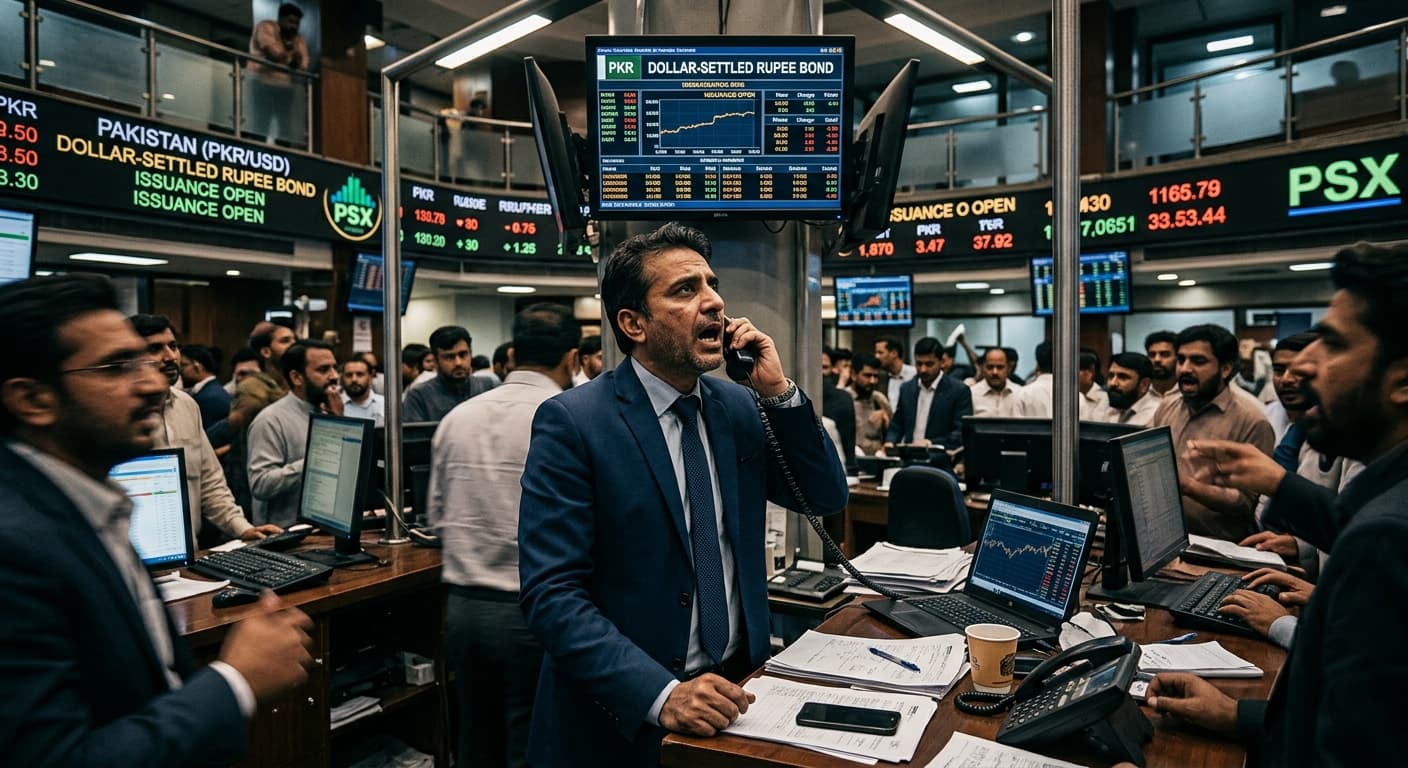
Pakistan's Dollar-Settled Rupee Bond: A Currency Risk Trade
Islamabad's first offshore rupee-linked note transfers FX risk to foreign investors while sparing $16bn in reserves — a bet that credibility, not cash, is now the binding constraint.
Pakistan will issue its first dollar-settled, rupee-linked bond alongside fresh Eurobonds and Sukuk, Finance Minister Muhammad Aurangzeb told the Pakistan Banking Summit on July 7, 2026 — the country's most consequential debt-market move since it returned to global markets in April after a four-year absence. The instrument is not, as headlines suggest, simply another dollar borrowing. It is a currency-risk transfer trade: investors get rupee exposure and settle in dollars, while Islamabad locks in lower yields than a straight Eurobond and shields its hard-currency reserves from further external debt service. Whether investors buy it in size will tell Aurangzeb — and the IMF — how much credibility the last two years of stabilisation has actually bought.
According to ProPakistani, Aurangzeb said the government has issued requests for proposals for all three instruments, adding: "These are not going to be incremental debt. They will largely replace earlier debt." The finance ministry framed the plan as liability-management, extending the maturity profile of external obligations rather than adding to a stock that the
World Bank still flags as a structural drag on fiscal space, given that provincial revenues have crept up to only about 6.5% of GDP while federal expenditure has failed to adjust.
What was actually announced
Three instruments are in the pipeline. First, a follow-on Eurobond, sized to the demand seen in the April 2026 return trade — a $750 million issue that priced after a greenshoe was exercised. Second, an international Sukuk, keeping the sovereign compliant with the government's roadmap to shift all new domestic and international borrowing to Shariah-compliant instruments from January 2028 onward. Third — and new — a dollar-settled, rupee-linked bond, echoing the Panda Bond blueprint that raised $250 million in yuan in May 2026 and was oversubscribed five times at Pakistan's lowest-ever three-year international coupon of 2.5%, according to a
BBC Urdu briefing citing finance ministry adviser Khurram Shahzad. Shahzad told the BBC that both the Eurobond and Panda Bond drew "extraordinary interest" and reflected renewed investor confidence in Pakistan's macroeconomic stabilisation.
The macro pitch is real. The IMF Executive Board, which cleared the third review of Pakistan's 37-month Extended Fund Facility on May 8, 2026, reported gross reserves of $16 billion at end-December 2025 — up from $14.5 billion six months earlier — and a primary surplus tracking 1.6% of GDP for FY26. Aurangzeb told the summit that FY26 closed with 3.7% growth, a debt-to-GDP ratio below 70%, and expected remittances of $41–$42 billion. On the same day, the SBP-led SME Finance Task Force was announced, an attempt to widen the credit channel beyond the sovereign — an implicit acknowledgement that the bond programme alone will not restart the real economy.
Why "dollar-settled rupee-linked" is the whole story
Strip out the jargon and the structure is straightforward: the bond's principal and coupon are denominated in Pakistani rupees, but every cash flow between issuer and investor is paid in US dollars, converted at a reference rate on the settlement date. It is, in effect, a sovereign non-deliverable bond — the fixed-income cousin of the non-deliverable forward markets described in an IMF working paper by Schmittmann and Chua, which notes that such structures let authorities "intervene without affecting foreign exchange reserves" because a short USD exposure "does not imply a USD liability on the issuing central bank's balance sheet." The same paper documents how Bank Indonesia used domestic non-deliverable forwards, introduced in November 2018, to ease rupiah pressure without depleting reserves — a template Pakistani officials clearly studied.
Two things follow, and both matter for Pakistan.
First, the currency risk sits with the buyer. If the rupee depreciates against the dollar between issuance and coupon date — as it has done for most of the last decade — investors receive fewer dollars back. The State Bank of Pakistan does not have to defend the currency to protect bondholders, and the IMF's May staff report has explicitly instructed that "exchange rate flexibility should be the main shock absorber" — particularly given the balance-of-payments pressures the report attributes to "the impact of the war in the Middle East." That is a sharp reversal of the "original sin" trap — the term coined by Barry Eichengreen and Ricardo Hausmann in 1999 and revived in a
Brookings analysis — in which emerging sovereigns can only borrow abroad in hard currency and blow up when their own currency falls. Brookings notes that Indian corporates have raised more than $8 billion through masala bonds precisely because "the exchange rate risk of masala bonds are borne by lenders, not by borrowers."
Second, the pricing should compensate. Investors demand a rupee yield that reflects local inflation and expected depreciation, but net of Pakistan's dollar credit spread. That is the arithmetic behind India's masala bonds, launched by the IFC in 2013 at a coupon of 7.75% — 70 basis points below the prevailing three-year Indian government bond yield, according to India's Press Information Bureau — and behind Indonesia's domestic non-deliverable forward programme. Both offshore local-currency markets grew because they let global investors take a currency view without needing local custody, tax registration, or capital-account access. India's finance ministry called the IFC issue "an important milestone" for developing both onshore and offshore rupee capital markets. Pakistan is now trying to compress that decade-long institutional build into a single fiscal year.
The macro backdrop the bond is riding
The trade only works because Pakistan has, for now, cauterised its 2022–23 crisis. When the IMF approved the current EFF on September 25, 2024, gross reserves were $9.4 billion; by end-March 2025 they had climbed to $10.7 billion, and by end-2025 to $16 billion, per the IMF's April 2025 staff report, which also flagged that sovereign spreads had dropped from crisis levels to around 600 basis points before backing up after the April 2 tariff announcements. Moody's upgraded Pakistan to Caa2 with a positive outlook in the wake of the 2024 IMF deal, according to
Al Jazeera, and Fitch followed with a move to CCC+ later that year. Neither agency has yet pushed Pakistan into single-B territory, where index inclusion and mainstream EM buyers open up.
That rating ceiling is the reason a rupee-linked structure is more than a novelty. The IMF's October 2025 Global Financial Stability Report argues that emerging and frontier sovereigns should "increase the role of resident buyers in their financing strategies" precisely to reduce currency-mismatch risk — but Pakistan cannot yet rely on domestic non-bank savings at the scale India or Indonesia can. The GFSR also notes that bank ratings are generally capped by the sovereign's "country ceiling," reflecting transfer and convertibility risk — meaning that until Pakistan's rating rises, its banks cannot warehouse foreign portfolio flows the way Indian or Indonesian banks do. Offshore rupee paper offers a bridge: a foreign investor base, but with FX risk offloaded.
The pressure to pull this off is quantifiable. IMF data show Pakistan owes the Fund roughly $611 million in scheduled payments between May and December 2026 alone, including a $111.75 million GRA repurchase on October 9. Pakistan is separately targeting $2 billion in international bond issuance in FY27, according to
ProPakistani's June 2026 reporting, against a total external financing requirement of $23.4 billion — a gap that cannot be closed by Chinese, Saudi and Emirati rollovers alone. Beijing already holds about $29 billion in loans to Islamabad, or roughly 22% of external debt, according to
Al Jazeera's May 2026 feature, which also notes that Chinese exports to Pakistan hit $20.2 billion in 2025 against just $2.8 billion running the other way — a trade imbalance that constrains how much further Islamabad can lean on Beijing.

Who wins, who eats the risk
The immediate winners are Aurangzeb's finance team and the SBP. They get a diversified investor list — the Panda Bond opened Chinese onshore money, the rupee-linked note opens EM local-currency mandates that never buy CCC+ dollar paper — and they extend the maturity profile without adding hard-currency claims on reserves. Domestic banks, which have absorbed most of the government's rupee liabilities and hold portfolios highly correlated with sovereign risk, get some relief from crowding-out. The March 2026 IMF mission statement specifically flagged the need for the SBP to "ensure that the banking system remains able to accommodate import financing and other external payments amid potentially elevated balance of payments pressures" — a task the new instrument makes marginally easier.
The clear counterparty in a currency crack is the foreign investor. If the rupee weakens sharply — which the IMF's baseline explicitly allows as a shock absorber against Middle East war spillovers — the dollar-settled payment shrinks. Buyers will therefore price a large depreciation premium into the coupon. That is the tell of whether the market believes Pakistan's stabilisation is durable: a coupon that undercuts current dollar-Eurobond spreads meaningfully signals confidence; a coupon that matches or exceeds them signals that investors are pricing the rupee, not the sovereign. The historical parallel is unforgiving — a 2020 IMF working paper shows outstanding Indonesian DNDFs auctioned by Bank Indonesia ranged only between $1 billion and $4 billion at peak, well below the $10 billion Islamabad ultimately needs from capital markets.
The domestic loser, if there is one, is the political narrative that borrowing abroad is a triumph. Federal Planning Minister Ahsan Iqbal reportedly questioned that framing days before the announcement, telling colleagues that celebrating a bond raise is "a very shameful thing… bond is a loan." The technocratic answer — that liability management, not fresh borrowing, is the point — depends on the RFPs actually replacing, not augmenting, existing paper. That is not a rhetorical distinction: the same BBC report notes that Pakistan repaid $3.45 billion to the UAE in April 2026 by drawing on a fresh $3 billion Saudi deposit, an accounting shuffle that keeps gross reserves stable but does nothing to reduce net external liabilities.
What to watch next
Three catalysts will determine whether the July 8 announcement becomes a genuine market opening or a footnote:
- RFP award and roadshow (Q3 2026). Book-runner selection typically precedes issuance by four to eight weeks. A syndicate that includes Chinese and Gulf houses alongside Western banks would signal Islamabad wants the note distributed across three investor pools, not just one.
- October 9, 2026 IMF repurchase. Pakistan's largest single scheduled payment to the Fund in the second half of 2026, per the
IMF projected payments schedule. Issuance timing before this date signals defensiveness; after suggests confidence.
- Fourth EFF review and any Moody's/Fitch action. A Moody's move from Caa2 to B3 would materially expand the buyer base for both the dollar and rupee-linked notes and let Pakistan tighten spread guidance by 100–150bp.
Diplomat View
The dollar-settled rupee bond is Pakistan's clearest signal yet that it wants to graduate from bailout-and-rollover diplomacy into normal frontier-market plumbing — but it is doing so from a rating band, Caa2/CCC+, where the instrument has never really worked at scale. The most honest read of the market's answer will be the coupon: a print inside 9% on a three-year rupee-linked tenor implies foreign investors believe Aurangzeb's stabilisation is stickier than the political noise around it; a print above 11% means they still see the rupee, not the sovereign, as the binding risk. The forecast worth defending is that Pakistan gets its first tranche away in Q4 2026 at a coupon that compensates for expected depreciation but undercuts a hypothetical straight Eurobond by 100–200bp — small enough to keep sceptics honest, big enough to matter for a country still paying the IMF nearly $611m before year-end. What would change the call: a renewed regional flare-up that forces the SBP back into FX-defence mode, a Moody's downgrade, or an RFP that quietly slips past September without book-runners named. Any of those, and the dollar-settled rupee bond becomes a talking point, not a market. *
Discover more
Global Politics
Xi Jinping Calls China-Russia Ties 'Precious'
Xi Jinping's description of China-Russia ties as 'precious' reflects a strategic imbalance, with Beijing dictating terms in the partnership.
US Politics
SNAP Food Assistance Faces Legal Challenges
In 2026, SNAP faces stricter eligibility rules and mounting legal challenges, threatening food assistance for the millions of Americans who rely on the program.

US Politics
US Launches $166B Tariff Refund Portal
The US is launching a $166 billion tariff refund portal to aid importers hit by Trump-era tariffs, with major implications for trade and supply costs.

Conflict & Security
Drone Warfare Killing Aid Workers at Unprec
Over 1,000 humanitarian workers killed in three years as cheap armed drones collapse legal protections. Gaza, Sudan, Ukraine, and DRC see deliberate targeting of aid convoys and hospitals with zero prosecutions.