Pakistan's Dollar-Linked Rupee Bonds Test
A new bond issuance aims to shift currency risk to investors.
Model Diplomat9 min readAsia
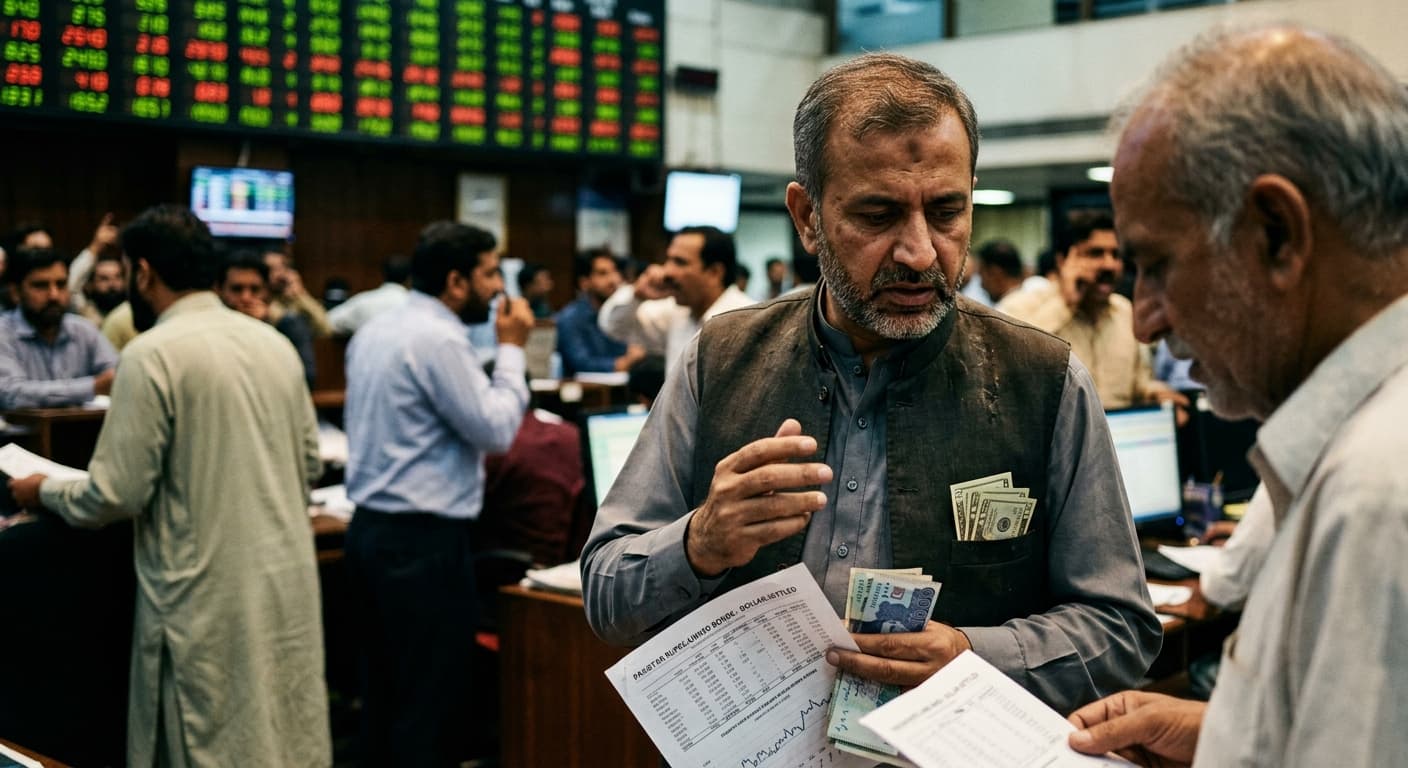
Pakistan's Rupee-Linked Dollar Bond: A Currency Confidence Test
Pakistan will issue its first dollar-settled rupee-linked bonds alongside new Eurobonds and Sukuk — a debt-swap that shifts FX risk to investors and puts the rupee on trial.
Pakistan's plan to sell dollar-settled, rupee-linked bonds is not a funding exercise — it is a market referendum on the rupee. Finance Minister Muhammad Aurangzeb announced on July 8, 2026 that Islamabad has issued requests for proposals for three parallel instruments — Eurobonds, international Sukuk, and, for the first time, dollar-settled rupee-linked notes — as reported by ProPakistani. The novel structure lets foreign investors buy Pakistani rupee exposure while receiving payments in dollars, transferring currency risk from the sovereign to the buyer. The yield foreigners demand to accept that risk will be the clearest, real-time market verdict on whether Aurangzeb's stabilization is credible — and whether
Pakistan is finally breaking the "original sin" of borrowing exclusively in hard currency.
What Islamabad is actually selling
The structure is a synthetic local-currency bond. Coupon and principal are denominated in rupees, but every payment is converted to and settled in U.S. dollars at the prevailing exchange rate. Pakistan owes rupees; the investor collects dollars whose value floats with the currency. If the rupee depreciates, the dollar payout shrinks — the foreign buyer, not the sovereign, absorbs the loss.
This is the same architecture India pioneered with its "masala bonds" from 2013 onward. The International Finance Corporation's first tranche in November 2013 raised $161 million at 7.75%, roughly 70 basis points below the prevailing Indian government yield, and was oversubscribed twice, according to a Press Information Bureau release. India's finance ministry noted at the time that "the exchange rate risk on the bond is borne by the investor" — the same feature Pakistan is now importing. That release argued the offshore rupee market was "crucial for India to develop… as an alternative source of dollar funding" — the exact rationale Aurangzeb is now applying to Karachi.
Brookings researchers Anne Kamau and Zenia Lewis frame the logic bluntly: dollar-denominated borrowing exposes an emerging economy to a currency mismatch that "can easily spin out of control" when the local currency weakens, a vulnerability economist Ricardo Hausmann labelled "original sin." A rupee-linked instrument, Brookings argues, is one of the few structures that meaningfully reduces that mismatch without requiring foreigners to open onshore accounts. The paper notes Indian corporations mobilised more than $8 billion through masala bonds after 2015 — a scaled proof that offshore appetite for structured local-currency EM paper is real.
For Pakistan, that is the entire point. Aurangzeb was explicit that the new issuances are not incremental: "These are not going to be incremental debt. They will largely replace earlier debt," he told the Pakistan Banking Summit 2026, per ProPakistani. What is being swapped is the currency composition, not the size, of the external stock. Wenxin Du and Jesse Schreger's foundational 2016 study of
Local Currency Sovereign Risk demonstrated that local-currency EM credit spreads are "positive and sizable" but "less sensitive to global risk factors" than hard-currency spreads — precisely the diversification benefit Pakistan wants to lock in before dollar liquidity conditions tighten again.
Why this only becomes possible now
Pakistan could not have marketed this bond eighteen months ago. In 2022 Moody's cut the sovereign to Caa1 amid catastrophic floods, and the finance ministry acknowledged that ratings mattered only "when a country is seeking to tap the global debt market," which Islamabad was not, according to Al Jazeera. By September 2024, Moody's had upgraded local and foreign-currency ratings to Caa2 from Caa3, citing "improving macroeconomic conditions and moderately better government liquidity and external positions," per
Al Jazeera. Rupee-linked paper needs credible reserves and a plausibly two-way exchange rate; a country burning through FX to defend a peg cannot sell foreigners on rupee upside.
That backdrop has shifted materially. The IMF Executive Board's third review under the $7 billion Extended Fund Facility, completed on May 8, 2026, disbursed a further $1.1 billion and confirmed a primary surplus of 1.6% of GDP for FY26, gross reserves of $16 billion at end-December 2025 (up from $14.5 billion in June), and a broadly balanced current account, per an IMF statement. Pakistan posted its first current account surplus in 14 years in FY25, according to the IMF's
second-review staff report published December 11, 2025.
Crucially, the Fund's April 2025 staff report explicitly sequenced the market re-entry: "Access to external commercial financing is expected to remain limited during the program, with a small 'Panda' bond issuance anticipated in FY26, ahead of a gradual return to the Eurobond/Global Sukuk market assumed in FY27, reflecting a restoration of policy credibility." That timetable is in IMF Country Report No. 25/109. Pakistan has now front-run it — the $750 million Eurobond priced in April 2026 and the $250 million Panda Bond in May 2026, oversubscribed five times at a 2.5% coupon that Aurangzeb's team called the lowest three-year international borrowing cost in the country's history, per
BBC Urdu. The rupee-linked instrument is the third stage of a market-reopening that the IMF had penciled in for a year later than it is happening.
The IMF also flagged the structural weakness the new bond is designed to address. Roughly 80% of Pakistan's domestic debt consists of short-term or floating-rate instruments, leaving public finances "highly exposed to interest rate risk," the Fund warned in its first review. Broadening the investor base beyond captive domestic banks, staff wrote, "is key to mitigating debt vulnerabilities." A dollar-settled rupee bond is the textbook instrument for that broadening: it reaches offshore accounts that cannot or will not enter Pakistan's onshore market.
The angle: whose confidence is really on trial
The framing in Islamabad — and in much of the local press — is that this issuance will "test investor confidence." That has it slightly backwards. The Eurobond and Sukuk tranches test confidence in Pakistan's dollar creditworthiness, and April's greenshoe expansion and May's Panda oversubscription answered that question with a qualified yes.
The rupee-linked note tests something narrower and more revealing: whether foreign investors believe the State Bank of Pakistan will let the currency float freely enough for the pricing to be honest. If the SBP is quietly managing the rupee — as it did for years, with inflation peaking at 38% in May 2023 while foreign reserves fell to $3 billion, per Al Jazeera — foreigners will demand a large risk premium to compensate for a suppressed exchange rate that eventually snaps. If the market believes exchange-rate flexibility is genuine, the premium collapses. The IMF's program exchange rate is currently set at 278.34 rupees per dollar, per
IMF eLibrary — any large gap between that reference and the offshore rupee curve implied by the new bond will be uncomfortable reading in both Islamabad and Washington.
The IMF has been unambiguous about which regime it expects. In its March 27, 2026 staff-level agreement, the Fund insisted that "exchange rate flexibility should continue to serve as the primary shock absorber, including against spillovers from the conflict in the Middle East," per an IMF release. The rupee bond effectively marketises that commitment: every basis point of yield above the sovereign Eurobond curve is the market's estimate of expected rupee depreciation plus a policy-credibility premium. It is the closest thing Pakistan has ever had to a live, foreign-investor-priced measure of currency confidence.
Who benefits, who loses
Winners. The Ministry of Finance benefits most obviously — it substitutes rupee liabilities for dollar liabilities, reducing the sovereign's exposure to a weakening currency. Foreign banks arranging the deal (the RFP recipients) collect fees on three parallel mandates. Domestic banks, currently holding the bulk of the government's rupee debt, get partial relief: offshore demand for rupee paper widens the buyer pool the IMF has explicitly asked Islamabad to develop, easing the sovereign-bank "doom loop" the World Bank's July 1, 2026 report on fiscal federalism identified as a structural drag on macroeconomic stability.
Losers, or at least people taking on new risk. Foreign investors now hold the currency mismatch that the Pakistani state used to hold. The IMF's October 2025 Global Financial Stability Report noted that local-currency emerging-market debt has delivered "weak returns over the past decade — driven largely by continuing dollar strength," making the asset class less appealing to global funds benchmarked to dollar assets. The Fund also warned that frontier issuers relying on shorter-maturity domestic and foreign borrowing "often continue to rely on expensive foreign currency debt" — precisely the trap Pakistan is trying to sidestep, but from a starting point of weak historical returns for the buyer.
Domestic savers face a subtler cost. If foreign demand pushes down the yield the government must pay on rupee-linked paper, that becomes the new benchmark for domestic long-dated rupee bonds — potentially compressing returns for Pakistani pension funds and insurers that have relied on double-digit yields on Pakistan Investment Bonds. The State Bank of Pakistan, meanwhile, loses a degree of policy latitude: a visible offshore rupee curve makes any future stealth intervention immediately observable in bond spreads.
The Islamic-finance clock is ticking
There is a second-order deadline that reframes today's announcement. Pakistan's federal and provincial governments have finalised a roadmap under which all new domestic and international borrowing from January 2028 onward will be raised through Shariah-compliant instruments, per Pay Tax Pakistan. That gives conventional Eurobonds and dollar-settled rupee-linked bonds a hard eighteen-month window.
The finance ministry is therefore not merely testing a new instrument — it is stress-testing the demand curve for Pakistani sovereign paper before the menu narrows to Sukuk-only. If the rupee-linked bond prices tightly, Islamabad has a template it can convert into a rupee-linked Sukuk structure after 2028. If it prices poorly, Pakistan will discover before the deadline that its offshore investor base has limited appetite for structured local-currency risk regardless of Shariah wrapper. That is a diagnostic worth paying for, even if the bond itself refinances only a modest slice of the roughly $23.4 billion in external financing the government targets for FY27, per ProPakistani.
What could break the trade
Three catalysts would change the pricing math sharply.
- The war in the Middle East. The IMF's May 2026 staff report warned that the conflict "clouds Pakistan's near-term outlook" through energy prices and tighter global financial conditions, per
IMF Country Report 2026/101. Higher oil prices widen Pakistan's import bill, pressure the rupee, and directly hit rupee-linked bond returns.
- The fourth EFF review, expected in late 2026. A clean review keeps the IMF endorsement — the single most important credibility anchor for the trade. A waiver or delay would be repriced immediately in offshore rupee yields.
- The FY27 budget's tax delivery. An
ISSI issue brief notes the FBR has been assigned a Rs 15.3 trillion tax target and the government has pencilled in a 2% primary surplus. Missing that target reopens the fiscal dominance narrative that has historically forced the SBP into rupee defence.
Diplomat View
The dollar-settled rupee bond is the first serious attempt by Pakistan to sell its currency, not its sovereign credit, to global investors. That is a bigger break with policy history than the size of the issuance will suggest. The base case: the bond prices at a spread of several hundred basis points over the equivalent-tenor Eurobond, foreign uptake is modest but real, and the trade succeeds mainly as a signalling exercise — a public commitment that the SBP will not resume managing the rupee. The forecast changes if any of three things happen: the Middle East war spikes Brent above roughly $110 sustained, the IMF's fourth review slips beyond Q1 2027, or FBR revenue undershoots the Rs 15.3 trillion target by more than five percent. Any of those and the rupee curve widens sharply, the debut becomes a one-off, and the 2028 Sukuk-only transition arrives before the offshore investor base is built.
What to watch next
- Pricing terms and lead-arranger mandate awards on the three RFPs — expected within weeks of the July 8, 2026 announcement.
- Fourth IMF EFF review, expected late 2026 / early 2027, and any accompanying rating action from Moody's, Fitch or S&P.
- SBP monetary policy committee decisions through H2 2026 — the observed gap between the policy rate and offshore rupee-bond implied yields is the cleanest measure of whether the market believes the float.
Discover more
Global Politics
Xi Jinping Calls China-Russia Ties 'Precious'
Xi Jinping's description of China-Russia ties as 'precious' reflects a strategic imbalance, with Beijing dictating terms in the partnership.

India
India-South Korea $50B Trade Expansion Plan
India and South Korea target $50 billion in bilateral trade by 2030, focusing on industrial cooperation and strategic alignment amid US pressures.

International Relations
Economist Impact Sustainability Week 2026
Economist Impact Sustainability Week 2026 spotlights the energy transition, AI in clean technology, and supply chain resilience as themes for global leaders.

Conflict & Security
Drone Warfare Killing Aid Workers at Unprec
Over 1,000 humanitarian workers killed in three years as cheap armed drones collapse legal protections. Gaza, Sudan, Ukraine, and DRC see deliberate targeting of aid convoys and hospitals with zero prosecutions.