Ojeda Duarte's Return Exposes ICE's Data Flaw
A father's deportation reveals systemic issues in ICE's data management.
Model Diplomat7 min readNorth America
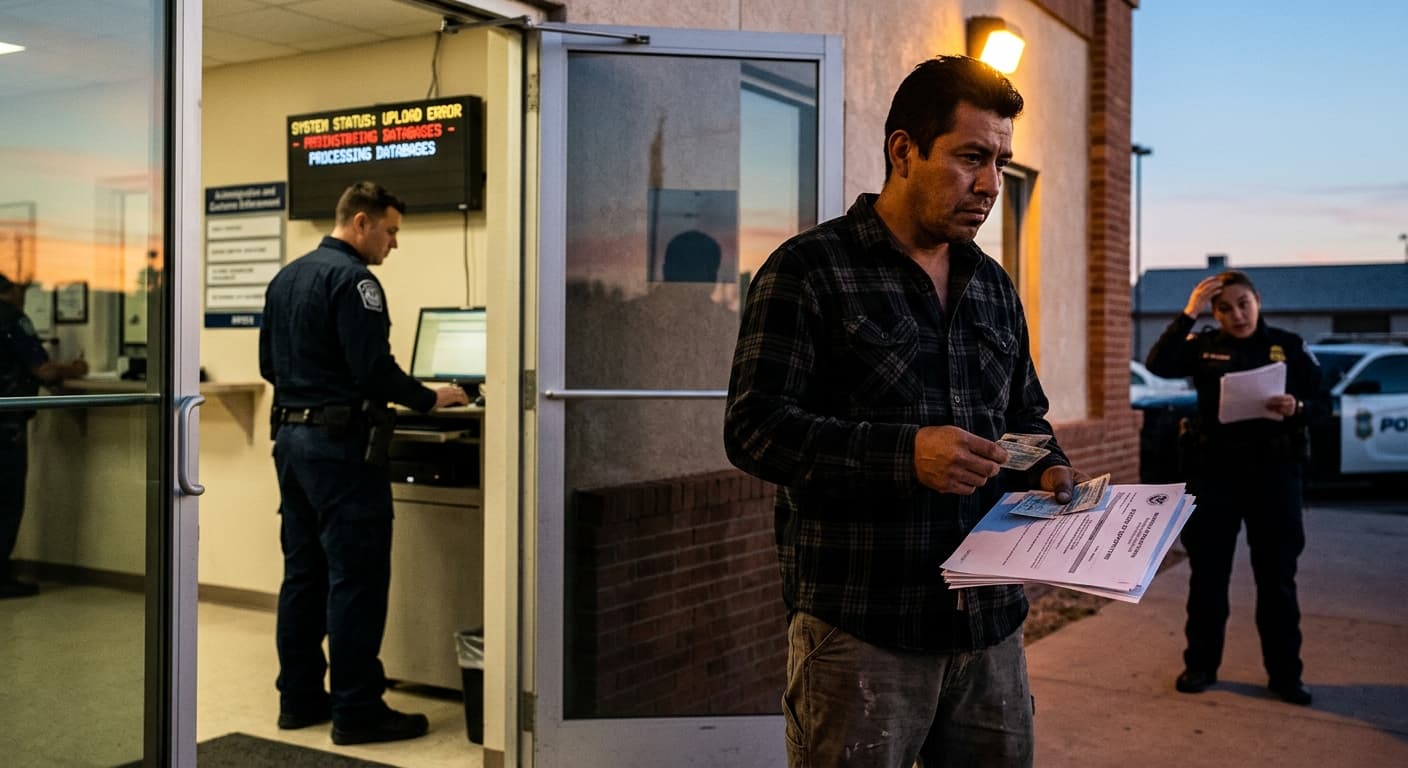
How Ojeda Duarte's Return Exposes ICE's Data-Error Problem
A Chicago father was deported to Venezuela by a DHS data glitch. His return under court order is the clearest test yet of judicial power over ICE.
On July 1, 2026, a federal judge in El Paso entered final judgment in Ojeda Duarte v. Warden, closing out a case in which the U.S. government admitted, in writing, that it had shipped a Venezuelan father to Caracas because of "an inadvertent error due to a data quality issue within DHS-ERO's case information system." The case matters less for what it says about one man than for what it exposes: the machinery of mass deportation is now producing errors faster than the courts can undo them, and DHS's own database is the point of failure. Jose Enrique Ojeda Duarte came home. The system that removed him did not change.
The 273-day round trip
Ojeda Duarte was arrested in September 2025 while driving to work in the Chicago area, swept up in Operation Midway Blitz — a Border Patrol-led surge that the Department of Homeland Security says produced more than 4,200 arrests in the region. Federal court filings reviewed by NPR show that fewer than 3 percent of those arrested had criminal records, contradicting DHS's public framing of the operation as targeting "the worst of the worst."
He spent nearly eight months in detention across multiple facilities. On January 19, 2026, his attorney Afshan Khan filed a habeas corpus petition in the Western District of Texas, docketed as case No. 3:26-cv-00089, according to public case records maintained by Habeas Dockets. While the petition was pending — and before his removal order became final — ICE Enforcement and Removal Operations deported him to Caracas in early April.
The response was a temporary restraining order filed on April 9, 2026. On April 16, the government conceded in a court filing that the removal had been unauthorized. Five days later, U.S. District Judge David C. Guaderrama ordered the administration to facilitate his return. He arrived at Chicago's O'Hare International Airport in mid-June, according to Latin Times, reuniting with his wife and children after nine months of separation.
The VisaVerge case brief quotes the government's court concession verbatim:
"An inadvertent error due to a data quality issue within DHS-ERO's case information system."
That single sentence — a DOJ admission in the docket — is the pivot of the case.

Why the DHS database is now the story
The Enforcement Alien Removals Module — the ERO case system referenced in Ojeda Duarte's filing — was built in the mid-2000s partly at the direction of the Government Accountability Office to fix custody-review compliance failures under Zadvydas v. Davis, according to a 2004 GAO report. That system is now the tool by which ICE decides who is removable, when their order is final, and whether a stay is in place. When the database says a case is closed and the case is not, the person on the flight is gone before anyone reads the docket.
That is not a hypothesis. It is now a documented pattern.
- In December 2025, ICE deported Federico Reyes Vasquez to Mexico four days after Utah District Judge Jill Parrish issued a stay. The government told the court "information on the stay had not been correctly communicated" to ERO before the removal,
NPR reported.
- Jordin Melgar-Salmeron was removed to El Salvador minutes after a judge ordered him held, in what court records called a "confluence of errors."
- Any Lucia Lopez Belloza, a Babson College freshman, was deported to Honduras the day after a court issued a 72-hour bar on her removal,
Al Jazeera reported; the government blamed "the mistake of one ICE agent."
- In February 2026, DHS deported a Cuban national to Mexico despite a protective order and blamed a "communication error," according to a
Center for American Progress analysis of the docket.
Each case turns on the same defect: the enforcement layer of ICE does not reliably see what the adjudication layer has decided. The Ojeda Duarte docket puts that defect on the record for the first time in the government's own words — a data-quality issue inside ERO's case information system.
The Abrego Garcia benchmark — and why Ojeda Duarte is different
Kilmar Abrego Garcia, deported to El Salvador's CECOT mega-prison in March 2025, is the reference point for every wrongful-deportation case that has followed. In April 2025, the U.S. Supreme Court ruled 9-0 that the administration must "facilitate" his return, largely upholding Judge Paula Xinis's order that he had been seized "without any lawful authority." Xinis wrote that the removal was a "grievous error" that "shocks the conscience," according to the BBC.
Abrego Garcia's return took roughly 14 months, ended with criminal charges filed against him, and involved months of open executive-branch resistance to the district court. Ojeda Duarte's return took roughly 68 days from removal to arrival at O'Hare. The reason is not that the government has become more cooperative. The reason is that his removal order was not final — a legal defect DHS itself conceded — which stripped the administration of the arguments it had used against Xinis: no CECOT custody, no foreign-affairs deference claim, no legal cover.
The lesson for defense counsel is procedural, not political. Detained cases turn on documentary posture — copies of BIA filings, notices of stay, ICE transfer records, sworn declarations — assembled before removal happens. Once a person is on a plane, the case gets harder, more expensive, and dependent on emergency habeas litigation whose success rate is unknowable because most detained noncitizens do not have counsel.
What the courts are counting
Federal judges have begun to document defiance rather than merely rule against it. On January 31, 2026, Chief Judge Patrick Schiltz of the District of Minnesota wrote that ICE had violated 96 court orders in his district in a single month, telling NPR the list "should give pause to anyone, no matter his or her political beliefs, who cares about the rule of law." Georgetown law professor Stephen Vladeck told the network that ICE had "likely violated more court orders this month than some agencies have violated in their entire existence."
The Center for American Progress, drawing on filings from 2025 and early 2026, reports that roughly 440 district court judges and panels on three federal appeals courts have ruled against the administration's mandatory-detention interpretation in nearly 11,000 cases, and that a public database now tracks "hundreds" of instances of ignored immigration-related court orders.
At the class level, the pattern is starker. In December 2025, Chief Judge James Boasberg of the D.C. District Court found that the Trump administration had denied due process to the 137 Venezuelans deported to CECOT under the Alien Enemies Act. In February 2026, he ordered the government to facilitate their return or accept them at a port of entry, NPR reported. Boasberg wrote that the government's earlier responses "essentially told the Court to pound sand."
Human Rights Watch, in a May 2026 report, documented 12,977 third-country nationals deported to Mexico between January 20, 2025 and March 9, 2026 — a 42 percent increase in monthly average versus the prior period, largely on the basis of what the Justice Department itself described in a March 2026 brief as a "standing (unwritten) agreement" with Mexico.
The policy stakes
The One Big Beautiful Bill Act, signed in July 2025, allocates roughly $170 billion over four years for immigration enforcement, including $45 billion to expand ICE detention capacity and $30 billion to hire 10,000 additional enforcement officers, according to the Council on Foreign Relations. It also caps immigration judges at 800, against a backlog of 3.8 million cases as of June 2025.
That is the architecture of the error. More officers executing removals; the same number of adjudicators processing appeals; a database that already fails to synchronize stays with removal officers; and a policy target of one million deportations a year. Every additional deportation flight increases the denominator against which the ERO data-quality problem operates. The Ojeda Duarte admission is a public rendering of a defect that is now structural.
Ojeda Duarte's counsel Afshan Khan told local outlets, including Telemundo Chicago, that her client would continue his immigration proceedings inside the United States. His return does not resolve his underlying removability, only the manner in which it was executed. He is one of a small number of deportees who had a lawyer, a docket, and a judge willing to enter an emergency order in time.
The Bottom Line
The bottom line: Ojeda Duarte's return is not a story of due process working — it is a story of due process working once, in one case, with counsel, against a system that on the government's own admission removes people because of a database error inside ICE. With federal judges now counting court-order violations in the dozens per month, and Congress funding the enforcement side of the ledger three times faster than the adjudication side, the Ojeda Duarte record is the first time DHS has told a court, in writing, that its removal machinery cannot reliably read its own files. That admission — not the reunion at O'Hare — is what will be cited in the next hundred habeas petitions.
What to watch
- August 2026 status conferences in the D.C. Alien Enemies class action before Chief Judge Boasberg, which will determine how many of the 137 Venezuelans deported to CECOT actually return under his February 12, 2026 facilitate-return order.
- The pending 5th Circuit review of related habeas rulings out of the Southern and Western Districts of Texas, which will set the appellate standard for emergency relief when a removal order is not final.
- DHS Office of Inspector General response to congressional requests, made after Chief Judge Schiltz's January 31 letter, for an audit of the DHS-ERO case information system's synchronization with EOIR and BIA docket data.
- Ojeda Duarte's own immigration proceedings, which resumed after the July 1, 2026 judgment and will test whether the government seeks re-detention or a second removal on a corrected record.
Discover more

India
Rajnath Singh's Durga Squad for 2026 Polls
Rajnath Singh's Durga Squad promised women's safety in Bengal but has since disappeared from the agenda, revealing BJP's true priorities.

India
Romanian Coalition Party Demands PM Resign
Romania's Social Democrats withdrew from coalition, joining far-right AUR to topple PM Bolojan, risking €10 billion in EU funds by August 2026.

India
Yamini Aiyar on Modi's Federalism Shift
Yamini Aiyar critiques Modi's shift from equity-based to performance-based federalism, highlighting implications for India's political landscape.

Economics
Fed's Amex AML order puts correspondent banking on notice
Federal Reserve's Amex AML order requires board-level controls and a 90-day plan; OCC fined the bank $350 million over enterprise-wide deficiencies.