Nigeria's ₦1.35 Trillion July Squeeze
A record liquidity drain reshapes Africa's debt landscape
Model Diplomat7 min readSub-Saharan Africa
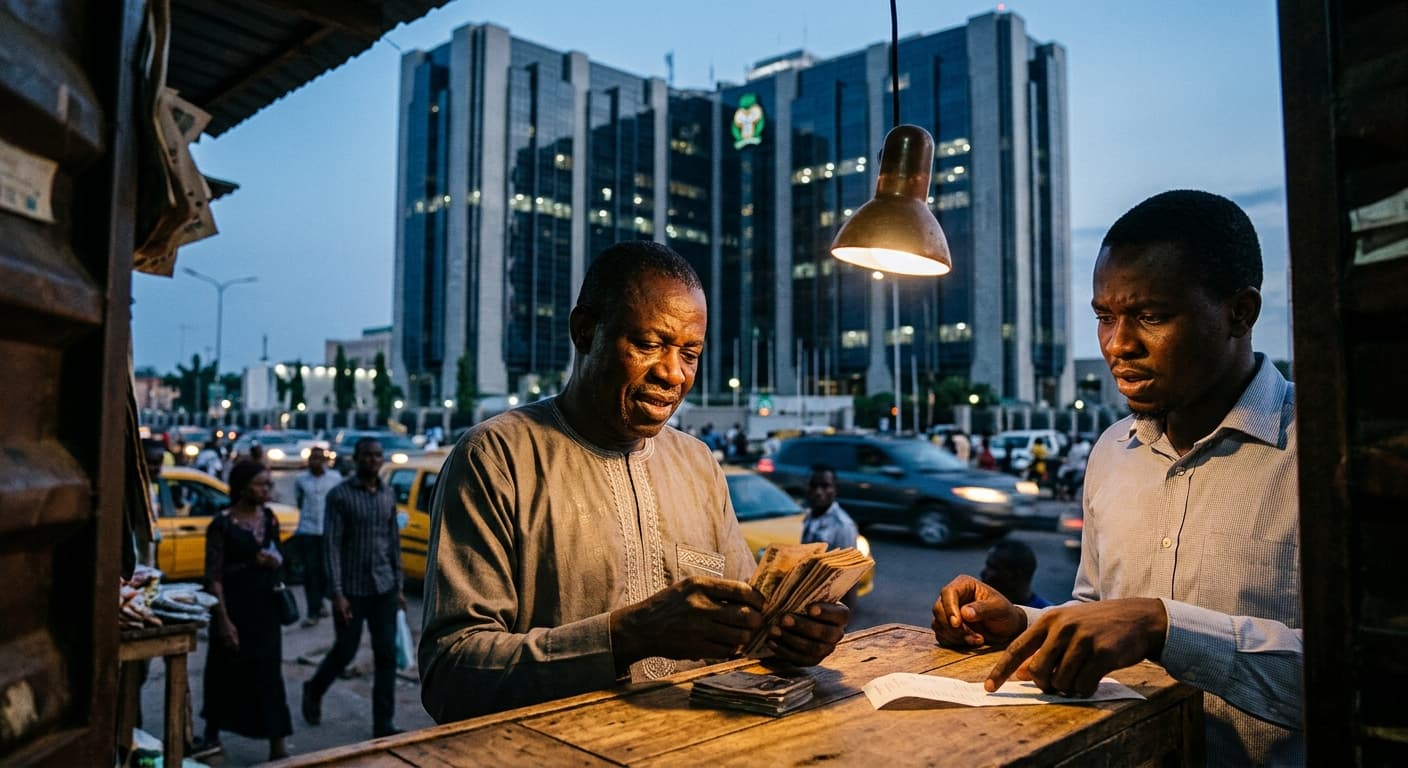
Nigeria's ₦1.35 Trillion July Squeeze Reshapes Africa's Debt Map
Nigeria's central bank will drain a record ₦1.35 trillion in July 2026 via T-bill sales — the sharpest signal yet of Sub-Saharan Africa's pivot to costly domestic debt.
The Central Bank of Nigeria will withdraw roughly ₦1.35 trillion from the banking system this month through a record ₦2.0 trillion Treasury Bill offering set against just ₦647.8 billion in maturities, making July 2026 the tightest liquidity month of the year and — more importantly — the clearest data point yet that Africa's largest economy is now fully substituting domestic borrowing for the Eurobond market it once dominated. That substitution is happening across Sub-Saharan Africa at a pace the IMF describes as faster than in any other region, and the July auctions will test whether Nigerian banks can absorb the paper without visibly starving the private sector of credit. The story is not the auction size. It is what the auction proves about who now finances African deficits — and who pays for it.
The mechanics of a record drain
The July programme sits inside a ₦5.8 trillion Q3 2026 issuance calendar, a 241% year-on-year jump in domestic borrowing versus Q3 2025's ₦1.76 trillion, according to The Daily Circular and confirmed by
Business Elites Africa. Meristem Securities' fixed-income desk, cited by
The Journal, describes the pattern as "front-loading" — a deliberate decision by the Debt Management Office to lock in funding before conditions deteriorate.
Net domestic borrowing for the quarter comes to ₦3.16 trillion after maturities. The 364-day paper cleared at 17.34% at the most recent auction, per DecisionMakers News, which is roughly 200 basis points above headline inflation of 15.38% recorded in March 2026. That positive real yield is precisely the point: with the Monetary Policy Rate held at 26.5% following the CBN's February 2026 cut, and the Cash Reserve Requirement now at 45%, the T-bill has become the CBN's cleaner instrument for absorbing structural surplus liquidity.
The context of that surplus matters. BusinessDay reports the CBN sterilised roughly ₦16.9 trillion in June through combined T-bill and OMO operations, even as system liquidity opened the last week of June at a net surplus of ₦7.0 trillion, according to
WestAfrica Business News. July is not a shock. It is the escalation of an existing regime.
Why this is a regional story, not a Nigerian one
The IMF's June 2026 Article IV consultation with Nigeria — the primary document that anchors this analysis — is explicit about the trade-off. Staff concluded that "banks have indicated that they have space to absorb more government securities than in the past, though this crowds out private credit," according to the IMF Country Report No. 26/125. The
IMF Executive Board press release endorsed continued monetary tightness but flagged the "sovereign-bank nexus" as a rising vulnerability.
That phrase is not Nigeria-specific. The IMF's April 2026 Regional Economic Outlook for Sub-Saharan Africa warned that "increased reliance on domestic borrowing has deepened the sovereign–bank nexus, and public sector credit has grown faster than private sector credit," with government paper accounting for 43% of bank assets across the West African Economic and Monetary Union, per the Regional Economic Outlook Chapter 1. Amadou Sy and Athene Laws, writing in the IMF's
Finance & Development magazine in March 2026, put it more starkly: Sub-Saharan Africa's sovereign-bank nexus "is growing faster than anywhere else in the world."
The shift is quantified in an April 2025 IMF working paper by Alter, Khandelwal, Lemaire, Mighri, Sever and Tucker: total domestic issuances across SSA (excluding sub-one-year maturities) averaged $10.9 billion per month in 2024, more than double the 2019 level. Ghana, since its 2023 Domestic Debt Exchange Programme, has issued only T-bills with an average outstanding maturity of under three months — a rollover treadmill Nigeria is now approaching in structure, if not yet in severity.
The Nigerian variant — and why it is not Ghana
The critical distinction is that Nigeria is issuing at scale while its macro numbers are improving, not deteriorating. Headline inflation fell from 34.80% in December 2024 to 15.06% by February 2026 on the rebased CPI, before ticking up to 15.38% in March, according to research by Olaniyi Evans in the Hequation Review. Gross external reserves hit a thirteen-year high of $50.45 billion. Total public debt was ₦159.28 trillion at end-2025, with a post-rebasing debt-to-GDP ratio of about 39.4% — well below the 60% ECOWAS convergence ceiling.
That is why the IMF assesses sovereign stress risk as "moderate" rather than high, with public debt actually declining from 39.3% of GDP in 2024 to 36.1% in 2025 on the back of naira appreciation and a favourable interest-growth differential, per the Article IV staff report. The Fund's Selected Issues Paper, published as
IMF Country Report 2026/126, notes that monetary transmission — long the weak link in Nigerian policy — is finally strengthening.
But the sequencing has a catch. The 2026 Federal Government budget doubles nominal borrowing limits versus 2025 and layers on a $5 billion total return swap with an international bank that requires 133% collateralisation with domestic government securities — an arrangement the IMF explicitly warned "exposes the government to margin calls if the fx value of the naira securities drops." That structural fragility is why July's auction size matters more than the headline number suggests. Every additional ₦100 billion of T-bill issuance is also ₦133 billion of implicit collateral supporting the swap.
The crowding-out question — where the evidence bites
Nigerian private-sector credit grew about 20% in 2025 after adjusting for exchange rate effects, driven by a 16% expansion in naira-denominated lending, per the IMF Article IV. That is the good news. The bad news, per the same report: credit exposure remains concentrated in oil and gas, services, manufacturing and industry, and private-sector credit is still only 12% of GDP — one of the lowest ratios in the emerging-market universe.
Academic evidence tilts against the government's frontloading gamble. A Bayesian VAR study published in the Journal of Developing Areas by Alenoghena, Aghughu and Odior found that domestic borrowing negatively affects broad money supply and credit to the private sector in Nigeria over the long run. A separate analysis in the
African Finance Journal covering 35 SSA countries from 2000 to 2022 concluded that domestic debt promotes inclusive growth "only in financially underdeveloped economies" where prudent management holds — a caveat Nigeria has historically struggled to satisfy.
The transmission mechanism is the sovereign-bank nexus itself. An IMF working paper by Nose and Menkulasi found that in countries where banks hold 40–50% of assets as government paper, fiscal loosening pushes 10-year yields up by more than 50 basis points — meaning the marginal cost of each new T-bill auction rises with the last one. Nigeria is not there yet, but Q3 2026 issuance moves the country meaningfully up that curve.
What the market is telling Cardoso
The pricing signal is unambiguous. At 17.34% for the 364-day, Nigerian T-bills offer a real yield of roughly 200 basis points — attractive against the broader emerging-market universe and structurally more attractive than the Nigerian Stock Exchange, whose flows have visibly shifted toward fixed income, per Tribune Online and
Business Elites Africa.
That is precisely the point of the exercise. CBN Governor Olayemi Cardoso's team is deliberately keeping yields high enough to sterilise excess liquidity, defend the naira around ₦1,500/USD, and — quietly — attract the marginal foreign portfolio investor. The Alter et al. IMF paper documents that Nigeria is one of only seven SSA countries with any positive share of non-resident domestic debt ownership, alongside Ghana, Kenya, Malawi, South Africa, Uganda and Zambia. Getting that share back up to its 2017–2019 highs would materially reduce the domestic banking system's exposure — the single lever most likely to break the crowding-out feedback loop.
The risk is that this depends on a benign external environment the IMF's own Article IV explicitly does not assume. Staff warned monetary policy "must remain tight for longer than previously expected given inflationary pressures from the war in the Middle East and a global risk-off environment." A single risk-off episode drains foreign holdings first — leaving Nigerian banks alone to absorb ₦5.8 trillion of Q3 paper at whatever yield clears.
Diplomat View
The trade Nigeria is running in July 2026 is defensible but narrow. Front-loading ₦3.16 trillion of net domestic borrowing while disinflation is intact and reserves are at a decade-plus high is textbook debt-management timing — the DMO is buying insurance against a worse issuance window later in the year. The forecast on which this holds: MPC keeps the MPR at 26.5% on July 21–22, headline inflation resumes its downward glide by the August print, and non-resident participation in NTB auctions edges above 10% of allotment. Revise the call if any of three conditions triggers — a July CPI print above 16%, a naira breach above ₦1,600/USD, or a 364-day stop rate above 18.5%. Any of those signals that the crowding-out cost is running ahead of the disinflation benefit, and the July drain will look, in retrospect, like the moment Nigeria stopped importing Ghana's debt lesson and started living it. This is the same trap Ghana sprang in 2022: T-bill dominance became involuntary, not strategic. Nigeria still has the choice. July tells us how much longer.
Forward look
- July 9, 2026 — first July NTB auction; 364-day stop rate above 17.5% would confirm rising crowding-out cost.
- July 21–22, 2026 — CBN MPC decision; a surprise hike would signal the IMF's inflation warning is biting.
- September 30, 2026 — end of Q3 issuance programme; cumulative private-credit growth data will show whether the "space to absorb" the IMF flagged has held.
The Bottom Line
Nigeria's ₦1.35 trillion July liquidity drain is not a monetary-policy technicality — it is the clearest evidence yet that Sub-Saharan Africa's largest economy has committed to financing its deficit domestically at 17%-plus yields rather than tapping cheaper external markets. If Abuja pulls this off without visibly crowding out private credit, it becomes the region's proof-of-concept for post-Eurobond debt management; if it does not, Nigerian banks will find themselves absorbing sovereign risk on Ghana's 2022 trajectory, only at ten times the scale.
Discover more

Global Politics
Xi Jinping Calls China-Russia Ties 'Precious'
Xi Jinping's description of China-Russia ties as 'precious' reflects a strategic imbalance, with Beijing dictating terms in the partnership.
India
Rajnath Singh's Durga Squad for 2026 Polls
Rajnath Singh's Durga Squad promised women's safety in Bengal but has since disappeared from the agenda, revealing BJP's true priorities.

US Politics
US Launches $166B Tariff Refund Portal
The US is launching a $166 billion tariff refund portal to aid importers hit by Trump-era tariffs, with major implications for trade and supply costs.

Economics
Fed's Amex AML order puts correspondent banking on notice
Federal Reserve's Amex AML order requires board-level controls and a 90-day plan; OCC fined the bank $350 million over enterprise-wide deficiencies.