Niger Names Russia Main Partner in Sahel
Niger's foreign minister declares Russia top counter-terrorism ally.
Model Diplomat7 min readAfrica
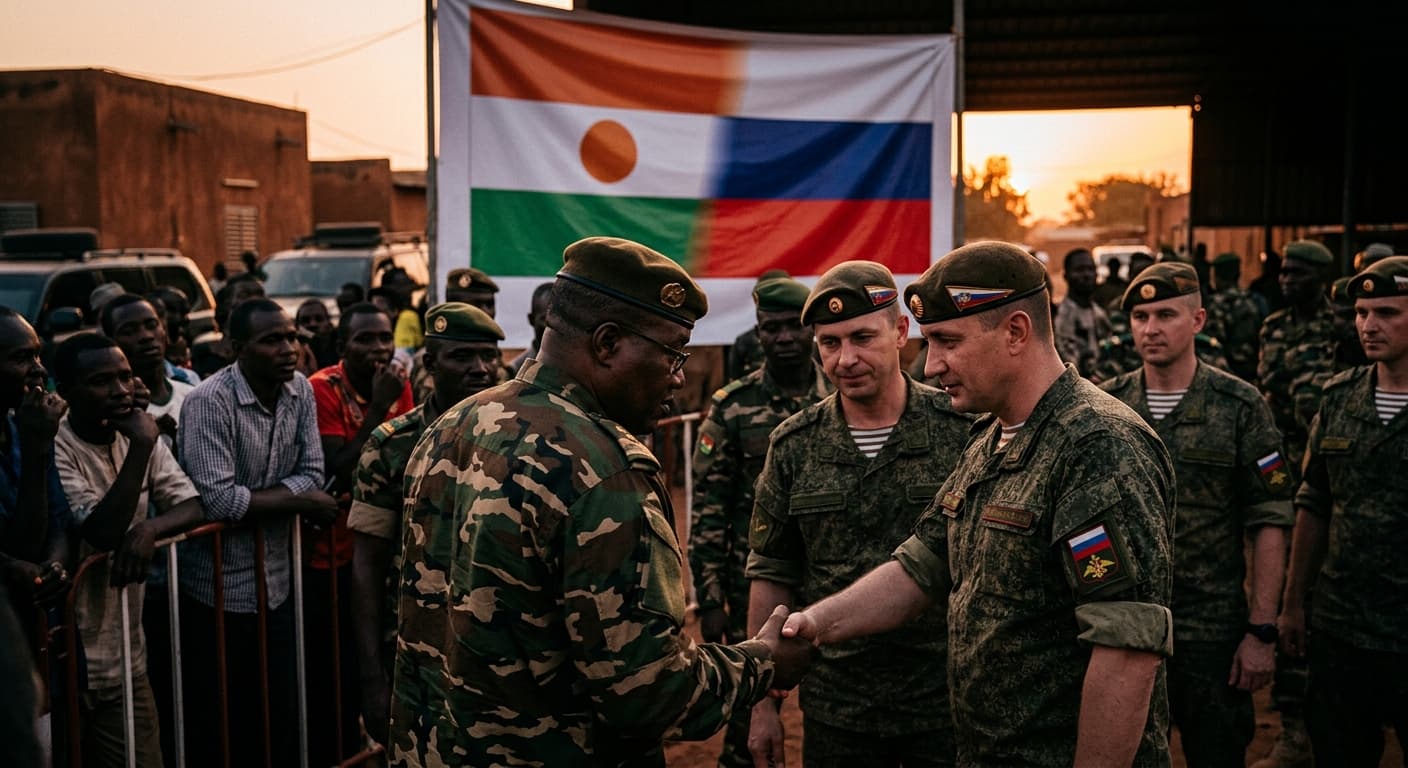
Niger crowns Russia its 'main partner' as Sahel jihad rages
Niger's foreign minister named Russia the Alliance of Sahel States' top counter-terrorism partner in July 2026 — even as Africa Corps loses ground and 51% of global terror deaths occur in the region.
Niger's declaration in Moscow that Russia is the Alliance of Sahel States' "main partner" against terrorism is less a security judgement than a sovereignty contract: three junta capitals are locking in a patron that will protect their regimes without demanding elections, while the jihadist insurgency they hired Russia to defeat is spreading faster than at any point since 2020. That is the news, and that is the trade — regime survival now, in exchange for uranium, gold, nuclear cooperation and a westward-facing salient of Kremlin influence stretching from Bamako to the Gulf of Guinea.
The statement, delivered by Foreign Minister Bakary Yaou Sangaré alongside counterparts from Mali and Burkina Faso, tracks a template first set at the April 2025 Moscow meeting where Sergey Lavrov publicly embraced the AES as a bloc, as the Hudson Institute recorded. The 2026 version, previewing the third Russia–Africa summit that a March 25 Russian presidential decree scheduled for Moscow later this year, is a formalisation exercise — from improvised Wagner deployments to state-to-state defence architecture.
What Niger actually signed up for
The AES — Burkina Faso, Mali, Niger — was born in September 2023 in the presence of Russian Deputy Defence Minister Yunus-Bek Yevkurov, upgraded to a confederation in July 2024, and given a 6,000-strong joint force headquartered in Niamey in December 2025, according to the Institute for Security Studies. Russia is the preferred security partner across all three, though the depth of engagement varies sharply: combat operations and roughly 1,000 personnel in Mali, training missions in Burkina Faso, instructors plus an air-defence detachment in Niger.
Moscow's contribution is concrete but modest by the standards of what France once deployed. The BBC puts Russian contractor numbers in Mali at "about 1,000," a fraction of the more than 4,000 French troops the Barkhane mission fielded before its 2022 exit. Over 80% of Africa Corps personnel are former Wagner fighters,
International Crisis Group noted after the 2025 rebranding — same men, different letterhead, run by GRU Major-General Andrey Averyanov under Yevkurov's supervision.
The financial arrangement is opaque but expensive. Bamako reportedly paid up to $10 million a month for Wagner services, per Crisis Group; Africa Corps demands direct payments to the Russian state, which is why the Central African Republic has resisted the switchover, as the Hudson Institute documented in September 2025. In parallel, Rosatom signed nuclear cooperation memoranda with Niger, Mali and Burkina Faso covering reactors, fuel supply and specialist training — a durable, decades-long instrument of non-military influence layered on top of the security contract.
The counter-terrorism claim is failing on its own metrics
If "main partner against terrorism" is the pitch, the ledger is brutal. The Global Terrorism Index 2025 recorded that the Sahel accounted for 51% of the world's terrorism deaths in 2024 — 3,885 of 7,555 fatalities — with Burkina Faso the world's most terror-affected country for the second year running. According to the
Atlantic Council, extremists killed 87% more civilians in Burkina Faso in the three years after Ibrahim Traoré's 2022 coup than in the three years before, while state-aligned forces killed up to 132% more.
The CDD West Africa tracker recorded 12,964 conflict deaths in West Africa in the first half of 2025, with Burkina Faso alone accounting for 3,539 — 27.3% of the regional total. JNIM, the al-Qaeda-aligned Group for the Support of Islam and Muslims, is credited with roughly 2,370 of those Burkinabe fatalities.
Russia's own recent battlefield record cuts the same way. On July 25, 2024, Tuareg rebels and JNIM ambushed a Malian–Russian column at Tinzaouaten, killing at least 46 Russian soldiers — the deadliest single loss in the history of Moscow's post-Soviet expeditionary campaigns, as Foreign Affairs reconstructed. In April 2026, Africa Corps confirmed via Telegram that it had withdrawn from Kidal alongside Malian troops after a coordinated FLA–JNIM offensive that killed the Malian defence minister and used FPV drones against Russian positions,
Al Jazeera reported. Kidal had been Wagner's signature 2023 victory; the FLA now calls the city "free."
The one clean win — and why the juntas are still buying
Against that ledger sits January 28, 2026: ISIL fighters attacked the Diori Hamani airbase adjoining Niamey's international airport, and Russian and Nigerien forces together killed all 20 assailants, including a French national, wounding four Nigerien soldiers. Russia's Foreign Ministry confirmed the joint operation in a statement carried by Al Jazeera, and junta chief Abdourahamane Tiani personally thanked the Russian base commander.
That single defensive success is why Sangaré's July 2026 label lands. What Africa Corps sells — and what juntas buy — is not victory against JNIM or Islamic State Sahel Province. It is a specific service that Western partners refused to provide: point defence of capitals, regime headquarters, and resource concessions, with no lectures about civilian protection or a return to constitutional order. The Elcano Royal Institute called this on July 1, 2026: "Russia's primary goals are regime preservation and territorial control, not promoting good governance, inclusion or civilian protection."
The Egmont Institute's policy brief is blunter: "Russia's engagement with … partners in the Sahel benefits from instability, conflict and fragile regimes. Stable states are unlikely to hire [mercenaries]." That is the market Moscow serves, and it is why the AES juntas — beneficiaries of "energy sovereignty" rhetoric, unconditional arms flows, and information-warfare training — signed on, even as jihadists absorb more territory. The winners are three colonels-turned-presidents whose grip on power now depends on external muscle. The losers are civilian populations across the Liptako-Gourma tri-border, and coastal states — Togo, Benin, Côte d'Ivoire — where JNIM cells are already infiltrating.
The Washington counter-move, and its limits
The most consequential second-order effect is not Russian. It is American. In mid-2026, the Trump administration executed a sharp policy shift: the State Department dispatched Nick Checker, head of the Bureau of African Affairs, to Bamako pledging "respect for Mali's sovereignty" and signalling cooperation across all three AES states, BBC News reported. AFRICOM deputy commander Gen. John Brennan has publicly confirmed continuing US intelligence support and hinted at potential arms transfers. Democracy and human-rights conditionality have been dropped.
Washington is not seeking to reopen the $110 million Agadez drone base it abandoned in 2024, but it is also refusing to concede the field to Moscow. Hudson Institute analyst Zineb Riboua argues that if the West fails to offer "credible alternatives … it risks surrendering a key strategic corridor to the Kremlin," while Foreign Affairs contends Russia has already exhausted much of its Sahel credit and that quiet US support for cross-border intelligence sharing could rebuild traction. Both readings implicitly concede the same point: the AES juntas now sit at the fulcrum of a US–Russia competition on West African terms, not Western ones.
The uranium file crystallises the stakes. Niger's junta expropriated the Somaïr mine from France's Orano and, per the BBC, is "lining up Russia as its new partner" through Rosatom. If that deal completes ahead of the third Russia–Africa summit later this year, Moscow will control both the security perimeter and the fuel cycle of a country supplying up to a quarter of the uranium that powers European reactors — the clearest single example anywhere in Africa of a full-spectrum Russian sovereignty package displacing a Western one.
Diplomat View
Niger's "main partner" declaration is the ratification, not the beginning, of a transaction: sovereignty theatre for the juntas, resource concessions for Moscow, and neither counter-terrorism results nor institution-building for anyone else. Our call: Russia's Sahel model will survive the next 12 months precisely because it is failing at what it advertises. The juntas cannot afford to acknowledge that failure without exposing their own strategic bankruptcy, and Moscow cannot afford to withdraw without conceding a rare post-2022 win. The AES therefore locks in as a durable client bloc through the Moscow summit — but its territorial control keeps eroding.
The forecast changes if any of three things happen: (a) JNIM overruns a provincial capital in Burkina Faso or Niger, forcing a regime-change moment Africa Corps cannot cover; (b) the Trump administration offers weapons and ISR without conditions, giving juntas a real hedge; or (c) a Kidal-style Africa Corps defeat kills a senior Russian commander and triggers a Kremlin recalibration. Absent those, expect deeper Rosatom penetration, more AES–Moscow joint exercises, and continued civilian bleeding.
What to watch
- Q4 2026 — Third Russia–Africa Summit, Moscow. By presidential decree of March 25, 2026, per the Valdai Club, this is where a formal AES–Russia security treaty is most likely to be inked. Watch for a signed AES Unified Force training and equipment package.
- Rosatom–Niger uranium/nuclear MOU implementation. Any binding supply contract that displaces Orano signals the definitive end of French nuclear leverage in West Africa.
- US arms decisions. The next AFRICOM statement on weapons transfers to Mali, Burkina Faso or Niger is the single clearest indicator of whether Washington will genuinely contest Russian primacy or settle for coexistence.
The Bottom Line
Niger's "main partner" label is not a battlefield verdict — it is a regime-protection contract dressed as counter-terrorism policy, signed by three juntas that need Moscow to hold power more than they need Moscow to defeat JNIM. The Sahel is now the clearest test case anywhere on earth of whether an unconditional Russian sovereignty package can outlast the insurgency it was meant to solve, and the answer through 2027 will reshape the security architecture of the entire West African coast.
Discover more
US Politics
House Ethics Committee Pushes Sexual Miscond.
The House Ethics Committee has shifted responsibility for sexual harassment settlement records to the Office of Congressional Workplace Rights, complicating disclosure efforts.

US Politics
SNAP Food Assistance Faces Legal Challenges
In 2026, SNAP faces stricter eligibility rules and mounting legal challenges, threatening food assistance for the millions of Americans who rely on the program.

Global Politics
U.S. Naval Blockade Heightens Iran Tensions
The U.S. naval blockade of Iran collapsed oil exports, creating a new maritime regime in Hormuz that favors Tehran.

Conflict & Security
Drone Warfare Killing Aid Workers at Unprec
Over 1,000 humanitarian workers killed in three years as cheap armed drones collapse legal protections. Gaza, Sudan, Ukraine, and DRC see deliberate targeting of aid convoys and hospitals with zero prosecutions.