Niger Launches AES Biometric Passport
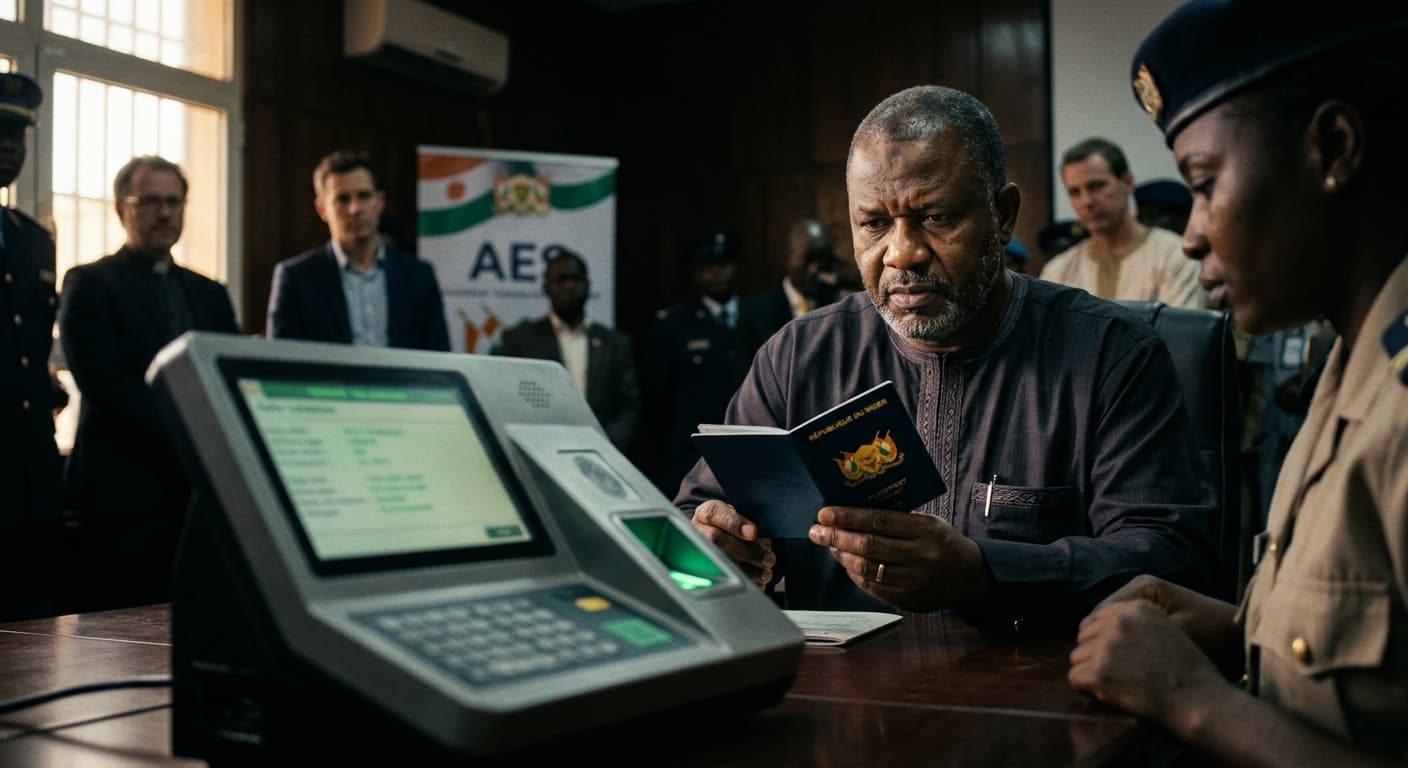
General Tiani enrolls in AES biometric passport, a tangible break from ECOWAS.
Model Diplomat3 min readSahel
Niger's AES Passport Turns a Military Pact Into a State — Using Western-Funded Infrastructure
On July 17, 2026, Niger's General Abdourahamane Tiani enrolled for the new AES biometric passport, Business Insider Africa reported, making the Alliance of Sahel States' breakaway travel document a physical reality, built on biometric systems the World Bank funded for ECOWAS.
The enrollment at the presidency in Niamey made Tiani the second AES head of state, after Burkina Faso's Captain Ibrahim Traoré, to take the document that replaces the ECOWAS-era travel booklet the three breakaway Sahel states abandoned 18 months ago. The passport's real function is not travel: it is the visible artifact that turns a military mutual-defence pact into something citizens can hold, while quietly repurposing Western-funded identity infrastructure for a sovereignty project those same Western donors oppose. The document is the latest, and most tangible, piece of a confederation-building project that has moved faster than almost anyone predicted. It exposes a structural paradox at the heart of West Africa's fragmentation.
A confederation built in two years
The Alliance of Sahel States (AES, by its French acronym) was born on September 16, 2023, when Mali, Burkina Faso and Niger signed the Liptako-Gourma Charter in Bamako — a mutual-defence pact forged in the immediate aftermath of Niger's July 2023 coup and ECOWAS's threat of military intervention to restore civilian rule. Within four months the three military governments, all suspended from the 15-member ECOWAS bloc, announced they would withdraw. On January 29, 2025, after the statutory one-year notice period, the withdrawal took effect — the first disintegration in ECOWAS's 50-year history, stripping the bloc of three members and roughly 63 million of its 409 million citizens, according to LSE Africa. The Liptako-Gourma Charter is available as a
primary document from the Government of Mali.
The passport was telegraphed early. In a televised address on September 15, 2024, Mali's Colonel Assimi Goïta, then the AES's acting president, said "in the coming days, a new biometric passport of the [alliance] will be put into circulation with the aim of harmonising travel documents in our common area," BBC News reported. The harmonized technical specifications were agreed by experts from all three countries at a meeting in Bamako in October 2024 and later endorsed by their ministers responsible for security, according to
Business Insider Africa.
The pace has been deliberate. At the Niamey summit on July 6, 2024, the three leaders, Tiani, Traoré and Goïta, signed the constitutive act of the Confederation of Sahel States. Tiani declared they were "irrevocably" turning their backs on ECOWAS and would build "a community of sovereign peoples far from the control of foreign powers," Al Jazeera reported. By the second AES summit in Bamako on December 23, 2025, the bloc had launched a confederal investment bank (the BCID-AES, capitalized at 500 billion CFA francs), a joint television channel, and a 5,000-strong Unified Force (FU-AES) to operate across borders against armed groups,
Al Jazeera reported. Burkina Faso's Traoré took over the rotating AES chairmanship from Mali's Goïta at that summit,
BBC News Pidgin noted. The passport may prove the confederation's most effective weapon yet: a document that makes the state tangible before the state itself exists.
Discover more
US Politics
House Ethics Committee Pushes Sexual Miscond.
The House Ethics Committee has shifted responsibility for sexual harassment settlement records to the Office of Congressional Workplace Rights, complicating disclosure efforts.
India
Rajnath Singh's Durga Squad for 2026 Polls
Rajnath Singh's Durga Squad promised women's safety in Bengal but has since disappeared from the agenda, revealing BJP's true priorities.

India
BJP's Misunderstanding of Women's Quota Needs
The BJP's linking of the Women Reservation Bill to delimitation risks delaying women's empowerment in India, misreading the aspirations of female voters.

Economics
Fed's Amex AML order puts correspondent banking on notice
Federal Reserve's Amex AML order requires board-level controls and a 90-day plan; OCC fined the bank $350 million over enterprise-wide deficiencies.