New Caledonia Votes Under Heavy Security
Provincial elections amid heavy police presence and uncertainty.
Model Diplomat3 min readoceania
New Caledonia Votes Under Heavy Security — France's Last Pacific Power Play Before 2027
The Pacific territory heads to the polls Sunday in its first provincial elections since 2019, with 2,500 police deployed and the failed Bougival Accord leaving the path forward with Paris dangerously undefined.
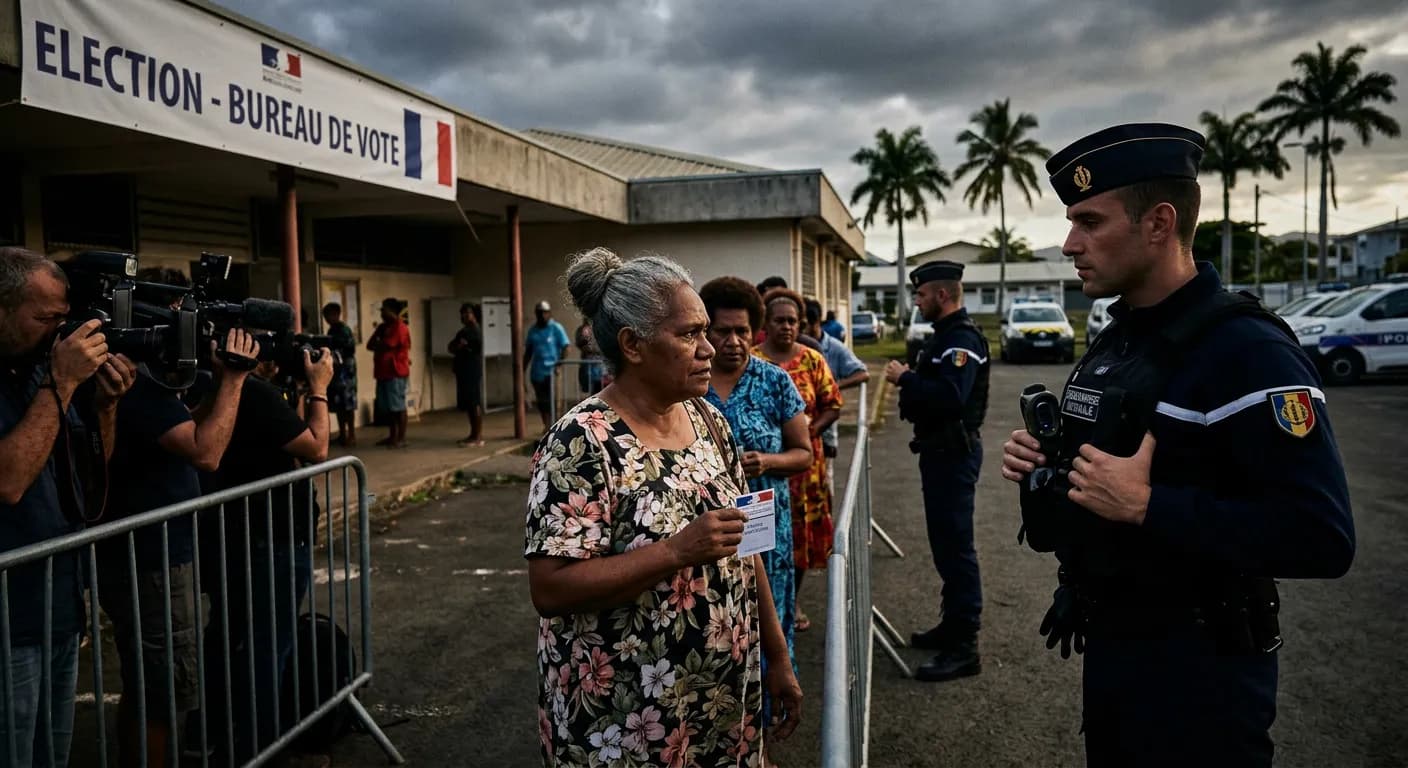
Polls opened Sunday in New Caledonia under the heaviest security presence the territory has seen since the 2024 riots that killed 14 people and caused over €2 billion in damage. Some 192,584 voters are eligible to cast ballots for 76 seats across three provincial assemblies — which will in turn determine the 54-seat Congress and, critically, who sits across the table from Paris when negotiations on the territory's political future resume in July.
Al Jazeera reports roughly 2,500 police officers were deployed to secure polling stations; voting began at 8 a.m. local time.
The numbers explain the tension. In the outgoing Congress, pro-independence blocs hold 25 of 54 seats against just 13 for pro-France loyalists — a near-majority that has made governing the territory an exercise in paralysis. The loyalist camp, however, has done what the independence movement could not: it united behind a single list, combining Les Loyalistes, Rassemblement-LR, and Génération NC, as RFI notes. The FLNKS, by contrast, is running fractured. Its PALIKA and UPM components broke away in August 2024 to form the Union Nationale pour l'Indépendance (UNI), contesting these elections separately.
RNZ reports a total of 23 party lists are competing — a record number of centrist and "middle way" lists that risk splintering the vote without clearing the 5% threshold required to win seats.
The Bougival Wreckage
The election is functionally a referendum on what comes after the Bougival Accord's collapse. That agreement, signed in July 2025 under then-Overseas Minister Manuel Valls, would have created a "State of New Caledonia" within the French Republic — greater autonomy, devolved foreign affairs, but France retaining defence and security. It was the first framework since the 1998 Nouméa Accord to bring both camps into the same negotiation. It lasted barely a month. Inter Press Service reports that the FLNKS-aligned Union Calédonienne rejected the deal outright in August 2025 — UC Vice-President Mickaël Forrest declared "Bougival, it's over" — and French MPs subsequently killed the enabling legislation in April 2026, with an unlikely coalition of far-left La France Insoumise and far-right Rassemblement National voting it down.
The result: Sunday's election produces the negotiating team for talks that have no agreed framework. RFI notes Prime Minister Sébastien Lecornu has extracted a commitment from all parties to re-engage in July, but pro-France leaders have already signalled deep scepticism that any consensus can be reached before the French presidential election in April 2027 — where Emmanuel Macron cannot stand again.
Who Gains From Delay
The French electoral calendar hands leverage to the loyalist camp. The three independence referendums — 2018 (56.7% remain), 2020 (53.3% remain), and 2021 (96.5% remain, boycotted by FLNKS) — all delivered pro-France outcomes, even if pro-independence forces contest the 2021 result. Loyalist leader Sonia Backès has stated her camp will "not budge" from upholding those results, per RNZ. With Macron departing and no successor yet defined, Paris cannot credibly offer constitutional guarantees. The loyalists, holding a status-quo position, can afford to wait. The independence movement, facing a territory that has lost 11,000 jobs since the riots and still operates under reduced health and transport services, cannot.
The electoral roll itself remains a flashpoint. A partial unfreezing approved in May 2026 added about 10,500 voters born in New Caledonia since 1998 — a compromise that satisfied neither side. Backès called it "democratically unacceptable" and threatened action at the European Court of Human Rights, while the FLNKS maintained the Nouméa Accord's restricted roll is "not negotiable," according to Pacific Scoop. Roughly 27,000 residents remain excluded from provincial voting.
What to Watch
The immediate number to track is whether the fractured independence vote — split between FLNKS and UNI lists — allows a united loyalist slate to close the seat gap. If pro-France forces can flip even a handful of seats in the Southern Province, where most of the population and wealth is concentrated, the balance for July's negotiations shifts. Then watch the French Constitutional Council: any modification to New Caledonia's status requires a constitutional amendment, the same mechanism that has failed repeatedly in a fragmented National Assembly. The next French president will inherit this file — and neither camp knows who that will be.
Discover more
US Politics
SNAP Food Assistance Faces Legal Challenges
In 2026, SNAP faces stricter eligibility rules and mounting legal challenges, threatening food assistance for the millions of Americans who rely on the program.
US Politics
House Ethics Committee Pushes Sexual Miscond.
The House Ethics Committee has shifted responsibility for sexual harassment settlement records to the Office of Congressional Workplace Rights, complicating disclosure efforts.
US Politics
Congress Targets AI Chatbot Access for Terror
The House passed the Generative AI Terrorism Risk Assessment Act, focusing on AI's role in terrorism and potential surveillance implications.

Conflict & Security
Drone Warfare Killing Aid Workers at Unprec
Over 1,000 humanitarian workers killed in three years as cheap armed drones collapse legal protections. Gaza, Sudan, Ukraine, and DRC see deliberate targeting of aid convoys and hospitals with zero prosecutions.