NATO's IP4 Pact Deepens Pressure on China
NATO strengthens ties with Indo-Pacific partners in Ankara.
Model Diplomat8 min readIndo-Pacific
NATO's IP4 Pact in Ankara Deepens the Squeeze on China and North Korea
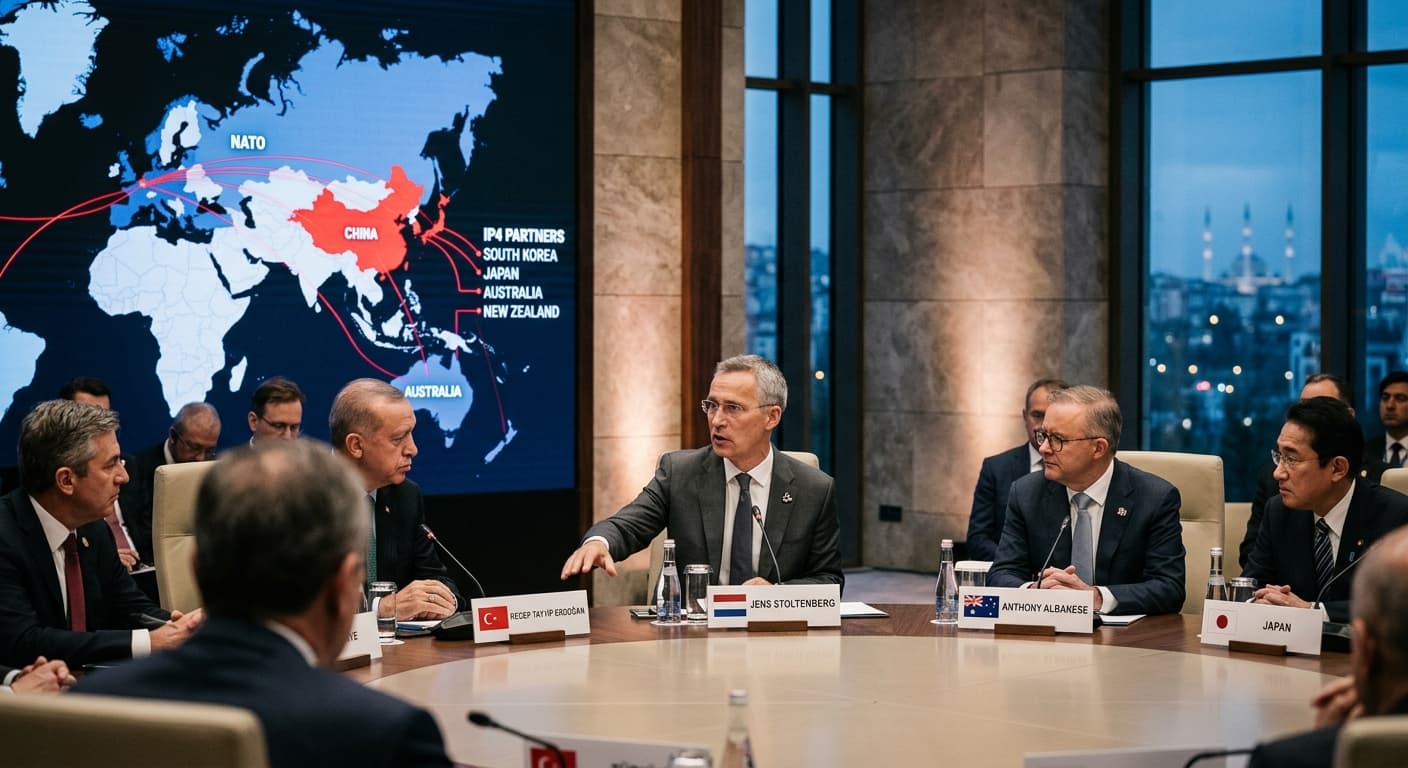
NATO and its Indo-Pacific Four partners agreed on July 7, 2026 in Ankara to tighten defence-industrial and cyber cooperation — a direct response to the Russia–China–DPRK–Iran axis.
The 30-minute IP4 meeting Turkish President Recep Tayyip Erdogan's guests barely acknowledged on the summit programme is the most consequential Indo-Pacific security event of 2026 — because it locks Japan, South Korea, Australia and New Zealand into NATO's defence-industrial and cyber architecture at precisely the moment the United States is drawing forces down from Europe and telling allies to carry more of the load. In Ankara, NATO Secretary-General Mark Rutte pointed to threats from China, North Korea and Iran alongside Russia, warning that "these countries are increasingly working together," Al Jazeera reported. The IP4 answer — coproduction, munitions interchangeability, and shared cyber defence — is what a two-theatre deterrent actually looks like in practice. This is not NATO going to Asia; it is Asia becoming the arsenal and cyber backstop of a Europe rearming under U.S. pressure.
What was actually agreed
Rutte hosted South Korea's President Lee Jae-myung, Japanese Foreign Minister Toshimitsu Motegi, Defence Minister Shinjiro Koizumi, Australia's Defence Industry Minister Pat Conroy, and New Zealand's Defence Minister at the ATO Congresium in Ankara, according to the NATO summit programme. The joint readout — reported by
The Mainichi — commits the six sides to deepening cooperation in defence industries and cybersecurity, and reaffirms that "Euro-Atlantic security is inseparable from Indo-Pacific security." Motegi delivered that line himself, framing it against Russia–North Korea military cooperation on Ukraine,
Jiji Press reported.
The four IP4 flagship projects agreed at NATO's 2024 Washington summit — support for Ukraine, cyber-defence, counter-disinformation and artificial intelligence — now anchor the working agenda, Al Jazeera's summit archive shows. Rutte's pre-summit release, published on
NATO's website on July 6, said allies would announce "tens of billions in new contracts" during the summit — a number that spills directly into IP4 supply chains through Korean tanks, Japanese fighters, and Australian undersea platforms.
Two structural facts frame Ankara. First, European NATO allies and Canada are now spending roughly 4% of GDP on defence, up from a 2% floor a decade ago, and are on a 10-year path to a 5% target agreed at the 2025 Hague summit, per NATO's own read-out. Second, U.S. Defense Secretary Pete Hegseth used the June 2026 Brussels ministerial to announce a six-month review of U.S. force posture in Europe and a phased withdrawal of warplanes, destroyers and submarines from NATO countries,
the Council on Foreign Relations noted. The gap this leaves — in air defence, ISR, long-range fires, cyber, and AI — is the gap the IP4 are being invited to help close.
Why Seoul is the swing player
Lee Jae-myung's presence is the biggest single change from prior IP4 gatherings. He is the only IP4 head of state in Ankara — Australia, Japan and New Zealand sent ministers — and he explicitly linked Korean peninsula conflict risk to the health of the alliance's defence industry, The Herald Business reported. The subtext is commercial. South Korea's Poland package — the 2022 $13.7 billion deal for K2 tanks, K9 howitzers and FA-50 jets, extended in 2025 by a further $6.5 billion for 180 K2 tanks with local coproduction — has already made Seoul the fastest-growing arms supplier to a NATO front-line state,
RAND analysts wrote in September 2025. Norway's rocket-artillery choice of the Korean Chunmoo over U.S. HIMARS made the same point in the north, as Norwegian Army Major-General Lars Lervik told a
CSIS Strategic Landpower dialogue earlier this year.
That commercial pull is now colliding with a strategic ask. NATO wants Korean munitions to help sustain Ukraine and, by implication, replenish European stockpiles that will be needed if the U.S. shifts weight to Asia. In exchange, Seoul wants what it has never had: NATO-standard interoperability, entry into AUKUS Pillar II-adjacent technology work, and a public alliance signal to Pyongyang. The Tallinn Mechanism joint statement of March 10, 2026 — the leading platform for civilian cyber support to Ukraine, which has channelled €302.6 million since December 2023 — quietly recorded the Republic of Korea joining as observer. That is the shape of the trade: Korean industrial capacity in, NATO cyber and technology architecture out.
The China calculus — sharper than the language
Publicly, NATO's line remains that it is not going to Asia. Privately, the entire IP4 architecture is designed to prepare for a scenario in which the United States is pulled into an Indo-Pacific contingency and Europe has to hold Russia alone. The Council on Foreign Relations frames the task as "reckoning with the potential that a conflict in the Indo-Pacific could force the United States to shift military assets from Europe to the Pacific," in an April 2026 analysis. CSIS goes further, arguing that European allies must be ready to "provide arms to mutual allies and partners in Asia, join in economic sanctions, and otherwise bolster the United States and its Asian allies and weaken China" in a Taiwan contingency,
in a 2025 study.
Beijing is reading it exactly that way. China's Foreign Ministry has repeatedly warned NATO against "eastward movement into the Asia-Pacific region" and pledged a "resolute response," Al Jazeera reported after Vilnius. State media formula — "wherever NATO shows up, turmoil and chaos will follow" — has become boilerplate in Xinhua editorials,
CFR's Indo-Pacific analysis noted. Hudson Institute's Liselotte Odgaard argues the IP4 track has already moved "from dialogue to cooperation, particularly in the domains of maritime security, emerging technologies, and resilience in the global commons,"
in a June 2026 assessment — even as European hedging keeps the framework issue-specific rather than treaty-shaped.
The North Korea vector is where the alliance's rhetoric bites hardest. Pyongyang's mutual defence pledge with Moscow, signed by Vladimir Putin and Kim Jong Un on June 19, 2024, has translated into artillery shells and ballistic missiles feeding Russia's war and, in return, technical support for Kim's nuclear and missile programmes, Brookings' Patricia Kim documented. Rutte's insistence that Russia, China, North Korea and Iran are "increasingly working together" is the operational rationale for pulling Seoul, Tokyo, Canberra and Wellington closer. The July 7 IP4 discussion covered precisely that alignment,
Jiji reported.
The cyber layer everyone underestimates
The most concrete near-term deliverable is cyber. NATO is racing to finalise agreement on a NATO Integrated Cyber Centre (NICC) around the Ankara summit, CSIS reported, with an initial mandate for shared situational awareness for the Supreme Allied Commander Europe. The IP4 are the natural first ring of partners: Japan and South Korea have world-class government CERTs and both have been repeated targets of Chinese and North Korean intrusions; Australia runs the Five Eyes cyber pipe; New Zealand has been quietly building NATO-standard cyber exercises.
The EU is layering on top. Council Implementing Decision COM(2026) 239, published on May 18, 2026, authorised Ukraine to draw from the EU Cybersecurity Reserve under Regulation (EU) 2025/38, in the EUR-Lex text. Together with the Tallinn Mechanism — which the UK is passing to Italy in July 2026 — this creates a Euro-Atlantic civilian-cyber envelope that IP4 states can plug into, share threat data with, and, in Korea's case, help fund. That is where "cooperation" stops being a communique word and starts being a budget line.
Who wins, who loses
The clearest winners are European front-line states and Korean and Japanese defence primes. Poland's arsenal now runs on Hyundai Rotem and Hanwha steel; Norway's rocket artillery is Korean; the UK–Italy–Japan Global Combat Air Programme is Britain's ticket to a sixth-generation fighter without American ITAR handcuffs. The BBC reported from Ankara that 12 nations, including the UK, will spend more than £37 billion ($50 billion) over the next decade on a new "Deep Precision Strike" long-range missile, with a range possibly extending to 1,250 miles — a programme whose supply chain will inevitably touch IP4 industry.
The losers are Beijing and Pyongyang. China loses on two fronts. Its narrative that NATO is an American axe "fanning flames beyond its scope" has to compete with the reality that Asian democracies are volunteering for the framework, not being conscripted. And its defence-industrial edge in Europe — dual-use exports, port investments — narrows as European procurement drifts toward Korean and Japanese suppliers with fewer political strings. North Korea, whose arms-for-tech pipeline with Moscow was the single most important shift in Northeast Asian security in 2024, now faces a Seoul that has moved from "cautious observer" to functional NATO partner in less than three years, as CSIS analysts flagged even under Lee's more centrist predecessor.
The wildcard loser is the Trump administration's own decoupling logic. Washington wants Europe to spend more and Asia to align tighter — but it also wants both to buy American. Every K2 tank in Gdynia and every GCAP airframe on the Warton line is a European or IP4 platform that a Boeing or Lockheed did not sell. The Brookings analysis of Turkey–Italy defence industrial cooperation makes the same point about Turkish drones: strategic pragmatism is quietly reordering NATO's supply chain away from U.S. exclusivity.
What to watch next
- August 15, 2026 — deadline for the U.S. Department of Defense six-month force posture review announced by Secretary Hegseth in Brussels in June. This determines how much of the U.S. air power drawdown from Europe actually happens, and by implication how much slack IP4 industry needs to take up.
- Autumn 2026 — first meeting under Italy's rotating lead of the Tallinn Mechanism,
per the UK government readout. Watch whether South Korea moves from observer to full member — the tell that Seoul is prepared to fund European cyber defence at scale.
- Q4 2026 — expected stand-up decisions on the NATO Integrated Cyber Centre. If IP4 liaison officers are embedded from day one, cyber becomes the first operational NATO domain with formal Indo-Pacific presence.
Diplomat View
The Ankara IP4 meeting is the moment NATO's Indo-Pacific engagement crosses from symbolism into supply chain. The alliance is not going to defend Taiwan and it is not going to admit an Asian member. What it is doing — coproducing Korean tanks in Poland, buying Japanese into a sixth-generation fighter, wiring Australian and Korean cyber into a NATO centre — is building the industrial and digital plumbing that lets Europe hold the Russian line while Washington's attention drifts to the Pacific. For Beijing, that is worse than a formal Asian NATO, because it is harder to caricature and harder to break. Our forecast: within 24 months, at least one IP4 state formally joins a NATO command-level cyber structure and Korean munitions become embedded in NATO stockpile planning. The forecast fails if a Trump–Putin Ukraine deal collapses U.S.–European trust before Ankara's industrial architecture hardens, or if Lee's government reverts to the Moon-era neutralist posture toward Beijing. Watch Seoul's next defence white paper, and watch which flag flies first inside the NICC.
The Bottom Line
NATO's July 7, 2026 pact with the IP4 in Ankara is not about deploying European frigates to the South China Sea. It is about turning Japan, South Korea, Australia and New Zealand into the industrial and cyber backstop of a Europe that is simultaneously rearming and being partly abandoned by Washington. If it holds, it will be the most consequential structural shift in Indo-Pacific security since AUKUS — and the one that most directly complicates Beijing's and Pyongyang's strategic calculations without a single new base or treaty.
Discover more

India
Delhi CM Rekha Gupta Blasts Opposition's Delm
Delhi CM Rekha Gupta's remarks on women's quota defeat reveal BJP's strategy for the 2029 Lok Sabha elections, focusing on delimitation.
India
Congress Accuses Modi of Stalling Women's Law
Congress accuses Modi of stalling women's reservation law by linking it to delimitation, revealing a deeper electoral strategy.

US Politics
US Launches $166B Tariff Refund Portal
The US is launching a $166 billion tariff refund portal to aid importers hit by Trump-era tariffs, with major implications for trade and supply costs.

Conflict & Security
Drone Warfare Killing Aid Workers at Unprec
Over 1,000 humanitarian workers killed in three years as cheap armed drones collapse legal protections. Gaza, Sudan, Ukraine, and DRC see deliberate targeting of aid convoys and hospitals with zero prosecutions.