Myanmar's 3.8 Million: Displacement Crisis
Exploring the ongoing displacement in Myanmar and its regional impact
Model Diplomat8 min readSoutheast Asia
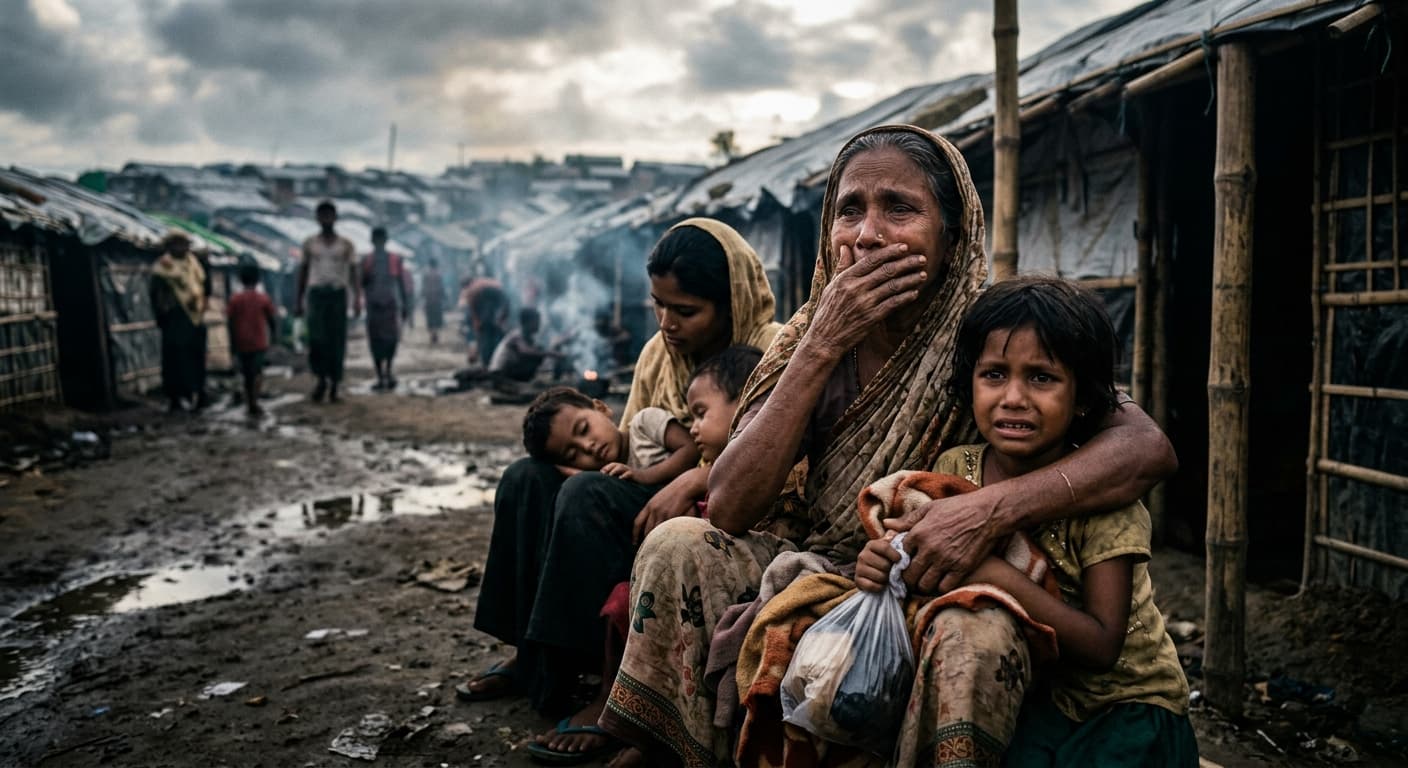
Myanmar's 3.8 Million: Displacement as the New Regional Order
As of July 6, 2026, UNHCR counts 3,814,100 people internally displaced in Myanmar — a permanent architecture of collapse now built into Southeast Asia.
The United Nations refugee agency's July 6, 2026 dataset records 3,814,100 internally displaced people inside Myanmar, with total population of concern reaching 4,523,661 — a figure the UN Secretary-General placed closer to 5.2 million when cross-border refugees are included, in a January 30, 2026 statement. The tally has stopped moving because the crisis has stopped being an emergency: five years after the coup, displacement is no longer a shock the region absorbs but the equilibrium it manages. Myanmar's military, having secured January's scripted election and Chinese-brokered ceasefires along the northern frontier, has effectively externalised the costs of its war — the humanitarian bill, the migrant labour shock, the criminal spillover — onto Bangkok, Dhaka, New Delhi and Beijing. That transfer, not the displacement itself, is the story.
The map, decoded
The UNHCR country dashboard for Myanmar, refreshed with the July 6 figures, is a portrait of asymmetric collapse. Sagaing Region alone holds 1,343,000 IDPs — 35.2% of the national total and the epicentre of the Bamar-heartland resistance the junta has bombed since 2021. Rakhine follows at 498,800 (including 224,749 stateless Rohingya), then Magway at 296,300, Kayin at 275,400, Bago East at 259,200, Tanintharyi at 264,800 and Kachin at 244,600. Yangon and Ayeyarwady, the commercial core the junta still fully controls, together account for under 1% — evidence that the regime has traded territorial reach for a fortified rump.
The single most telling shift on the map is what has not moved. UNHCR's July 14, 2025 overview recorded 3,282,900 post-coup IDPs on top of 270,000 pre-coup cases, for a headline total of 3,552,900. Twelve months later the figure is 3.81 million. That is a net gain of roughly a quarter-million people over a year in which the junta reclaimed ground in Kayin and Kachin, China brokered ceasefires with the MNDAA and TNLA, and the resistance's momentum visibly slowed. Displacement is no longer tracking battlefield swings; it is tracking the collapse of the underlying society.
From crisis to steady state
The tenfold rise since 2021 is what makes this different from any prior Myanmar displacement wave. The country's pre-coup IDP caseload — mostly Rohingya in Rakhine and long-displaced Kachin — sat around 370,000. UN OCHA's Humanitarian Update No. 47 logged 3.5 million as of June 2025; UNICEF's
Humanitarian Situation Report No. 4 put the end-2025 figure above 3.6 million, an increase of more than 150,000 in a single year, with the newly displaced concentrated in Sagaing, Kayin, Tanintharyi and Ayeyarwaddy and "often fleeing multiple times."
The macroeconomic backdrop hardens the case that this is now structural. The World Bank's Myanmar country update for the fiscal year ending March 2026 estimates 3.7 million IDPs, 12.4 million food-insecure and 16 million requiring humanitarian aid — nearly one-third of the population — with GDP projected to grow just 2% and poverty rising 2.4 percentage points. GDP has lost close to $100 billion since 2021, per the same
UN News briefing. A World Bank blog on Myanmar's education sector found that enrollment among 6- to 22-year-olds fell from 69.2% in 2017 to 56.8% in 2023, with a 23-point drop among the poorest households — a
generational human-capital loss baked in for a decade regardless of how the war ends.
The March 28, 2025 earthquake — 7.7-magnitude, 262 aftershocks — layered a disaster response onto the war. UNHCR's Flash Update #13 records that 2.1 million conflict-displaced people were themselves hit by the quake, an unusually cruel overlap given that half of the vulnerable displaced population lives in central Myanmar. The 2026 Humanitarian Needs and Response Plan, published by the
United Nations in Myanmar on December 10, 2025, contracted the target caseload from 6.7 million in 2025 to 4.9 million — not because needs have eased, but because donors have walked away. Only 12% of the 2025 appeal was funded by mid-year, per OCHA's own tracking.
Who is banking the crisis
The angle worth naming: the junta is no longer trying to reintegrate the displaced — it is farming them out to the neighbourhood, and the neighbours are absorbing the cost in different currencies.
Thailand now hosts more than four million Myanmar nationals, nearly half undocumented, according to a Human Rights Watch report issued July 14, 2025. Cambridge University Press's
European Journal of International Security puts the total similarly, with 2.3 million registered under Thailand's Ministry of Labour. That is a labour subsidy to Thai construction, fisheries and garments — and a tax on the Thai state, which has watched U.S. funding cuts strip food aid from more than 100,000 refugees in the nine border camps since July 31, 2025, per a second
Human Rights Watch briefing. The Trump administration's dismantling of foreign assistance is the proximate trigger; the deeper story is that a decades-old encampment regime has run out of donors precisely as demand peaks.
Bangladesh has absorbed the sharpest secondary shock. UN News reported in July 2025 that some 150,000 Rohingya fled to Cox's Bazar over the previous 18 months — the largest exodus since 2017 — driven by the Arakan Army's late-2024 capture of Maungdaw and the full 271-kilometre Rakhine border. Roughly 121,000 had been biometrically registered by end-June 2025. Dhaka now hosts close to 1.2 million Rohingya on 24 square kilometres, ahead of a general election in April 2026 that has made the file politically radioactive, as India's
Manohar Parrikar Institute has flagged. The 2024 UNHCR appeal for Cox's Bazar was only 35% funded — meaning cooking-fuel supplies, food rations and schooling for 230,000 Rohingya children are now on a cliff-edge.
India's Mizoram temporarily received around 20,000 people fleeing Falam Township clashes in Chin State in July 2025, most of whom returned within days, per OCHA's mid-August 2025 Humanitarian Update. Italy's
ISPI documents that over 275,000 people have fled Myanmar to third countries since February 2021, with 49% moving to Bangladesh and 22% to India — reshaping the ethnic geometry of northeast India's Manipur, Mizoram and Nagaland just as New Delhi races to complete the Kaladan Multi-Modal Transit Transport Project through Rakhine.
China's stake is different: Beijing tolerates displacement so long as it does not spill across the Yunnan frontier. The International Crisis Group documents that after 2015, when MNDAA attacks in Kokang sent tens of thousands of ethnic-Han refugees into Yunnan, Beijing became sharply intolerant of border instability — a lesson it has since applied by brokering ceasefires with the MNDAA and TNLA in 2025 and quietly pressuring the United Wa State Army to cut arms flows to allied groups.
The second-order shock: crime, conscription, contagion
Displacement in Myanmar is not just a humanitarian metric — it is the labour supply for an industrialised transnational crime economy. A June 22, 2026 DIIS working paper shows how scam compounds in Kokang and Myawaddy are built on control of border checkpoints, with trafficked workers moved through the same corridors used by IDPs. The Crisis Group's
June 2026 briefing is blunt: Myanmar's instability is "increasingly spilling across borders — manifest in scam centres with victims worldwide, narcotics production, illicit financial flows and human trafficking." The UN previously estimated that as many as 120,000 people, most of them foreign nationals, have been forced to work in Myanmar-based scam operations.
Conscription has become the other engine of displacement. The junta activated its 2010 conscription statute in February 2024; the International Crisis Group estimates that some 100,000 young men have been drafted at a rate of 4,000–5,000 per month, and the
BBC reports that the policy has decisively shifted the battlefield in the junta's favour. It has also produced a self-selecting migration wave: draft-age men flee to Mae Sot, Ranong and Yangon's diaspora networks in numbers the Thai Ministry of Labour registers only in fragments. This is the mechanism by which the war reproduces itself as a regional labour crisis.
What January's election changed — and didn't
The three-phase election between December 2025 and January 2026 was designed to cement, not resolve, this order. The Union Solidarity and Development Party won roughly 80% of contested seats, according to CSIS, with voting held in only 263 of 330 townships. UN human rights chief Volker Türk said the poll had "served only to exacerbate violence and societal polarisation," per the
January 30 UN briefing, which documented 408 military airstrikes killing at least 170 civilians during the voting period alone. IISS's
Myanmar Conflict Map frames the transition as a rerun of 2010 — a quasi-civilian veneer over consolidated military rule — with Min Aung Hlaing installing a loyalist, Ye Win Oo, as commander-in-chief and manoeuvring to become president.
The implication for displacement is grim: the new administration has no incentive to negotiate returns because the current equilibrium — a hollowed-out periphery, a rearmed core, a compliant Chinese partner, and neighbours absorbing the humanitarian cost — suits it. The Crisis Group notes that Beijing has moved from cool disapproval to active support, brokering ceasefires and, under a security pact signed with Russia, providing drone technology that has neutralised the resistance's earlier tactical advantage.
What to watch
- UNHCR's next weekly overview, due around July 13, 2026, will show whether the 3.81 million figure is genuinely a plateau or a pause before monsoon-driven displacement in Bago, Kayah and Southern Shan pushes it higher.
- The Bangladesh general election in April 2026 and its aftermath: interim leader Muhammad Yunus warned in June 2025 that the Rohingya file "could blow up" if unresolved; a nationalist successor government could shut Cox's Bazar to new arrivals, per the
MP-IDSA analysis.
- The 2026 HNRP funding gap: with only 12% of the 2025 appeal met and donor fatigue deepening, the
UN in Myanmar has already narrowed the target from 6.7 to 4.9 million. A funding collapse in Q3 2026 would force triage decisions with direct mortality consequences.
- The U.S. Burma policy review: the Trump administration's decision on whether to engage the post-election junta, flagged by
CSIS, will determine whether Western sanctions architecture holds or fragments.
The Bottom Line
Myanmar's 3.81 million displaced are no longer a symptom of the war — they are the equilibrium the junta, China and, tacitly, the neighbours have agreed to live with. Bangkok gets cheap labour and a border problem, Dhaka gets a permanent Rohingya caseload and an election-year headache, Beijing gets ceasefires and rare-earth access, and Naypyitaw gets to externalise the cost of its own state failure. The map published on July 6, 2026 is not a snapshot of crisis — it is the blueprint of a regional order built on displacement.
Discover more
US Politics
Washington's Scrutiny of Iran War Prediction
The Iran war prediction market scandal exposes political ties and regulatory challenges in Washington, as insider trading concerns rise.

US Politics
Virginia GOP Rallies Rural Voters Against Red
Virginia Republicans are mobilizing rural voters against a Democratic-led redistricting referendum, a fight seen as pivotal to control in the 2026 midterms.
Global Politics
Xi Jinping Calls China-Russia Ties 'Precious'
Xi Jinping's description of China-Russia ties as 'precious' reflects a strategic imbalance, with Beijing dictating terms in the partnership.

Conflict & Security
Drone Warfare Killing Aid Workers at Unprec
Over 1,000 humanitarian workers killed in three years as cheap armed drones collapse legal protections. Gaza, Sudan, Ukraine, and DRC see deliberate targeting of aid convoys and hospitals with zero prosecutions.