Myanmar's 3.6 Million Displaced: A Crisis
Displacement in Myanmar becomes a permanent regional issue.
Model Diplomat7 min readSoutheast Asia
Myanmar's 3.6 Million Displaced: A Crisis Frozen Into the Map
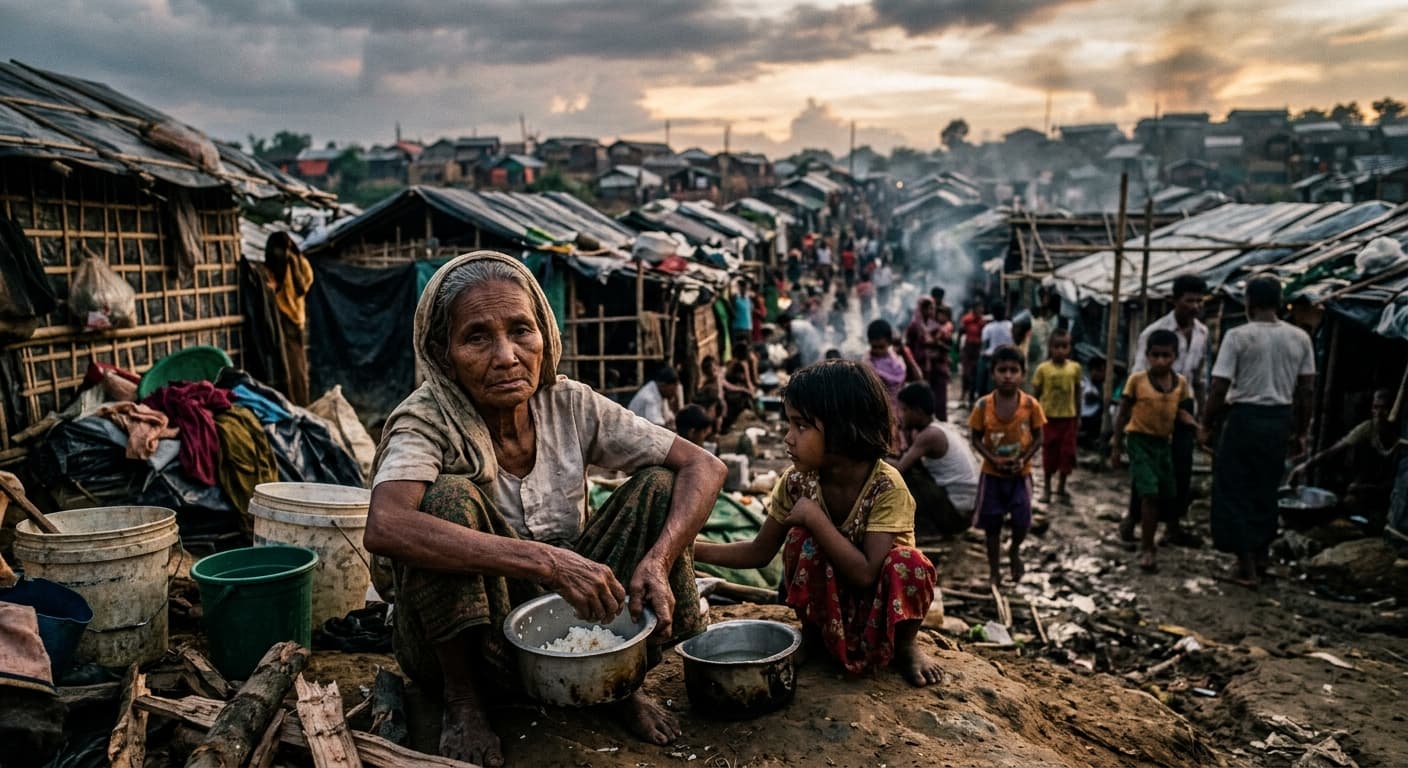
Five years after the coup, 3.6 million Myanmar civilians remain internally displaced as of June 2026 — a number that is no longer a shock but a settled feature of Southeast Asia's security landscape.
Myanmar's displacement crisis has passed the point of emergency and become structural: UN OCHA's Humanitarian Update No. 51, published on 9 March 2026, records roughly 3.6 million people internally displaced, while the
2026 Humanitarian Needs and Response Plan puts total displacement since the February 2021 coup above 4 million. The load-bearing analytical point is this: the international system has quietly stopped trying to reverse the displacement and started trying to manage its regional externalities — refugees, drugs, scam compounds, drone spillover — while the junta uses a controlled election and Chinese diplomatic cover to lock the map in place. That shift, more than any single battlefield swing, is the story of the last twelve months.
The map, read carefully
The UNHCR emergency overview map dated 8 June 2026, published on the agency's operational data portal, keeps the top-line figure at roughly 3.6 million IDPs. The next update, produced on the 29 June cutoff that this feature tracks, sits within the same band — a plateau, not a peak.
Beneath that plateau, the geography is severely uneven. According to OCHA's northwest analysis, roughly half of Myanmar's displaced population is concentrated in Sagaing, Chin, Magway and Mandalay — the "four cuts" heartland where the Myanmar Armed Forces have relied on airstrikes, arson raids and paramotor bombings. Rakhine State hosts around 560,000 displaced people, including Rohingya IDPs from the pre-2012 camps and roughly 350,000 driven from their homes by the Arakan Army–military war that reignited in November 2023. UNICEF's
Humanitarian Situation Report No. 4 notes that most new displacement in 2025 came from Sagaing, Kayin, Tanintharyi and Ayeyarwady — a widening front, not a contracting one.
The plateau is a statistical artifact. People are still fleeing — on top of returns and repeat displacements — in a country the UN describes as the world's second-highest in conflict intensity in the first half of 2025.
Why 2026 is not 2023
Three shifts have hardened the crisis into something regional powers now treat as a fixed condition rather than a solvable one.
The junta's conscription law changed the demographics of flight. When the regime activated the 2010 People's Military Service Law on 10 February 2024, the character of migration flipped from primarily rural, conflict-driven displacement to urban, draft-driven flight. Human Rights Watch, citing IOM data in its July 2025 Thailand report, recorded more than 330,000 entries to Thailand in March–April 2024 alone — over three times the same period a year earlier. ISPI's Paola Morselli notes in
A War Beyond Borders that this triggered "a new wave of internal displacement" and pushed educated urban youth into the exodus for the first time.
China rebalanced the war. As BBC's Jonathan Head reported, Beijing brokered the surrender of Lashio by the MNDAA in April 2025 without a shot fired, then engineered a withdrawal by the Ta'ang National Liberation Army from Mogok and Momeik in October 2025. The junta's counter-offensive that followed retook Kyaukme, Hsipaw, Nawnghkio, Thabeikkyin, Demoso and Mobye — flattening several by air first. ACLED, quoted by
Al Jazeera, assessed the gains as "limited in the context of the overall conflict" but sufficient to green-light the December 2025 vote.
The election locked in the political map. The Union Solidarity and Development Party swept the three-phase election, taking 232 of 263 lower-house seats declared, according to Al Jazeera's 31 January 2026 count. ASEAN refused to certify. UN human rights chief Volker Türk called the vote conducted in "an environment of violence and repression." A parliament is due to convene in March 2026 and a new government to take office in April — with Min Aung Hlaing widely expected to be installed as president. For displaced populations, that means the entity presiding over any future return is the same one that produced the displacement.
The regional spillover — where the analysis actually is
The Myanmar Emergency Overview Map is a humanitarian document. Its geopolitical significance now sits along the country's borders.
Bangladesh. Ambassador Salahuddin Noman Chowdhury told the UN Security Council on 19 June 2026 that Bangladesh continues to shelter "nearly 1.2 million forcibly displaced Rohingyas," per BSS. Since November 2023 more than 150,000 additional Rohingya have crossed into Cox's Bazar, according to
Human Rights Watch's February 2026 submission to the UN Democracy and Human Rights review. Amnesty International's
September 2025 assessment is blunt: northern Rakhine is now controlled by the Arakan Army, which many Rohingya describe as their new oppressor, making repatriation talk "catastrophic" in current conditions.
Thailand. Deputy Prime Minister Sihasak Phuangketkeow told CNA on 5 June 2026 that "the ground is shifting" inside ASEAN toward re-engagement. Bangkok is not driven by sympathy for the junta — it is driven by drone incidents (three Myanmar migrants killed in Tak province in early June 2026), by more than 5,300 people still trapped in scam compounds near the border per
CNA reporting, and by the meth pipeline out of Shan State that Thailand and India both now treat as a first-order security problem.
India. New Delhi worries about its northeast being destabilised by Myanmar's collapse — arms flows into Manipur, drugs into Mizoram, and, as CNA analyst Nirmal Ghosh notes in a December 2025 commentary, a Bangladesh drifting toward China across the same borderland. ISPI records that of the roughly 275,000 people who have left Myanmar for third countries since the coup, about 22% went to India — a small number in absolute terms, but concentrated in states where a few thousand refugees reshape local politics.
The angle: displacement as strategic asset
Myanmar's displacement is not a failure of policy for every actor. It is a feature.
For the junta, an emptied Sagaing or Chin countryside is easier to control than a populated one — the "four cuts" doctrine, updated. HRW's submission documents the junta's deliberate blockages of humanitarian aid as collective punishment, including after the March 2025 earthquake. For China, a fragmented Myanmar with the junta dependent on Beijing for weapons, diplomacy and border management is a more useful client than a unified federal state. For ASEAN, per Malaysia's Deputy Foreign Minister Lukanisman Awang Sauni
speaking on 7 July 2026, the crisis is being reframed from a political problem to a humanitarian one — a subtle downgrade that lowers pressure to enforce the Five-Point Consensus.
The clearest evidence of containment mode is the UN's own numbers. The 2026 HNRP requests US$890 million — down from US$1.4 billion in 2025, per the 10 December 2025 launch. Target caseload dropped 27%, to 4.9 million from 6.7 million. OCHA states plainly that this "reflects hard decisions and revised analyses, rather than an improvement on the ground." The 2025 plan closed at 26% funded — making Myanmar, in OCHA's own phrase, "one of the world's most dire and yet under-funded humanitarian crises."
Long-term implications for regional stability
Three second-order effects deserve attention.
First, a generation of Myanmar youth is being socialised abroad or in armed resistance. RSIS analyst Janet Fung warned in April 2024 that conscription would push young people into rebel movements or exile — the National Unity Government estimates 14,000 military defections since 2021. This creates a durable transnational diaspora with grievances, networks and, in some cases, combat experience.
Second, the Rohingya file is un-repatriable in practice. ORF's Between Diplomacy and Displacement documents that the Arakan Army controls 14 of 17 townships in Rakhine — effectively the entire India-Bangladesh border strip. Any repatriation deal negotiated with Naypyidaw is a deal with the wrong sovereign.
Third, the humanitarian architecture is being repurposed as border management. The 2026 HNRP's decision to focus exclusively on conflict and earthquake zones — two-thirds of Myanmar's townships, not the whole country — signals that donors and agencies are triaging by proximity to regional risk, not by need. That is a rational adaptation. It is also, as Al Jazeera's coverage of the estimated 80,000 killed since the coup implies, an admission that the crisis has been priced in.
What to watch
- March–April 2026 (now settled): Myanmar's parliament convened and Min Aung Hlaing was installed as president — formalising the political geometry facing all displacement diplomacy through the rest of the decade.
- Bangladesh post-election (February 2026 → now): The new government's posture toward Rohingya presence — and its tilt toward China and Pakistan, per
CNA's Nirmal Ghosh — is already reshaping the terms of any repatriation track.
- Next OCHA Humanitarian Update and the next UNHCR emergency map (quarterly): whether the 3.6 million figure moves down (returns following junta reconquest, often coerced) or up (Arakan Army offensives pushing beyond Rakhine into Ayeyarwady, Bago, Magway) is the single cleanest indicator of who is winning where.
- Monsoon June–September 2026 (ongoing): flooding in Bago, Kayah, Kayin, Kachin, Mon, Rakhine and Shan compounds displacement — a seasonal pattern documented in prior OCHA updates. Expect a spike in figures irrespective of combat trends.
The Bottom Line
Myanmar's 3.6 million displaced are no longer an emergency the world is trying to end — they are a permanent regional condition the world is trying to manage. The junta has used China's diplomatic cover and a controlled election to lock the map in place; ASEAN and donors have quietly downshifted from resolution to containment; and the displaced themselves — particularly the Rohingya in Bangladesh and the conscription-age youth scattered across Thailand, India and Malaysia — are becoming a structural feature of Southeast Asia's security order. The UNHCR map's frozen number is the diplomatic result, not a data problem.
Discover more
Global Politics
Xi Jinping Calls China-Russia Ties 'Precious'
Xi Jinping's description of China-Russia ties as 'precious' reflects a strategic imbalance, with Beijing dictating terms in the partnership.

US Politics
Virginia GOP Rallies Rural Voters Against Red
Virginia Republicans are mobilizing rural voters against a Democratic-led redistricting referendum, a fight seen as pivotal to control in the 2026 midterms.

India
Rajnath Singh's Durga Squad for 2026 Polls
Rajnath Singh's Durga Squad promised women's safety in Bengal but has since disappeared from the agenda, revealing BJP's true priorities.

Conflict & Security
Drone Warfare Killing Aid Workers at Unprec
Over 1,000 humanitarian workers killed in three years as cheap armed drones collapse legal protections. Gaza, Sudan, Ukraine, and DRC see deliberate targeting of aid convoys and hospitals with zero prosecutions.