Mozambique's $246M Aid Crisis Amid Gas Boom
Humanitarian needs grow as gas projects restart in Cabo Delgado.
Model Diplomat8 min readAfrica
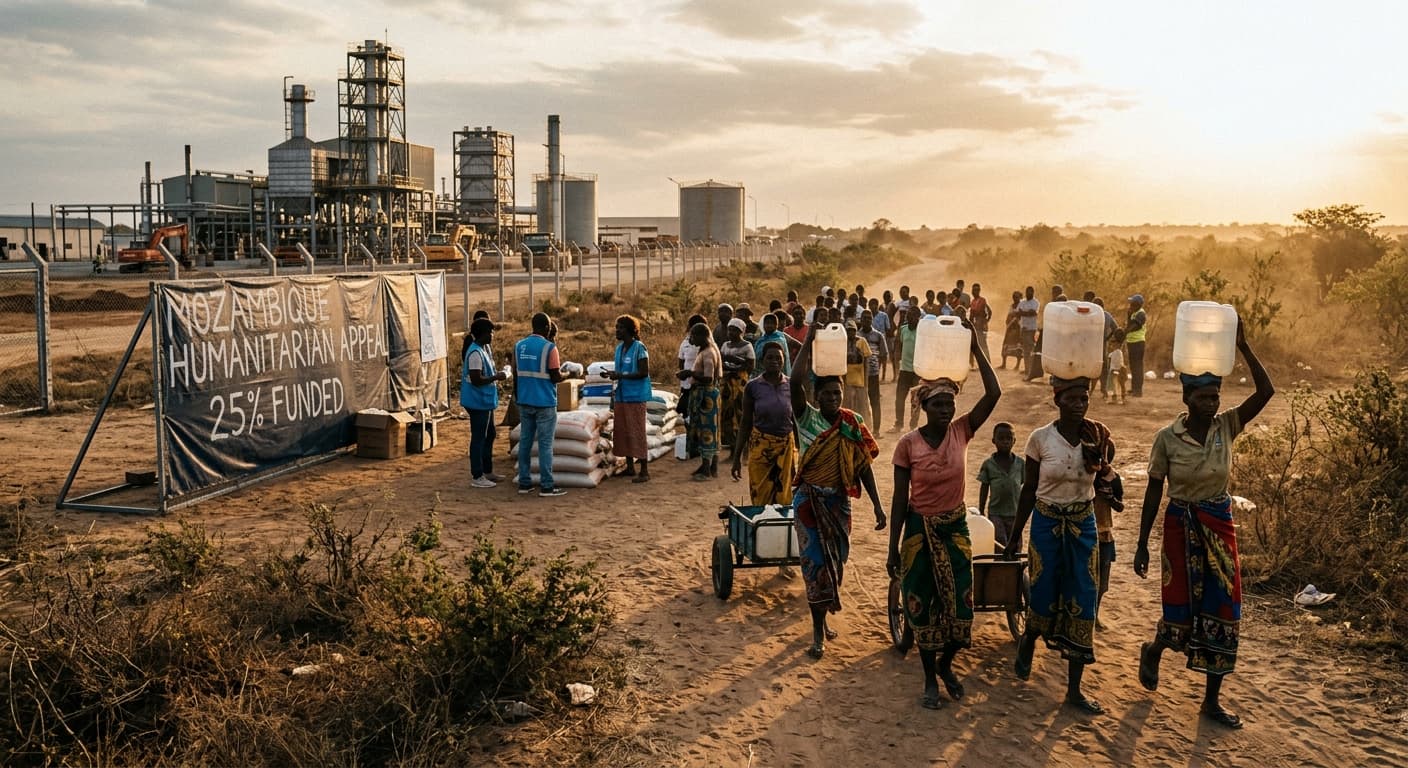
Mozambique's aid crisis: a $246 million gap as gas project restarts
Mozambique's 2026 humanitarian appeal is only 25% funded even as attacks spread across Cabo Delgado — and TotalEnergies has just restarted its $20bn LNG project on the same map.
Mozambique's northern war has entered a new phase in which capital is returning faster than aid: TotalEnergies relaunched its $20 billion Afungi liquefied natural gas project on January 29, 2026, while the UN's 2026 Humanitarian Needs and Response Plan for the same conflict zone has raised only US$102 million of US$348 million required — 25 percent, according to the UN Office for the Coordination of Humanitarian Affairs (OCHA). The mismatch is the story. Cabo Delgado is being re-securitised for gas at the moment US and European aid cuts hollow out the humanitarian architecture that has, since 2020, absorbed the war's civilian cost. The likely losers are 919,000 people OCHA classifies as "hyper-prioritised" in severity-4 districts; the beneficiaries are TotalEnergies, ExxonMobil and a Mozambican state whose calculus has shifted decisively from protection to extraction.
The map has moved south — and aid hasn't kept up
The insurgency known locally as al-Shabab, an Islamic State affiliate with no link to the Somali group of the same name, spent 2025 and early 2026 pushing operations out of its northern strongholds into districts once considered secondary. OCHA's May 31 situation report recorded more than 20,875 people newly displaced since the start of that month across Ancuabe, Chiure, Namuno, Metuge, Moc[í]mboa da Praia and Montepuez, with attacks periodically shutting the N380, N14, R763, R762, R760 and N1 corridors that aid convoys depend on (OCHA). The IOM's Displacement Tracking Matrix, in its 23rd round published in February 2026, counted 661,532 internally displaced people nationwide — a 9 percent increase over April 2025 — with Cabo Delgado alone hosting 474,410, or roughly 72 percent of the national caseload (
OCHA Snapshot).
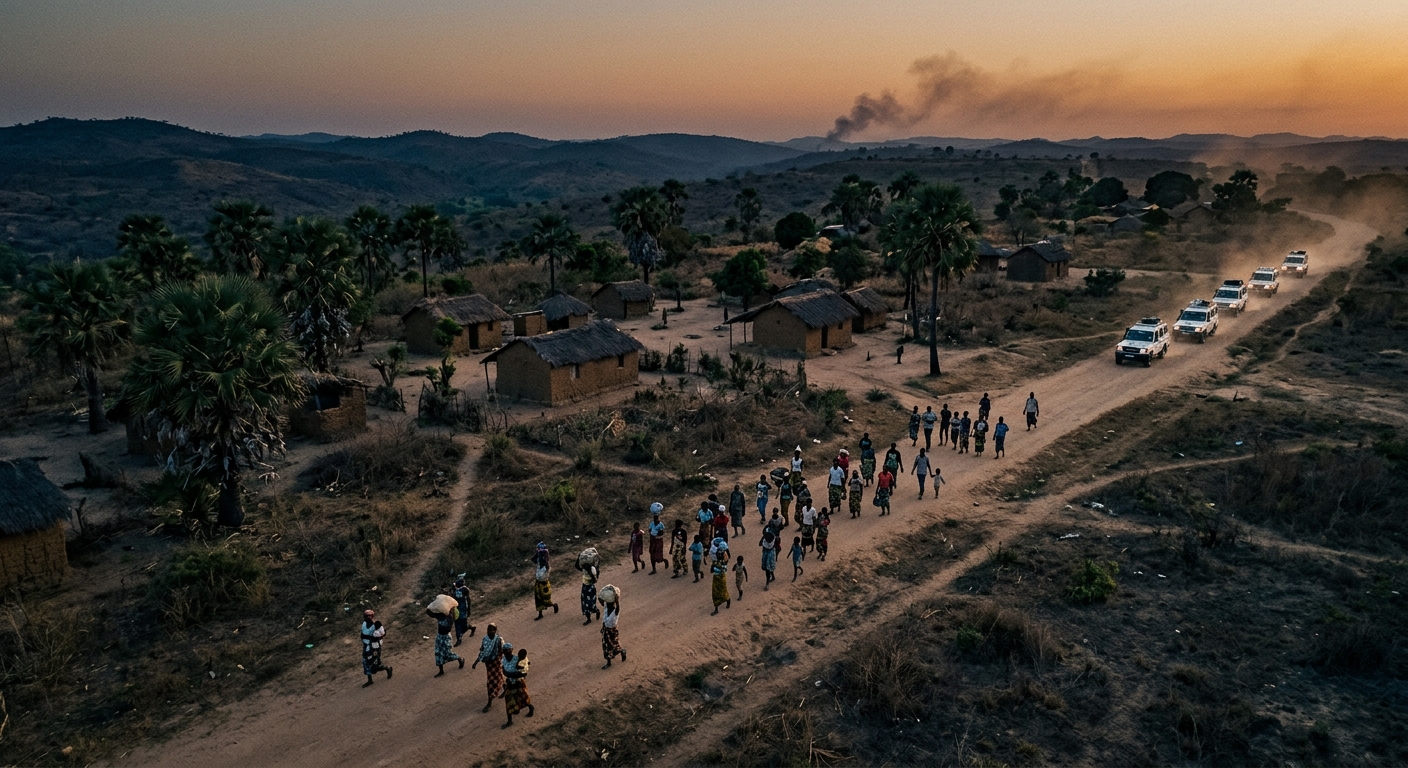
That geographic drift is not incidental. When Rwandan and SADC troops arrived in mid-2021, they cleared Moc[í]mboa da Praia and Palma — the coastal districts closest to the Afungi gas peninsula — but pushed the insurgents into smaller mobile cells that migrated south and west. As the Institute for Security Studies noted in October 2025, attacks have since expanded to 16 of Cabo Delgado's 17 districts, and the conflict has killed more than 6,200 people and displaced over 1.1 million since 2017 (ISS Africa). The Southern African Development Community Mission in Mozambique (SAMIM) formally ended on July 15, 2024; only Rwandan forces and a small Tanzanian contingent remain, and the areas of vulnerability are precisely those SAMIM used to cover.
The humanitarian consequence is arithmetical. By 31 March 2026, aid partners had reached about 369,000 people — 26 percent of the 1.1 million targeted — with food security and livelihoods operations accounting for the bulk of that number (OCHA). In the severity-4 districts where OCHA has concentrated its "hyper-prioritisation," only 299,000 of 919,000 targeted people had been reached. A further US$187 million is needed for a floods addendum covering 620,000 people in southern provinces — a bill nobody is on track to pay.
Who defunded the response
The immediate cause of the shortfall is not new needs but withdrawn money. The Trump administration's dismantling of USAID beginning in January 2025 removed the single largest donor from the ledger; in July 2025, Congress codified an additional US$7.9 billion rescission of previously appropriated foreign aid, including cuts to migration and refugee assistance and to humanitarian assistance broadly (NPR). The World Food Programme, which last year received US$4.5 billion from Washington, announced in May 2025 that it would cut 25–30 percent of its global workforce — roughly 6,000 posts — and projected that in 2026 it would receive less than half of what it needed (
NPR). WFP has been Cabo Delgado's primary food provider, and CSIS reports that even before this year's cuts, funding gaps had already forced it to halve rations, restricting aid from the 1.1 million previously food-insecure to only those in the most severe categories (
CSIS).
European donors have partially offset — but only partially. The European Commission's DG ECHO 2026 Humanitarian Implementation Plan for Southern Africa and the Indian Ocean earmarks EUR 15 million for Mozambique out of a regional envelope of EUR 29.5 million, an increase from the 2025 baseline but nowhere near the scale of vanished US contributions (EU DG ECHO). Set against a US$348 million appeal, a EUR 15 million European tranche is a rounding error. The UN Secretary-General's 2025 annual report on humanitarian assistance already showed the pattern: the Mozambique appeal that year closed at US$196 million against needs, or 39 percent funded, one of the weaker performances in East and Southern Africa (
UN Secretary-General).
The gas has come back before the aid
The second-order effect is the story most wire coverage misses. TotalEnergies' Afungi project, suspended after the March 2021 Palma attack, is once again under construction. President Daniel Chapo and CEO Patrick Pouyanné jointly relaunched the site on January 29, 2026, projecting output of more than 13 million tonnes of LNG annually from 2029 and up to US$35 billion in lifetime revenue to the state (Al Jazeera). ExxonMobil, whose chief executive sought security assurances from Chapo in mid-2025, is weighing a separate US$30 billion project (
Financial Times).
The security perimeter these projects require was built around Afungi and Palma, not around the southern districts where displacement is now concentrated. CSIS documents that after attacks near Ancuabe, checkpoints established by Mozambique's Forças de Defesa e Segurança "suspended humanitarian access," leaving partners unable to reach more than 42 percent of internally displaced people in hard-to-reach areas (CSIS). The European Union under the European Peace Facility doubled its investment in Mozambican security operations while contributing nothing at organisational level to WFP's request — a rebalancing the same CSIS analysis calls out by name.
The reputational cost of this hierarchy is beginning to show. TotalEnergies is facing a war-crimes complaint in French courts over alleged torture and executions of civilians held by Mozambican security forces in shipping containers at the Afungi site in June and July 2021; the company denies responsibility (BBC). In December 2025, UK Export Finance pulled a US$1.15 billion guarantee from the project. That neither has stopped the restart tells you where leverage lies.
What the aid gap actually breaks
The gap is not abstract. IOM and UN-Habitat, in a report released on 18 February 2026, documented deteriorating conditions among urban internally displaced people in Pemba, Metuge and Mecufi, where 60 percent of surveyed IDPs said they preferred local integration to going home — a preference driven by better security and services in urban areas, and one that the shrinking aid budget cannot sustain (OCHA Snapshot February). In Chiure district, humanitarian partners' February access assessment found "critical community concerns regarding the transparency and fairness of beneficiary targeting" — the operational language for what happens when aid runs out and rationing decisions poison relations with host communities.
Child protection has been particularly exposed. Human Rights Watch reported in June 2025 that abductions of children by al-Shabab were escalating; Save the Children's child-protection coordinator told Al Jazeera that "we no longer operate in this area and couldn't continue the process" for two abducted brothers her programme had begun to treat (Al Jazeera). Health infrastructure is thinning in parallel: cholera-related disinformation drove more than 24 attacks on health workers and community leaders across Cabo Delgado and Nampula between January and March 2026, with 74 percent of cholera deaths occurring at community level because families were afraid or unable to seek care (
OCHA).
The political map has also shifted
Two governance shocks compound the picture. The October 2024 election, which the National Electoral Commission awarded to FRELIMO's Daniel Chapo, triggered nationwide protests that CSIS and Mozambican researchers found most intense in extractive districts including Montepuez in Cabo Delgado; the added strain on security forces during the unrest created an opening for insurgents (CSIS). Chapo has since offered dialogue with opposition leader Venâncio Mondlane and, in a September 2025 interview, floated engagement with the insurgency's "leadership and motivations" as a possible off-ramp (
Al Jazeera). Whether Maputo has genuine capacity to conduct such talks while presiding over an LNG restart is the open question — insurgent messaging has always centred on the state's alleged capture by extractive interests.
The historical parallel worth naming is not Somalia or Boko Haram — it is Colombia's mid-2000s security-humanitarian split, where oil corridors were secured with foreign help while displaced Afro-Colombian and indigenous populations were left to underfunded IDP programmes. In Mozambique the analogue is starker: the CSIS 2023 landscape review warned that without pooled multi-sectoral financing, Mozambique risked drifting closer to a Nigeria trajectory than a Colombian one (CSIS). The 2026 numbers suggest the drift is happening.
What to watch
- The July–October 2026 pledging window. OCHA typically issues a mid-year appeal update in August. If the HNRP does not close at least half of its US$246 million gap by then, WFP will face another rationing round heading into the lean season, and the floods addendum will effectively lapse.
- ExxonMobil's Rovuma final investment decision. A green light on the US$30 billion project would deepen the imbalance between security investment around Afungi–Palma and aid coverage in Ancuabe, Chiure and Montepuez; a delay would signal that even the majors judge Chapo's security guarantees insufficient.
- The French war-crimes complaint against TotalEnergies. If prosecutors advance the case, UK Export Finance's December 2025 withdrawal may not remain isolated among European backers, and the political cost of the securitisation-over-aid trade will rise.
- Chapo–Mondlane and Cabo Delgado dialogue tracks. The commitments Chapo made in May 2025 on police accountability were the closest Maputo has come to acknowledging the security-forces abuse driver of the insurgency; extension to Cabo Delgado is the single most credible political de-escalation lever on the table.
The Bottom Line
Mozambique's 2026 humanitarian appeal is 25 percent funded because the donors who used to write the cheques — the United States above all — no longer do, while the same governments and companies are re-investing in the security architecture that protects the Afungi LNG site. The result is a war in which capital returns before civilians do: 474,410 people remain displaced in Cabo Delgado, 919,000 sit in severity-4 districts OCHA cannot reach at scale, and the gap between what the plan requires and what donors have delivered is US$246 million and widening. If ExxonMobil moves forward and the aid appeal does not, Cabo Delgado will become the clearest case yet of a humanitarian crisis financed out of the extractive economy it sits on top of — and that will be a political fact, not a funding accident.
Discover more
US Politics
Washington's Scrutiny of Iran War Prediction
The Iran war prediction market scandal exposes political ties and regulatory challenges in Washington, as insider trading concerns rise.
US Politics
SNAP Food Assistance Faces Legal Challenges
In 2026, SNAP faces stricter eligibility rules and mounting legal challenges, threatening food assistance for the millions of Americans who rely on the program.
India
Women’s Reservation in India
India's 33% women's reservation law is enacted but won't take effect until after 2029 due to political setbacks and census delays.

Conflict & Security
Drone Warfare Killing Aid Workers at Unprec
Over 1,000 humanitarian workers killed in three years as cheap armed drones collapse legal protections. Gaza, Sudan, Ukraine, and DRC see deliberate targeting of aid convoys and hospitals with zero prosecutions.