Mark Carney's Push for US Trade Deal
Mark Carney's push for a US trade deal faces major setbacks.
Model Diplomat9 min readNorth America

Carney's Push for a US Trade Deal Hits the July 1 Wall
Mark Carney wants a comprehensive US trade deal. Washington just refused to renew USMCA — here's what that means for Canada, tariffs and the 2036 deadline.
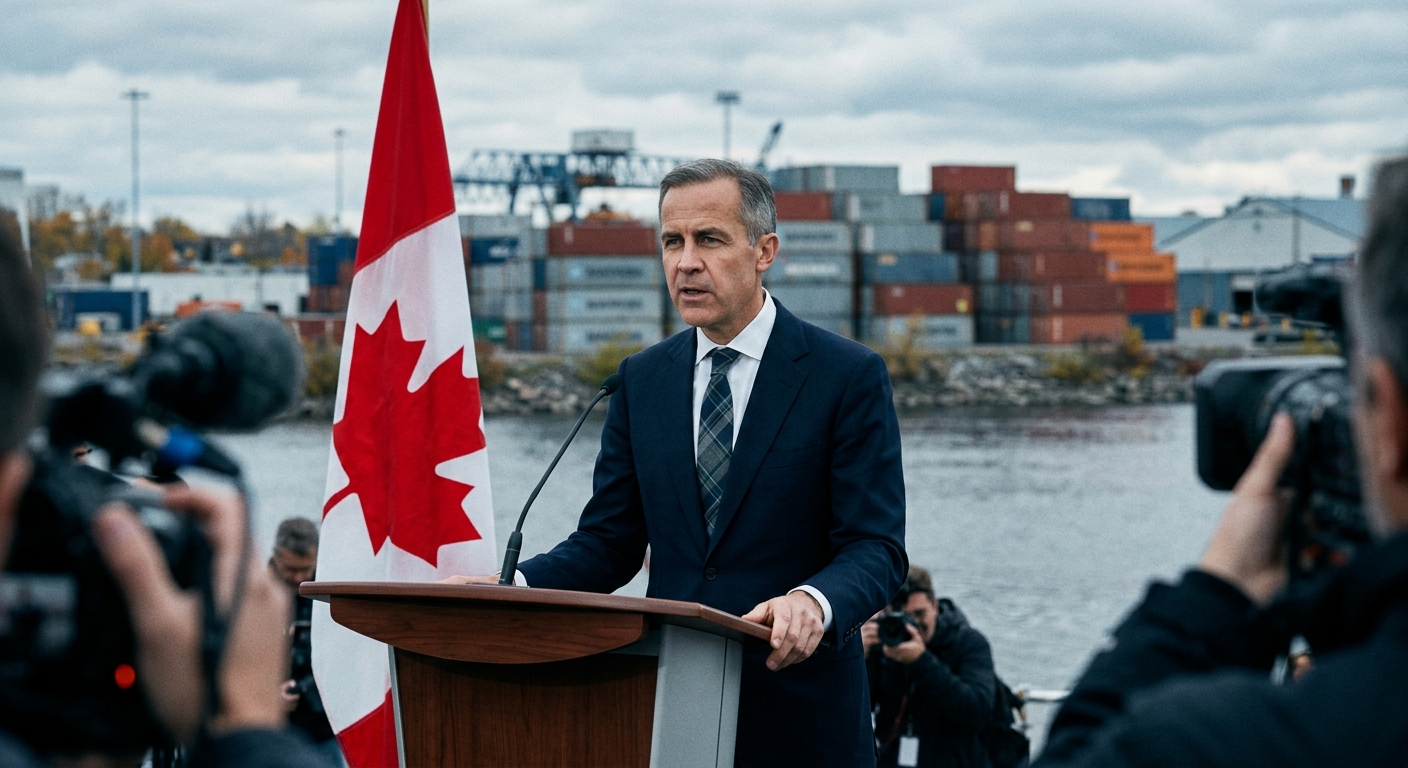
Mark Carney spent the first half of 2026 trying to convert a Canadian majority mandate into a "grander bargain" with Donald Trump — a comprehensive economic-and-security deal that would lift sectoral tariffs, lock in USMCA and settle the border, minerals and Golden Dome files in one package. On July 1, US Trade Representative Jamieson Greer told him no. Canada is now negotiating in the shadow of a 10-year countdown clock — and the leverage Ottawa had been quietly rebuilding since February has, for the moment, been neutralised by the White House's willingness to simply let the deal drift.
What actually happened on July 1
The trilateral joint review of the United States–Mexico–Canada Agreement was mandated by Article 34.7 of the treaty itself. The three parties had to decide whether to extend USMCA for another 16 years or trigger a cycle of annual reviews running to a 2036 sunset. In a one-page statement issued on July 1, Ambassador Greer wrote that "the United States did not agree to renew the USMCA in its current form. As a result, the USMCA is not renewed." The pact remains in force; the clock has started.
Ottawa had spent the previous month lobbying for the opposite outcome. On June 2, Trade Minister Dominic LeBlanc formally wrote to Greer and Mexican Economy Minister Marcelo Ebrard requesting a clean 16-year renewal plus parallel talks on sectoral tariffs. Mexico backed the same position. The US side had already signalled its answer: bilateral negotiating rounds with Mexico began in Mexico City in late May, a second was held in Washington in mid-June, and a third is scheduled for the week of July 20 — after the statutory decision date. There was never a serious trilateral track for Canada to join.
The July 1 virtual meeting of the three trade ministers, once billed as a potential flashpoint, was subdued. As the BBC put it, the war with Iran had "absorbed the White House's attention," stripping political heat from a review Washington was in no hurry to conclude. Greer's own reasoning was structural rather than tactical: the US goods trade deficit reached $197 billion with Mexico and $48.3 billion with Canada in 2025, and USTR wants those numbers addressed before it locks in another decade and a half.
Why Carney had thought he could win a bigger deal
The prime minister's strategy, coming out of his April 2026 majority, was built on three assumptions — each of which has partially unwound.
The first was that domestic legitimacy would translate into negotiating credibility. Carney told an Economic Club of New York audience on May 28 that "Canada strong will help make America great again," and pitched deeper integration on aluminum, autos and critical minerals. It was a deliberately Trumpian formulation from a former Bank of England governor — designed to give the president a headline win. US ambassador Pete Hoekstra called the phrase "worth repeating."
The second was that the Supreme Court had done Carney a favour. On February 20, 2026, the Court ruled 6–3 in Learning Resources, Inc. v. Trump that the International Emergency Economic Powers Act does not authorise the president to impose tariffs. Chief Justice Roberts wrote that "IEEPA contains no reference to tariffs or duties. The Government points to no statute in which Congress used the word 'regulate' to authorize taxation. And until now no President has read IEEPA to confer such power." That vacated Trump's 25% "fentanyl" tariffs on Canadian and Mexican imports and his global "reciprocal" tariffs. A
Congressional Research Service legal sidebar confirmed the ruling covered all IEEPA-based tariffs, forcing the White House to shift to Section 232, Section 301 and — within hours — a 10% Section 122 global tariff good for 150 days through July 24, 2026. Carney's team read that as leverage: the cudgel Trump had used to threaten a 35% across-the-board tariff on non-USMCA-compliant Canadian goods was legally weaker than it had been.
The third assumption was diversification. Since taking office, Carney has, by his own count at Davos, signed 12 economic and security accords across four continents — including a tariff-reduction deal with China on canola, lobster and crab in exchange for 49,000 electric vehicles. His pitch to fellow middle powers, delivered in Davos on January 20, was that the rules-based order had experienced
"a rupture, not a transition" and that "middle powers must act together because if we're not at the table, we're on the menu."
The reality Ottawa is now negotiating in
Each pillar has cracked in a different way.
The IEEPA ruling did not end sectoral tariffs — it redirected them. Steel and aluminum remain under 50% Section 232 duties, autos face a 25% levy, and lumber sits at 10%. These are the sectors Carney told reporters on June 25 he refuses to sign a "bad deal" to unlock. The problem is that USMCA renewal was never the vehicle to fix them. Section 232 tariffs sit on separate statutory authority, and Greer has consistently told Ottawa that Canada "may have to accept some tariffs" if it wants to engage on the review at all.
The diversification story is real but slow. According to the IMF's January 2026 Article IV report on Canada, the economy has "held up better than expected despite the largest shift in North American trade policy since NAFTA," but growth is projected to remain below potential and the structural fiscal deficit is expected to peak at around 2% of GDP in 2026. Statistics Canada slipped into a technical recession across late 2025 and early 2026. Bank of Canada projections cited by
BBC News put GDP growth at 1.1% in 2026 and 1.6% in 2027 — hardly the room from which to run a decade-long pivot.
The math on exposure, though, is less catastrophic than the headline "75% of exports" suggests. A June analysis by the Centre for International Governance Innovation argues that on a value-added basis, exports to the US amount to roughly 15% of GDP, of which only about half — potash, oil, gas, aluminum — is genuinely disruptable. That gives Carney more room to hold out than his critics allow. It does not give him room to hold out forever.
The Canada gap and the Mexico contrast
The most uncomfortable feature of the July 1 outcome is what it reveals about Canada's isolation. Mexico is deep into bilateral talks with the US; Canada is not. Deputy USTR Rick Switzer told a Council on Foreign Relations event, in remarks flagged in a CFR analysis, that "the grown-ups are in the room talking because there's a grown-up in leadership there. And I would argue there's not a grown-up in Canada in charge." Greer had earlier told Congress that "there are two countries that have retaliated economically against the United States in the past year: the People's Republic of China and Canada." The framing is not accidental — it is the pretext Washington is using to run separate tracks.
Carney's problem, laid out in a BNN Bloomberg analysis, is that his "middle powers" framing plays badly with a White House that reads independence as retaliation. And his early concessions — rescinding the
Digital Services Tax in June 2025 "in anticipation of a mutually beneficial comprehensive trade arrangement," dropping most retaliatory tariffs, withdrawing softwood-lumber legal disputes — have not translated into tariff relief. They read, in Washington, as evidence the squeeze works.
What Hoekstra's "bigger deal" was really offering
The most consequential piece of information sitting on the table is one Ottawa has not fully answered. US ambassador Pete Hoekstra told a Canadian International Council audience last autumn that Washington had wanted a "bigger deal" — one covering trade and defence. An analysis in The Hub, by former Conservative trade minister Ed Fast, argued this should be read as an invitation, not a warning: a comprehensive package would let Canada trade concessions on dairy, digital services and rules of origin against formal US recognition that Canada is not a Section 232 national-security threat, plus integration on critical minerals and Arctic defence.
That trade is not costless. Trump has claimed Canada should pay $61 billion toward his Golden Dome missile-defence architecture, a figure a Congressional Budget Office preliminary estimate suggested was well below the true $400 billion satellite-based interceptor cost. Ottawa's
C$6 billion contract with Australia for over-the-horizon radar, Carney's new Iqaluit military base, and his commitment to NATO spending of up to 5% of GDP are the down-payments on that conversation. What Ottawa has not yet said is whether it will reverse Canada's 2005 decision to stay out of the US Ballistic Missile Defense System — the concession that would make a "grander bargain" real.
Who wins, who loses
The winner from the July 1 non-decision, on the current evidence, is the White House. Trump preserves maximum leverage — tariffs stay on, the deal remains technically alive, and annual reviews give him a recurring occasion to extract concessions. As a July 2 CSIS panel of experts observed, the choreography allows either an early conclusion before the November midterms — a Trump "victory" — or extended talks in which Washington raises demands after the vote.
The losers are Canadian steel, aluminum, auto and lumber workers, and the North American automotive supply chain more broadly. CSIS's June commentary "Don't Let the USMCA Drift Away" frames the risk not as collapse but as "erosion": plants that don't get built, supply chains that quietly settle elsewhere. More than 13 million US jobs depend on commerce with Canada and Mexico, and the drag on investment is already showing up in Canadian manufacturing data. Mexico, paradoxically, may benefit relatively — its bilateral track with Washington is active, calendared and narrower.
What to watch
The next 90 days contain three decision points that could reset the picture:
- July 20–24, 2026: third round of US–Mexico bilateral talks in Mexico City; Section 122 global tariff expires July 24 unless Congress extends or Trump finds another authority.
- Autumn 2026: any formal US–Canada bilateral negotiating track — its absence is the single most telling indicator that Ottawa's "grander bargain" pitch has not landed.
- November 2026 midterms: the trigger point CSIS analysts flag as the moment Washington's demands either soften (for a pre-election win) or harden.
The Bottom Line
Carney's push for a US trade deal has become a push to prevent one from being written on Washington's terms alone. The July 1 non-renewal did not kill USMCA — it converted a deadline into a decade of leverage for the White House, and Ottawa's diversification, Supreme Court and majority-government cards have not been enough to buy a comprehensive settlement. If Carney cannot open a formal Canada-specific negotiating track before the US midterms, the base case is a slow erosion of North American integration in which Canada absorbs the shock and Mexico takes the growth.
Diplomat View
The forecast: no comprehensive Canada–US deal before November 2026, and a working assumption in Ottawa's Finance department of Section 232 tariffs on steel, aluminum, autos and lumber remaining in place through 2027. Carney's real play is not the review itself — it is buying time until either a domestic US backlash (rising consumer prices, auto-sector layoffs) or a post-midterm political reset forces Trump back to the table on Canada's terms. The falsifier would be a Canada-specific bilateral round announced by USTR before October 2026, coupled with even partial Section 232 relief; that would signal Washington is willing to compartmentalise the relationship the way Hoekstra hinted. Absent that, expect Carney to keep escalating the diversification story — an India free-trade push, a Mercosur opening, more middle-power theatre at the UN General Assembly in September — because the political economy at home requires visible movement even when the leverage isn't there yet. The story to watch is not what Carney signs. It is what he refuses to.
Discover more

India
India-South Korea $50B Trade Expansion Plan
India and South Korea target $50 billion in bilateral trade by 2030, focusing on industrial cooperation and strategic alignment amid US pressures.

Conflict & Security
Drone Warfare Killing Aid Workers at Unprec
Over 1,000 humanitarian workers killed in three years as cheap armed drones collapse legal protections. Gaza, Sudan, Ukraine, and DRC see deliberate targeting of aid convoys and hospitals with zero prosecutions.

Global
World Normalises Taliban as Afghan Women Eras
UN data shows Afghan women erased from public life as Russia recognises the Taliban, EU hosts officials in Brussels, and ICC warrants for gender persecution go unenforced.

Conflict & Security
West Africa Food Crisis: Three Shocks in 2026
Conflict, climate extremes, and the Strait of Hormuz closure drive a severe food crisis in West and Central Africa, with fertilizer prices surging 80% and millions displaced.