Marcos Orders AFP to Hold the Line in SCS
Philippines' military stance amid rising tensions in the West Philippine Sea
Model Diplomat8 min readSoutheast Asia
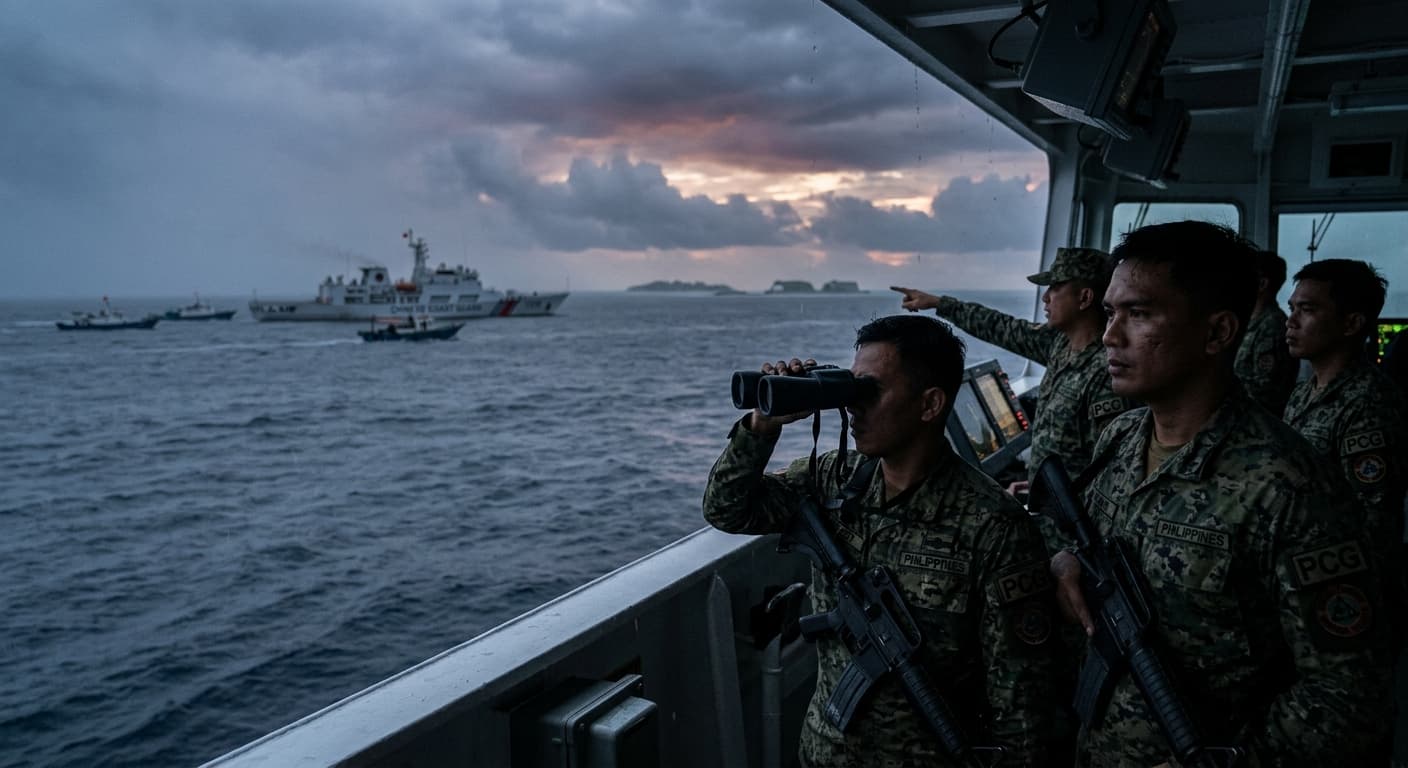
Marcos Tells AFP to Hold the Line in the South China Sea
Marcos orders the Armed Forces of the Philippines to stay "steadfast" in the West Philippine Sea days before the 10th anniversary of the 2016 ruling — and as Scarborough Shoal patrols hit record levels.
President Ferdinand Marcos Jr., on July 7, 2026, ordered the Armed Forces of the Philippines to hold their external-defense posture in the West Philippine Sea — a directive that lands not as a fresh policy but as a public seal on a hard-balancing architecture built brick-by-brick since 2022, and one designed to survive the next Philippine election. The order matters because China Coast Guard presence at Scarborough Shoal has already reached 933 ship-days in the first half of 2026, nearly matching the entire record year of 2025, according to Asia Maritime Transparency Initiative data. Manila is not escalating. It is locking the door before the room changes.
The directive, in context
The instruction was delivered at the 2026 AFP Command Conference at Camp Aguinaldo and relayed publicly by Defense Secretary Gilberto Teodoro Jr. Marcos told commanders to remain "steadfast" in external defense as the country approaches the July 12 anniversary of the Permanent Court of Arbitration award that invalidated most of China's nine-dash-line claims. The
Philippine Daily Inquirer reported that Teodoro emphasized "strategic recalibration" without disclosing operational specifics, while
Manila Bulletin added a second instruction — to monitor "foreign malign influence" domestically, a phrase that in Philippine defense usage now translates to Chinese information operations aimed at the 2028 presidential race.
The timing is not coincidental. AFP Chief of Staff General Romeo Brawner Jr. retires on July 21, per PhilNews24, and Marcos is fixing doctrine before the transition. The tenth-anniversary window gives the palace maximum diplomatic cover to reiterate a hard line while ASEAN partners cannot easily object.
What "hold the line" actually means now
The order is not an operational escalation. It is a political fence around an operational reality that changed 30 months ago.
Manila's Comprehensive Archipelagic Defense Concept (CADC), adopted under Marcos, requires the AFP to push forces outward from coastal garrisons to the country's 200-nautical-mile exclusive economic zone and to the Philippine-held features in the Spratlys. In Defence Studies, De La Salle University's Renato de Castro argues the CADC is the operational face of a "hard-balancing" strategy that, in his framing, prepares the AFP "for a possible armed conflict in the South China Sea, and even over Taiwan" — a scope explicit in his peer-reviewed article. The
IISS strategy paper on Philippine archipelagic defense notes that three of the four EDCA sites added in 2023 face north and east — toward Taiwan and the Bashi Channel — not merely west toward the Spratlys.
The hardware follows the doctrine. Re-Horizon 3, the third phase of the AFP modernization program approved on January 23, 2024, allocates roughly $35 billion over 10 years, gives the Navy the largest branch budget in Philippine history, and reserves 80–110 billion pesos for two Scorpène-class submarines to be based at Subic Bay, according to a Manohar Parrikar IDSA brief. India delivered the first BrahMos anti-ship batteries in 2024; a U.S. Army Typhon ground-launched Tomahawk and SM-6 system, deployed to Luzon in April 2024 for exercises, remains in country as of mid-2026, per a
Congressional Research Service brief. That is the deterrence hardware the AFP now defends politically.

The pressure that made the order necessary
Scarborough Shoal is where the paper architecture meets the water. AMTI's July 2026 tracking, drawing on Starboard AIS data, finds China Coast Guard patrols reached 933 ship-days at the shoal in the first six months of 2026 — nearly matching 2025's full-year total of 1,099, which itself had doubled from 516 in 2024. Philippine Coast Guard and Bureau of Fisheries and Aquatic Resources patrols averaged 43 ship-days per month, a 43-percent increase year-on-year, but still an order of magnitude below the CCG. Between January and June 2026, AMTI observed 112 days of direct interaction between Chinese and Philippine vessels near the shoal — one every 1.6 days.
The pressure is qualitatively new, not just quantitatively. In May 2026, China deployed a 6-by-6-meter "temporary research structure" inside Scarborough's lagoon, the first fixed floating object of its kind, before removing it on June 17 following a Philippine diplomatic protest. Beijing had already declared a "nature reserve" at Scarborough in September 2025 — a civilian-branded escalation that CSIS's Manila Strategy Forum white paper describes as an "unprecedented surge" in Chinese forces around the shoal. This is gray-zone salami-slicing without land reclamation, engineered to stay under the threshold that would trigger the U.S.-Philippines Mutual Defense Treaty.
The legal insurance policy
The reason Marcos can afford to "hold" rather than escalate is that Manila has already changed the legal terrain. On November 7, 2024, Marcos signed Republic Act 12064, the Philippine Maritime Zones Act, and Republic Act 12065, the Archipelagic Sea Lanes Act, both now registered with the UN Division for Ocean Affairs. Section 14 of RA 12064 explicitly binds the Philippines' maritime rights to "the South China Sea Arbitration (PCA Case No. 2013-19)" — writing the 2016 award into domestic statute.
That is the point. A CSIS analysis put it plainly: the law "insulates the Philippines' claims from future administrations that might, like that of previous president Rodrigo Duterte, seek to shelve the findings of the arbitral award in the interest of relations with China." Any future president who wants to soften the WPS position now has to repeal a statute in a legislature that voted the bills through by wide margins.
The order to "hold the line" is therefore addressed to two audiences simultaneously: the AFP officer corps two weeks before a change of command, and the Philippine political class 22 months before an election in which the Duterte camp — currently ascendant in vice-presidential politics — will run against precisely this posture.
Washington's money, Manila's leverage
The external scaffolding is unusually thick. The CSIS Manila Strategy Forum paper reports that the FY2026 U.S. National Defense Authorization Act authorized up to $2.5 billion in Foreign Military Financing and another $500 million in loans to the Philippines over five years — "levels of funding traditionally reserved for a handful of U.S. partners in the Middle East." The Trump administration, per CSIS, unfroze Philippine FMF alongside Taiwan's and Ukraine's in the first weeks of its foreign-aid review; a
CRS product on China-Philippines tensions notes that $336 million in modernization assistance was exempted from the broader aid freeze in February 2025.
Layered atop that: the Japan-Philippines Reciprocal Access Agreement, signed July 8, 2024, and detailed in an ISEAS analysis; a defense cooperation agreement with Germany; a SOVFA with New Zealand; and a France-Philippines visiting forces agreement now in final negotiation. The 2024 Bilateral Defense Guidelines with Washington, published by the
U.S. Department of Defense, commit the two militaries to a Security Sector Assistance Roadmap that plans five years of procurement in advance — long enough to survive one U.S. election.
A November 2025 CSIS field note on ASEAN and the South China Sea revealed the operational output: at the ADMM-Plus meeting, U.S. Defense Secretary Pete Hegseth and Teodoro announced Task Force Philippines, a permanent U.S. Indo-Pacific Command cell of roughly 60 personnel led by a one-star flag officer, with a wider mandate than the earlier Task Force Ayungin. That is what "hold the line" looks like in the U.S. order of battle.
The non-obvious angle: the doctrine is now Taiwan-facing
The most important thing Marcos did not say out loud is that the AFP's northern posture is now geared as much to Taiwan as to the Spratlys. The IISS paper documents that "Philippine Sea development projects have focused heavily on the Northern Luzon Command (NOLCOM) and in areas close to Taiwan rather than just the Western Command." Marine detachments were placed on Mavulis and Fuga in the Batanes group between 2019 and 2022; BrahMos batteries are believed to be based at Naval Station Leovigildo Gantioqui in Zambales, with new coastal-defense regiments considering sites at Lubang and Calayan Island — a maritime chokepoint south of Taiwan.
Read that geography alongside the Typhon deployment in Ilocos Norte and the May 6, 2026 Tomahawk live-fire from Tacloban to Nueva Ecija, reported by Al Jazeera, and the Philippines has quietly become the northern anchor of the U.S. First Island Chain. Stratbase ADRi, in a
December 2025 monograph, makes the connection explicit: the CADC is a component of a "trilateral archipelagic defense network linking" the Philippines, Taiwan and Japan.
That is the second-order effect a wire summary misses. Marcos's "hold the line" order is not only about Second Thomas Shoal or Scarborough. It preserves the AFP's role in a Taiwan contingency posture that the palace will never state publicly because doing so would break the Philippines' formal One-China position — and blow up Manila's carefully managed diplomatic track with Beijing.
The ASEAN problem
Manila's 2026 ASEAN chairmanship exposes the limit. The Australian Institute of International Affairs has argued that ASEAN's consensus rule leaves Manila isolated; CSIS's own read is that the Code of Conduct negotiation this year "will require accepting a watered-down political agreement rather than the legally binding pact ASEAN has sought for decades." At the 2025 Kuala Lumpur summit,
Malaysian Prime Minister Anwar Ibrahim warned against "outside forces" — a rebuke Marcos publicly accepted while quietly deepening exactly those partnerships.
The uncomfortable truth for Manila is that the "hold the line" directive is a substitute for the diplomatic escalation it cannot get through ASEAN. Filing a second arbitration case — this time on marine environmental destruction at Scarborough — is under active consideration but would rupture the fragile Beijing-Manila hotline that has kept resupplies at Second Thomas Shoal running since the July 2024 provisional accord.
What to watch next
- July 12, 2026 — Tenth anniversary of the
PCA arbitral award. Expect a joint statement with Washington and Tokyo, and diplomatic protests from Beijing.
- July 21, 2026 — Gen. Brawner retires. His successor's first public posture on Scarborough will signal whether the AFP moves from "hold" to something more forward.
- September–October 2026 — International Maritime Organization review of the Archipelagic Sea Lanes Act. Rejection would force Manila to broaden its designated lanes.
- November 2026 ASEAN Summit (Manila) — The COC endgame. Whether Marcos accepts a non-binding political declaration or walks away.
Diplomat View
The Marcos directive is not news of an escalation; it is news that the escalation has already happened structurally, and the president is confirming it will not be reversed by his own hesitancy. The load-bearing move was Republic Act 12064 in November 2024, which converted the 2016 arbitral award from a diplomatic asset into domestic law. Everything since — Typhon in Luzon, Task Force Philippines, the FY2026 NDAA package, the Japan RAA — is scaffolding around that legal core.
Our call: the Philippines has crossed the point at which a Duterte-camp restoration in 2028 could unwind the WPS posture without paying a legislative and alliance cost that outweighs the diplomatic dividend from Beijing. That is the falsifiable claim. It would be revised if (a) Congress moves to amend RA 12064 in the 2027–28 session, (b) the U.S. cuts the Task Force Philippines cell below 30 personnel, or (c) Manila abandons the second-arbitration option publicly. Absent those signals, "hold the line" is not rhetoric. It is the new equilibrium.
The country page: Philippines. Topic:
International.
Discover more

India
Women's Reservation Bill 2026: A Political Sh
India's Lok Sabha rejected the Women's Reservation Bill, exposing a political maneuver to redraw electoral maps favoring the north over the south.

US Politics
Virginia GOP Rallies Rural Voters Against Red
Virginia Republicans are mobilizing rural voters against a Democratic-led redistricting referendum, a fight seen as pivotal to control in the 2026 midterms.

India
700 Activists Accuse PM Modi of MCC Breach
Over 700 activists allege PM Modi breached election code with a televised address attacking opposition parties just before state elections.

Economics
Fed's Amex AML order puts correspondent banking on notice
Federal Reserve's Amex AML order requires board-level controls and a 90-day plan; OCC fined the bank $350 million over enterprise-wide deficiencies.