Manila's South China Sea Ruling: 10 Years On
Ten years on, 14 nations call Hague ruling binding as China escalates gray-zone tactics.
Model Diplomat10 min readSoutheast Asia
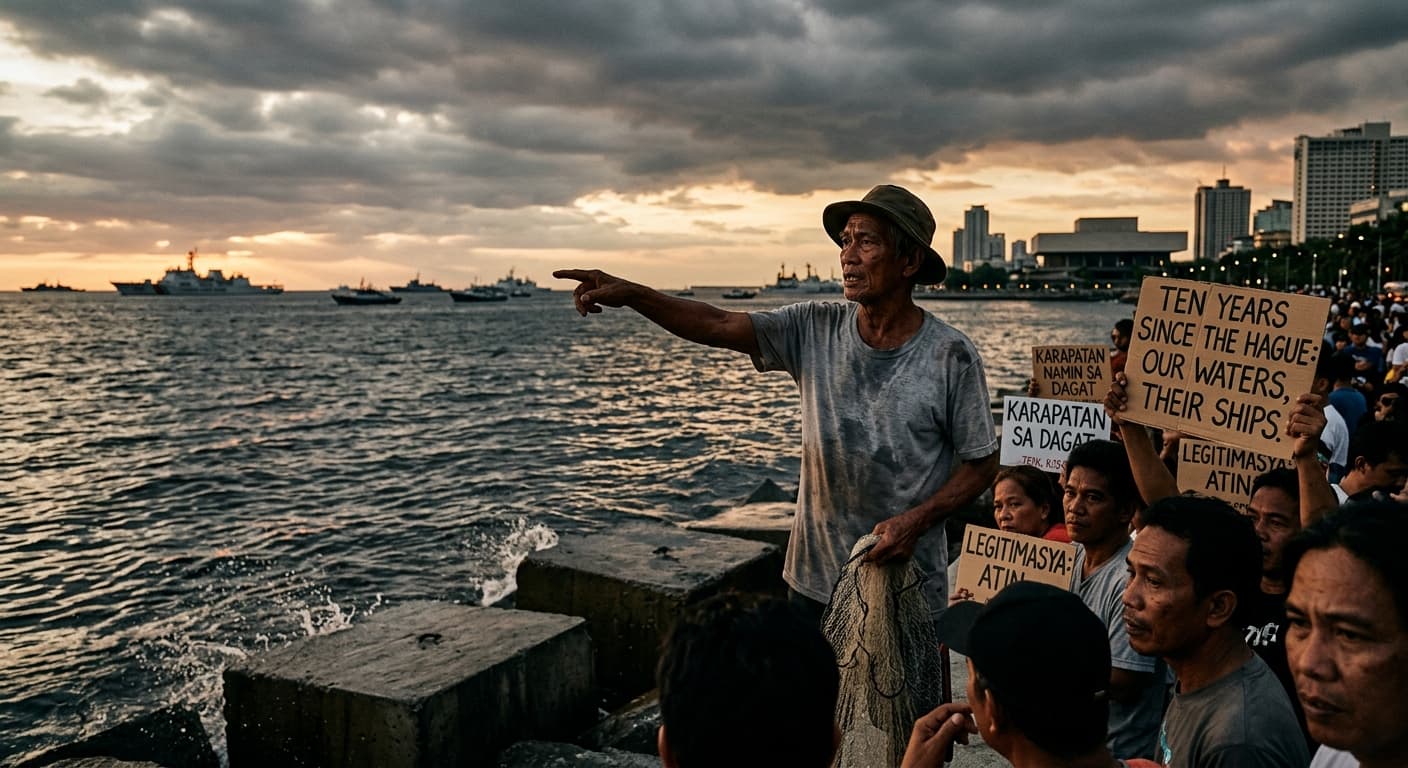
Manila's Decade-Old Legal Victory Is Winning the World but Losing the Water
Ten years after the Hague ruling invalidated China's nine-dash line, 14 governments now call it binding — but Beijing's coast guard patrols at Scarborough Shoal have nearly doubled in a year, testing how far "gray zone" control can go before the U.S. treaty trigger fires.
On July 12, 2016, five arbitrators at the Permanent Court of Arbitration in The Hague unanimously rejected China's claim to most of the South China Sea; ten years later to the day, 14 governments — from Washington to Ljubljana — issued a joint statement declaring that award "final, legally binding, and definitive." The ruling's power is growing precisely because it cannot be enforced, converting a legal defeat for Beijing into a normative anchor that 18 more governments have publicly endorsed since November 2022 — while China's coast guard has nearly doubled its ship-days at the contested Scarborough Shoal and Beijing declares the whole exercise a "worthless piece of paper." The decade's real scorecard: China has won the facts-on-the-water battle but is losing the legitimacy battle, and Manila's play is no longer to compel compliance — it is to make noncompliance steadily more expensive.
The Commemoration, and Beijing's Reply
President Ferdinand Marcos Jr. marked the anniversary at a July 10 diplomatic reception in Pasay City, framing the award as "not just an abstract triumph of jurisprudence" but a matter of "defending lives" and livelihoods of Filipino fishermen. Foreign Affairs Secretary Ma. Theresa Lazaro delivered Manila's bluntest statement on the ruling's permanence, calling it "an unshakable, permanent anchor of our rules-based international order" that is "not subject to negotiation or compromise," according to the Asia Media Centre. Defense Secretary Gilberto Teodoro Jr. led a flag-raising on Thitu Island in the Spratlys and a community visit to fishing towns in Masinloc, the municipality nearest Scarborough Shoal, telling residents the anniversary would "only succeed if its benefits reach our people." At a Makati forum, Teodoro went further, calling the award "not an award for the Philippines, but an award for the world, because it institutes the peremptory nature of UNCLOS, and it guards UNCLOS against revisionist attempts by selfish and tyrannical and autocratic powers."
The commemorative optics were deliberate. The Philippine Postal Corporation unveiled a stamp set inscribed "Final & Binding: 10th Anniversary South China Sea Arbitral Award 2016–2026," one design featuring a Filipino fisherman against the national flag, the other a green sea turtle. The message to domestic and international audiences was the same: the ruling is permanent, it belongs to ordinary Filipinos, and it is not going away.
Two days later, the Philippines and 13 partners — New Zealand, the United States, Australia, Canada, Japan, the United Kingdom, Germany, Italy, Estonia, Latvia, Lithuania, Romania and Slovenia — issued a joint statement reaffirming that "there is no legal basis for China's expansive maritime claims" and opposing "the use of coast guard, military, and maritime militia forces to harass, obstruct, or intimidate lawful operations," as reported by The Manila Times. New Zealand's ambassador to Manila, Dr. Catherine McIntosh, attended a parallel forum hosted by the Stratbase Institute — a signal that even non-claimant middle powers now treat the award as a litmus test for the rules-based order rather than a bilateral quarrel.
Beijing's response was immediate and categorical. A July 12 statement from China's Ministry of Foreign Affairs called the award "nothing but a worthless piece of paper that is illegal, null and void, and has no binding force," and warned that "China's territorial sovereignty and maritime rights and interests in the South China Sea shall not be affected by the 'award' under any circumstances," according to China's Foreign Ministry. Two days later, Foreign Ministry spokesperson Lin Jian told reporters the arbitration was "in essence a political farce masqueraded as a legal process," and confirmed Beijing had lodged protests with the EU delegation and several European embassies over their endorsement. The language tracks word-for-word with the position China took the day the ruling was issued in 2016 — a decade of unbroken rejection, anchored in a 2014 position paper arguing the tribunal lacked jurisdiction because the dispute's essence was territorial sovereignty, not maritime entitlement, as
China's Foreign Ministry has maintained.
The Gray-Zone Buildout at Scarborough
If the legal front is Manila's, the physical front is Beijing's. Scarborough Shoal — Bajo de Masinloc to Manila, Huangyan Dao to Beijing — is a triangular atoll 240 kilometers west of Luzon and roughly 1,000 kilometers from the Chinese mainland. China seized effective control in 2012 after a standoff; the 2016 tribunal ruled it is a rock generating only a 12-nautical-mile territorial sea and that Beijing must respect Filipino traditional fishing rights, according to the Permanent Court of Arbitration. A decade on, Beijing administers the shoal as effectively Chinese sovereign territory — without building a single permanent structure on the reef itself.
The most revealing metric is coast guard presence. New AIS analysis from the Asia Maritime Transparency Initiative shows China Coast Guard patrols at Scarborough ran to 933 ship-days in the first half of 2026 alone — nearly matching 2025's full-year record of 1,099 ship-days, which itself had doubled from 516 in 2024, according to AMTI. Interactions between Chinese and Philippine vessels were observed on 112 days in the first six months of 2026 — averaging 19 per month. The pattern is no longer episodic harassment. It is sustained, law-enforcement-style presence on a scale AMTI describes as "beyond any previously observed CCG activity in the South China Sea" since it began tracking in 2019.
The tactics have evolved beyond ships. In December 2024 Beijing published territorial baselines around the shoal. In September 2025 it declared the 8,650-acre atoll a nature reserve, a move the Philippine foreign ministry and U.S. Secretary of State Marco Rubio immediately rejected as unlawful, as Al Jazeera reported. In October 2025 the Philippine Coast Guard documented two newly installed Chinese buoys. On May 25, 2026, it found a 6-by-6-meter floating structure inside the lagoon — described by the Chinese embassy as a "temporary research facility" and by Manila as evidence of creeping occupation; it was removed on June 17, but other floating objects remain, according to
AMTI's buoy analysis. The
Epoch Times reported that the Philippine government urged removal and warned against any artificial island construction.
The encounters have turned violent. In August 2025, a Chinese navy warship and a Chinese coast guard vessel collided with each other while pursuing the Philippine patrol boat BRP Suluan at high speed near the shoal, according to Al Jazeera. In September 2025, a Philippine coast guard member was injured by glass shattered by a Chinese water cannon during a confrontation at the same feature. The BBC, which had a crew aboard a Philippine vessel chased by Chinese ships near Scarborough, reported water cannon strikes smashing an awning and mangling a railing, with vessels coming within five meters of collision, according to
BBC News.
Beijing's calculus is clear: assert control through persistent presence and administrative measures — baselines, nature reserves, buoys, research platforms — while staying below the threshold of permanent construction or overt military force that could trigger a coordinated international response or U.S. treaty obligations. The 2002 Declaration on the Conduct of Parties bans occupation of currently unoccupied features; Beijing has cited that restriction against Philippine repairs to the BRP Sierra Madre at Second Thomas Shoal while carefully framing its own Scarborough activity as environmental stewardship rather than occupation.
The Legitimacy Countermovement
The diplomatic counter-narrative is where Manila has gained the most ground. The CSIS Arbitration Support Tracker identifies 27 governments that have publicly called for the ruling to be respected as legally binding, up from just a handful in 2016. Eighteen governments have shifted from passive acknowledgment to full endorsement since November 2022, when France and Italy broke the post-ruling ice, according to AMTI's tracker. India joined in June 2023; 14 European nations followed in July 2023; South Korea in September 2023; Norway in October 2024. By contrast, only eight governments have publicly rejected the ruling.
The notable absence is ASEAN. Not a single Southeast Asian neighbor — not Vietnam, not Malaysia, not Brunei, all of which have their own South China Sea claims — has formally endorsed the 2016 award. This is not accident. Every ASEAN state must manage its own bilateral relationship with Beijing, and a collective endorsement would invite Chinese retaliation against the ASEAN-China trade and investment relationship that the bloc has spent two decades building. Manila's 2026 ASEAN chairmanship gives it agenda-setting power, but the most it can realistically deliver on the Code of Conduct is a watered-down political agreement rather than the legally binding pact ASEAN has sought since the 1990s, as CSIS analysis notes.
The deeper parallel is with Mauritius and the Chagos Islands. A small state secured an ICJ advisory opinion and a General Assembly resolution against a great power — the United Kingdom — and over years of sustained diplomatic pressure made noncompliance so costly that London eventually negotiated a sovereignty transfer. CSIS analysts Greg Poling and others argue Manila could replicate that model: file a UNGA resolution demanding compliance, win it with a likely margin of 44-plus votes, then seek an ICJ advisory opinion on whether China's behavior violates the UN Charter and maritime collision regulations, according to CSIS. Losing repeated votes in different international bodies would not compel Beijing to comply, but it would raise the reputational costs and make a face-saving compromise progressively more attractive.
Manila's Legal Playbook
Philippine officials have been exploring two options for a second arbitration, according to CSIS analysis. The first would be a new UNCLOS Annex VII case focused on environmental damage from China's island-building and maritime activities — a claim the 2016 tribunal partially addressed but did not fully adjudicate. The second, broader option would seek an ICJ advisory opinion through the General Assembly, sidestepping China's Security Council veto.
Manila has also been building its domestic legal architecture. The Philippine Maritime Zones Act, passed in 2024, codifies the country's EEZ and continental shelf claims in domestic law, aligning Philippine statutes with UNCLOS and the arbitral award. This gives Manila a firmer basis for filing diplomatic protests, conducting patrols, and licensing oil and gas exploration within its declared maritime zones. The Congressional Research Service notes that the 2016 ruling found Second Thomas Shoal, Scarborough Shoal, and the PRC-occupied Mischief Reef fall within the Philippines' EEZ, and that China unlawfully interfered with Philippine fishing and created a risk of collision.
The July 2024 "provisional arrangement" between Manila and Beijing reduced tensions at Second Thomas Shoal by allowing resupply to the grounded BRP Sierra Madre. But that de-escalation displaced the friction to Scarborough, where there is no equivalent diplomatic off-ramp. China is reacting to all Philippine government vessel navigation in a much larger geographic area between the shoal and the eastern edge of the nine-dash line, as AMTI documented. Without a clear point of compromise, any Philippine maritime asset operating in that corridor is likely to attract a Chinese escort — and a heightened risk of accident — for the foreseeable future.
The Treaty Trigger
The escalation question ultimately runs through Washington. The 1951 U.S.-Philippines Mutual Defense Treaty covers an "armed attack on the armed forces, public vessels, or aircraft of the Republic of the Philippines in the Pacific," including the South China Sea. U.S. statute, codified in 22 U.S. Code Chapter 25, affirms that such an attack "would trigger the mutual defense obligations of the United States." The
Congressional Research Service confirms that U.S. officials have stated that "an armed attack on Philippine armed forces, public vessels, or aircraft in the South China Sea would invoke U.S. mutual defense commitments."
The ambiguity is in the definition of "armed attack." Water cannon strikes, dangerous maneuvers, and collisions involving coast guard vessels exist in a gray zone that neither Washington nor Manila has publicly defined as a treaty trigger. The June 2024 clash at Second Thomas Shoal — where Chinese coast guard personnel boarded a Philippine boat and seized equipment — came closest without crossing the line. The Congressional Research Service notes that the U.S. government condemned Chinese "dangerous and escalatory actions" but stopped short of invoking the treaty.
The deterrent architecture is expanding regardless. The Enhanced Defense Cooperation Agreement increased the number of Philippine bases accessible to U.S. forces from five to nine in 2023, including two facing the South China Sea and two across the Luzon Strait from Taiwan. The U.S. pledged $500 million in foreign military financing for the Philippines in FY2024, and the Trump administration in February 2025 exempted $336 million in Philippine military modernization assistance from its broader foreign aid freeze, according to CRS. The 2026 Balikatan exercises involved over 16,000 troops and, for the first time, drills in the Philippine EEZ beyond territorial waters.
Diplomat View
The decade-old ruling has become something its authors did not anticipate: a coalition-building instrument rather than a compliance instrument. China will not comply — that is a fixed position, not a negotiating stance. Manila's strategy now is to make the ruling so widely endorsed that noncompliance carries escalating reputational costs, and to pair that with physical presence on the water backed by an expanding U.S. deterrent footprint.
The risk is asymmetric. Beijing can escalate gray-zone pressure at Scarborough in calibrated increments — more buoys, more ship-days, another "research platform" — without triggering the U.S. treaty obligation or provoking ASEAN unity. Manila must avoid a miscalculation that produces casualties while keeping enough pressure on Beijing to maintain the moral high ground. One Philippine coast guard member injured by water cannon is a diplomatic victory; one killed would be a crisis neither side can control.
What to watch:
- September 2026 UNGA session: Whether Manila files or lobbies for a General Assembly resolution endorsing the award, or signals movement toward an ICJ advisory opinion request.
- ASEAN Summit, October 2026: Whether Manila's chairmanship produces any progress on a Code of Conduct or whether negotiations stall over binding-versus-political language.
- Scarborough Shoal, ongoing: The next Chinese installation — buoy, platform, or structure — and whether the Philippine Coast Guard attempts another close approach. Each interaction is a potential treaty-trigger test.
The bottom line: The 2016 award is more legitimate and less enforceable than at any point in its history. China has spent a decade proving that international law cannot compel a great power to vacate territory it occupies; the Philippines has spent the same decade proving that international law can organize a coalition against that occupation. The question is whether gray-zone control or coalition pressure breaks first — and whether a collision at Scarborough answers it before diplomacy does.
Discover more

US Politics
White House Pressures Congress for Crypto Leg
The Trump administration's push for the CLARITY Act aims to reshape crypto regulation, impacting trillions in market value and the Trump family's wealth.

India
India-South Korea $50B Trade Expansion Plan
India and South Korea target $50 billion in bilateral trade by 2030, focusing on industrial cooperation and strategic alignment amid US pressures.
India
Rajnath Singh's Durga Squad for 2026 Polls
Rajnath Singh's Durga Squad promised women's safety in Bengal but has since disappeared from the agenda, revealing BJP's true priorities.

Economics
Fed's Amex AML order puts correspondent banking on notice
Federal Reserve's Amex AML order requires board-level controls and a 90-day plan; OCC fined the bank $350 million over enterprise-wide deficiencies.