Manila Won at The Hague a Decade Ago; Beijing
A decade after the 2016 UNCLOS award, Manila pivots from compliance to coalition-building.
Model Diplomat9 min readSoutheast Asia
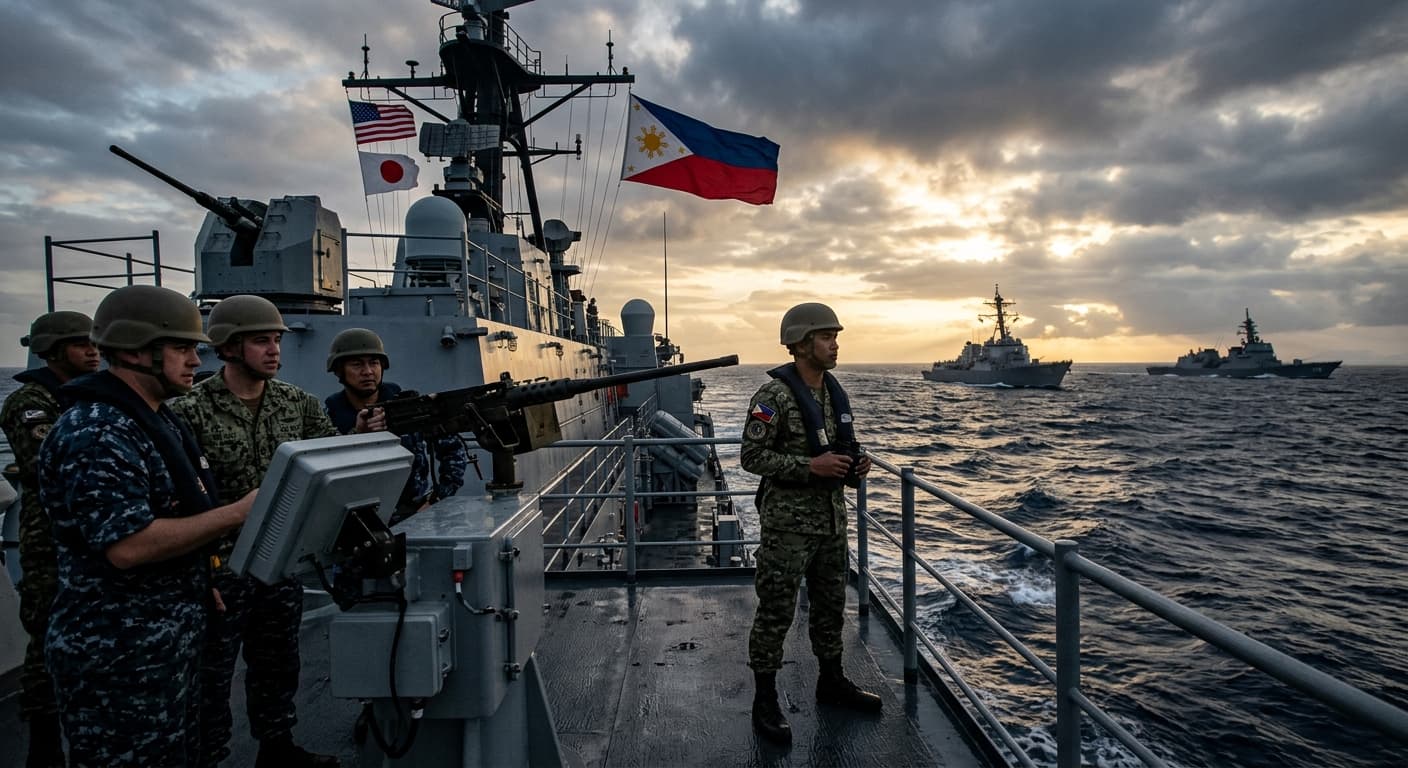
Manila Won at The Hague a Decade Ago; Beijing Took the Sea Anyway
Ten years after the 2016 arbitral award invalidated China's nine-dash line, Manila is using the anniversary not to compel Beijing's compliance — which never came — but to legitimize a minilateral defense network ASEAN itself refuses to endorse.
On July 12, 2016, a tribunal constituted under Annex VII of the UN Convention on the Law of the Sea ruled unanimously that China's sweeping "nine-dash line" claim to most of the South China Sea had no legal basis, and that none of the Spratly features China occupies generate a 200-nautical-mile exclusive economic zone. The award, published by the Permanent Court of Arbitration, held that China violated Philippine sovereign rights within its EEZ and aggravated the dispute during proceedings. Ten years on, the Philippines has spent a week commemorating that victory — stamps, a flag-raising on Thitu Island, a "peace walk" through Manila, and a 14-country joint statement. Beijing has not moved an inch.
The award's function has flipped. It no longer constrains China, which has only entrenched; it has instead become the legal and moral cover for the minilateral defense architecture Manila is now building with Washington and Tokyo — a pivot ASEAN itself quietly refuses to endorse.
The commemoration, and what was said
President Ferdinand Marcos Jr. addressed a diplomatic reception at Manila's Conrad Hotel on July 10 under the banner "A Decade Hence: The Enduring Promise of Peaceful Dispute Settlement." He framed the ruling as a matter of "defending lives," not jurisprudence, and insisted disputes be settled "not through coercion, not through the threat or use of force," according to the Asia Media Centre.
Foreign Affairs Secretary Ma. Theresa Lazaro delivered the government's bluntest line on the award's permanence:
"This award is final. It is legally binding. It is not a mere statement of policy. It is not subject to negotiation or compromise. It is an unshakable, permanent anchor of our rules-based international order."
Defence Secretary Gilberto Teodoro Jr. went further, calling the ruling "not an award for the Philippines, but an award for the world, because it institutes the peremptory nature of UNCLOS, and it guards UNCLOS against revisionist attempts by selfish and tyrannical and autocratic powers." Teodoro, whom Beijing sanctioned after his Shangri-La Dialogue remarks on May 31, led a flag-raising on Thitu Island, a forum in Makati, and a community visit to fishing towns in Masinloc, Zambales — the coastal municipality nearest Scarborough Shoal.
The week's optics were deliberate: Manila is positioning the award as a global public good, not a bilateral grievance. The Philippines Postal Corporation issued a commemorative stamp set inscribed "Final & Binding: 10th Anniversary South China Sea Arbitral Award 2016–2026," one design featuring a Filipino fisherman against the national flag, the other a green sea turtle.
Fourteen voices — but not ASEAN's
On July 12, Manila, Wellington, Washington, Canberra, Ottawa, Tokyo, London, Berlin, Rome, Tallinn, Riga, Vilnius, Bucharest and Ljubljana issued a joint statement that "reaffirm[ed] the Arbitral Tribunal's decision that there is no legal basis for China's expansive maritime claims" and condemned "the use of coast guard, military, and maritime militia forces to harass, obstruct, or intimidate lawful operations," as published by the UK Foreign, Commonwealth & Development Office.
Notably absent: every ASEAN member. The omission is not accidental. The ASEAN Leaders' Declaration on Maritime Cooperation, endorsed at the Cebu summit in May 2026, reaffirms UNCLOS repeatedly but makes no reference to the 2016 award — a gap the
Lowy Institute calls "striking given the Philippines' efforts to anchor the Code of Conduct in UNCLOS." Reaffirming UNCLOS without naming the award leaves ASEAN "without a common legal point of reference for interpreting how the Convention applies to the South China Sea."
The 14-country statement's composition is itself a signal. It is not a regional coalition. It is a trans-Atlantic-plus-Indo-Pacific grouping — anchored by the U.S., Japan, Australia, and the UK, with the Baltics and Eastern Europe filling out the roster. The statement explicitly invokes "a free and open Indo-Pacific" language that ASEAN has never formally adopted. Manila's diplomatic strategy is now clear: when ASEAN cannot deliver consensus, it builds coalitions outside the bloc.
The facts on the water: Beijing dug in, not out
If the award was meant to clarify rights, China has spent a decade demonstrating that rights without enforcement are advisory. The Heritage Foundation notes the tribunal found China illegally blocked Filipino fishermen from Scarborough Shoal — yet as recently as April 10, 2026, Chinese vessels used floating barriers to block the shoal's entrance again.
The quantitative trend is starker. New automatic identification system (AIS) data from the Asia Maritime Transparency Initiative (CSIS) shows China Coast Guard patrols at Scarborough Shoal reached 933 ship-days in the first six months of 2026 alone — nearly matching 2025's full-year total of 1,099, which itself had doubled from 2024's 516. Interactions between Chinese and Philippine vessels occurred on 112 days in the first half of 2026, averaging 19 per month. AMTI's assessment: "The level of concerted CCG presence at the shoal in 2026 is beyond any previously observed CCG activity in the South China Sea since AMTI began regular AIS tracking in 2019."
The pattern extends beyond Scarborough. In May, Manila filed a diplomatic protest over a 6-by-6-meter floating "research" structure China placed inside the shoal's lagoon — a new tactic. Chinese official sources called it a "temporary research facility," but its removal on June 17 left Beijing's installed buoys in place. China declared a nature reserve at the shoal in September 2025, layering an environmental-cover jurisdictional claim atop its physical presence. AMTI's earlier analysis had already flagged China's eastward expansion of patrols — using the nine-dash line, rather than any territorial-sea boundary, as its "imagined jurisdictional boundary."
The Congressional Research Service documented China's position from the outset: "The South China Sea arbitration case initiated by the Philippines is illegal, null and void from the outset. China will never accept nor recognize whatever ruling the arbitral tribunal may produce." That sentence, issued in 2016, remains Beijing's position verbatim in 2026.
The lost years and the Marcos reversal
The award's first four years were effectively wasted. President Rodrigo Duterte, inaugurated 12 days before the ruling, pursued a "pivot to China" and set the arbitration aside in favor of economic ties and infrastructure loans. Manila did not formally re-acknowledge the award until July 13, 2020 — four years on — when the DFA under Duterte belatedly called compliance "non-negotiable," as AMTI documented. By then, China had consolidated its presence at Scarborough, completed its artificial-island buildout in the Spratlys, and faced no sustained diplomatic cost.
Marcos Jr., elected in May 2022, reversed course. His administration adopted the Comprehensive Archipelagic Defense Concept (CADC), shifting the armed forces from internal security to external defense, and launched an "assertive transparency" campaign — publicizing every water-cannon incident, every ramming, every blockade. The strategy's premise is that China's coercion only becomes costly if it is visible.
The minilateral pivot: Japan, the U.S., and the architecture behind the law
The real second-order effect of the award's non-enforcement is the defense architecture now rising around it. Manila and Tokyo signed the Reciprocal Access Agreement in July 2024 — allowing mutual deployment of forces — which entered force in September 2025. In January 2026, they added the Acquisition and Cross-Servicing Agreement, enabling tax-free exchange of ammunition, fuel, and logistics during joint operations, as Al Jazeera reported. The
Observer Research Foundation calls the ACSA the "logistical backbone" operationalizing the RAA.
Japan's Official Security Assistance has scaled accordingly: ¥600 million in FY2023 for coastal radar, ¥1.6 billion in FY2024 for rigid-hulled inflatable boats and air-surveillance equipment, and ¥900 million in FY2025 for boathouses and slipways — the first OSA infrastructure project anywhere. The 2026 Balikatan exercises, per MP-IDSA, involved Japan's Self-Defense Forces operating under the RAA for the first time, alongside U.S. and Philippine forces in the Northern Luzon Command area — covering Scarborough Shoal and the Taiwan Strait approaches.
The CNAS trilateral report frames 2026 as a convergence of milestones: 80 years of U.S.-Philippines diplomatic ties, the 75th anniversary of the Mutual Defense Treaty, 70 years of Japan-Philippines relations, and the 10th anniversary of the UNCLOS ruling. The architecture is designed to outlast any single administration — a hedge against a return of Duterte-era equivocation.
ASEAN's silence and the COC test
ASEAN took its first collective position on the South China Sea only in December 2023 — seven years after the ruling — and even then did not name China. The RSIS commentary observes that while the award is binding, "the arbitral tribunal has no power to compel China to comply" and that "China's assertive actions and aggressive stance in the South China Sea have not diminished since the arbitral award and appear to be increasing."
Manila's 2026 ASEAN chairmanship has made concluding a legally binding Code of Conduct its centerpiece, with monthly negotiating rounds now underway. But the ISEAS analysis is skeptical, noting that "a legally binding COC remains a long-term aspiration" and warning that "the real danger is not delay, but the adoption of a weak COC that, in effect, provides the illusion of a completed job." The
CSIS assessment is blunter: Manila's COC push "appears to be largely rhetorical," and "meaningful progress in addressing ongoing security challenges will depend less on ASEAN consensus and more on its expanding network of defense partnerships."
Who wins, who loses
The winners are the Marcos administration's security principals — Teodoro and Lazaro — whose positioning has made Manila indispensable to the U.S.-Japan-Philippines trilateral. Japan is a structural winner: Tokyo has parlayed shared maritime anxiety into a basing-and-logistics network it could not have built bilaterally with Washington alone. China's physical position has improved, but its diplomatic isolation among G7-plus maritime states has hardened — 14 governments on one statement is a record for this anniversary.
The losers are ASEAN centrality and the claimant states that hedge. Vietnam, Malaysia, and Brunei all share Manila's legal position but will not say so collectively; their silence is the price of economic ties with Beijing. The LKYSPP analysis frames the COC negotiations as a test of "whether ASEAN can finally translate decades of aspiration into a binding framework" — and warns that Philippine domestic inconsistency could "further hollow out the COC process and deepen perceptions of ASEAN's declining relevance in regional security."
The historical parallel is instructive. The 2016 award functions like the 1928 Kellogg-Briand Pact — legally unambiguous, morally authoritative, enforcement absent. Both instruments failed to prevent the behavior they prohibited. Both became the rhetorical foundation for coalitions that eventually confronted the violator. Manila's commemoration is not a victory lap. It is a mobilization call.
Key Takeaways
- The 2016 arbitral award invalidated China's nine-dash line unanimously, but Beijing has rejected it for a decade and intensified its coast-guard presence to record levels — 933 CCG ship-days at Scarborough Shoal in the first half of 2026 alone.
- Manila used the 10th anniversary to publish a 14-country joint statement backing the ruling — but no ASEAN member signed, and the ASEAN maritime declaration omits any reference to the award.
- The real outcome of non-enforcement is a minilateral defense build-up: Japan-Philippines RAA (2024), ACSA (January 2026), scaled OSA funding, and trilateral exercises with the U.S. under Balikatan 2026.
- The Code of Conduct negotiations, Manila's ASEAN chairmanship priority, face structural deadlock over bindingness, geographic scope, and whether the COC will reference UNCLOS in name only or incorporate the award's findings.
- The award's function has shifted from a compliance instrument to a legitimacy framework for an extra-ASEAN coalition — a coalition ASEAN itself will not join.
Diplomat View
The bottom line: the 2016 award will never be enforced against China's will, and Manila knows it. What the Marcos administration has done is convert a legal victory that changed nothing at sea into diplomatic capital for a defense network that can. The forecast rests on three conditions: first, that the U.S.-Japan-Philippines trilateral survives the Philippine 2028 presidential election and any Trump-era transactional shock; second, that ASEAN's COC negotiations produce at least a politically binding text by end-2026 rather than collapse into ambiguity; and third, that no incident at Scarborough Shoal — where CCG-PCG interactions now average 19 days per month — triggers a U.S. treaty obligation before the architecture is fully in place. If those conditions hold, the award's legacy will be not Chinese compliance, but the institutional enclosure that made non-compliance expensive. If any one fails, Manila is back to 2016: a ruling, a stamp, and no enforcement.
What to watch:
- ASEAN-China Code of Conduct negotiating rounds through Q4 2026 — whether Manila delivers a binding text or accepts a face-saving political declaration.
- Next CCG-PCG incident at Scarborough Shoal after the 2026 monsoon season — the trigger metric is a collision causing casualties, which would test U.S. Mutual Defense Treaty Article IV language.
- Philippine presidential election cycle opening in early 2028 — whether a Duterte-aligned candidate resurfaces and threatens the trilateral architecture.
Discover more

US Politics
US Launches $166B Tariff Refund Portal
The US is launching a $166 billion tariff refund portal to aid importers hit by Trump-era tariffs, with major implications for trade and supply costs.
US Politics
Virginia's Redistricting Referendum
Virginia's redistricting referendum is drawing a flood of dark money, shaping future elections and the fight for congressional control amid party stakes.

International Relations
U.S.–Iran Peace Deal
A narrow US-Iran deal on nuclear and regional issues could reshape Middle East diplomacy, offering a pragmatic path forward despite grand bargain obstacles.

Economics
Fed's Amex AML order puts correspondent banking on notice
Federal Reserve's Amex AML order requires board-level controls and a 90-day plan; OCC fined the bank $350 million over enterprise-wide deficiencies.