Mali's Sovereignty Under Siege: July 4 Attaks
Attacks reveal cracks in Mali's security and sovereignty narrative.
Model Diplomat8 min readAfrica
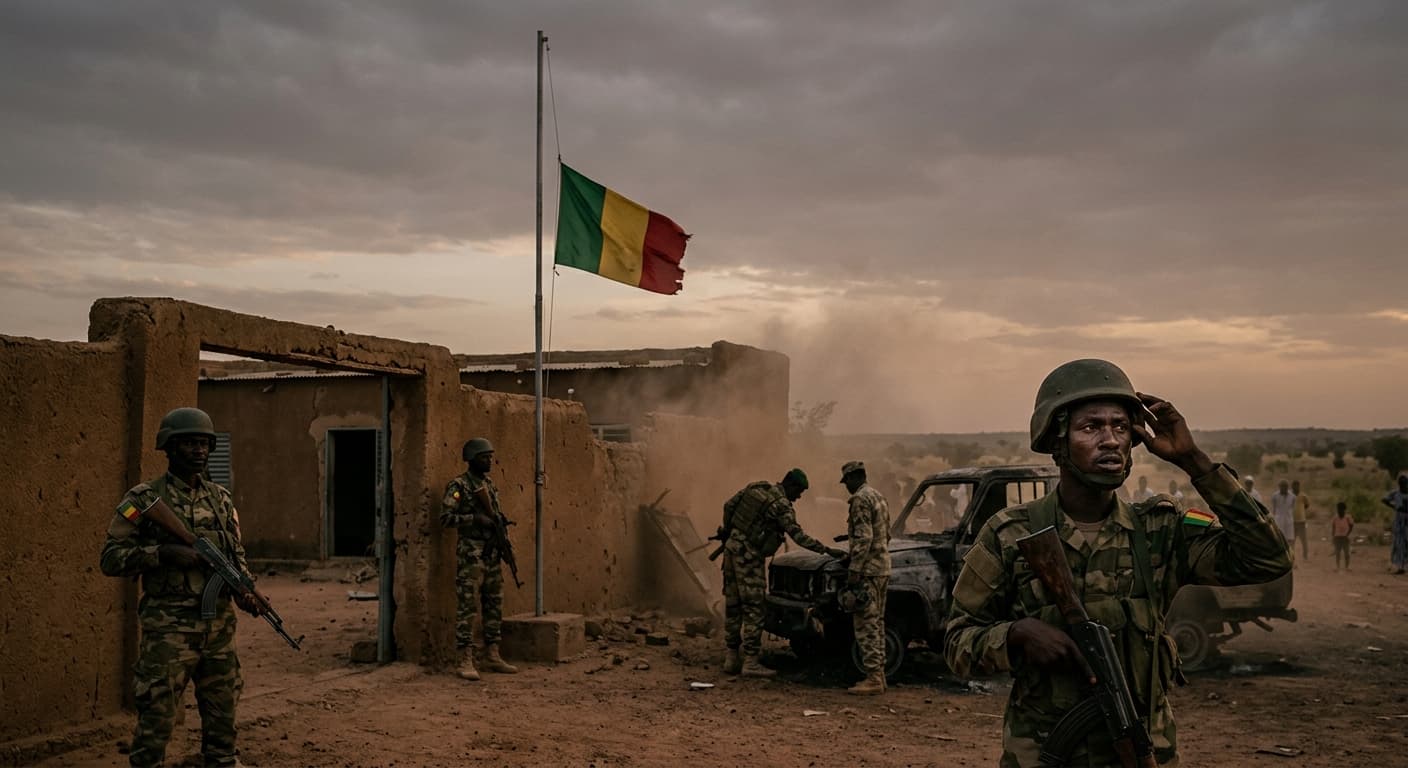
Mali's "Wall of Sovereignty" Cracks: Inside the July 4 Attacks
Coordinated JNIM–FLA assaults on five Malian positions on July 4, 2026 expose the limits of Assimi Goïta's sovereigntist doctrine and the Sahel Confederation's security model.
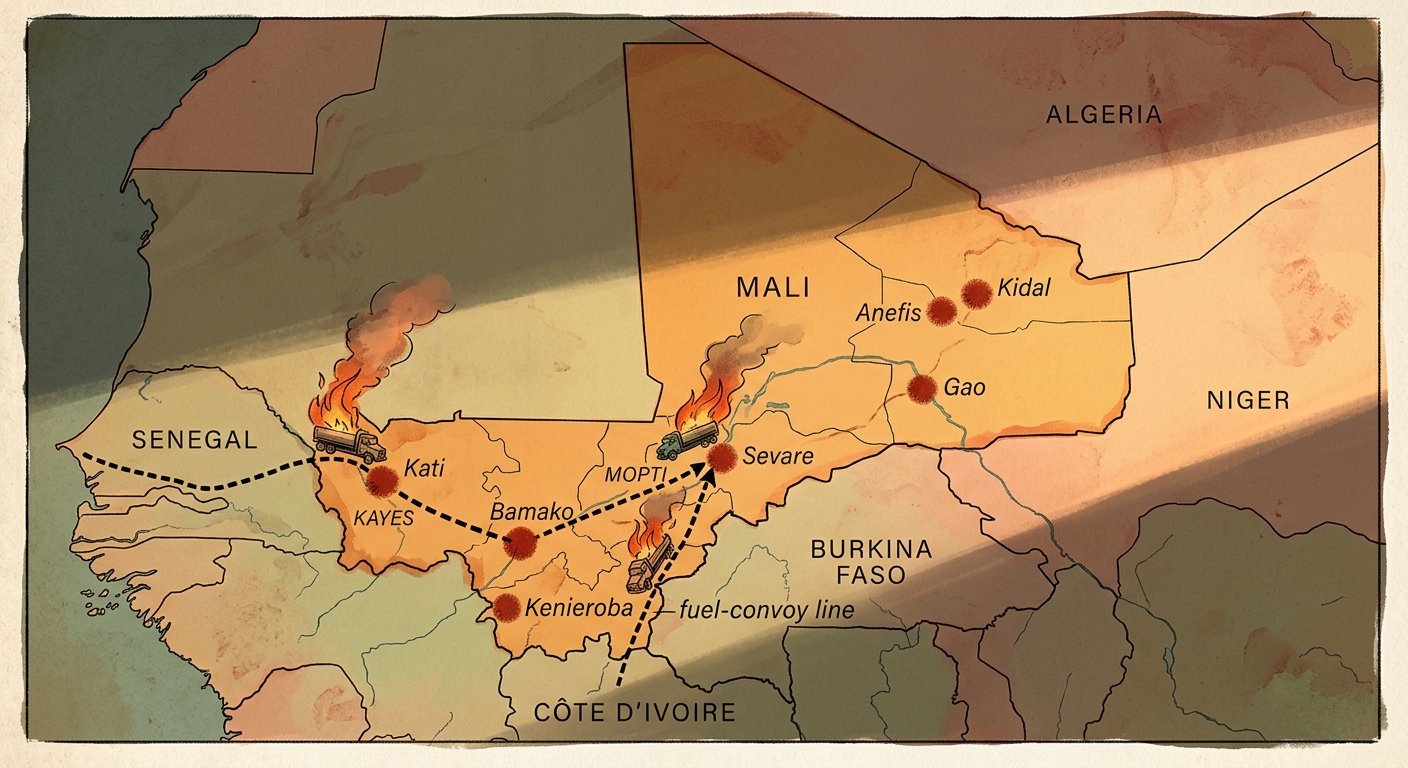
The July 4, 2026 attacks on Aguelhok, Anéfis, Gao, Sévaré, and Kéniéroba were tactically repelled by Mali's army, but they mark something Bamako's official narrative cannot admit: the JNIM–FLA alliance has now normalised nationwide, near-simultaneous strikes on the junta as a routine operational tempo — the third such wave in fifteen months — while a fuel blockade quietly costs Mali roughly one percentage point of GDP and 10 tonnes of gold output a year. The maliweb editorial's "wall of sovereignty" (Maliweb) is real as domestic ideology; as a security architecture, it is porous, expensive, and, on current trajectory, losing.
What actually happened on July 4
At roughly 05:40 local time on Saturday, July 4, 2026, fighters from the al-Qaeda-linked Jama'at Nusrat al-Islam wal-Muslimin (JNIM) and the Tuareg-led Azawad Liberation Front (FLA) hit five positions across northern, central, and southern Mali. The Malian Armed Forces (FAMa) declared the situation "totally under control" by afternoon, reporting 20 assailants killed at Sévaré and six at Gao, against one pro-government fighter dead and four wounded, according to Al Jazeera. A separate FAMa communiqué said the Kremlin-linked Africa Corps helped repel further assaults at Konna and Somadougou.
Two details deserve emphasis. First, one of the targets was Kéniéroba — the recently built maximum-security prison south-west of Bamako, holding 2,500 detainees including senior JNIM cadres and opposition figures arrested after the April 25 offensive, as Al Jazeera reported. Hitting "Africa's Alcatraz" a second time inside two months is a message aimed at both the detained cadres and the civilian opposition figures the junta accused of collusion. Second, by July 6 the government's own line had softened:
Le Patriote confirmed fighting had resumed at Anéfis, where FLA reinforcements pushed a second wave. "Under control" is a claim, not a fact.
The African Union response was formal but pointed. In a statement dated 5 July, AU Commission Chairperson Mahmoud Ali Youssouf "strongly condemns the coordinated terrorist attacks carried out on 4 July 2026 against several localities across northern, central, and southern Mali," and pledged support for "regional and continental initiatives" (African Union). The wording matters: Youssouf had already, on 9 November 2025, warned of a "rapidly deteriorating security situation" and called for "urgent international action" (
African Union). Eight months on, that call has produced no continental deployment.
The sovereignty doctrine, priced
The maliweb framing — attacks as "cowardly" strikes on an "impassable wall of sovereignty" built by President Assimi Goïta — is not propaganda ornament. It is the operational doctrine that replaced the French-led Barkhane counter-terrorism model in 2022 and the UN's MINUSMA mission in 2023. Its four pillars: expulsion of Western forces, contract with Russia's Africa Corps, exit from ECOWAS in favour of the Alliance (now Confederation) of Sahel States (AES), and indefinite postponement of elections.
The doctrine has a domestic constituency. On July 3, 2025 Mali's transitional council granted Goïta a five-year presidential mandate, renewable "as many times as necessary" until "pacification," effectively clearing him to rule until 2030 or beyond, per BBC. Political parties were dissolved by decree in May 2025. A Brookings assessment titled
"Explaining Mali's Democratic Breakdown" notes that the "feeling of infringements upon sovereignty" left by the French/MINUSMA era is what the junta successfully monetised into legitimacy.
But the price is now measurable. The World Bank's Mali Macro-Poverty Outlook reports GDP growth decelerated to 4.1% in 2025 from a projected 4.9%, and gold output fell from 57 to 47 metric tons as the JNIM blockade disrupted the Sikasso–Kayes–Bamako corridor (World Bank). Transport activity contracted 9.3% year-on-year; inflation hit 4%, above the WAEMU 3% ceiling; the fiscal deficit widened to 2.9% of GDP as tax collection slipped. An IMF Country Report published July 2025 found that a two-standard-deviation rise in Malian policy uncertainty coincides with a 0.9 percentage-point fall in quarterly GDP growth and raises recession probability by nearly 20 points (
IMF). Bamako's premium over the rest of WAEMU on one-year T-bills reached 2.2 percentage points by May 2025. Sovereignty, in other words, is being financed at a spread.
The alliance that changed the arithmetic
The decisive shift is not on the government side; it is between the insurgencies. Until 2024, Mali's Tuareg separatists and the al-Qaeda-linked JNIM maintained a wary distance. The Azawad Liberation Front (FLA), formed in November 2024 from remnants of earlier rebel coalitions and led by Alghabass Ag Intalla, changed that. As Al Jazeera's reporting on the FLA makes clear, the April 25, 2026 offensive — which killed Defence Minister Sadio Camara in a suicide truck bombing at his Kati residence — was the first formally coordinated joint operation between the two movements, involving what Russian sources later claimed were up to 12,000 fighters.
The Egmont Institute's Nina Wilén argues that Bamako's rupture of the 2015 Algiers Accords in January 2024 was the "reigniting" event: the CSP-DPA/FLA and JNIM discovered, at Tinzaouaten in July 2024, that ad-hoc coordination could inflict 40 Malian and roughly 80 Wagner deaths — the worst single loss for Russian mercenaries in Africa (Egmont Institute). That template — separatists holding ground in the north, jihadists striking anywhere — is what Bamako now faces every eight to ten weeks.
The Hudson Institute's Liam Karr places 14 large-scale JNIM attacks (20+ fatalities each) in Mali in 2025 — more than in all of 2024 — and identifies the group's blockade of Bamako, ongoing since September 2025, as a decisive strategic innovation (Hudson Institute). His comparative verdict is bleak: Mali's most likely medium-term trajectory is "a Somalia-like fragmented state" rather than a Taliban-style takeover. Karr's Afghan/Somali/Syrian typology is not idle scholarship. It reframes the July 4 attacks as siege tactics — pressure without conquest — precisely the pattern the Rida Lyammouri study for the Policy Center of the New South, drawing on ACLED's dataset of nearly 3,000 JNIM events, identifies as the group's twelve-month operational doctrine (
Policy Center).
That study's forecast, published in December 2025, warned that "coordinated multi-drone convoy attacks are plausible by mid-2026." July 4 fits.
The Confederation's stress test
The Confederation of Sahel States — Mali, Burkina Faso, Niger — was formally consolidated on July 6, 2024 as a rebranded Alliance (Institute for Security Studies), and now underwrites Mali's sovereignty narrative. Its 6,000-strong AES Unified Force, headquartered in Niamey and launched in December 2025, is the third such attempt after the still-born Multinational Joint Task Force of 2017 and the G5 Sahel Joint Force, and it is financed largely from a 0.5% import levy adopted on 28 March 2025 (
ISS Africa). It has not, to date, been deployed at scale against JNIM–FLA.
The maliweb piece names Algeria and Mauritania as the "two neighbouring countries" allegedly backing the assailants. That allegation is not idle rhetoric: Algiers shot down a Malian drone near the border in April 2025, all three AES states withdrew their ambassadors, and airspace was closed. But ISS Africa's analysis shows the fracture already softening — Niger's ambassador returned to Algiers on 12 February 2026, and Niamey/Ouagadougou re-engagement with Algiers has isolated Bamako inside its own bloc (ISS Africa). If AES cohesion frays, Mali loses its last multilateral cushion.
Who wins, who loses
The winner Bamako does not want to name is Russia's Africa Corps, whose escorted convoys are now the only reliable way fuel reaches the capital. The BBC verified footage of Russian attack helicopters shepherding fuel tankers to Bamako after the April 25 assault, and the BBC confirmed dozens of trucks were still being burned near Bamako in the run-up to Eid al-Adha 2026. Africa Corps has, in effect, become Mali's logistics chain — a dependency far more binding than Wagner's earlier combat role. The Kremlin gains political leverage without needing to win the war.
The clear loser is Mali's civilian population. The Centre for Democracy and Development's West Africa Security Tracker recorded 2,157 conflict fatalities in Mali in the first half of 2025 alone, 16.6% of the West African total, with 344 civilian deaths attributable to state or allied drone and air strikes (CDD West Africa). Mali announced a $1.1 billion 2025–26 national security plan and the recruitment of 24,000 additional soldiers, but the same tracker notes that state forces are killing three to four times more civilians than JNIM. That statistic will not appear in the "wall of sovereignty" editorial.
The gold sector — 80% of Malian exports, ~$4.3 billion in 2024 revenue per Al Jazeera's mapping of Malian resource wealth — is the second casualty. The Loulo-Gounkoto complex operated by Canada's Barrick has been in dispute since May 2025, when Bamako sought provisional court administration. Chinese lithium producer Ganfeng (via the Goulamina project) is the counter-cyclical winner as gold falters and Bamako courts non-Western capital.
Historical parallel
The apt reference point is not 2012, when a Tuareg-jihadist alliance collapsed Malian sovereignty in the north and triggered French Operation Serval. It is 2013 Somalia — a recognised government controlling the capital and a few urban islands, funded by extractive exports, dependent on foreign combat auxiliaries, negotiating a permanent siege by an al-Qaeda affiliate that governs the countryside. Hudson's Karr makes this comparison explicit. The July 4 attacks did not breach the wall; they demonstrated the wall now encloses shrinking, expensive territory.
Diplomat View
The evidence is now sufficient to make a specific call: Bamako will not lose Bamako in 2026, but the July 4 attacks confirm Mali's trajectory toward a Somalia-style fragmented state, not the Taliban-style collapse Western commentary has flirted with since October 2025. The junta's "wall of sovereignty" holds the capital and the main garrison towns; it does not hold the roads, the north, or the fiscal base. Three conditions would revise this forecast: a resumption of the Algerian rapprochement that reopens northern supply corridors and puts diplomatic pressure on the FLA; a decisive AES Unified Force deployment beyond training exercises; or a collapse of the JNIM–FLA tactical alliance over the FLA's stated refusal to sit under an al-Qaeda banner, a fault line BBC reporting has flagged. Absent one of those, expect a fourth coordinated wave by October and a further ratcheting of the Bamako fuel blockade.
What to watch
- September–October 2026: JNIM's blockade traditionally intensifies around the harvest and the anniversary of its September 2025 escalation; watch fuel prices in Bamako as the leading indicator.
- AES Summit (date TBC, late 2026): whether the Confederation formalises Algeria dialogue or Bamako vetoes it will tell you if the bloc is still a single actor.
- Barrick–Bamako litigation: any settlement or seizure at Loulo-Gounkoto reshapes the 2027 fiscal outlook and the gold-for-security equation with
Russia's Africa Corps.
The Bottom Line
Mali's "wall of sovereignty" is a domestic legitimacy device, not a security architecture — and July 4, 2026 is the third demonstration in fifteen months that JNIM and the FLA can strike nationwide at will while Africa Corps holds the roads and the World Bank tallies the cost. The junta will survive 2026 in Bamako; the state it governs is contracting toward the capital, the garrison towns, and the mines. The real question is no longer whether Goïta falls, but which power — Moscow, Algiers, or the AES itself — extracts the price of keeping him standing.
Discover more

US Politics
US Launches $166B Tariff Refund Portal
The US is launching a $166 billion tariff refund portal to aid importers hit by Trump-era tariffs, with major implications for trade and supply costs.
Global Politics
Xi Jinping Calls China-Russia Ties 'Precious'
Xi Jinping's description of China-Russia ties as 'precious' reflects a strategic imbalance, with Beijing dictating terms in the partnership.

US Politics
SNAP Food Assistance Faces Legal Challenges
In 2026, SNAP faces stricter eligibility rules and mounting legal challenges, threatening food assistance for the millions of Americans who rely on the program.

Conflict & Security
Drone Warfare Killing Aid Workers at Unprec
Over 1,000 humanitarian workers killed in three years as cheap armed drones collapse legal protections. Gaza, Sudan, Ukraine, and DRC see deliberate targeting of aid convoys and hospitals with zero prosecutions.