Mali, Niger, Burkina Faso Quit ICC: Sahel's 3
Sahel juntas withdraw from ICC, raising concerns over justice.
Model Diplomat7 min readAfrica
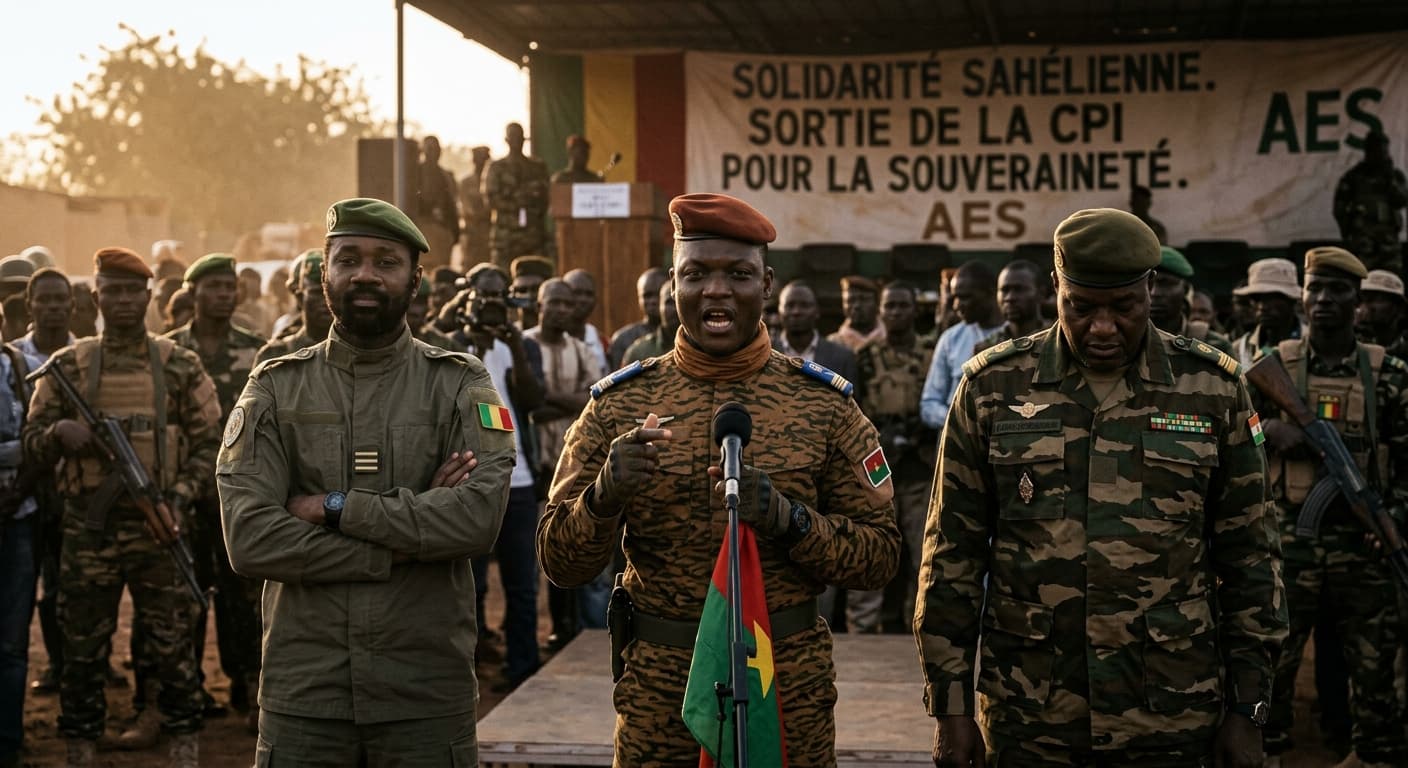
Mali, Niger, Burkina Faso Quit ICC: Sahel's Impunity Gambit
Three Sahel juntas deposited Rome Statute withdrawal papers in June 2026. What their ICC exit means for regional stability, victims, and the AU.
Between June 18 and June 24, 2026, the three military juntas of the Alliance of Sahel States lodged their instruments of withdrawal from the Rome Statute with the UN Secretary-General — the final procedural act of a rupture that began with a joint communiqué in September 2025. The move is not really about The Hague. It is a legal firewall built around commanders whom Human Rights Watch, Amnesty International and the ICC's own Mali docket have already named — insulation constructed just as the evidence against them thickens, and just as an African-designed alternative court is being drafted to legitimise it.

Niger notified the UN on June 18, 2026 (depositary notification CN.251.2026); Burkina Faso and Mali followed on June 24 (CN.263 and CN.264). Under Article 127 of the Rome Statute, each withdrawal takes effect one year after receipt — so the three states remain bound by cooperation obligations until mid-2027, a window the ICC Prosecutor is already using. The ICC Presidency of the Assembly of States Parties, which "regrets these developments," reminded the three governments in a July 1 statement that withdrawal "does not relieve a State Party of obligations arising during the period in which it remained a Party."
The legal wall goes up as the evidence piles up
The timing is the story. In April 2026, Human Rights Watch published None Can Run Away, a 450-witness investigation that documented 1,837 civilians killed in Burkina Faso between January 2023 and August 2025 — more than 1,200 of them by Burkinabè security forces and the pro-government Volunteers for the Defence of the Homeland (VDP). The report named Captain Ibrahim Traoré, Burkina Faso's junta leader, and six senior commanders as potentially liable for war crimes and ethnic cleansing of Fulani communities. Al Jazeera reported the findings on April 2, 2026.
In Mali, ACLED data cited by Al Jazeera show Malian forces and Russian fighters — first Wagner, now Africa Corps — killed more than 900 civilians in 2024, more than double the toll attributed to jihadist groups. A
BBC investigation published November 26, 2025 recorded eyewitness accounts of executions and torture in central Mali; the Senegal-based Timbuktu Institute estimates that 70–80% of Africa Corps personnel are former Wagner. In Burkina Faso, HRW documented in a
May 2025 report at least 130 Fulani civilians killed by the army and VDP near Solenzo in March 2025 alone.
The regional death toll is not slowing. The CDD West Africa Security Tracker recorded 12,964 conflict-related fatalities in the first half of 2025 across West Africa, with 3,539 in Burkina Faso, 2,157 in Mali and 947 in Niger — nearly half the regional total. Air and drone strikes alone killed 1,110 people. This is the criminal record the juntas are seeking to remove from The Hague's jurisdiction before it enters a Prosecutor's request for authorisation.
Two treaty exits, one architecture
The ICC withdrawal is not an isolated act of sovereignty theatre. It is the second leg of a deliberate exit from the post-1998 international justice architecture. In January 2025, the AES states left ECOWAS, and with it the ECOWAS Community Court of Justice, a tribunal that since 2005 has heard human rights cases without requiring exhaustion of local remedies — and that has issued landmark rulings against Ouagadougou, Bamako and Niamey. Human Rights Watch called the January exit an "accountability" blackout for citizens. The Rome Statute departure closes the second door.
What replaces them, on paper, is the Sahel Criminal and Human Rights Court, announced by the AES in June 2025 and to be based in Bamako. The Institute for Security Studies notes the court is pitched as "grounded in local realities and immune from the negative influence of imperialist powers." No statute has been published; no bench has been named; no budget line has been disclosed. As Al Jazeera's Nicolas Haque wrote in a
December 31, 2025 feature, the Sahel court is either "justice brought home, or justice brought under control, depending on who you ask."
The template exists, and it is not encouraging. The African Union's 2014 Malabo Protocol, which would create an African Court of Justice and Human Rights with criminal jurisdiction, has been ratified by fewer than a dozen states in twelve years and remains dormant. Its most contested clause — Article 46A bis, which grants sitting heads of state and "senior state officials" immunity from prosecution — is, Amnesty International argued in 2017, precisely the "Achilles' heel" of any African substitute for the ICC. If the AES court replicates that immunity, Traoré, Goïta and Tchiani have designed themselves out of jurisdiction.
The victims the exit strands
The concrete losers are already visible. On the same day the ICC Presidency issued its July 1 statement, the ICC Trust Fund for Victims announced completion of the reparations programme for the Al Mahdi case — the 2016 conviction for the destruction of Timbuktu's shrines. In its notice, the TFV explicitly regretted Mali's June 30 notification, warning that the decision "weakens the system of reparative justice that has benefited the community of Timbuktu." The Trust Fund is now scrambling to structure reparations for the Al Hassan case — a war crimes and crimes against humanity conviction with a
reparations order issued April 28, 2026 and an implementation plan due January 25, 2027, six months before Mali's withdrawal is legally complete.
There is also the ICC arrest warrant against JNIM leader Iyad Ag Ghaly, unsealed in June 2024. Ghaly's al-Qaeda-linked coalition is the single deadliest actor in the region — responsible, per CDD data, for more than 2,370 fatalities in Burkina Faso in the first half of 2025 alone. Bamako's withdrawal removes the one standing international warrant against him. Amnesty International, in its July 2, 2026 statement, warned the exits leave "a bleak future" for victims' rights to truth, justice and reparations.
The Russia dimension nobody is naming out loud
The three states are the deepest African beachhead of Russia's Africa Corps, the Ministry of Defence successor to Wagner. President Vladimir Putin has himself been the subject of an ICC arrest warrant since March 2023. As long as Bamako, Ouagadougou and Niamey were Rome Statute parties, they were technically obliged to arrest him on their territory — a source of diplomatic friction Moscow no longer needs to manage. The BBC noted the Kremlin connection explicitly when the withdrawal was announced. Russian mercenaries operating in the Sahel are also, under Article 8 of the Rome Statute, personally exposed. That exposure ends in mid-2027.
The parallel with Hungary — which announced its own withdrawal in April 2025 after Prime Minister Viktor Orbán refused to enforce the Putin warrant during a Budapest visit — is the pattern the ICC is now openly worrying about. Uganda's Justice Minister Norbert Mao told the 24th Assembly of States Parties in December 2025 that four withdrawals in twelve months represented "a serious setback" for universalising the Rome Statute, and floated a rewrite of Article 87(7) to give juntas softer landing. The proposal will not save the Sahel three. It signals the Assembly's fear of contagion.
Diplomat View
The Sahel three are not making a jurisprudential argument. They are executing a legal risk-management operation, and the sequence — leave ECOWAS's court, leave the ICC, propose a Bamako court whose statute will almost certainly borrow Malabo's head-of-state immunity — reads as a deliberate perimeter around commanders whose criminal exposure is documented and growing. Read the September 2025 communiqué against HRW's April 2026 findings and the ICC's April 2026 Al Hassan reparations order: the timing is not coincidence, it is defence.
The forecast: the withdrawals will hold. South Africa's 2016–2017 reversal happened because a domestic court blocked the executive; no such judicial check exists in any AES state today. The Sahel court will be announced but under-resourced, and — if the Malabo template holds — will grant serving leaders immunity in the founding statute. The African Union, which has consistently declined to censure the three juntas, will not intervene. The revision trigger would be a domestic power shift in one of the three capitals before June 2027 — most plausibly Bamako, where Goïta's transition timetable has slipped repeatedly — or an AU decision to invoke the "unconstitutional change of government" doctrine against Traoré. Neither is likely, but both are the falsifiable conditions to watch.
What to watch next
- January 25, 2027 — ICC Trust Fund for Victims must submit the Al Hassan reparations implementation plan; Bamako's cooperation is required and no longer guaranteed.
- June 18–24, 2027 — the withdrawals take legal effect; any pending ICC cooperation requests must be executed before this date.
- December 2026 ASP session (The Hague) — Uganda's Article 87(7) reform proposal is scheduled for debate; the vote will signal whether the Assembly plans to bend to keep African states in or hold the line.
- AES summit, Niamey (rumoured Q4 2026) — publication of the draft statute for the Sahel Criminal and Human Rights Court; the immunity clause is the tell.
The bottom line: The AES exit from the ICC is not a rebellion against Western justice — it is a legal shield being welded around named commanders while atrocity evidence against them accumulates, and the Sahel Criminal Court proposed to replace it will almost certainly enshrine the head-of-state immunity the Rome Statute forbids. If the Bamako court's statute mirrors the AU's Malabo Protocol, the three juntas will have engineered impunity into regional law before mid-2027 — and the Global Politics template for withdrawing under legal pressure will have a working African precedent that Moscow, Budapest and others are already studying.
Discover more
International Relations
Economist Impact Sustainability Week 2026
Economist Impact Sustainability Week 2026 spotlights the energy transition, AI in clean technology, and supply chain resilience as themes for global leaders.
US Politics
House Ethics Committee Pushes Sexual Miscond.
The House Ethics Committee has shifted responsibility for sexual harassment settlement records to the Office of Congressional Workplace Rights, complicating disclosure efforts.
India
Rajnath Singh's Durga Squad for 2026 Polls
Rajnath Singh's Durga Squad promised women's safety in Bengal but has since disappeared from the agenda, revealing BJP's true priorities.

Conflict & Security
Drone Warfare Killing Aid Workers at Unprec
Over 1,000 humanitarian workers killed in three years as cheap armed drones collapse legal protections. Gaza, Sudan, Ukraine, and DRC see deliberate targeting of aid convoys and hospitals with zero prosecutions.